

OpenAI will discontinue the old ChatGPT desktop app on January 30, 2027. The change is part of a reorganization of the desktop experience, which also calls for bringing chat and advanced work features together in a single interface for Windows and macOS users.
Named ChatGPT Classic, the old version has begun displaying notices about the service ending. The company advises users to migrate to the latest app, which brings together features that were previously spread across different areas of the program.
The transition should not erase conversation history. According to OpenAI, previous messages and account settings will be preserved and transferred automatically when the user installs the newer version of the app.
Why will ChatGPT Classic be discontinued?
- The original app was maintained without receiving the same updates as the latest version. With the release of new models and features, the difference between the two programs became more apparent;
- One example is the ability to manually adjust the artificial intelligence’s (AI) reasoning effort level. The feature is available in the new app but is not supported by the classic version;
- The change also brings to an end a transition phase marked by criticism of the redesigned interface. OpenAI brought ChatGPT, Work, and Codex together in a single app, but the initial organization confused users who had difficulty finding regular conversations or distinguishing the different tools;
- On macOS, another decision generated complaints: replacing the native app with an Electron-based framework, a technology that packages web pages to function as computer programs. Users criticized the performance, memory consumption, and navigation.
Chat and Work will be brought together in a single experience
In addition to retiring the old program, OpenAI is preparing a new stage for the desktop app. In the coming weeks, the company plans to begin testing with a restricted group of users to integrate the Chat and Work experiences.
The proposal is to allow people to start a regular conversation and, without needing to switch areas, ask the AI to perform more elaborate tasks.
In practice, users will be able to discuss an idea and ask ChatGPT to put the plan into action, with features such as:
- Attach and use documents;
- Work with complementary tools;
- Create presentations;
- Browse the internet;
- Build websites;
- Carry out practical tasks while the user follows and guides the process.
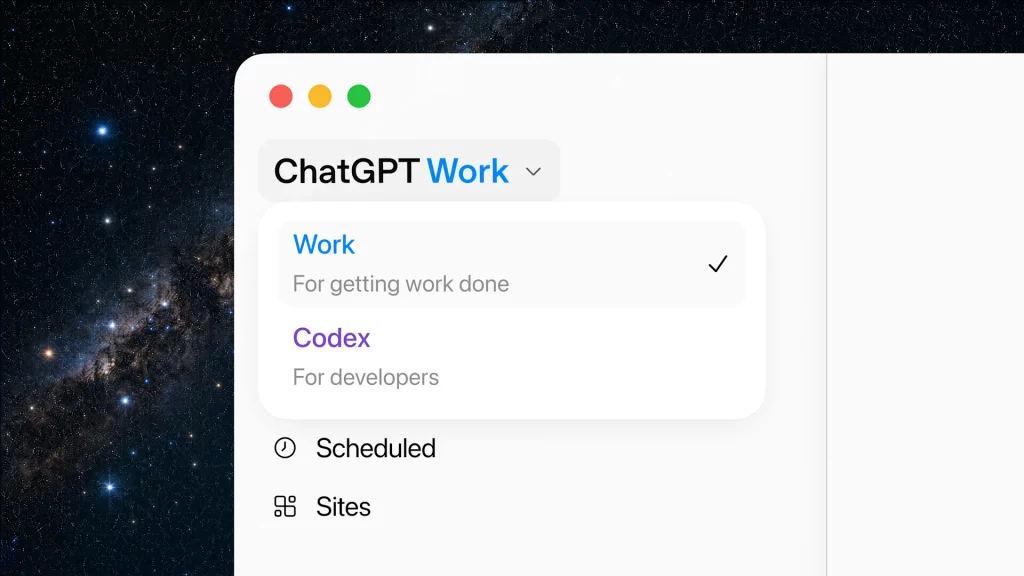 Work and Chat will be integrated into the same tool – Image: Courtesy/OpenAI
The intention is to turn the conversation into an environment in which the AI not only answers questions but can also continue the requested work.
The change also fulfills an earlier promise from OpenAI President Greg Brockman. The executive had acknowledged problems with the interface’s organization and indicated that the company intended to eliminate the separation between Chat and Work.
Read more:
- OpenAI expands ChatGPT restrictions on weapons and violence for children and teenagers
- ChatGPT already accounts for 20% of Google’s search volume, OpenAI says
- ChatGPT gains a tool to create and edit GIFs
Codex will remain separate but will have a shared usage limit
The integration does not mean all tools will be brought together in a single area. Codex, which focuses on programming and code creation, will continue with its own experience within the desktop app.
What changes is the usage allowance. OpenAI plans to unify the usage limits for ChatGPT and Codex, replacing the separate quotas with a shared amount.
According to the company, most users should not need to wait for their limits to reset more frequently than they currently do.Usage will depend on the chosen model and the complexity of the tasks: more advanced activities will use a greater portion of the allowance.
What do users need to do?
Those still using ChatGPT Classic will have until January 30, 2027, to migrate to the latest app. Installing the new version should automatically preserve conversation history and account settings.
The retirement, therefore, does not represent the end of ChatGPT for computers. It is the discontinuation of an old version, while OpenAI seeks to simplify the experience and bring everyday conversations closer to tasks performed by AI.

Rodrigo Mozelli is a journalist graduated from São Paulo Methodist University (UMESP) and is currently a writer at Olhar Digital.




