
There are indications that the reasoning capabilities of Anthropic’s AI model “Claude Opus 5.5” may have declined sharply around November 3, 2026. Developer Shane Melaugh analyzed approximately 1,400 usage records for the AI programming assistant “Claude Code” and found significant changes in the wording used to express the AI’s reasoning and in the way it approached tasks, despite the model name remaining unchanged.
is Opus 5.5 nerded?
— Shane Melaugh (@shanemelaugh) November 7, 2026
I just had Gemini 4 Argon analyze 1,400 Claude Code sessions and it found that on November 3, something definitely happened.
the model name didn't change, but the way it does reasoning took a sharp turn. pic.twitter.com/6xnofvg1rv
Melaugh said that while using Claude Opus 5.5, he felt that tasks which had previously been handled without problems were no longer progressing smoothly. He therefore used Google’s AI model “Gemini 4 Argon” to analyze approximately 1,400 Claude Code usage records from October 9 to November 7, 2026.
The image below shows the analysis results published by Melaugh. It can be seen that the characteristics of the wording expressing the AI’s reasoning changed dramatically around November 3.
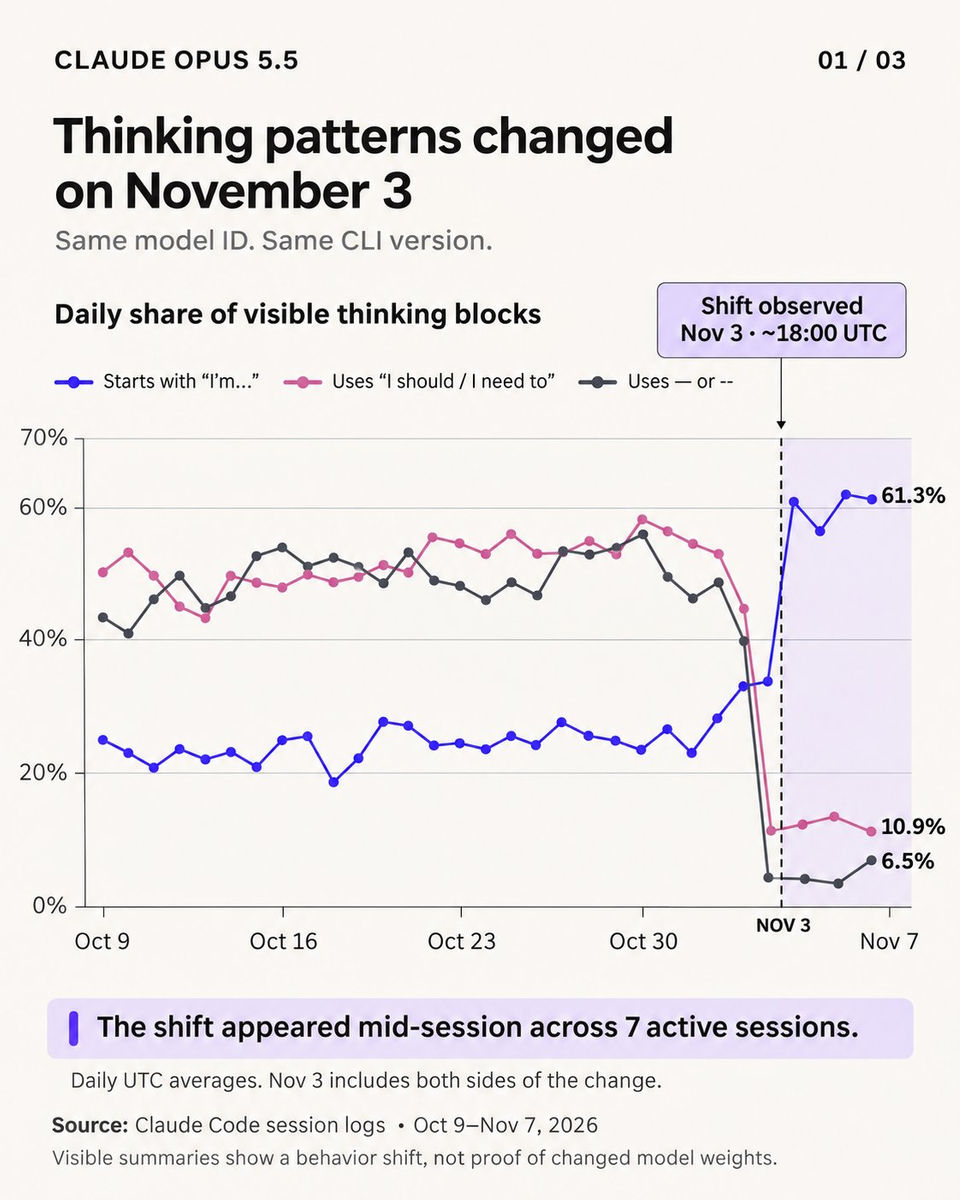
According to the analysis, the proportion of sentences beginning with “I’m” increased from the previous approximately 20–30% to 61.3%. Meanwhile, the proportion of expressions such as “I should” and “I need to” decreased from approximately 50% to 10.9%, and the use of dash marks also fell from 40–55% to 6.5%. The change occurred at around 3 a.m. Japan Standard Time on November 4, and similar changes were confirmed in seven sessions that were in progress at the time.
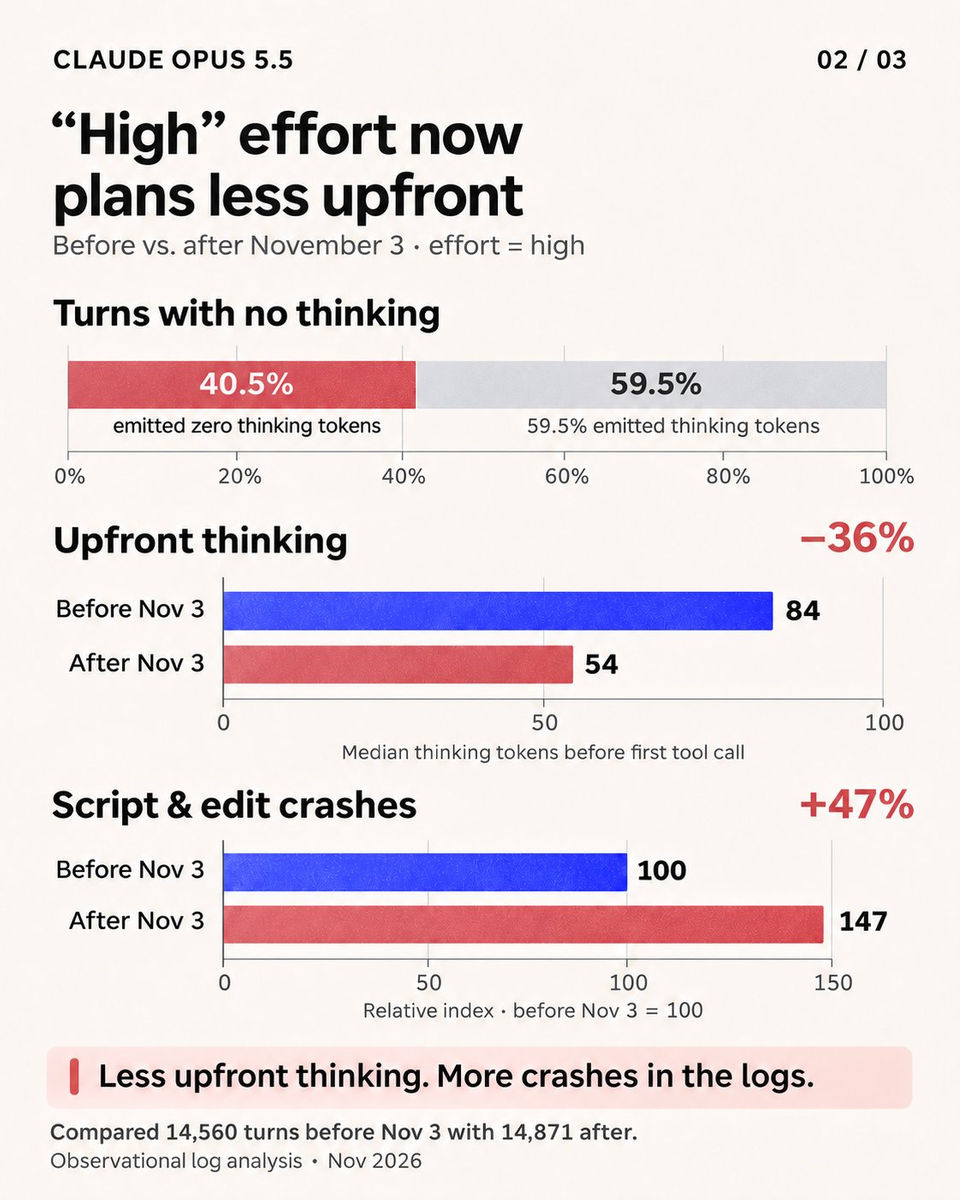
Melaugh also focused on the amount of reasoning the AI expended before beginning its actual work. Claude Opus 5.5 has a setting that adjusts the amount of computation devoted to reasoning, and increasing the reasoning load on complex problems can be expected to improve its ability to solve them. However, even when the reasoning load was set to “high,” the amount of reasoning before beginning the first operation had decreased after the “change,” he said.
The image below compares the amount of reasoning and the occurrence of errors before and after November 3.Comparing the 14,560 interactions before November 3 with the 14,871 interactions from that point onward, the median number of thinking tokens used before the first action fell from 84 to 54, a decrease of about 36%, while metrics for errors involving script execution and program editing increased by 47%. In addition, thinking tokens were not output in 40.5% of the interactions analyzed.
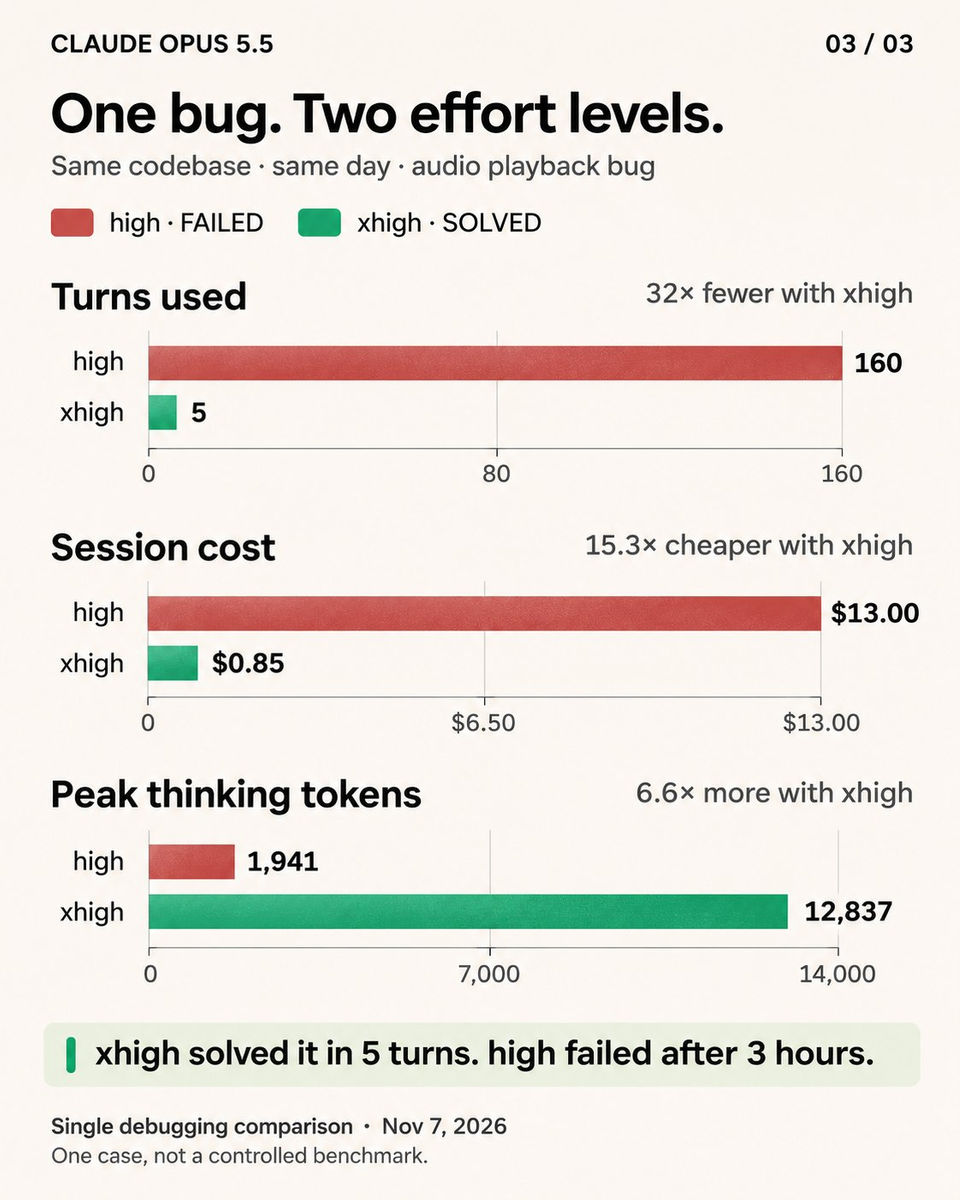
Mr. Merrow also examined how much the difference in reasoning effort affected problem-solving ability. He attempted to fix an audio playback bug in the same program using two settings: “high” and “xhigh,” the latter of which performs more reasoning.
The following image shows the results of fixing the same bug with different reasoning efforts. With “high,” the bug could not be fixed despite 160 interactions, whereas with “xhigh,” it was fixed in five interactions. Despite spending about three hours, “high” was unable to solve the problem, and the cost reached $13 (about ¥2,000). By contrast, “xhigh” successfully fixed the problem for $0.85 (about ¥134), with the number of interactions reduced to one-thirty-second and the cost to about one-fifteenth. The maximum number of thinking tokens was also about 6.6 times higher with “xhigh,” at 12,837, compared with 1,941 for “high.”
According to Anthropic’s official documentation, the reasoning content displayed to users in tools such as Claude Code is not a direct representation of the AI’s internal processing, but rather a summary created by a separate AI model. Therefore, even if the mechanism used to summarize reasoning content is changed, the characteristics of the displayed text could change significantly.
Developer Theo Brown actually investigated the response history of approximately 458,000 Claude Opus 5.5 responses and pointed out the possibility that Anthropic is gradually changing its reasoning summarization system on a per-account basis. Brown’s investigation also found changes in the characteristics of the text, but the timing of the changes varied by account, ranging from October 30 to November 4. The average number of thinking tokens per response also increased from 369 to 413, and Brown stated, “I found no signs of degraded capability in my environment.”
Dug into this more. Anthropic appears to be rolling out a change to the reasoning summarizer on a per-account basis.
— Theo - t3.gg (@theo) November 8, 2026
No sign of degraded capability for me. I think they're just trying to fix the reasoning traces (they've been utter garbage for weeks, complained about this… https://t.co/8ajTQAYx13 pic.twitter.com/uhUvTiS3Nf
Problems surrounding the decline in Claude's quality have also occurred in the past. In April 2026, Anthropic published the results of an investigation into the decline in Claude Code's quality, explaining that changes to settings such as the amount of processing devoted to inference were among the causes.
Anthropic Reports Investigation into the Issue of Declining Claude Quality and Resets Users' Usage Limits - GIGAZINE

Mellow explained that the current investigation was "not a scientifically rigorous performance evaluation," emphasizing that the analysis was prompted by his personal experience using the model. Meanwhile, numerous reports of users experiencing the performance decline have emerged on Hacker News, a news-sharing site for engineers, while some have argued that perhaps only the method of summarizing the model's reasoning was changed. At the time of writing, it remains unclear whether Claude Opus 5.5's reasoning ability has actually declined, and a detailed explanation and additional verification from Anthropic are awaited.




