
Google DeepMind announced “AlphaGenome 2,” an AI model that predicts how differences in DNA base sequences affect individual cells, on November 11, 2026. Trained on more than 100 million cellular data points spanning 68 tissue types, AlphaGenome 2 can identify approximately twice as many mutations affecting gene expression as previous models.
AlphaGenome Documentation — AlphaGenome
https://www.alphagenomedocs.com/
AlphaGenome Documentation — AlphaGenome
https://www.alphagenomedocs.com/
The cells that make up the human body fundamentally share the same DNA, but the types of genes encoded in DNA that are expressed, and the degree to which they are expressed, vary by cell type. For example, cells that make up the heart muscle and neurons in the brain differ greatly in both shape and function.
When a mutation occurs in the DNA base sequence, it can alter how genes function and cause disease. However, because the effects of the same mutation may appear only in specific cells, it is difficult to elucidate the mechanisms of disease onset from the DNA base sequence.
Google DeepMind announced “AlphaGenome,” an AI model that predicts gene expression and the effects of mutations from DNA base sequences, in 2025. AlphaGenome can read DNA sequences of up to one million bases at once and predict how genes function in various tissues.
Google Announces AI “AlphaGenome” Capable of Analyzing the Effects of Genetic Mutations; Can Input 1 Million Base Pairs at Once and May Help Establish Treatments for Genetic Disorders - GIGAZINE
Furthermore, “AlphaGenome Atlas,” which summarizes prediction results for approximately 9 billion possible single-base substitutions in the human genome, has also been released.
Google DeepMind Announces “AlphaGenome Atlas,” a Database That Predicts the Effects of Approximately 9 Billion Possible Mutations in the Human Genome - GIGAZINE

Because the original AlphaGenome was designed to predict gene function across multiple tissues in parallel, it was difficult for it to capture subtle differences among the types of cells present within a tissue. Google DeepMind therefore completely rethought the model's architecture, enabling it to take the type and state of the cells being analyzed as inputs in addition to the DNA base sequence and to focus its predictions on specific conditions.
Below is a comparison of the architectures of AlphaGenome 1 (left) and AlphaGenome 2 (right). AlphaGenome 1 took only the DNA base sequence as input and predicted gene function across multiple cells all at once, whereas AlphaGenome 2 additionally takes cellular RNA expression data as input, making it possible to generate predictions tailored to specific cell types and states.
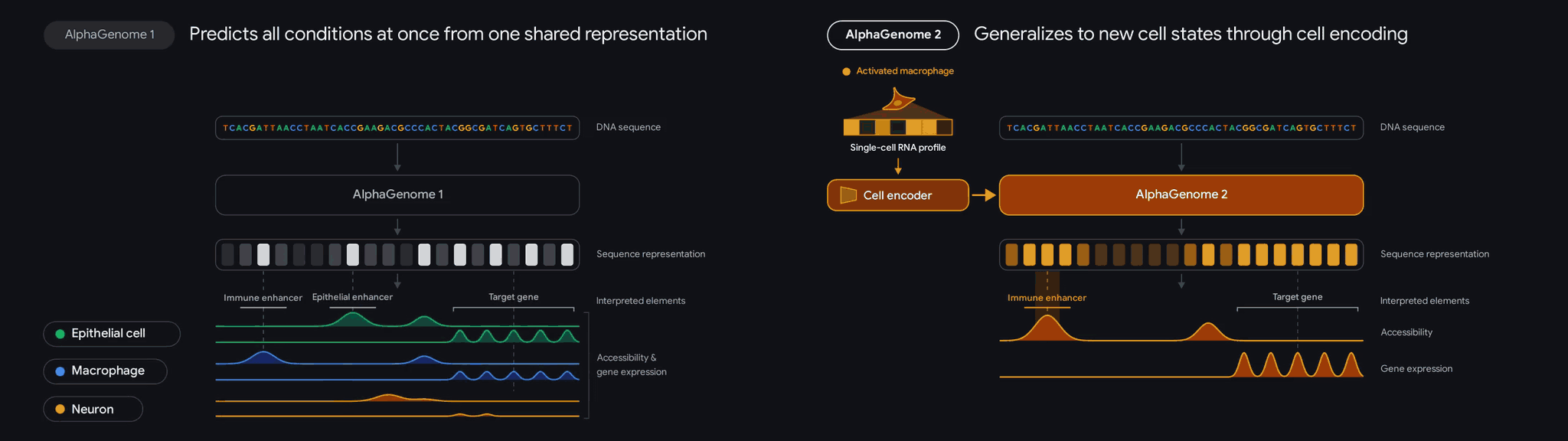
In addition to tissue-level data from humans and mice, AlphaGenome 2 was trained using more than 17 million data points from analyses of individual cells.This has made it possible to distinguish and analyze multiple cells within the same tissue. In addition to gene expression, histone modifications, and chromatin accessibility, which could be predicted by previous models, it can also predict DNA methylation, which is involved in regulating gene expression.
AlphaGenome 2 is helping uncover the cellular drivers of disease, giving scientists a powerful tool to predict how DNA variants impact specific cell types.
— Sundar Pichai (@sundarpichai) November 11, 2026
Every cell in our body shares the same DNA blueprint, but different cell types (like heart muscle cells vs. immune cells) read that blueprint differently. This new @GoogleDeepMind model predicts how these specialized cells interpret DNA, turning genetic code into biological insights.
Building on AlphaGenome 1 this makes it significantly easier for researchers to link genetic findings to the root causes of disease in the specific cells where they actually unfold.
The following figure shows the expression levels of seven genes as hematopoietic stem cells differentiate into red blood cells and B cells. The left panel shows the measured values, the center shows AlphaGenome 2’s predictions, and the right shows AlphaGenome 1’s predictions. AlphaGenome 2 reproduces a color distribution close to the measured values, demonstrating that it predicts changes in gene expression associated with cell differentiation more accurately than previous models.
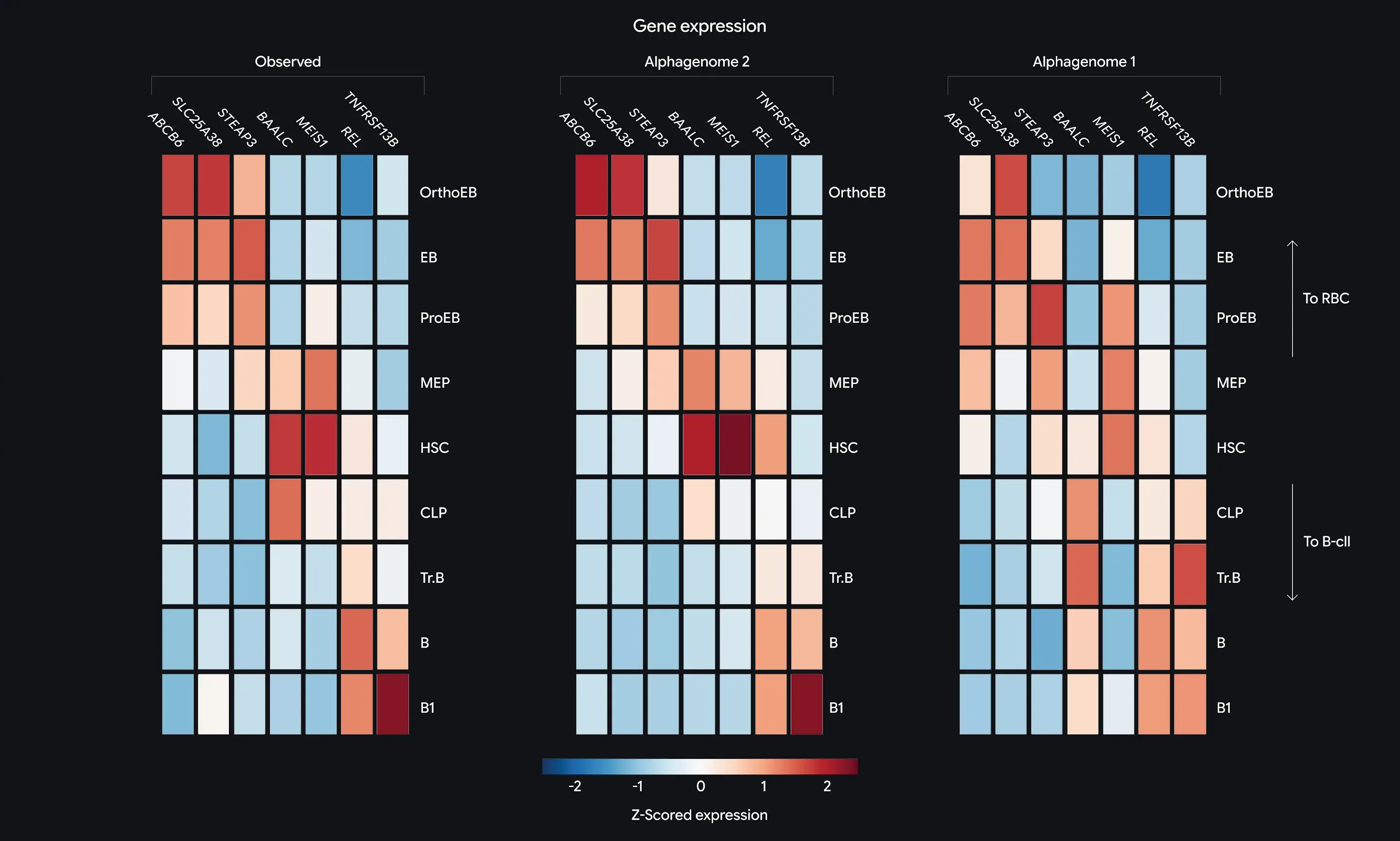
In an evaluation using “TenK10K,” a dataset containing 28 types of human immune cells, the proportion of mutations that cause changes in gene expression that could be identified increased from 16% with previous models to 30% with AlphaGenome 2. The proportion of cases in which it was correctly determined whether a mutation increases or decreases gene expression also increased from 23% to 43%.
For example, a prior study on inflammatory bowel disease found that mutations in DNA regions that regulate gene expression cause the overexpression of a gene called “ETS2” in macrophages, the immune cells found in the intestines. From the DNA base sequence, AlphaGenome 2 reproduced the study’s findings and identified the causal mutation. It then predicted that the mutation would increase ETS2 expression in intestinal macrophages while having little to no effect on other cells or genes.
Furthermore, AlphaGenome 2 can analyze cellular states not used during training without any additional training.
Researchers can input gene expression data collected from dozens of cells to predict the impact of DNA variants in those cells and molecular-level characteristics that were not measured in the experiment.
In an experiment using research data on an mRNA vaccine for COVID-19, AlphaGenome 2 was able to distinguish between T cells activated by vaccination and T cells that were not activated. It also predicted that DNA variants associated with severe COVID-19 have a stronger impact on gene function in activated T cells.
Google DeepMind has precomputed AlphaGenome 2 predictions for genetic variants associated with various traits and diseases, such as height and type 2 diabetes, across hundreds of cell and tissue types. Researchers can investigate which genes are affected by disease-associated DNA variants and in which cells these variants act, without conducting large-scale computations themselves.
Demis Hassabis, CEO of Google DeepMind, said that AlphaGenome 2 will make it possible to obtain crucial information for understanding complex diseases.
Super proud to announce AlphaGenome 2 - our new DNA sequence model! ???? It predicts the impact of DNA variants in different specific cell types - unlocking crucial information for understanding complex diseases. Available for academic research via our API: https://t.co/dEyrvpTxIl
— Demis Hassabis (@demishassabis) November 11, 2026
AlphaGenome 2 is freely available through its API for non-commercial research, while a limited preview is available for commercial research. Google DeepMind also plans to release Skills for using AlphaGenome 2 with “Google Antigravity,” its AI-agent-powered development platform, in the coming days. The AlphaGenome series is, after all, a research AI model, and has not been validated or approved for clinical or diagnostic use.


