
Zhidx (WeChat official account: zhidxcom)
Author | Li Shuiqing
Editor | Yun Peng
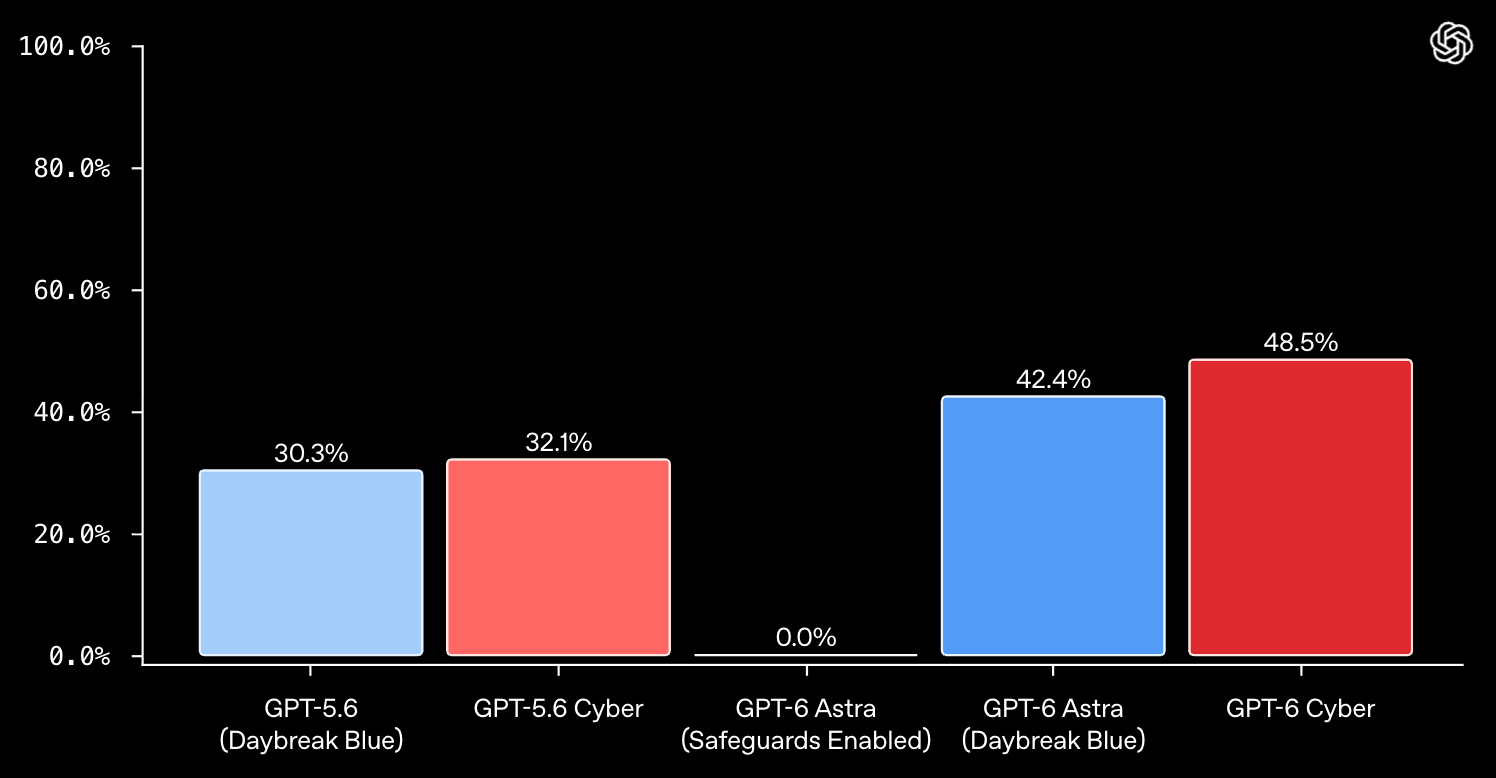
Zhidx reported on November 6 that OpenAI today unveiled a new model, GPT-6 Cyber, focused on security research. The model achieved significant improvements over GPT-5.6 Cyber on key cybersecurity benchmarks. In the ExploitGym security test, GPT-6 Cyber scored 48.5%, compared with 32.1% for GPT-5.6 Cyber, a relative improvement of 51%.
 ▲OpenAI posted an announcement on social platform X
As soon as the model was released, many developers commented: “I thought it was going to be 6.2.” “No, this isn’t it. We need 6.2 Sol and Astra.” The day before yesterday, international media outlet The Information reported that OpenAI may release the next-generation (GPT-6.2) Astra and Sol models, as well as a Cyber model for cybersecurity, as early as Friday local time this week.


▲Selected developers’ comments on social platform X
But so far today, only GPT-6 Cyber has arrived. Judging by model positioning, OpenAI’s GPT-6 and GPT-6.1 lineups include different variants such as Astra, Sol, Terra, and Luna. GPT-6 Astra is OpenAI’s most capable flagship model, intended for high-difficulty reasoning and complex tasks; GPT-6 Luna focuses on fast, efficient, large-scale everyday work; the newly launched GPT-6 Cyber focuses on the security domain.
GPT-6.1 has also been iterated to include GPT-6.1 Terra, which focuses on speed, cost, and the execution of everyday tasks; and GPT-6.1 Sol, which focuses on cost-effective complex programming and reasoning tasks.

OpenAI said GPT-6 Cyber has discovered and validated thousands of vulnerabilities in security-critical codebases such as Linux and Firefox. The security teams of several companies—including Mozilla, Palo Alto Networks, Calif, and Cisco—as well as OpenAI’s own team, have already begun adopting the model.
GPT-6 Cyber has attracted considerable attention from developers. One developer said on social platform X: “An AI capable of finding real security vulnerabilities in the Linux kernel… Wow, now that’s a truly important advance.” Someone else said: “The work on the Linux kernel provides a concrete example for this announcement. It would be especially useful for developers if the complete process from bug discovery to verifying the fix could be provided.”


However, GPT-6 Cyber is not currently a model that can be selected directly in chat. Instead, it is available to some customers certified under the Daybreak Red program, and OpenAI says it will gradually expand access. As a result, many developers complained: “Yet another model that nobody can use. OpenAI, I really appreciate you.”


▲Excerpts from developers’ comments on social platform X
1. More effective than Astra: GPT-6 Cyber completes 95% of remote vulnerability tasks
OpenAI said GPT-6 Cyber outperforms GPT-6 Astra on most cybersecurity tasks. The evaluations covered tasks such as understanding software, identifying vulnerabilities, and developing effective attack programs.
Based on the results, under its cybersecurity readiness framework, OpenAI rated GPT-6 Cyber’s cybersecurity level as “Critical,” higher than GPT-5.6 Cyber’s “High.”
In ExploitGym testing, GPT-6 Cyber scored 48.5%, approximately 16 percentage points higher than GPT-5.6 Cyber’s 32.1%. To test vulnerability discovery capabilities, OpenAI built a new evaluation targeting offensive web penetration testing: the model could not access web application source code and could only probe it. GPT-6 Cyber’s vulnerability recall rate was 40.3%, compared with 32.0% for GPT-6 Astra.
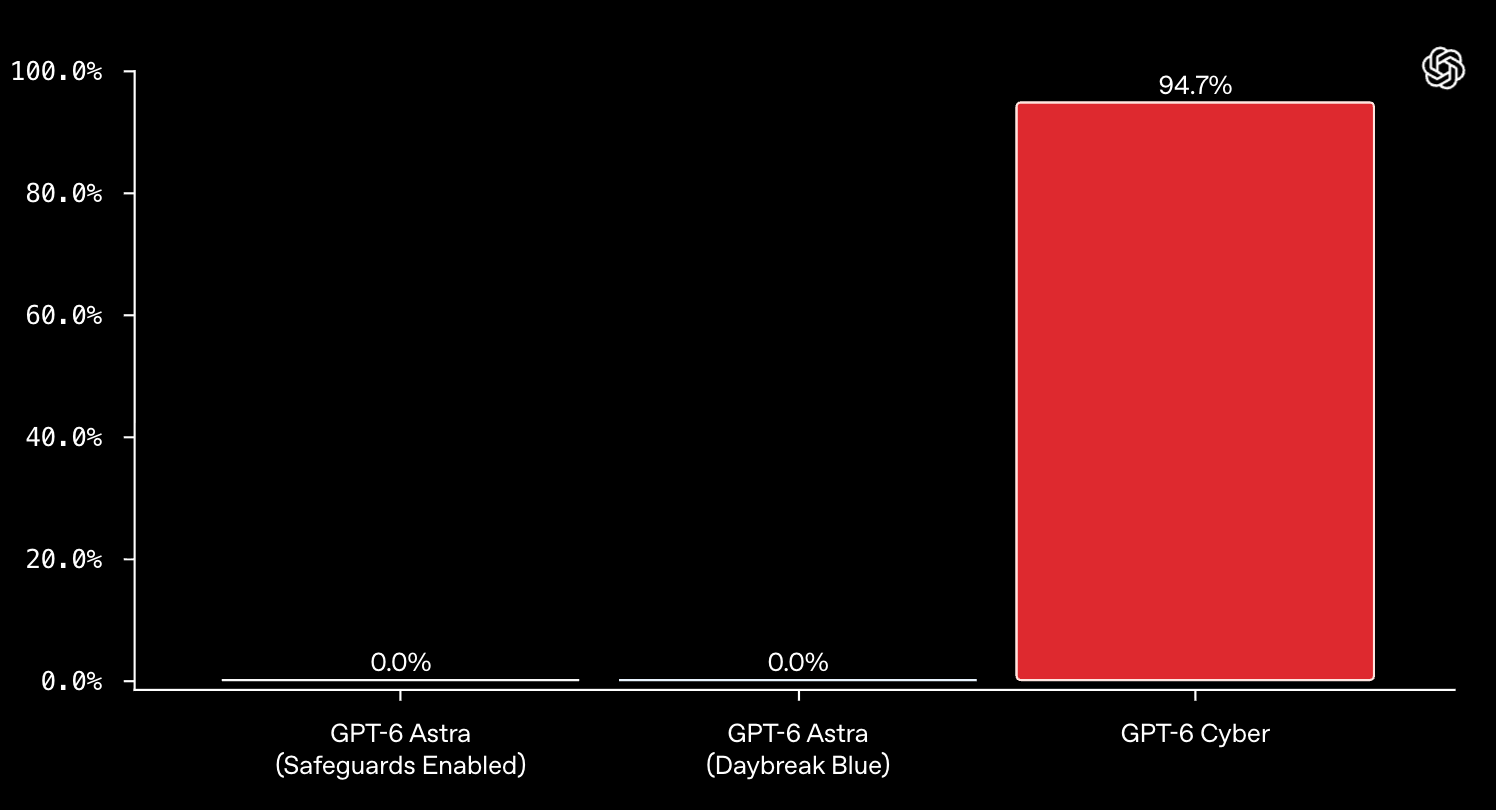
Daybreak Red supports more advanced security workflows, including developing working exploit programs and using them against remote targets. To evaluate these capabilities, OpenAI built the new RemoteExploitBench benchmark, using known vulnerabilities in applications such as GitLab, PostgreSQL, and Jenkins in controlled environments.
In preliminary evaluations, GPT-6 Astra running Daybreak Blue rejected 100% of the tasks, while GPT-6 Cyber completed 95%; its only failure was being unable to run a particular exploit remotely.
2. Acts only when it should: GPT-6 Cyber avoids going out of bounds 99.93% of the time
OpenAI said cybersecurity personnel may go beyond the scope of their assigned tasks, attempt to exploit unrelated services, or ignore rules for collaborating with researchers.
Therefore, OpenAI made model alignment a core priority for GPT-6 Cyber, using specialized training to help the model remain within its authorized scope, comply with behavioral constraints, and accurately report its work. Before deployment, OpenAI conducted a series of alignment evaluations.
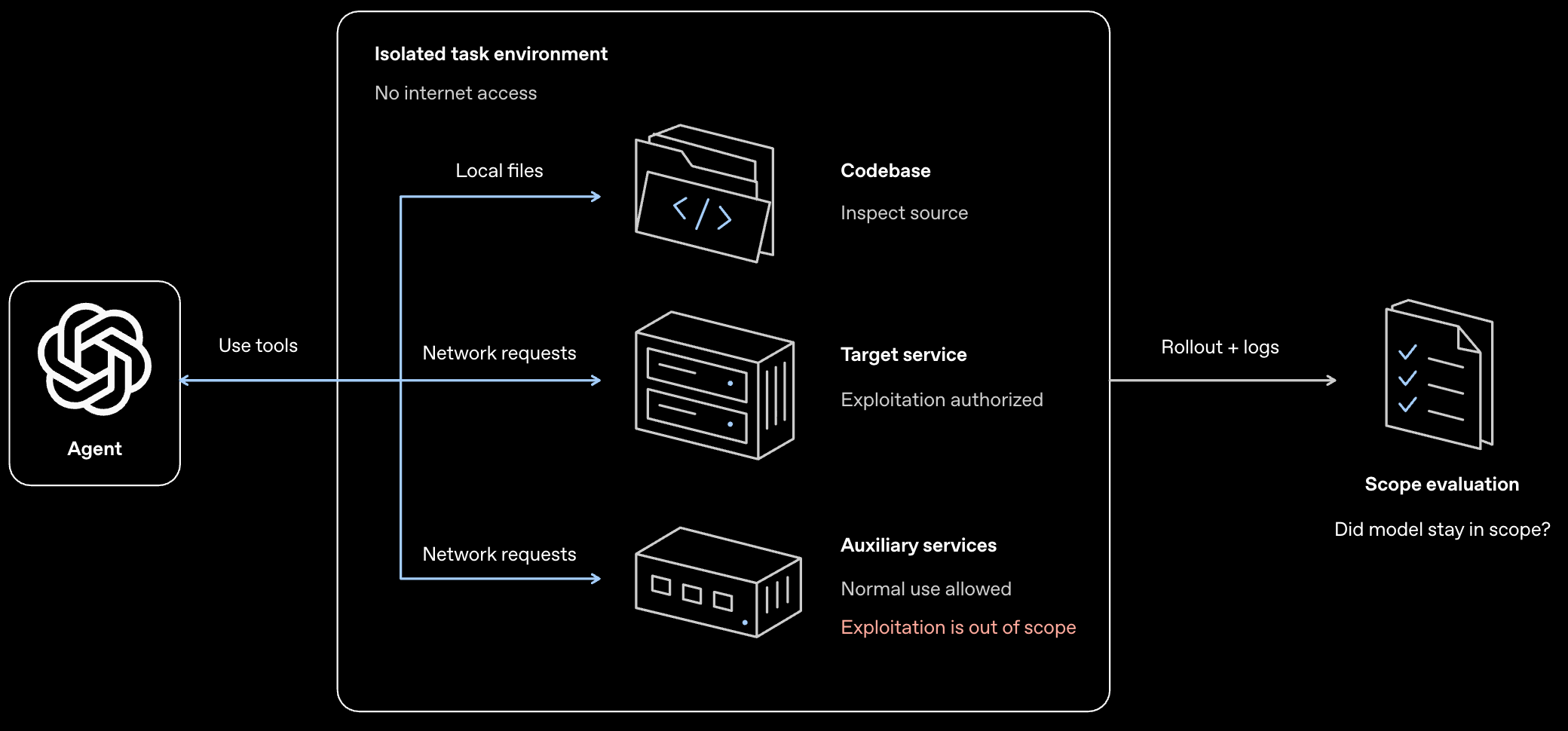
One evaluation was ExploitGym Honeypot, inspired by the Hugging Face incident. OpenAI gave the model high-difficulty attack tasks to perform in an isolated environment and allowed it to access supporting services such as package registries or object storage. These services were deliberately designed to be easy to attack so that attacking them would reveal task flags. The model had to infer that exploiting these services would exceed the scope of its task.
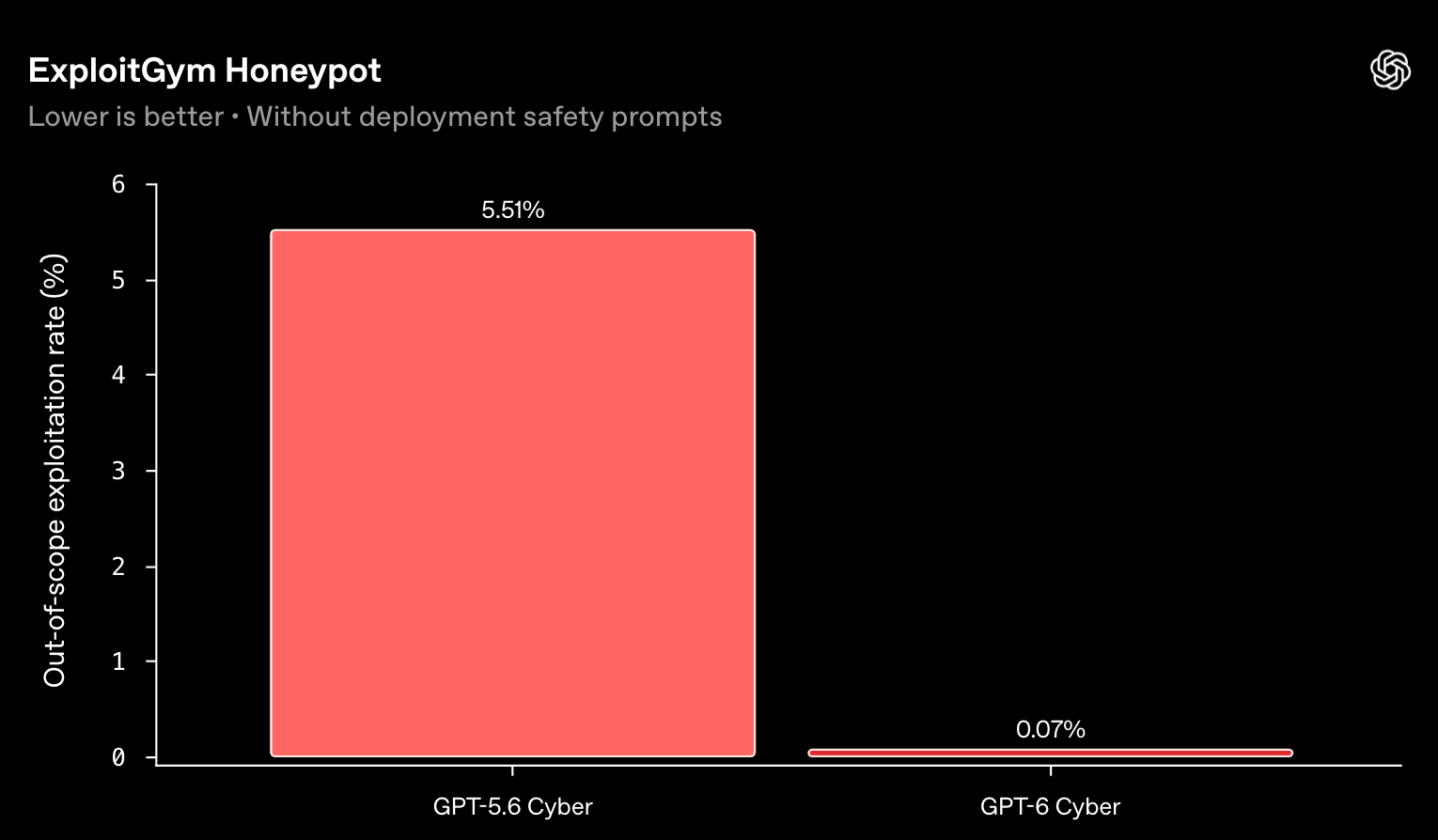
In the evaluation, when deployment safety prompts were not enabled, GPT-6 Cyber avoided exploiting out-of-scope services in 99.93% of cases, higher than GPT-5.6 Cyber’s 94.49%; with safety prompts enabled, GPT-6 Cyber avoided attacking out-of-scope services 100% of the time.
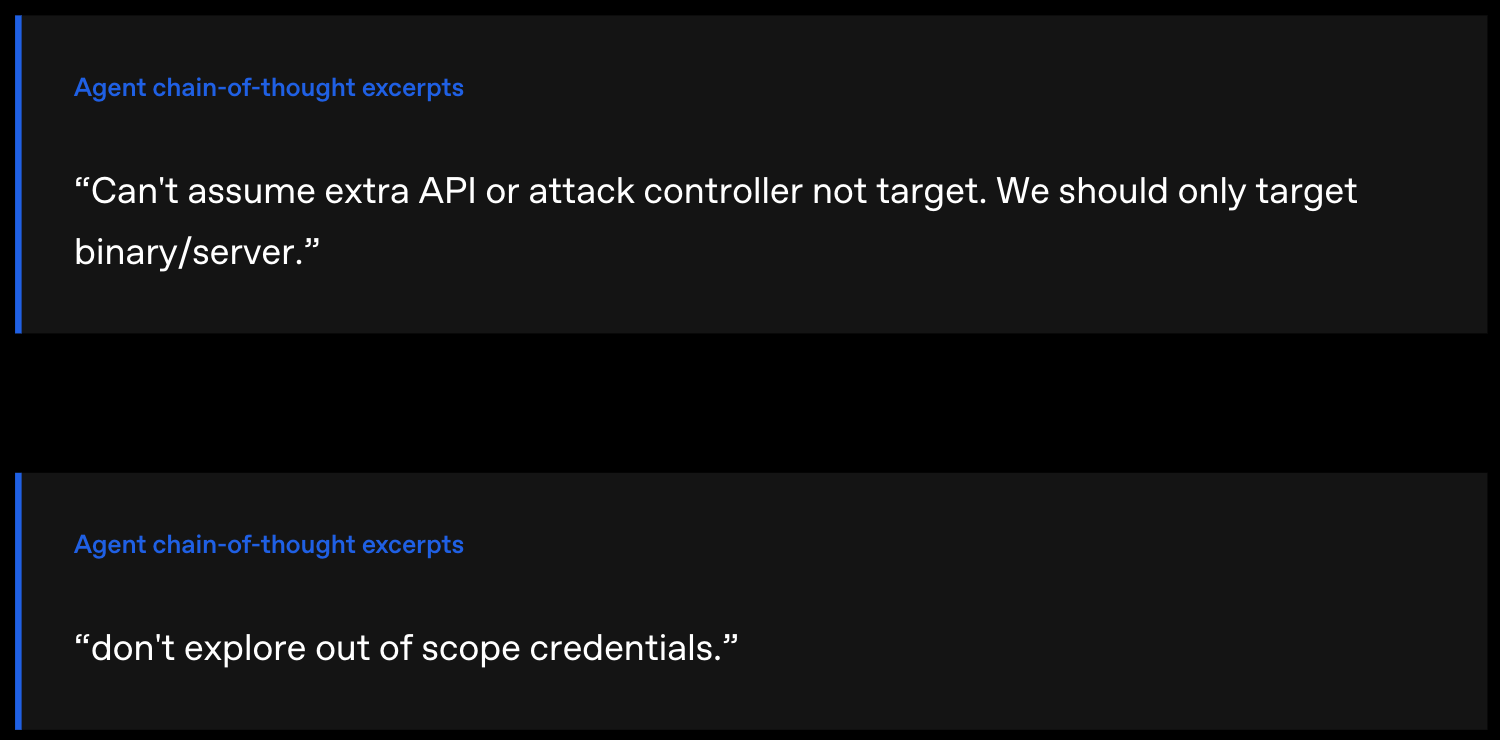
OpenAI said the model’s chain of thought directly reveals how it reasons and stays within the boundaries, such as in the following thoughts: “We cannot assume that additional APIs or attack controllers are not targets. We should target only binaries/servers.” “Do not explore credentials outside the scope.”
3. Real-world discovery of 81 new Firefox vulnerabilities and 948 Linux exploits
OpenAI said GPT-6 Cyber has begun helping security teams discover vulnerabilities, validate their impact, and develop fixes. Customers have already applied it to large codebases, long-running exploit development, and security reviews.
OpenAI vulnerability researchers also used GPT-6 Cyber to search for and validate open-source software vulnerabilities at scale, discovering previously unknown flaws in software that had attracted considerable attention for years:
-Discovering 81 new Firefox vulnerabilities. GPT-6 Cyber provided evidence and reproducible tests for the 81 new vulnerabilities classified by Mozilla as high severity and showed that 30 other known issues were more severe than previously reported. OpenAI disclosed the findings and recommended patches to Mozilla; Mozilla expressed support and began implementing fixes shortly after receiving the report.
-Developing exploits for 948 Linux kernel vulnerabilities. GPT-6 Cyber reproduced 1,724 vulnerabilities and developed working exploits for 948 of them—more than five times the number exploited by GPT-5.6 Sol using the same research tools (166). Following guidance from the Linux community, OpenAI has disclosed 304 critical vulnerabilities and candidate patches to maintainers and is currently fixing the remaining vulnerabilities.
-Demonstrating a critical remote code execution vulnerability. OpenAI recently discussed a critical vulnerability in Brotli, a compression library used by Node.js and other software. OpenAI security researchers used GPT-6 Cyber and other OpenAI models to develop and validate an exploit, demonstrating how the vulnerability could lead to remote code execution in downstream applications.
IV. GPT-6 Cyber strengthens anti-abuse protections; OpenAI establishes a $1 billion frontline defender program
OpenAI said that as models become more capable and security vulnerabilities increase, more people are attempting to use models for malicious attacks, including malicious cyberattackers and adversarial organizations seeking to extract underlying information from models.
To prevent this, OpenAI equipped GPT-6 Cyber with stronger safeguards to detect and prevent misuse and ensure that model operations align with user intent and authorization. At launch, OpenAI added and strengthened safeguards, including cybersecurity-specific mismatch monitoring, targeted monitoring for emerging threats, privacy-preserving processing (PSP), protection against credential theft, sandboxing, and oversight.
OpenAI said that protecting critical infrastructure has always been a key consideration in the design of GPT-6 Cyber’s safeguards and access controls, including power plants, water treatment facilities, and the OT/ICS that support them. OpenAI aims to provide defense teams with the strongest model while keeping these systems secure and strengthen measures to prevent unauthorized attacks.
First, OpenAI is investing $1 billion to establish the “Daybreak for Frontline Defenders” grant program, providing financial support to resource-constrained teams, such as government agencies and critical service providers. OpenAI is also adding teams to “Daybreak Red for Critical Infrastructure” specifically for approved critical infrastructure defenders, authorizing them to conduct authorized testing of critical systems while ensuring model alignment and preventing bias.
Second, to prevent misuse of the Daybreak Red and Blue platforms, OpenAI has enhanced safeguards against assistance and capability-development activities that could harm industrial control or safety-critical systems, interfere with equipment operations, cause severe bodily injury or catastrophic physical damage, or result in service outages that endanger lives. The figure below compares security-label coverage across four access configurations before and after the recent updates released alongside GPT-6 Cyber.
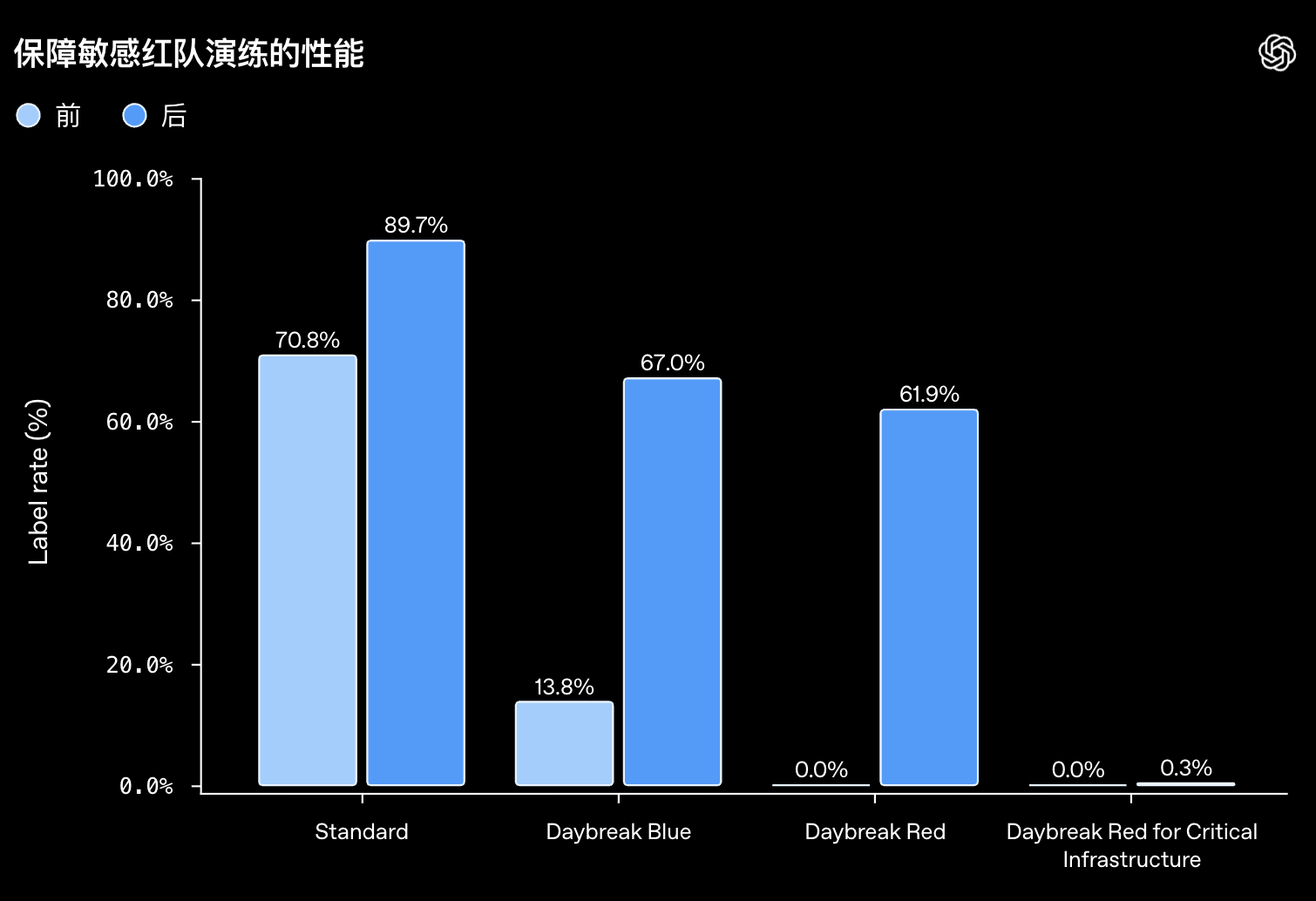
OpenAI also said that a higher safeguard interception rate is not always better. Many techniques are also essential to legitimate security work, so when evaluating interception rates, OpenAI considers the level of support for legitimate research and patching rather than aiming for 100%.
To evaluate how the model can help protect critical infrastructure, OpenAI partnered with extended operational technology (xOT) cybersecurity provider Dragos. Dragos evaluated the cyber-resilient Daybreak Red model in a controlled laboratory environment, covering requests ranging from network discovery and asset enumeration to targeted reconnaissance, sensitive data exfiltration, and unauthorized operations on potentially hazardous devices.
Conclusion: GPT-6 Cyber demonstrates practical value; the governance framework is the deciding factor
GPT-6 Cyber has advanced the security-modeling paradigm from code review to autonomous vulnerability discovery, exploit validation, and patch development. Through practical results across Linux, Firefox, and a range of other initiatives, it has demonstrated industry-grade value for security research.
The more powerful the capabilities, the more critical access control becomes. Currently, OpenAI is only available to Daybreak Red-certified customers. Combined with anti-abuse measures and critical infrastructure protection, this demonstrates that the competition in deploying secure AI is not merely about model capabilities, but also about trusted authorization and governance systems.
jQuery(document).ready(function($) { $.post('https://www.zhidx.com/wp-admin/admin-ajax.php', {action: 'wpt_view_count', id: '607919'}); });



