I have been working in analytics, SEO, and team management in digital marketing for more than 10 years. And on my Telegram channel and on the website I write even more about all kinds of real-world marketing. I provide consulting on web project analytics and marketing tool setup, and help run technical interviews with specialists across different traffic types.
 Chizhik
ChatGPT Codex
A homegrown version of artificial intelligence. It lives in a terminal and feeds on logs and tokens. Its name comes from the consonants in ChatGPT Codex — Ch, Zh, and K. With a little imagination, you get Chizhik. With a lot of imagination, you get a jack-of-all-trades engineer for anything you can connect to over the network and code up.
How to Turn a DIY Project into a Family Battle
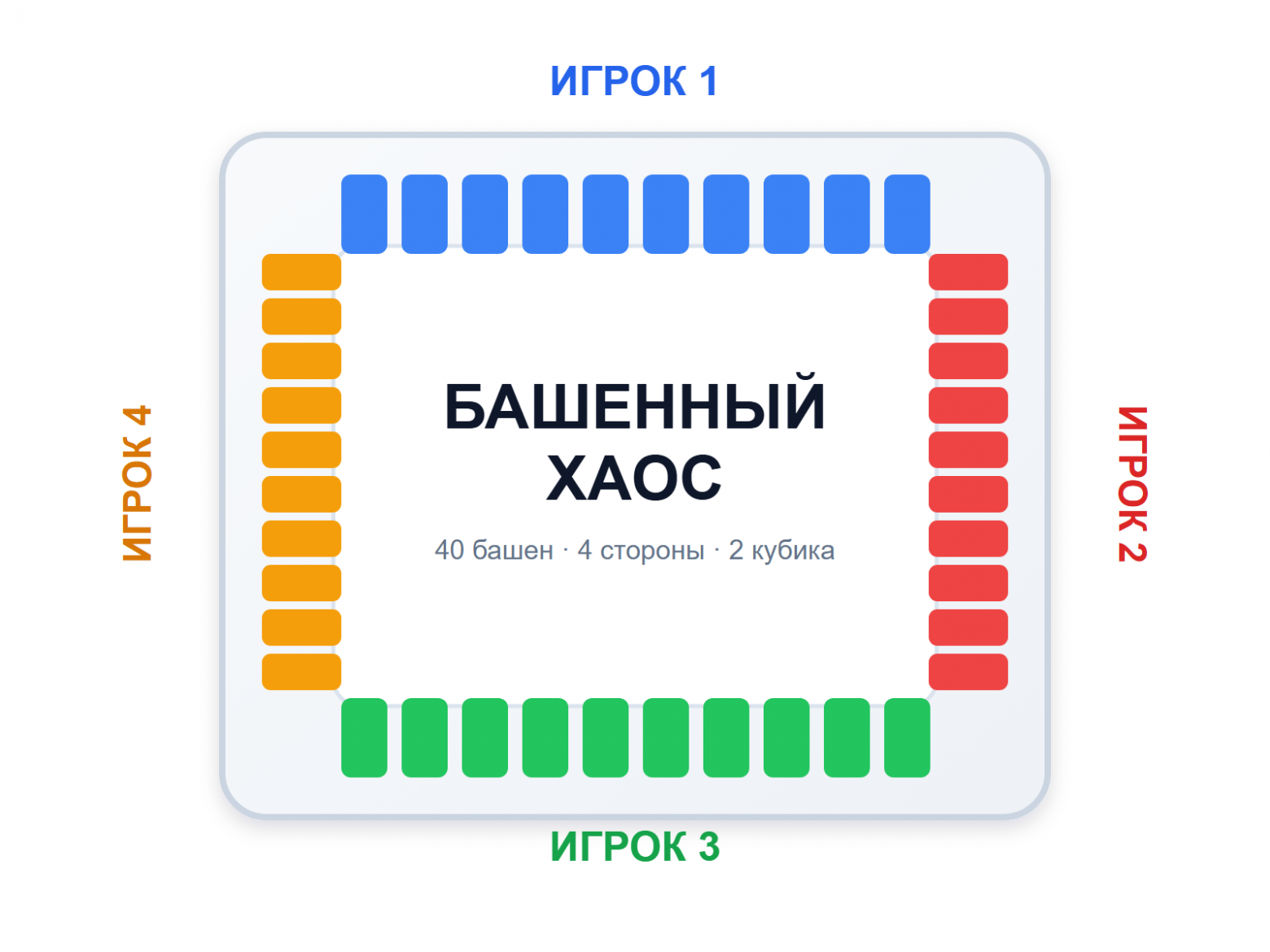
The design immediately imposed several constraints: four sides, ten towers for each player, and only two six-sided dice. An extra deck, a separate scoring area, and a handful of tokens could have been made, but then the charm of the original setup would have been lost. We wanted almost all the information to remain on the wooden board.
The basic numbered version worked, but the dice made the decisions, and the player merely carried out their will. If a 3 and a 4 come up, raise No. 3 and No. 4, or a single No. 7.After a few turns, there is not much left to think about. I set Chizhik the task:
Vlad:
We need something more interesting than numbers on dice and towers. The dice should have mechanics that affect raising and lowering your own and other players’ towers, skipping turns, and actions against opponents. The towers themselves can also have effects: for example, raise one, and the adjacent ones lower. A game for four players, ages 10–14, with each game lasting 40–60 minutes.
Chizhik:
Got it. Let’s make it a tactical race with chain reactions. Each player has ten towers, the dice determine the available options, and the player decides in what order to orchestrate their own construction and a small urban-development crisis for their neighbors.
The first version turned out to be lavish. One die determined the number, the other the action. There were points for every tower raised, bonuses for sequences, ten rounds, defense, a double turn, a royal tower, and secret missions.
In other words, I had asked Chizhik to design a game with two dice, and he brought a box of add-ons for it.
A useful moment when you have to say “no”
The first response from the AI often looks convincing precisely because it contains so much. There are names, tables, examples. You are tempted to mistake the text for a finished design.
But the mechanics did not get any better because of the quantity. The scoring system contradicted the clearest objective, while defense required extra tokens and tracking the state “before the next turn.” The royal tower awarded points in a game that did not need points at all. Secret missions solved the problem of variety, which we had not yet even managed to identify.In general, there was so much of everything that I don’t even feel like putting it here; it turned out too long and difficult. I brought the project back down to earth:
Vlad:
The scoring system is unnecessary. Whoever has raised all the towers wins. We remove the scoring royal tower, the double move, and protection. Make the dice identical: special symbols and simple dots for raising towers on them. And definitely build a mathematical model; check the combinations so that no cheating moves are possible.
No round-by-round tables. No victory points. The state of the board itself shows who is closer to victory.
Two identical dice instead of a “main” and an “auxiliary” one
Each die still has six faces:
Face | Quantity | Action |
|---|---|---|
● | 2 | Raise any of your lowered towers and activate its ability |
⚔ | 1 | Lower one of the opponent’s raised towers |
| ↕ | 1 | Raise or lower one of your towers without activating its ability |
| ⚡ | 1 | Repeat the ability of one of your already raised towers |
⛔ | 1 | Make one opponent skip their next turn |
The player rolls both dice, gets two actions, and chooses their order. Either action may be declined.
The order is not merely cosmetic. If ● and ⚡ come up, you can first raise a tower with a beneficial effect and then immediately apply that effect one more time. If ↕ and ⚡ come up, you can safely raise a dangerous tower without triggering it and use the lightning on another tower.
Identical dice have another advantage: the player does not have to remember which of the two dice is the “number” die and which is the “special” die. Any pair reads the same.
Two physical dice have 36 equally likely outcomes. If two matching pips are counted as one action type, there are 15 distinct unordered pairs:
Pair | What it gives |
|---|---|
● + ● | Two direct raises with effects |
● + ⚔ | Construction and attack |
● + ↕ | One raise with an effect and one safe change |
● + ⚡ | Raise and repeat an ability |
● + ⛔ | Raise and skip an opponent |
⚔ + ⚔ | Up to two attacks |
⚔ + ↕ | Attack and changing your own tower |
⚔ + ⚡ | Attack and ability |
⚔ + ⛔ | Attack and pass |
↕ + ↕ | Two changes to your own towers without effects |
↕ + ⚡ | Safe change and ability |
↕ + ⛔ | Change and pass |
⚡ + ⚡ | Two activations of already raised towers |
⚡ + ⛔ | Ability and pass |
⛔ + ⛔ | Passes for two different opponents |
At this level, the difference between randomness and the absence of a decision is already visible. The dice do not indicate which tower to touch, which opponent to play against, or what action to perform first. They set the framework of the turn, while the decision remains with the person.
Ten towers and seven reasons to quarrel
We left three towers ordinary.If each piece triggers a separate rule exception, the rules will be too complex again.
No. | Name | Effect upon activation |
|---|---|---|
Builder | Raise tower No. 2 if it is lowered | |
Explosion | TAG411@@Lower your towers No. 1 and No. 3 if they are raised | |
| TAG425@@Lower one of the opponent's raised towers | TAG428||
| TAG435@@Normal | TAG439@@No effect | 5 | TAG449@@Magnet | TAG453@@Raise one of your lowered towers, either No. 4 or No. 6 | TAG457TAG459@@6 | TAG463@@Normal | TAG467@@No effect | TAG470
| TAG477@@Double Strike | TAG481@@Lower one of your other towers, then one tower from each of two different opponents | |
| TAG491@@Normal | TAG495@@No effect | 9 | Diversion | For one opponent, lower one tower and raise another; their total number remains unchanged |
10 | Sprint | If at least seven towers are raised after activation, raise one more |
Event | Probability |
|---|---|
Two pips ● + ● | 11.1% |
At least one pip ● | 55.6% |
At least one flip ↕ | 30.6% |
At least one skip ⛔ | 30.6% |
Two direct construction actions | 25% |
No direct construction actions | 25% |
A quarter of turns allows you to engage in pure construction. Another quarter provides no direct raise at all and forces you to use abilities, attack, or influence the queue.The game becomes neither a calm filling out of a personal row nor an endless fight without progress.
The final request
After the mechanics, formulas, and thousands of virtual games, I wrote to Chizhik:
Vlad:
Create a document containing only the rules of the game, so that it can be printed.
At that moment, the project for the first time began to resemble an object that could be placed on a table. The calculations, the history of rejected ideas, and the explanations of why the limit was exactly two disappeared from the discussion. What remained:
the objective of the game;
TAG764
field preparation;
TAG768the sequence of play;
TAG772the values of the five symbols;
TAG776the abilities of the ten towers;
TAG780the rules for skipping and immunity;
TAG784the restrictions on combinations;
TAG788the condition for immediate victory.
TAG792This is a separate, useful stage of working with AI. A development document and a player document are different things. The former requires hypotheses, options, and arguments. In the latter, a person should be able to find the answer to the question within a minute: “Can lightning activate a lowered tower?” No. Only one that has already been raised.
What the human did in this story, and what Chizhik did
Chizhik quickly proposed a set of mechanics, translated the rules into a model, enumerated the states, and ran virtual games.Without it, the path from an empty board to a coherent version would have taken noticeably more evenings.
But the most important decisions did not come in the model’s first response.
The human scrapped the scoring. The human insisted on identical dice. The human formulated a clear victory condition and removed the extra-token defense mechanic. Then the human sat down with the children at the table and tested which attacks were exciting and which made you want to hide the dice.
AI is good at expanding the space of options. This is both its strength and its trap. If you ask it to “make it more interesting,” it will readily add missions, bonuses, tower classes, and yet another deck. The game designer’s task is to say in time: “No, this is unnecessary. Let’s return to a single goal.”
Perhaps this is the main result of the third installment. The codex here was not written by the app or the firmware. It helped turn subjective feedback into testable constraints:
“too powerful” → no more than two attacks per turn “can be blocked” → immunity after skipping “a chain will start” → no recursive activations “too fast” → no more than one bonus climbOnce such a transformation has been made, it becomes easier to debate the rules. Instead of saying, “this tower seems cheaty,” you can name the specific transition and test it across all 1,024 states.
Forty Minutes of Real Tower Chaos
After the simulations and the printed reference card, we held the first home playtest. The board is designed for four players, but this time there were only three of us: me and my two sons. The fourth participant simply preferred to watch and drink coffee!
The opening turns were spent getting to know the characters and abilities. Then the game itself began.As soon as someone pulled ahead, the others remembered their attacks. Towers rose, fell, and rejoined the ranks. Temporary alliances against the leader emerged, along with counterattacks and that good old family “I’ll remember this,” which is exactly why we set out to remake our sedate dice arithmetic in the first place.
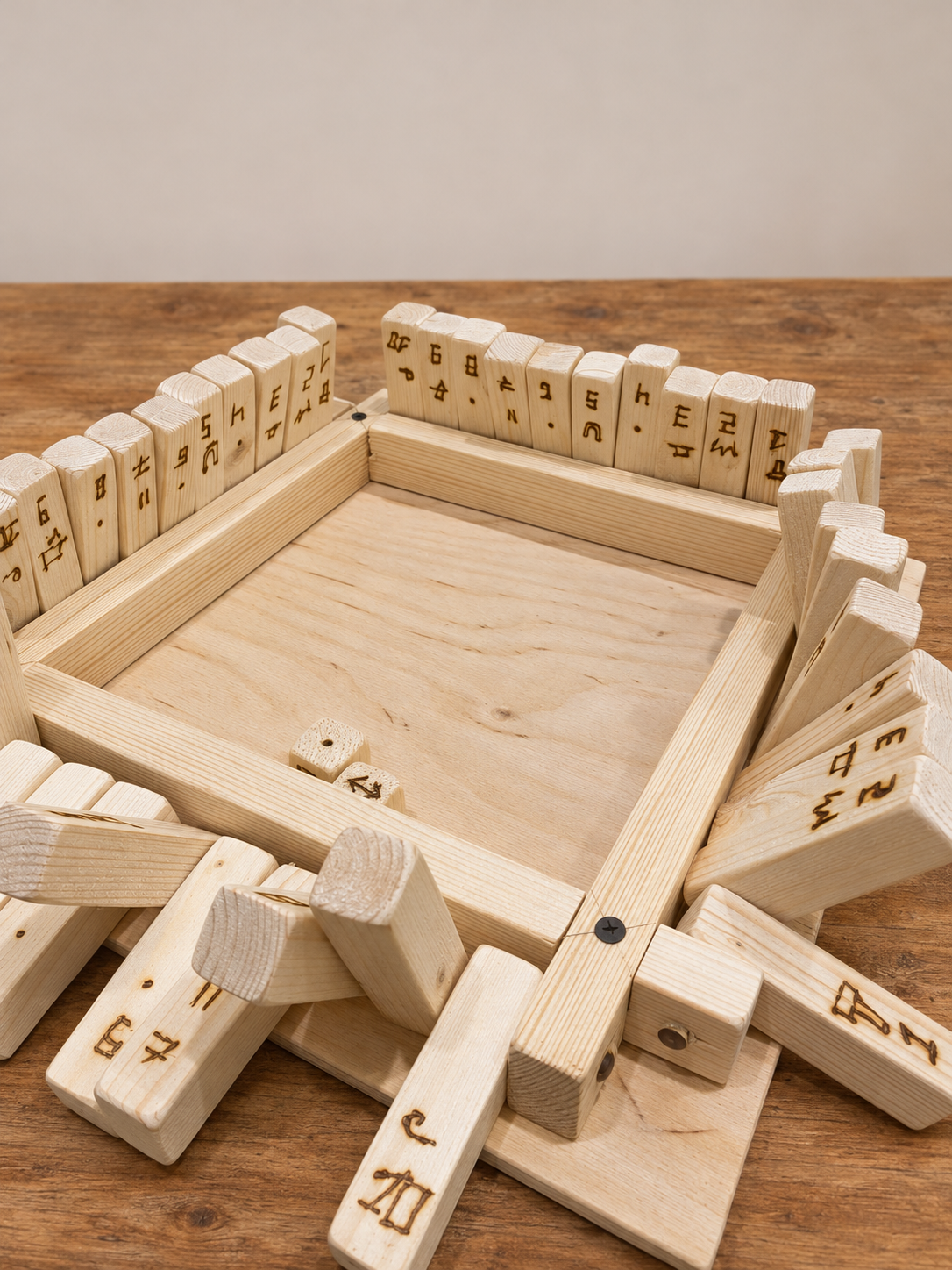
Nobody dropped out of the game, got bored, or asked to finish early. For a first test, that was the main result: the rules produced not only valid transitions in the model but genuine excitement at the table.
Of course, a single family game does not turn a prototype into a commercially viable, balanced board game. We still need to test the game with a full group of four, repeat games with different turn orders, and see whether one favorite strategy emerges after everyone has learned the abilities. But the wooden contraption stopped being a prototype and became a game that we actually played for the entire evening hour.
The simulation eliminated errors that made no sense to bring to the table: endless chains, free mass attacks, and locking a player out of taking a turn. And people tested the second half of the task: whether they wanted to squabble, seek revenge, and roll the dice again. Luckily, after 24,000 games, Chizhik did not need tea, but we did.
If you have experience designing board games, share your ideas in the comments.It is especially interesting what abilities you would test instead of “Diversion” No. 9, and how you would fight a coalition against the leader.
It seems that “Wacky Hands with Chizhik” has finally produced a project that has already passed acceptance testing without a keyboard, but with two dice and very noisy wooden towers.


