
The daily use of artificial intelligence in study routines may be associated with worse performance in assessments. Data from Pisa, released by the OECD, shows that 15-year-old students who rely on chatbots daily for certain school tasks obtain lower grades than peers who almost never use the technology.
In Brazil, almost half of the students already use AI to study. The data itself, however, shows that the relationship between technology and performance depends on frequency and, mainly, on the way these tools are used.
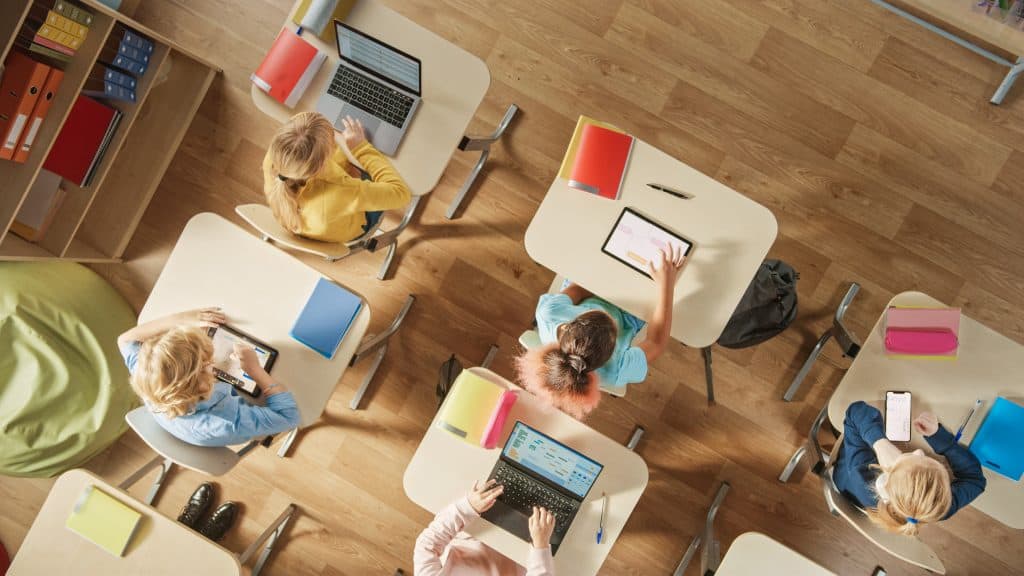 The OECD report warns about cognitive offloading, when the student transfers difficult tasks to AI. Image: gorodenkoff/iStock
Frequent use of AI raises an alert
The latest survey by the Programme for International Student Assessment (Pisa) collected data from over 760,000 young people in 91 countries. Among students who use AI daily or almost every day to write school texts, the average science score was 481 points. Among those who never or almost never use the technology for this purpose, the result reached 509 points.
The 28-point difference, calculated after socioeconomic adjustments, corresponds to approximately one and a half years of schooling. A similar pattern appears when chatbots are used for preliminary research on new topics or to summarize readings.
Just as we don't stay in shape by watching sports, but by practicing sports, learning does not occur through consuming content, but as a productive cognitive struggle with new material. Andreas Schleicher, Director of Education and Skills at OECD, to Bloomberg.
Schleicher argues that AI should be used as "a scaffold, not as a crutch." According to him, technology can contribute to learning when it stimulates intellectual effort, but can hinder development when it does this work on behalf of the student.
Almost half of Brazilians use AI
In Brazil, as we discussed here at Olhar Digital, 48% of 15-year-old students say they use AI chatbots at least once a week for studying. The percentage is close to the OECD average of 46%.
Technology appears at different moments in the school routine:
- Preliminary research: 40% of Brazilians use AI to explore new topics, compared to 31% in the OECD average.
- Summary of readings: 31% use the tool to summarize texts, compared to 30% in the OECD.
- Drafting papers: 27% turn to the systems to draft papers, while the OECD average is 29%.
- Rare or no use: 11% said they never or almost never use chatbots in the analyzed school activities, compared to 14% in the OECD.
Brazil's performance is below OECD
Brazil's educational results fell below the OECD average in the three areas evaluated. In science, 48% of students reached at least level 2 proficiency, compared to 74% in the organization. Only 1% reached levels 5 or 6, versus 7% in OECD.
In mathematics, 28% achieved at least level 2, while the OECD average was 65%. In reading, Brazil recorded 49%, against 69% in the organization.
The data also shows that technology is not necessarily harmful. Students who use AI once or twice a week tend to outperform both those who use it less and those who rely on the tool daily.
 According to OECD, technology in education should act as a scaffold for learning, and not as a crutch that replaces effort. Image: Deemerwha studio/ Shutterstock
Conscious use of AI can save students' grades
The report shows that the secret lies in pedagogical mediation. Students guided in class to critically check data generated by AI gain 13 points more in science — more than half a year of extra schooling.
A study in China with 27,000 students proved that delegating tasks to AI reduces lesson time, but lowers final exam scores. Global adoption also reveals cultural gaps: while 40% of young people in Japan reject AI in studies, only 4% avoid technology in Vietnam.
Read more:
- Pisa 2025: prohibition of cell phones in schools jumps from 37% to 81% in Brazil
- AI will no longer be able to correct exams and essays in schools; see what changes
- Pisa 2025: 17% of Brazilian students suffer bullying; cyberbullying affects 3% The discussion gained momentum along with concerns about the so-called "cognitive offloading," when students transfer tasks that would require their own reasoning to AI. At the same time, technology advocates argue that it can promote personalized learning and help teachers with administrative tasks.

Valdir Antonelli is a journalist specializing in digital marketing and consumer behavior.

