Cainiao Flies First
In the past, getting a parcel to the other side of the world faster might have cost a logistics company more than $100. Today, Cainiao can cut that figure in half while achieving three-day delivery worldwide.
This is powered by a new efficiency lever—AI—as well as AI spending that is growing tenfold every year.
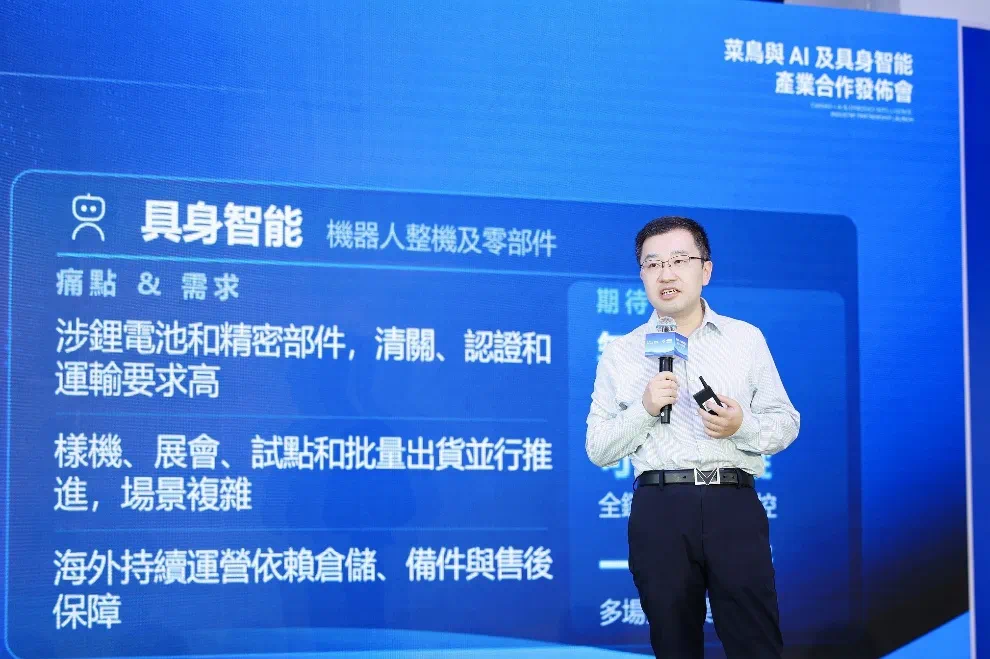
On November 5, at the AI and Embodied Intelligence Industry Cooperation Conference held at Cainiao Hong Kong Smart Port, Cainiao International President Xiong Wei cited a dazzling array of figures—
At present, the share of Cainiao’s warehouse allocation assisted by AI has reached 96%, generating tens of millions in cost savings every year;
AI is also handling a large amount of work in areas such as merchant engagement, exception management, and overseas customs classification.
But Cainiao is not satisfied with this; it aims to fly higher.
At the conference, Cainiao announced two major initiatives in one go. One was to open upreal-world warehouse scenarios around the worldas training sets, accelerating the transition from embodied-AI demos to products.
The other was to accelerate the global expansion of hard tech. Cainiao provides a “tech going globalthree-day delivery” service for hard-tech products such as AI computing infrastructure and robots, offeringone-stopsupply-chain support from cross-border transportation and overseas warehousing to after-sales service.
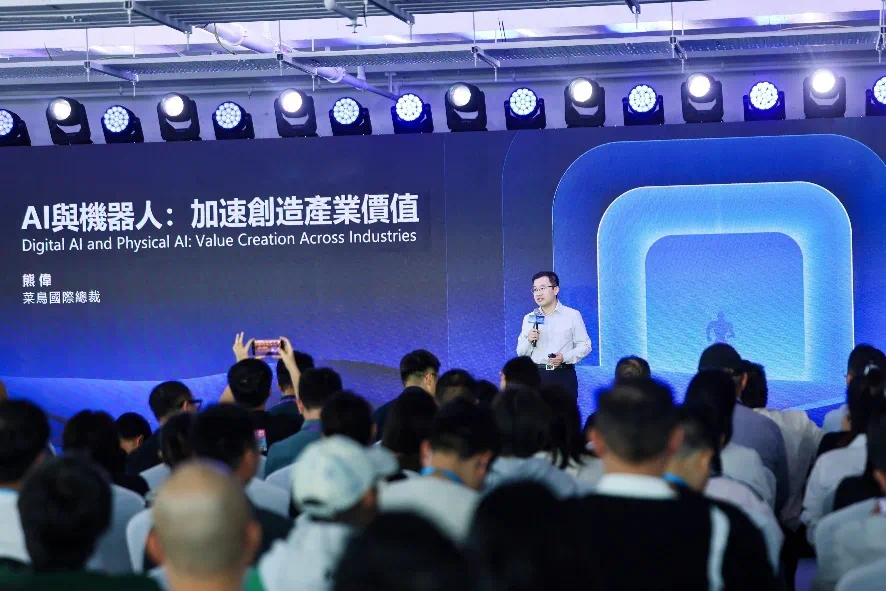
This inward-and-outward strategy clearly stems from Cainiao’s innate “technology-driven and global” DNA.
Xiong Wei said it was hard to imagine that, ten years from now, companies would still be using today’s operating methods to address more complex and challenging operating environments while embodied robots achieved greater productivity breakthroughs at a faster pace: “At least in this field, we hope to achieve 50% robotic assistance over the next ten years.”
This is also the starting point for Cainiao’s decision to open up collaboration. First, Cainiao has its own need for greater productivity. It hopes to benefit from this shift and is willing to invest ahead of time to help it materialize sooner.
At the same time,we are at the beginning of the wave of hard tech going global over the next ten years.
Xiong Wei revealed that, over the past few years, AI computing capacity going overseas had grown nearly tenfold every year. Meanwhile, relatively mature consumer-robotics categories already accounted for 10% of Cainiao’s revenue, and their growth doubled this year.They will represent “the greatest structural opportunity in cross-border supply chains over the next 3–5 years.”TAG42@@Want to move beyond the demo? Head to the warehouse first.Cainiao Hong Kong Smart Port, where the conference was held, is already a highly automated logistics hub, with hundreds of specialized logistics robots operating in an orderly manner inside the facility.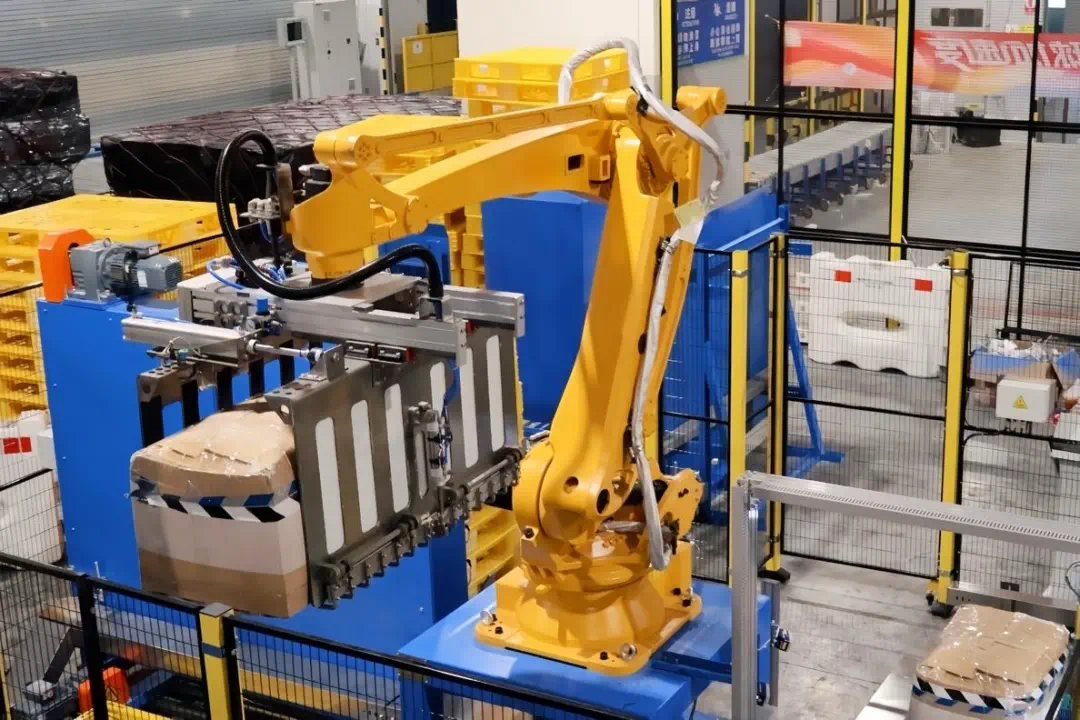
Automated palletizer at the Cainiao Hong Kong Smart Port Freight Center
TAG51@@Over the past decade or more, Cainiao has deployed more than10,000specialized logistics robots across its global logistics operations, yet a large amount of work on site still cannot be done without people, such as loading, sorting, packing, and applying labels. These tasks, which require greater generalization, hand-eye coordination, and execution capabilities, are difficult for traditional technologies to cover and have become a key focus for Cainiao as it introduces embodied intelligence.This year marks the first year that embodied intelligence has truly entered industrial applications. Xiong Wei said that Cainiao was confident logistics would be the first sector to achieve the large-scale deployment of new technologies. Over the next ten years, the global installed base of robots will reachtens of millions of units, and embodied robots will certainly be the fastest-growing.。
Why does Cainiao believe logistics will be the first deployment scenario for physical AI?First, logistics is a real physical world sufficiently large in scale and rich in tasks.。It encompasses vast scenarios involving numerous physical operations, including production, warehousing, transportation, sorting, loading, and unloading, giving robots roles that extend far beyond material handling.
Even when robots perform relatively standardized actions, the objects they handle vary enormously. Take parcel sorting, for example: a laboratory may test only a few hundred parcels, with a dozen or so types tested repeatedly. But at a real logistics site, it may have to process 1,000–2,000 parcels an hour and face tens of thousands of different parcels over the course of a day.
These packages vary in size and weight, may stick to or press against one another, and can be positioned and arranged in different ways.
The environment is not always ideal either. Lighting, temperature, humidity, and even dust can affect the robot’s perception and manipulation.
After mastering a few motions in the lab, a robot may not be able to perform them just as successfully in a real warehouse. What robots need to cope with is a constantly changing physical world.
Second, a “semi-structured” environment is just the right level of difficulty.
Compared with open environments such as homes, warehouse aisles, shelves, and workflows are relatively orderly and governed by clear rules; yet goods, locations, and placement methods are not entirely fixed. This gives robots a good practice environment, exposing them to the complexity of the real world without requiring them to tackle a highly open setting such as a home right from the start.
Moreover, robots do not have to replace all human labor from the outset. Work that can be completed consistently can be handed to robots first, while tasks that cannot yet be completed independently can still be supported by human workers and existing workflows.
Some logistics tasks also leave room for trial and error. When picking an item, for example, if the robot fails to grasp it on the first try, it can adjust its posture and try again. If it encounters an exception it truly cannot handle, the task can be handed over to on-site employees.
Compared with some industrial tasks that demand extremely high precision and safety, where an error could damage materials, certain logistics operations are more amenable to adjustment and correction.
Third, there is an opportunity to create a continuously operating “data flywheel.”
For embodied intelligence to move from “being able to do something once” to “doing it reliably over the long term,” continuous training in real-world settings is key. Logistics, meanwhile, happens to provide an endless supply of tasks. Every grasp, movement, unpacking, and palletizing operation is a genuine physical interaction. What the robot did right, where it went wrong, and what adjustments it needed to complete the task can all be distilled into valuable data.
Xiong Wei specifically noted that on-site data includes not only successful operations but also data from mistakes that were subsequently corrected. These experiences can help models continually improve their reliability.
More importantly, the capabilities developed in logistics are generalizable.
For example, picking items in a warehouse shares considerable operational logic with similar picking tasks in supermarkets and pharmacies. Experience accumulated in one setting can potentially be transferred to other similar tasks.
In that case, logistics would be not only a vertical application scenario but also an important proving ground for training embodied intelligence to develop general-purpose operational capabilities.
During the roundtable session, Lingdong General founder and CEO Ji Chao also pointed out that, over the next few years, the focus must be on product-level solutions that meet demand.
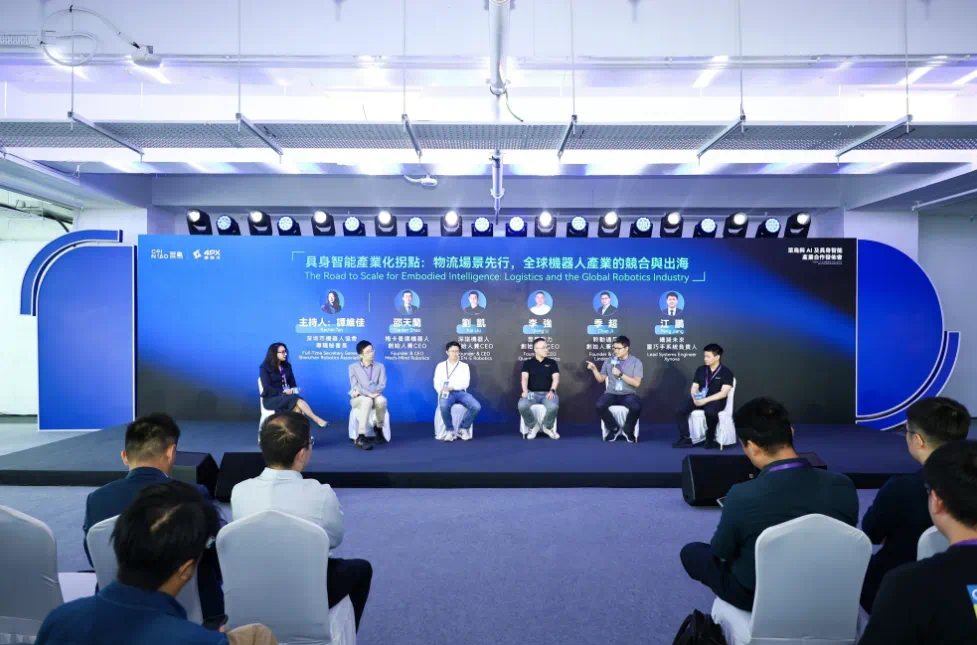
He further explained that this round of embodied intelligence first saw a technological breakthrough, but that most breakthroughs are still happening in laboratories. Truly bringing the technology into industry requires filling the gaps in infrastructure.
That is why, over the past year or two, the entire industry has been focused on catching up, including in computing power, toolchains, data, and other areas. Once this infrastructure is gradually completed, embodied intelligence is expected to usher in a new round of explosive growth.
Three application scenarios: deployment need not wait for the world model to be ready
Over the past decade or more, Cainiao has experimented with various technologies and products in logistics scenarios. It found that a general-purpose robot body paired with a generalizable “brain,” after pretraining, could already reach an “80-point level of usability” in many scenarios. But there is still a gap between being able to complete a task and truly adapting to industrial settings.
The key is to get robots into real-world settings so they can keep learning as they are used.
For example, through model parameter adjustment, post-training, and In-Context capabilities, robots can continuously practice and improve in actual operations, gradually reaching a “95–98-point” level and essentially completing product validation. To achieve stable, long-term industrial applications, they must continue iterating to a “99-point, or even 99.99-point” level.
In this process, on-site data is critically important. Xiong Wei emphasized that it includes both data from operations the robot completed correctly and data from errors that were subsequently corrected. Every execution, adjustment, and correction by a robot can provide valuable experience for subsequent model iterations.
This is also an important reason for Cainiao to open up real-world logistics scenarios this time.
Cainiao has a global warehousing network of millions of square meters and has long served industries such as express delivery, e-commerce, FMCG, and auto parts—dozens of industries in total. At the launch event, Cainiao announced that it would open to industry partners covering dozens of industries and hundreds of real PoC scenarios in areas including warehouse picking, intelligent navigation delivery, aerial inspection, security operations and maintenance, air cargo logistics, and auto-parts management.
These scenarios contain vast numbers of SKUs, with products of varying sizes and shapes; they include orders that suddenly surge during major promotions as well as operating tasks that may change at any moment. What robots will face is a real-world environment full of diversity and uncertainty.
However, given that real-world scenarios are so complex, where should robotics companies begin?
Drawing on years of experience applying logistics robots in professional applications and its assessment of the development path of embodied intelligence technology, Cainiao divides logistics scenarios into three tiers: short-horizon generalization, mid-horizon precision, and long-horizon strategy.
In simple terms, this means first mastering a single action, then completing a sequence of operations, and finally autonomously planning an entire work process. The three types of scenarios place progressively higher demands on robot capabilities, and their levels of commercialization maturity also vary.
Drawing on its industry experience and technological innovation expertise, Cainiao will help embodied intelligence companies find more accessible entry points for breakthroughs.
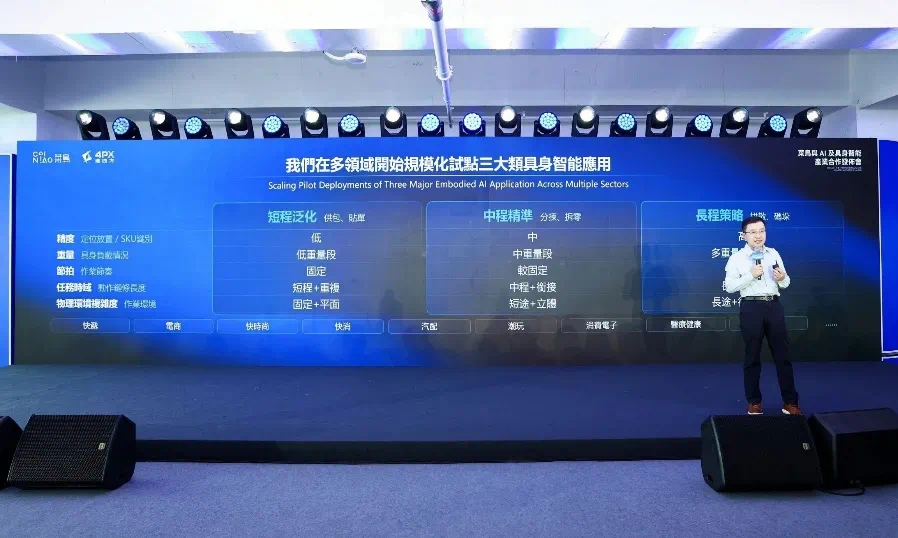
So-called short-horizon generalization means first performing a single action well.
These tasks are generally short and highly repetitive, take place in relatively fixed operating environments, require centimeter-level precision, and primarily involve light loads. Examples include logistics sorting and parcel grasping.Although the actions appear simple, the difficulty lies in the diversity of the SKUs: robots must handle both small parcels and light goods of different shapes and sizes.Why, then, do short-horizon tasks have the opportunity to be deployed first?Ji Chao explained that reinforcement learning is essentially a search process. The longer the task chain, the more likely it is to encounter sparse-reward problems, and the greater the space the model needs to explore. By comparison, tasks involving short-horizon decision-making have fewer steps and more direct feedback, impose relatively lower requirements on data and long-term memory, and are therefore more likely to achieve a breakthrough first.This also means that, at least for short-horizon tasks, industrial applications do not have to wait until world models and long-term memory capabilities are fully mature. At present, many operations in the logistics sector can already be implemented through VLA or imitation learning.Currently, embodied robots in short-horizon generalization scenarios have basically achieved efficiencies and capabilities comparable to those of humans. Meanwhile, robot hardware cost-effectiveness, engineering capabilities, and model capabilities are all improving rapidly. Xiong Wei expects that in 2027, the short-horizon generalization field will see a significant breakout, and that the opportunities will not be confined to logistics, as many other industries have substantial similar needs.The second tier: mid-horizon precision, moving from individual actions to continuous operations.
Task difficulty now rises significantly. A task may involve a dozen or even dozens of steps, with operation precision required at the millimeter level. At the same time, robots must coordinate multiple stages within complex three-dimensional environments involving shelves and goods.Examples include picking in supermarkets and warehouses, as well as loading and unloading in the consumer electronics, auto-parts, and FMCG industries. These tasks require robots not only to see accurately and grasp securely, but also to continuously complete a series of operations.Xiong Wei believes that, as robot hardware capabilities improve and model architectures continue to advance, mid-horizon precision scenarios are also maturing rapidly. More importantly, the market space behind this tier is at least 10 times that of short-horizon generalization. In addition to logistics and warehousing, the consumer electronics, auto-parts, and FMCG industries also have substantial demand for similar loading and unloading tasks.The third tier: long-horizon strategy, giving robots global planning capabilities.For example, in air cargo terminals or large-scale warehousing scenarios, goods are not simply placed in fixed locations.
Robots need to understand the distribution of cargo, available space, and operating conditions throughout the three-dimensional space, and then plan a series of operations in advance based on the task objectives.
Cainiao is already using digital AI to optimize cargo loading, unloading, and other operations to improve space utilization. Such tasks involve a typical long-horizon strategy: they require both an understanding of complex three-dimensional environments and continuous planning of operations over an extended future horizon.
Compared with short-horizon generalization and medium-horizon precision, such tasks face greater technical challenges on the path to large-scale application.
Of course, before robots can enter real-world production environments, they must first demonstrate technical feasibility. They then need to clear two more hurdles: engineering and economics.
Ji Chao pointed out that the metrics customers use to evaluate performance go far beyond task success rates. In the logistics scenario, for example, customers also care about a range of indicators such as volumetric utilization, dropped-item rate, return-flow rate, and operating cycle time. Even the stack pattern used when loading vehicles may vary depending on different customers’ requirements.
The further question is how to replicate an already validated technology solution for more customers and more use cases through productization and engineering, without having to start from scratch each time.
When selecting embodied intelligence application scenarios, Cainiao had already factored ROI into the equation. Xiong Wei estimates that, for some selected scenarios, the payback period in China is expected to be 1–2 years, and overseas it may even be less than one year. Of course, this is contingent on the technology and products undergoing thorough engineering refinement.
Through high winds and rough seas: From a single robot to global delivery
Domestic robots are becoming a “new calling card” for China’s foreign trade. Data shows that for every 10 humanoid and quadruped robots sold worldwide, eight are made in China.
At the same time, China’s leading technology companies are investing in AI hardware and data-center construction on an unprecedented scale.
High-value hardware such as robots, GPUs, and servers is expanding into global markets at an accelerating pace, but sending these products overseas has long since ceased to be merely “transportation.” Technology exports can be understood as a sophisticated engineering system that requires deliveries to be completed over long chains, at relatively high frequency and under strict safety requirements.
Compared with ordinary e-commerce parcels, hard-tech products are high-value and intricately engineered, and place far more demanding requirements on timeliness, safety, and compliance. Delivering a set of servers to a data center may also involve racking, cabling, and power-on testing. Once the equipment is put into use, maintenance and spare-parts replenishment also become concerns.
This is also why Cainiao further extends the “Three-Day Delivery” consumer-facing experience into services supporting technology exports, while providing “one-stop” solutions for companies at different stages.
Even early-stage companies with only a single prototype can access end-to-end global transportation services. Whether for overseas trade shows, research and testing, or customer demos, Cainiao can use its global express network and flexible shipping options to address the cross-border transport of small batches of time-sensitive equipment.
TAG230For companies entering the small-batch delivery or large-project stage, Cainiao provides global air freight and project-based delivery services. For example, when delivering embodied robots to overseas factories or shipping a complete suite of AI computing equipment to a data center, it can match air-freight resources to the cargo’s dimensions, weight, and transportation requirements, while providing fine-grained services such as scheduled delivery, delivery upstairs, and placement in position.For companies already scaling their overseas operations, Cainiao can also provide supply-chain services covering overseas warehousing, distribution, and after-sales operations and maintenance.
With a global warehouse network spanning dozens of countries and totaling millions of square meters, Cainiao can help companies manage overseas inventory, arrange local delivery, and provide supporting services such as spare-parts replenishment, returns and exchanges, repairs, customs and regulatory compliance, insurance for high-value cargo, and global logistics tracking.
TAG240@@Xiong Wei believes that safe, reliable, compliant, and reassuring end-to-end solutions will be an important demand in this field in the coming years.What underpins this service is not only Cainiao’s existing global logistics network, but also compliance capabilities covering customs, inspection, taxation, and foreign exchange, as well as experience coordinating delivery nodes across different countries and regions—and even service know-how covering dozens of countries worldwide for some leading consumer robotics companies.
Xiong Wei gave an example. Cainiao has accumulated extensive experience in complex scenarios such as the Olympic Games and international exhibitions. When dealing with multiple batches and types of cargo and strict time windows, service providers must ensure that the entire delivery chain operates smoothly.
The Olympic Games may come around only once every four years, but in serving Chinese technology companies expanding overseas, providers may have to deal with a similar “mini Olympics” every day.

Cainiao’s two initiatives this time may appear to be one internal and one external, but they actually point to the same goal:to serve as infrastructure that enables AI technology to truly enter the industry.
“Internal”provides embodied intelligence with real-world training grounds and product-validation environments, while “External”adds the supply-chain capabilities needed for global delivery and long-term operations to Chinese hard-tech companies.
Under this strategy, Cainiao does not intend to take on every technical component in the field of embodied intelligence. Instead, it willfocus on technology directions closely related to logistics scenarios, including vertical-scenario technologies, agents, harnesses, etc., dividing work and collaborating with specialist partners, first validating on a small scale in real-world scenarios and then gradually moving toward productization and scale-up.
This also reflects a trend in the development of the AI industry: technological breakthroughs are only the starting point. It is the coordination of real-world scenarios, engineering capabilities, and industrial infrastructure that ultimately determines how far technology can go.


