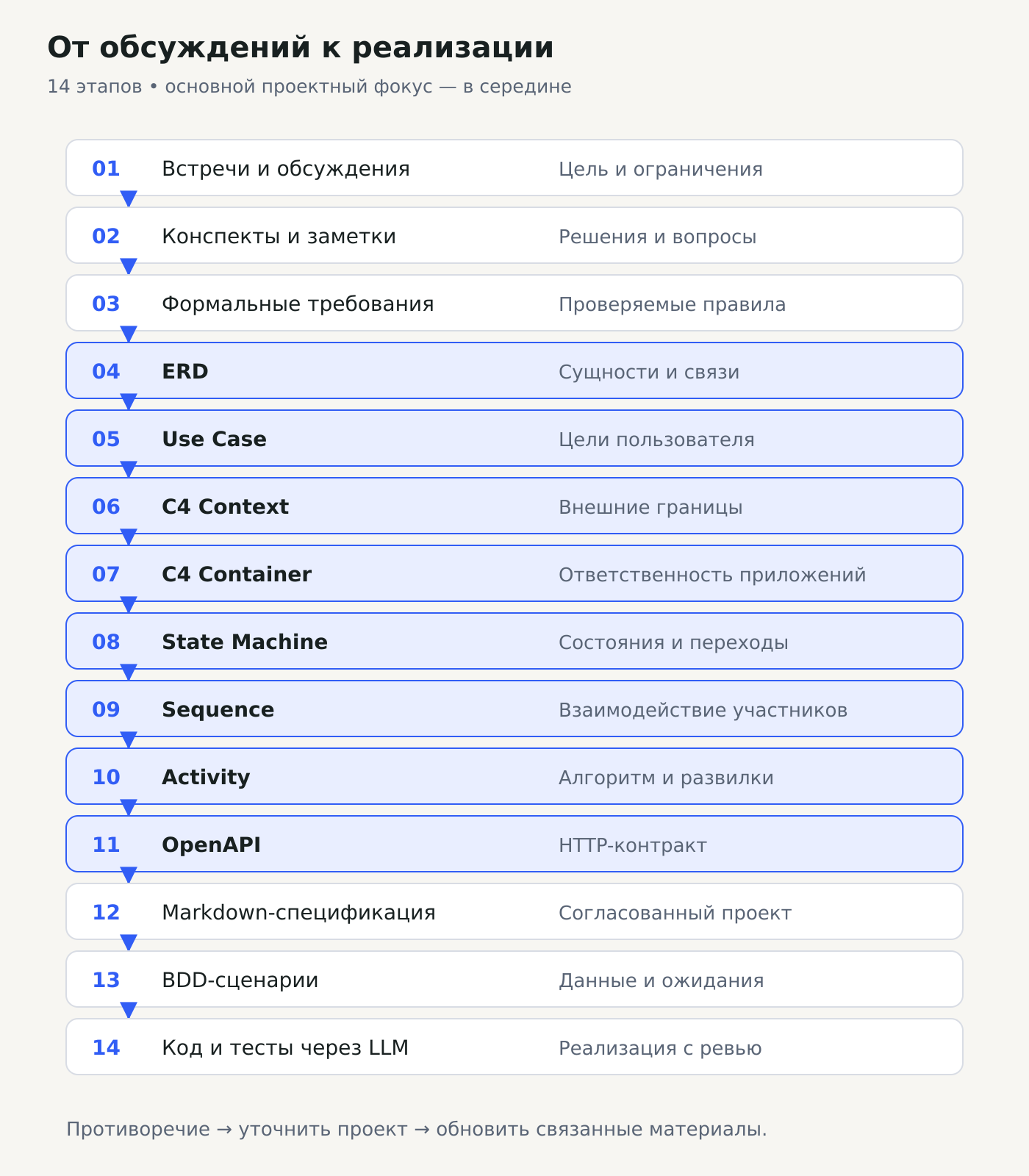
But there is an inconvenient catch. In a field experiment involving nearly a thousand high school students solving math problems, access to GPT-4 raised their practical assignment grades by 48% in the version replicating the standard ChatGPT interface and by 127% in the version with protective hints. And when access was removed, students in the first group performed 17% worse than those who had not used AI at all. The assistant worked like a crutch: while it was available, performance improved, but without it, it turned out that no learning had occurred.
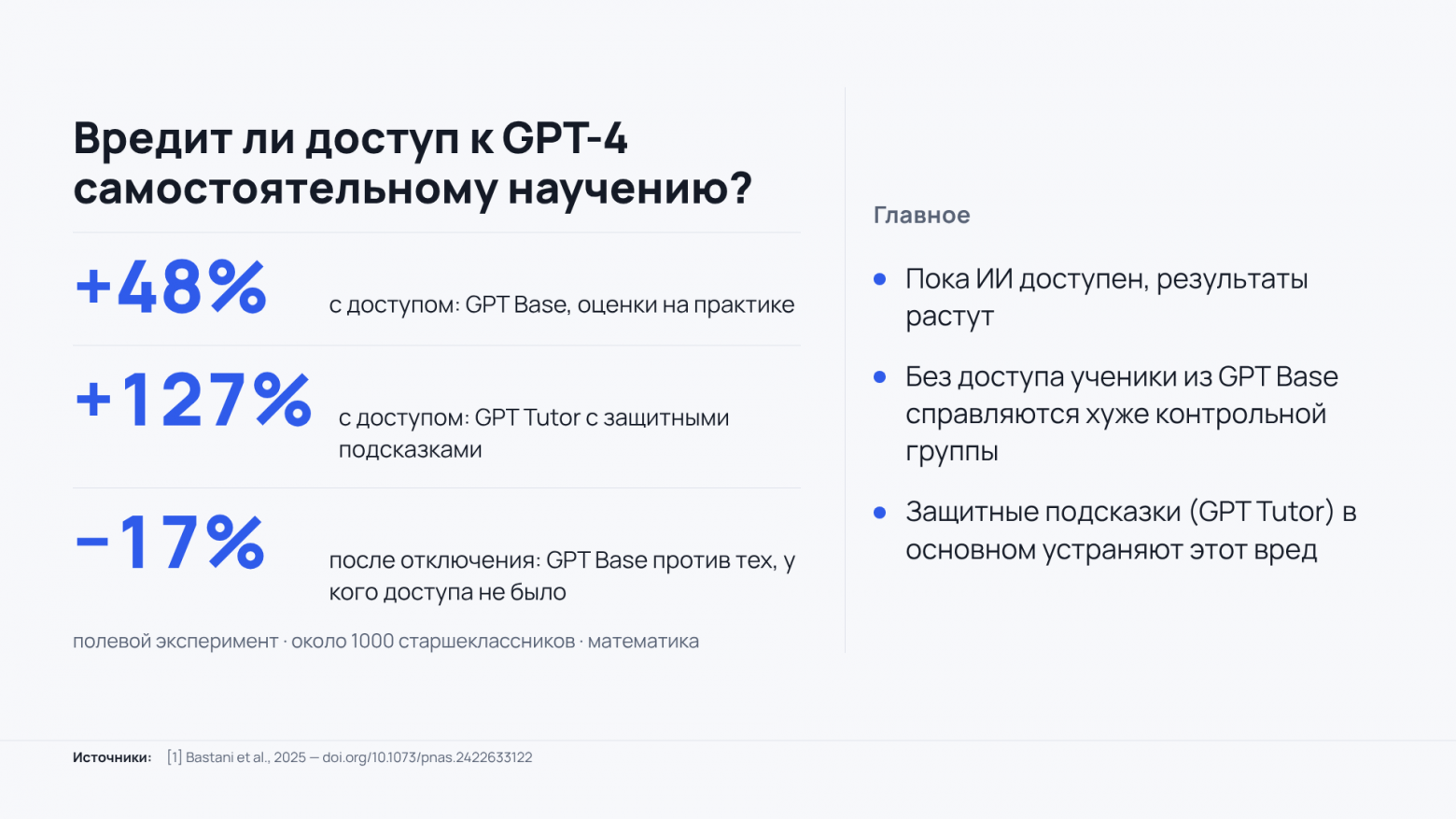
A similar picture will be familiar to anyone who has worked with AI tools on a team:
a junior developer accepts Copilot’s suggestions one after another, tasks get completed quickly, but during a code review they cannot explain why the solution is designed the way it is;
an analyst receives a ready-made market summary from AI, transfers it into a presentation, and gets lost on the manager’s first follow-up question;
a support representative responds to customers using templates generated by the assistant and, six months later, still does not understand the product;
a student submits a polished essay written with ChatGPT but cannot restate its argument in their own words.
In allIn some cases, performance metrics look good: tasks are completed, time is reduced, and satisfaction is high. Yet no skill was gained in the process.
This would seem to contradict everything we know about a good interface: less effort is better. But what if effort comes in different forms, and AI removes not only the kind that should be removed?
Three Loads
To understand which effort is unnecessary, we need Cognitive Load Theory (Cognitive Load Theory, CLT). It is based on how human memory works. Everything new goes through working memory, which is limited both in capacity and in retention time. The processed information is then stored in long-term memory, which has no known limitations. Once knowledge is already in long-term memory and is retrieved from there, working-memory constraints no longer apply to it.
This leads to an important idea: expertise is, first and foremost, the content of long-term memory. An expert differs from a novice not by having a larger working memory, but in that they have already encountered similar tasks many times and store ready-made schemas for solving them. A novice has to build the solution step by step within the limits of working memory.According to John Sweller, accumulated knowledge is the main, and perhaps the only, malleable source of differences between people.
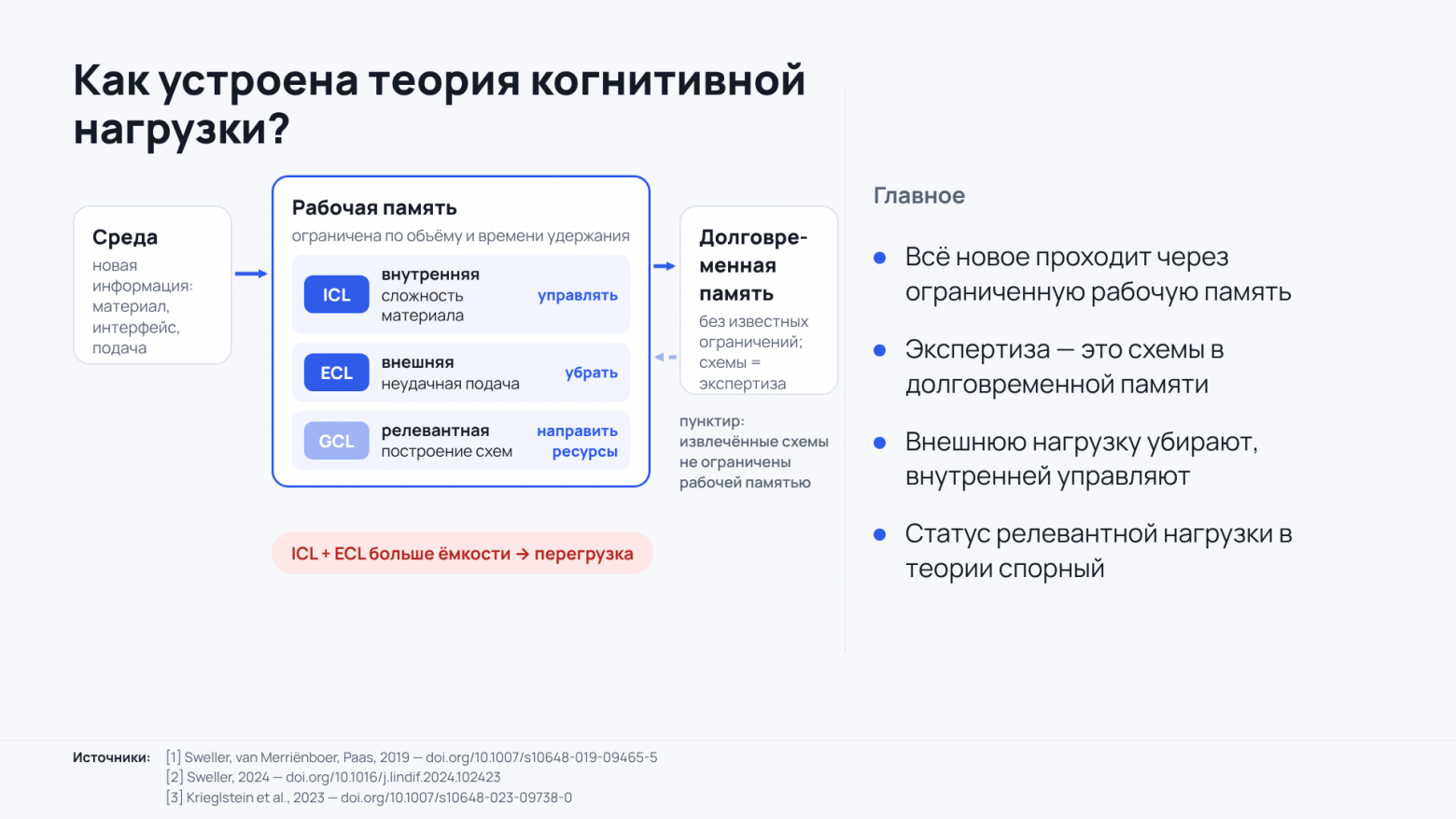
In this architecture, CLT distinguishes three types of load:
intrinsic load (intrinsic load, ICL) — the complexity of the material itself: how many elements must be held simultaneously and how closely they are interrelated;
extraneous load (extraneous load, ECL) — the effort created by the manner of presentation: disconnected labels, superfluous elements, confusing navigation;
germane load (germane load, GCL) — the effort a person invests in constructing and consolidating schemas, that is, in learning itself.
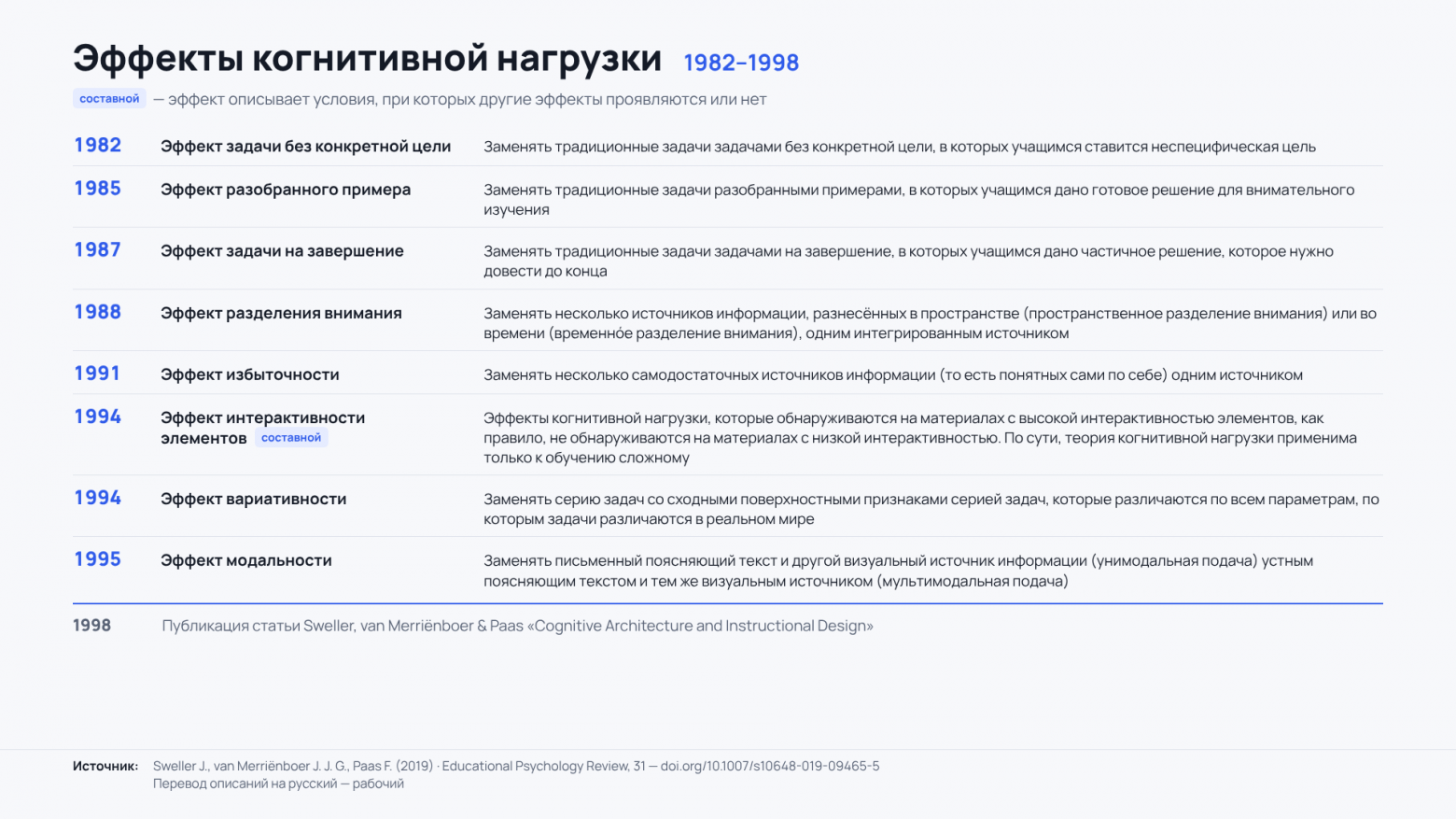 Classical effects of cognitive load