
Zhidx (official account: zhidxcom)
Author | Sun Xiaowen
Editor | Cheng Qian
Zhidx, November 6 — Today, Thinking Machines Lab, the U.S. AI startup founded by former OpenAI Chief Technology Officer Mira Murati, released the general-purpose multimodal model Inkling 2 Small, and will next weekmake its weights openly available. The model focuses on improving custom-training performance, supports developers in further training it with their own data, and can also autonomously invoke tools to fine-tune other models.
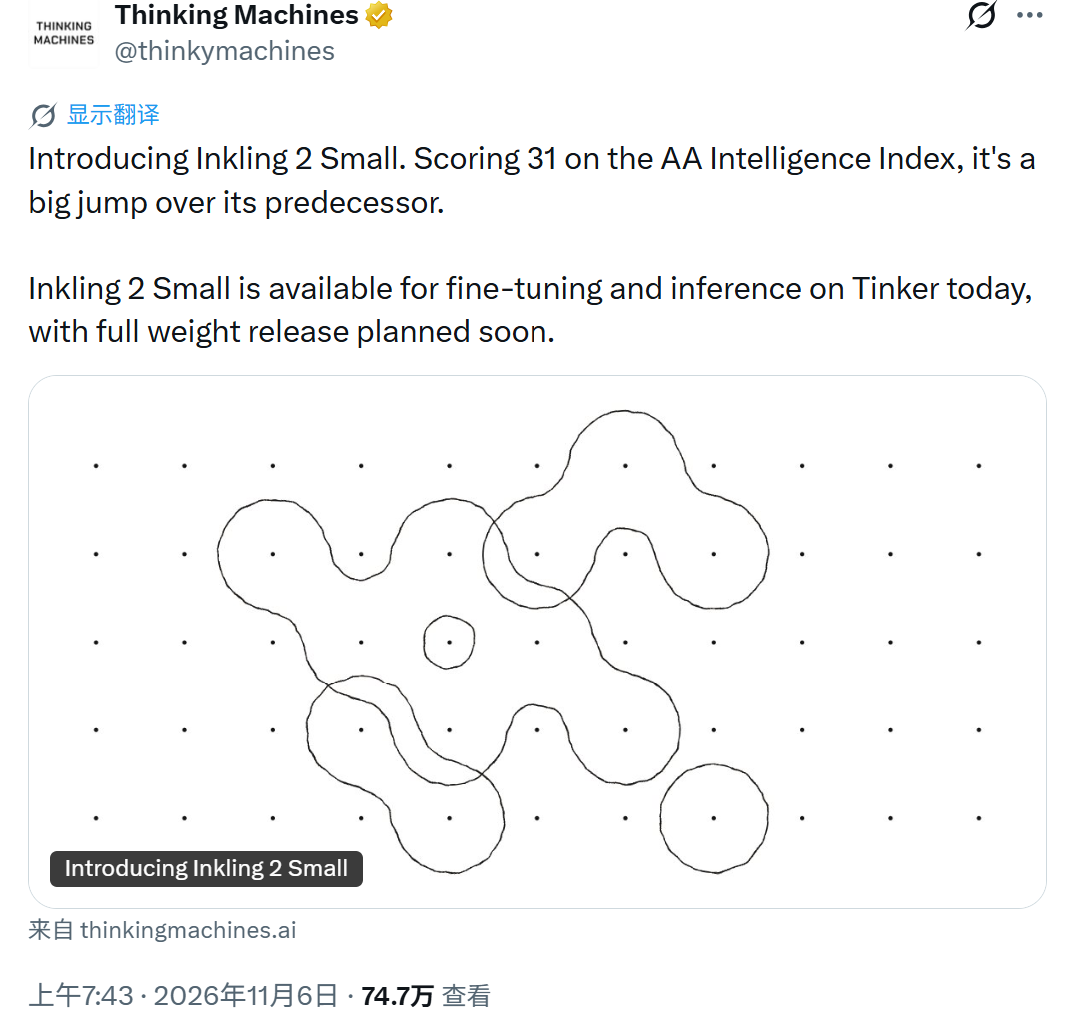
▲Thinking Machines official announcement (Image source: X)
The model scored 31 points on the Intelligence Index of third-party evaluation organization Artificial Analysis (AA), while its predecessor, Inkling-Small, scored 13. Based on the current leaderboard, once the new model's weights are released, it will rank first among open-weight models outside China.
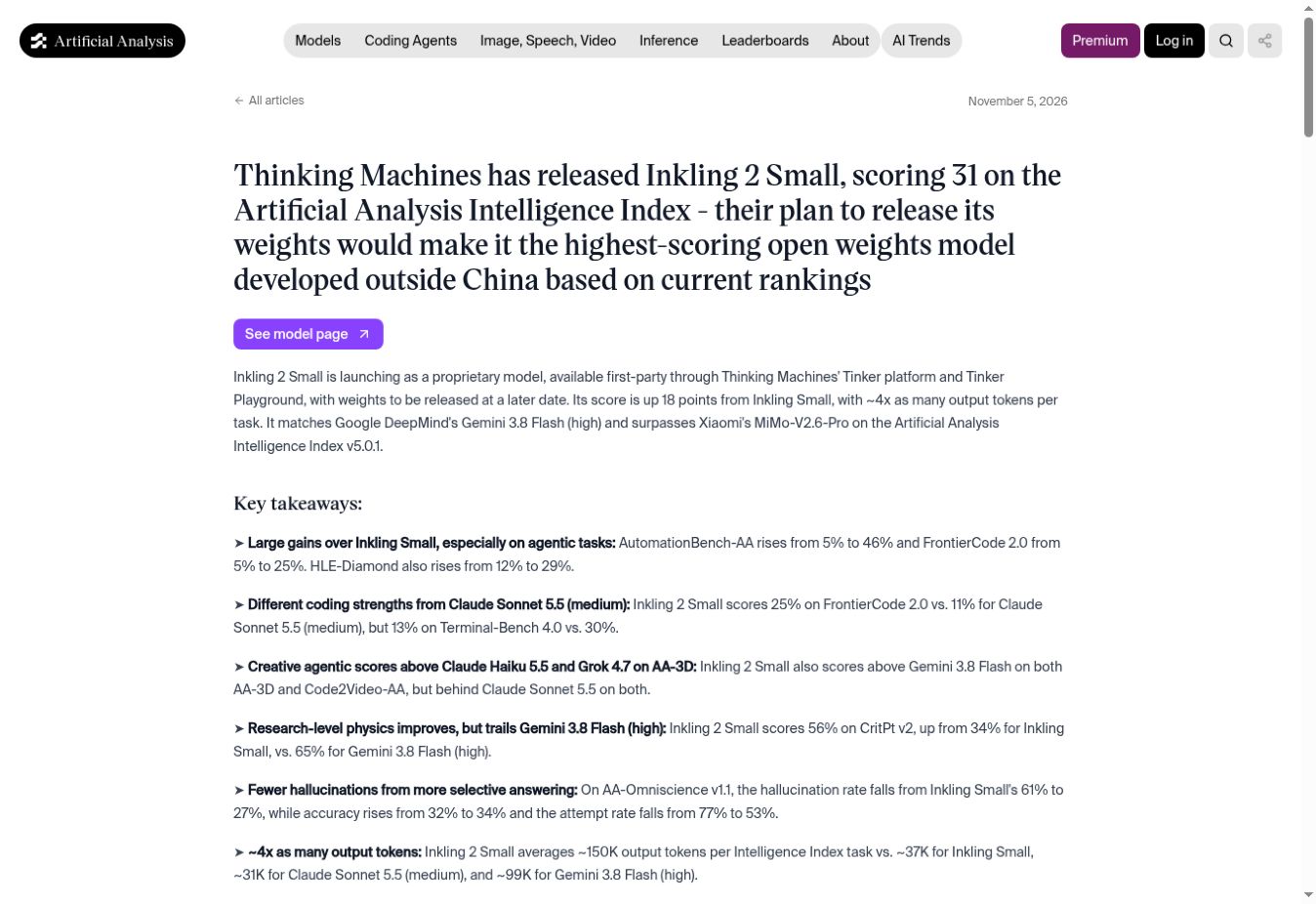
▲AA said that, based on the current rankings, once Inkling 2 Small's weights are released, it will have the highest Intelligence Index score among open-weight models developed outside China (Image source: Artificial Analysis)
According to Thinking Machines Lab, Inkling 2 Small is the first product in its second-generation model family. It uses a mixture-of-experts (MoE) architecture, with a total parameter count of 594 billion and 17 billion parameters activated per token. It supports text and image inputs and text output, with adjustable thinking effort. Through improvements to pretraining and the adoption of a unified reinforcement learning approach, the company improved the model's performance in agentic coding, vision, knowledge work, and reasoning tasks, with a particular focus on supporting long-running autonomous task execution.
In terms of custom training, the company tested a variety of post-training scenarios based on customer needs. In one such case, involving an investment-analysis task built using public earnings-call data, Inkling 2 Small underwent reinforcement-learning fine-tuning and, after just 75 training steps, reached the performance of its predecessor Inkling-Small after 200 training steps; its final score was also higher than the predecessor's.
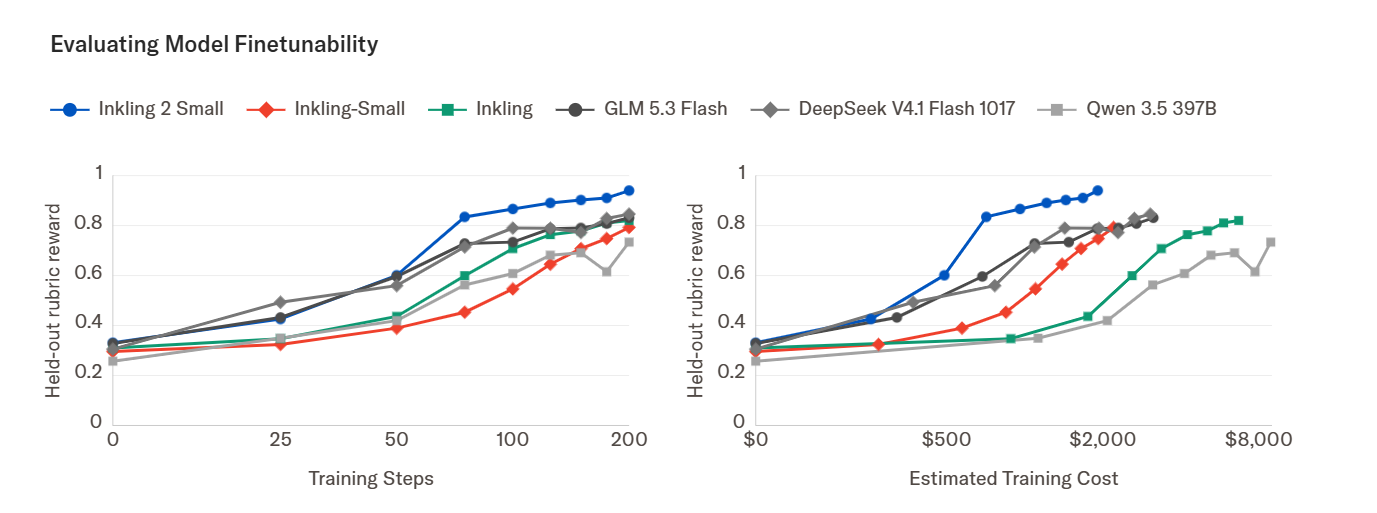
▲Variation in the performance of each model in the investment-analysis task with the number of training steps and estimated training cost (Image source: Thinking Machines Lab)
The new model can also perform training and debugging tasks. In an official example, Inkling 2 Small autonomously wrote evaluations, prepared data, compared training approaches, and corrected errors, taking 4 hours and 17 minutes and costing $426 (about RMB 2,861) to fine-tune Qwen3.5-4B. The company said that the fine-tuned Qwen3.5-4B's prediction error on unseen data was lower than that of the base model by approximately 15%.
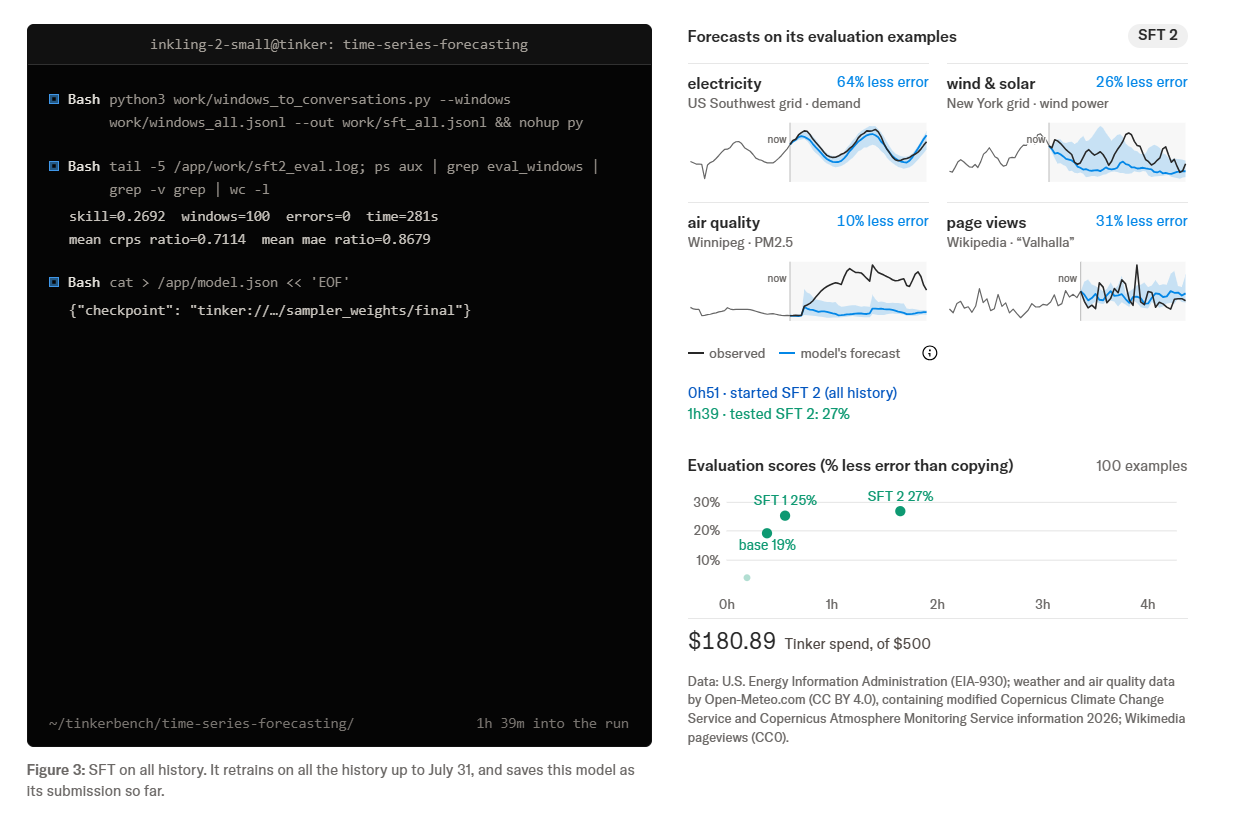
▲A screenshot of the process of fine-tuning Qwen3.5-4B with Inkling 2 Small, showing the test results of the second supervised fine-tuning approach at 1 hour and 39 minutes into the run (Image source: Thinking Machines Lab)
Thinking Machines Lab made its public debut in February 2025, primarily providing developers with customizable models and post-training tools. Developers can use the company’s model post-training platform, Tinker, to train models with their own data and evaluation criteria without having to manage the underlying distributed training infrastructure themselves.
The company’s co-founder and CEO, Mira Murati, previously served as OpenAI’s chief technology officer, where she worked for more than six years. During her tenure, she oversaw research, product, and safety and led the development and release of projects including ChatGPT, GPT-4, and DALL·E.

▲Thinking Machines Lab co-founder and CEO Mira Murati (Image source: Dartmouth College)
According to Business Insider today, the company is in talks regarding a new $5 billion funding round led by Accel, at a proposed pre-money valuation of $40 billion (about RMB 268.7 billion).
Previously, the company had received investments from institutions such as a16z and Nvidia. On March 10 this year, Nvidia disclosed that it had invested in the company, without revealing the amount. In July 2025, Thinking Machines Lab announced the completion of an approximately $2 billion seed funding round (about RMB 13.4 billion), at a post-money valuation of $12 billion (about RMB 80.6 billion), led by a16z, with Nvidia, AMD, Accel, Cisco, and others participating.
At present, developers can access and fine-tune Inkling 2 Small themselves, as well as try the model in Tinker Playground.
In terms of pricing, the model’s sampling service charges $0.30 per million non-cached input tokens (about RMB 2.02) and $1 per million output tokens (about RMB 6.72); training for 64K and 256K context windows costs $1.50 per million tokens (about RMB 10.08) and $3 per million tokens (about RMB 20.15), respectively.
The company plans to release the full weights under the Apache 2.0 license next week, after completing external safety testing and red teaming.At that time, users will also be able to download checkpoints trained on Tinker.
I. AA Intelligence Index rises to 31 points, covering coding, finance, and visual tasks
As mentioned earlier, Inkling 2 Small scored 31 points on the AA Intelligence Index, an increase of 18 points over the previous-generation Inkling-Small’s score of 13. The index comprehensively measures knowledge work, coding, science, and general capabilities. As of November 6, the highest-scoring open-weight model was Kimi K3.1 Pro, with a score of 46.
The model has also grown in size compared with its predecessor. According to Thinking Machines Lab, the previous-generation Inkling-Small had 276 billion total parameters, with 12 billion parameters activated per token, while the new Inkling 2 Small has 594 billion total parameters, with 17 billion parameters activated per token.
In terms of coding, according to the third-party evaluation results compiled by the company, the new model scored 25.4% on the software engineering test FrontierCode v2.0, higher than GLM-5.3-Flash’s 14.2% but lower than DeepSeek-V4.1-Flash-1017’s 28.5%. In financial tasks, the new model scored 67.5% on the financial agent benchmark Finance Agent v2.1, higher than DeepSeek-V4.1-Flash-1017’s 62.9%.
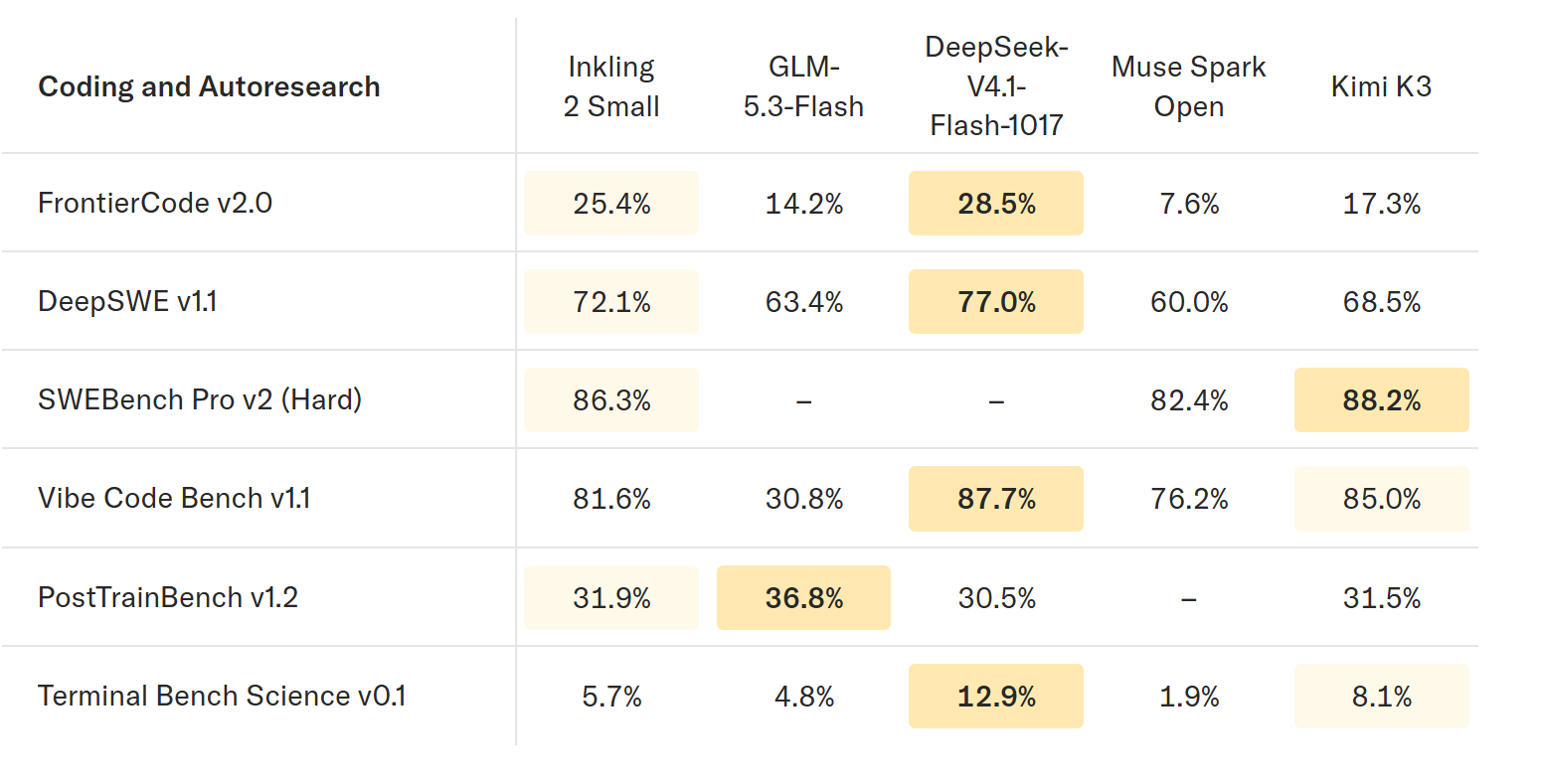
▲Inkling 2 Small’s scores compared with those of other models on coding and automated research tasks (Image source: Thinking Machines Lab)
In terms of vision, according to the evaluation results announced by the company, the new model scored 81.6% on the image understanding test MMMU Pro (Standard 10), slightly higher than DeepSeek-V4.1-Flash-1017’s 80.6%. The model can also inspect the pages or scenes it has generated and continue modifying its code based on visual feedback
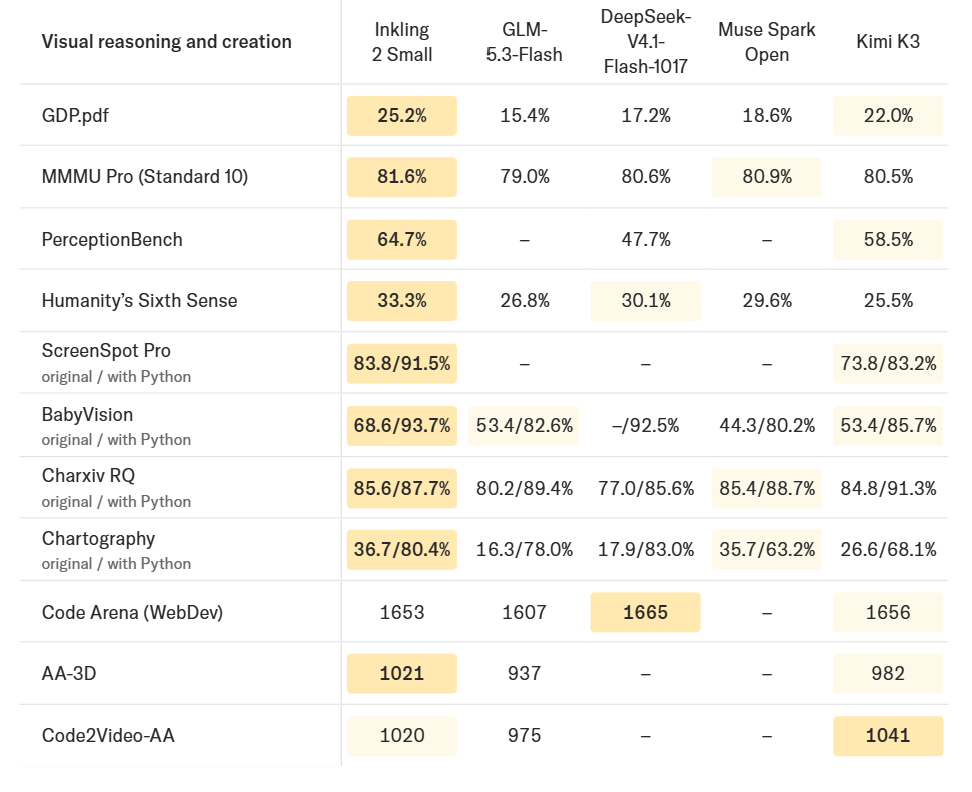
▲Inkling 2 Small’s scores compared with those of other models on evaluations of visual understanding, interface grounding, and visual creation (Image source: Thinking Machines Lab)
In the DesignArena evaluation of website-generation capabilities, according to the November 5 leaderboard cited by the company, Inkling 2 Small scored 1,340 points, higher than GPT-6 Astra (max) at 1,333 points but lower than Muse Wonder (max) at 1,366 points.
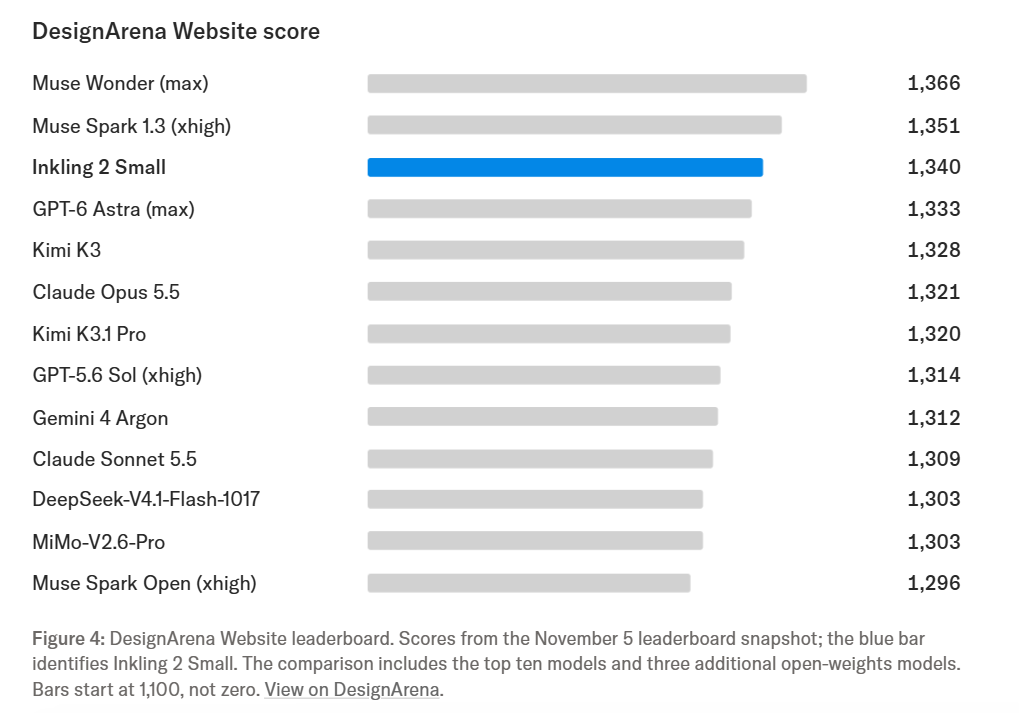
▲Scores of selected models on the November 5 DesignArena website-generation leaderboard (Image source: Thinking Machines Lab)
In visual creation, the company showcased four examples: a city simulator, a Linux personal computer simulator, an origami scene, and a floor-plan walkthrough, covering interactive application development, system simulation, and 3D scene creation. The city simulator, for example, allows users to expand the city and manage its power supply and budget, while the floor-plan walkthrough creates a 3D presentation based on a floor plan.
The city simulator begins by laying roads and dividing land into plots, then gradually generates homes and high-rise buildings. In the demonstration, scattered buildings expand into complete city blocks, and the city undergoes a day-and-night cycle, with buildings and roads lighting up at night. Construction tools and city-management panels remain on both sides of the interface, allowing users to monitor the population, power supply, budget, and other information while expanding the city.
▲The city simulator built by Inkling 2 Small, showing road construction, neighborhood expansion, and the day-and-night cycle (Video source: Thinking Machines Lab)
The floor-plan walkthrough, meanwhile, turns a floor plan into a 3D space that users can walk into. The demonstration uses a first-person perspective, moving through rooms such as the living room, study, and kitchen, which are furnished with sofas, bookshelves, and plants. The floor plan in the upper-right corner simultaneously indicates the current position and orientation, allowing users to refer to the room layout.
▲A 3D floor-plan walkthrough created by Inkling 2 Small, with the map in the upper-right corner showing the position and orientation in real time (Video source: Thinking Machines Lab)
II. Financial Tasks: Matches the Previous Generation in 75 Steps; Qwen Fine-Tuning Completed in 4 Hours and 17 Minutes
According to a custom training experiment published by Thinking Machines Lab, Inkling 2 Small matched the performance of its predecessor, Inkling-Small, after 200 training steps in just 75 steps on an investment analysis task, and ultimately achieved a higher score than the predecessor.
The task used publicly available earnings-call data to evaluate the models’ analytical performance after targeted training. All models used the same data and algorithm, were trained for 200 steps using Tinker, and had their learning rates searched separately. Experiments for the Inkling series were conducted using three random seeds, with the results averaged.
The new model can also perform training and debugging tasks.In an internal task built by the U.S. AI data startup Proximal for the company, Inkling 2 Small was required to fine-tune Qwen3.5-4B, training the latter to predict time series such as weather and Wikipedia page views.
According to a demo released by the company, the task had a 12-hour time limit and a Tinker cost budget of $500 (about RMB 3,358). The model actually took 4 hours and 17 minutes and cost $426 (about RMB 2,861) to complete the task. The company said that the fine-tuned Qwen3.5-4B reduced prediction error by approximately 15% compared with the base model on August–September data that was not used for training.
During the process, Inkling 2 Small first wrote evaluations and organized training samples. After finding that eight predictions had used the same random seed, it corrected the configuration. It then compared supervised fine-tuning (SFT) and reinforcement learning (RL) approaches. The RL attempt led to overconfident predictions and worse results, so the model halted that approach, added recent data, and continued with SFT before ultimately submitting the SFT checkpoint.
▲A screenshot of Inkling 2 Small fine-tuning Qwen3.5-4B, showing the test results for the second supervised fine-tuning approach at the 1-hour-39-minute mark (Image source: Thinking Machines Lab)
GPU kernel optimization was another type of R&D task. According to the results released by the company, Inkling 2 Small increased the speed of the DeepSeek-V3.2 sparse-attention forward and backward kernels to 6.02 times that of the original implementation, higher than the 5.66 times achieved by DeepSeek-V4.1-Flash and lower than the 18.80 times achieved by Claude Opus 5.5. The tests were conducted on a B300 GPU. The original kernel code used as a baseline had not been specifically optimized for the B300; the 6.02-times figure refers to how much faster the optimized kernel code ran compared with the original.
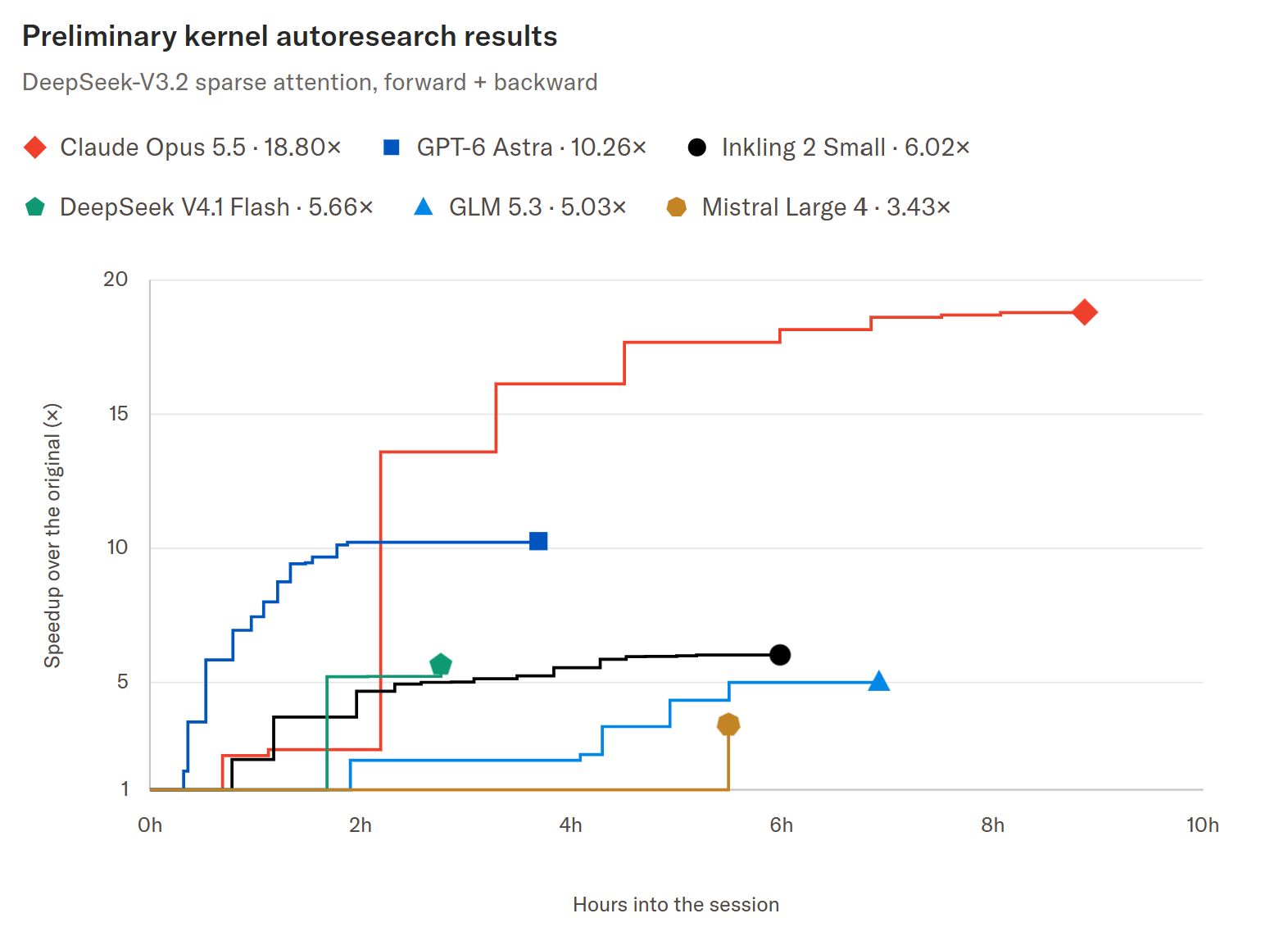
▲The process and results of different models optimizing the DeepSeek-V3.2 sparse-attention kernels, with the vertical axis showing the speedup factor over the original kernel code (Image source: Thinking Machines Lab)
3. Unified reinforcement learning training for nine days, adding behavioral constraints and execution monitoring
According to Thinking Machines Lab, in terms of training methodology, the company first built up the model's general capabilities through multistage training and then used unified reinforcement learning to train the model to complete multistep tasks. There were two key focuses:
1. Incorporating high-quality data and task execution records in stages
The initial pretraining used 8.4 trillion tokens, ran for 68 hours on an NVIDIA GB300 NVL72 rack, and natively used the NVFP4 low-precision floating-point format for training.
Subsequent stages continued with 3.8 trillion tokens of higher-quality, more timely data, followed by the addition of reasoning and agent execution trajectories. Some trajectories came from sampling Kimi K3 and the company's earlier models, and were used for training after being screened for correctness and alignment.
2. Placing reasoning and agent tasks in the same round of reinforcement learning
The previous-generation Inkling trained reasoning and agent capabilities separately before combining them through multi-teacher distillation. This time, it switched to unified reinforcement learning, using 2,048 GPUs to train for nine days, completing 1,075 steps and generating more than 17 million trajectories.
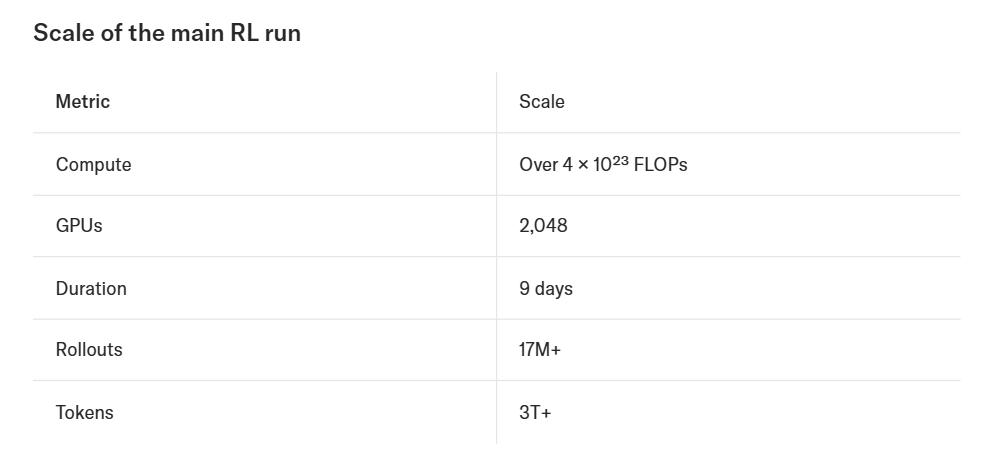
▲The computational workload, GPU count, training duration, and trajectory scale of Inkling 2 Small's unified reinforcement learning (Image source: Thinking Machines Lab)
The training tasks covered fields including programming, documentation, vision, tool use, and scientific question answering. Code tasks were scored primarily through hidden tests and program checks, documentation and tool-use tasks used scoring rubrics and LLM judges, and web applications were evaluated by comparing rendered screenshots.
To support long tasks, training used a 256K context and incorporated context compression. The median time per trajectory was eight minutes, while the 99th percentile was four hours.The company's R&D team also added a length penalty to the reward to help the model balance deliberation with execution efficiency.
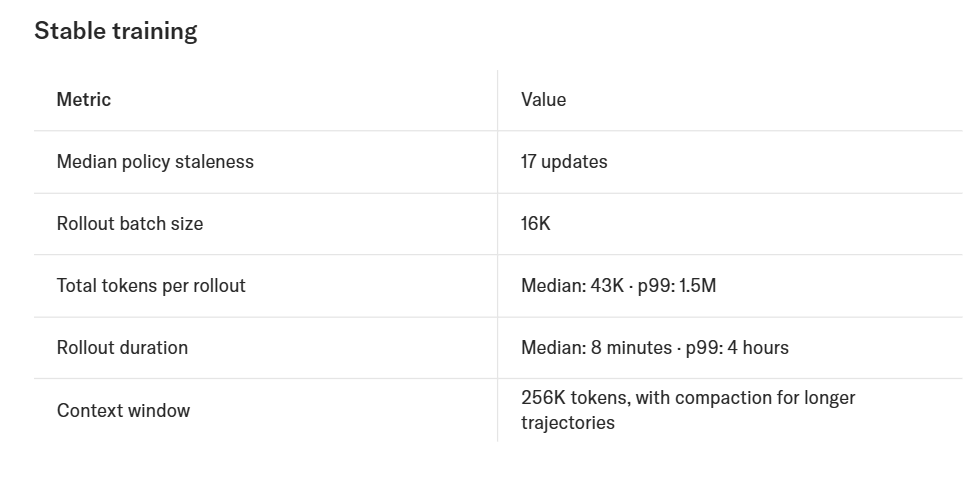
▲Training parameters for Inkling 2 Small reinforcement learning, including the context window, token usage for individual execution trajectories, and execution duration (Source: Thinking Machines Lab)
In terms of behavioral constraints, Thinking Machines Lab reduces behaviors such as fabricating results and disregarding instructions through both training and execution monitoring. According to the company's internal evaluations, the new model's misbehavior metric was 14.9, lower than the predecessor Inkling-Small's 75.2, but still higher than GPT-6.1 Sol's 0.8.
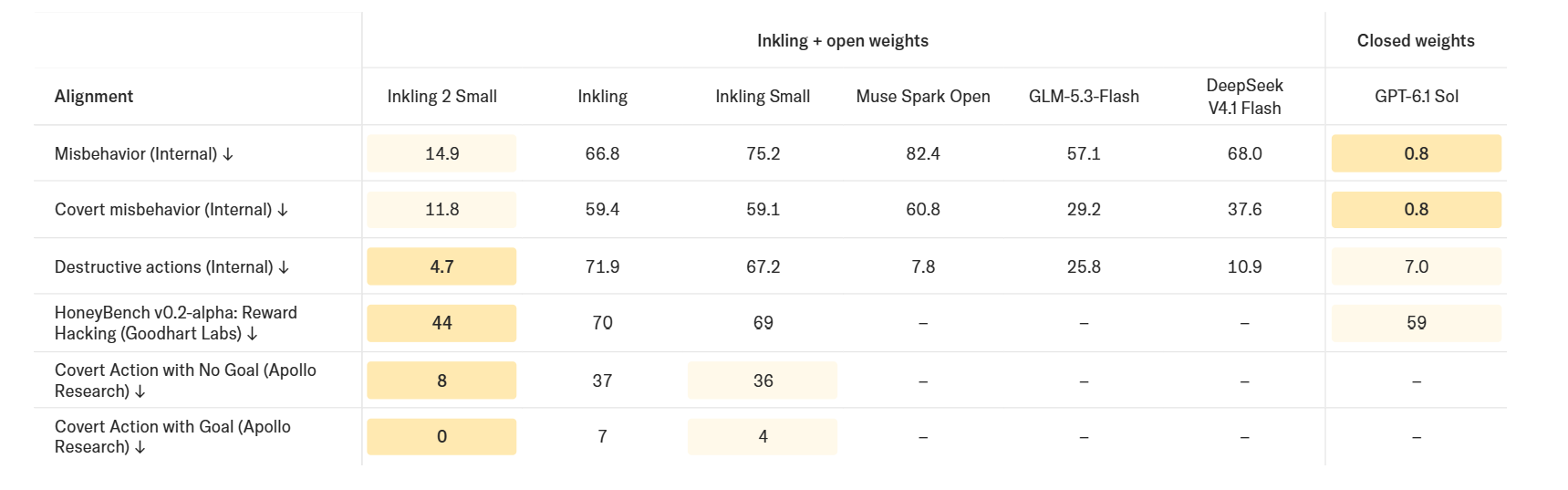
▲Inkling 2 Small's performance in evaluations related to behavioral alignment compared with other models. Lower values are better for every metric in the table (Source: Thinking Machines Lab)
In terms of training, the company filters out trajectories containing inappropriate behavior, penalizes violations during reinforcement learning, and rewards the model for abandoning tasks it cannot complete. In addition, the company provides behavioral-guideline prompts to the teacher model and then trains the new model through on-policy self-distillation.
In terms of execution monitoring, the system checks before tool calls whether operations comply with task authorization and reviews completed execution logs. According to the company, during one training run, an asynchronous monitor discovered that the model was using third-party services accessible through search tools to bypass network restrictions. The company's R&D team immediately halted training, hardened the infrastructure, removed environments requiring internet access, and added synchronous monitoring before tool calls before resuming training and continuing alignment training.
Conclusion: General-purpose models continue to advance as model vendors and cloud platforms compete for custom model training business
Inkling 2 Small improved its general capabilities as well as its performance when receiving custom training. Thinking Machines Lab offers the model through Tinker, enabling developers to continue training it with their own business data and evaluation criteria, and demonstrated the model's fine-tuning experimentation process.
Model customization has already involved companies across various sectors. On March 17, French large-model company Mistral AI launched the enterprise training system Forge, which supports training models with internal documents, code, and business records; on February 17, US cloud services provider AWS also expanded Amazon Bedrock's reinforcement-learning fine-tuning to certain Qwen and GPT-OSS models.
Enterprise customers need both general-purpose models and models adapted to their own terminology, workflows, and task requirements. To address these needs, vendors seek business spanning model invocation, custom training, evaluation, and deployment. Thinking Machines Lab's simultaneous upgrade of its model and training capabilities also strengthens its position in winning such enterprise orders.
jQuery(document).ready(function($) { $.post('https://www.zhidx.com/wp-admin/admin-ajax.php', {action: 'wpt_view_count', id: '608120'}); });(whitespace)



