On November 20–21, the 2026 Singularity Intelligence Technology Conference will be held at the Beijing Wanda Renaissance Hotel.
Agentic Scaling, RSI, AI4AI, Self-Evolving, Harness, Physical AI… Over the past year, new models, frameworks, and methodologies have arrived in waves. Many concepts that were unfamiliar just a few months ago have quickly become frequent topics of discussion across the industry.
AI is moving from “more powerful models” toward “more autonomous systems” and beginning to move from the digital world into the real physical world.
Against this backdrop, the 2026 Singularity Intelligence Technology Conference will be held at the Beijing Wanda Renaissance Hotel on November 20–21. The conference invites technology experts, researchers, and engineering practitioners from leading companies and research institutions, including OpenAI, Tencent, Alibaba, Xiaomi, Ant Group, Moonshot AI, Kunlun Tech, Baidu, JD.com, and Didi, to share their latest research insights, real-world engineering practices, and experience deploying AI in industry, with a focus on the evolution of AI capabilities, Agent implementation, AI-native software development, world models, Physical AI, AI infrastructure, and enterprise applications.
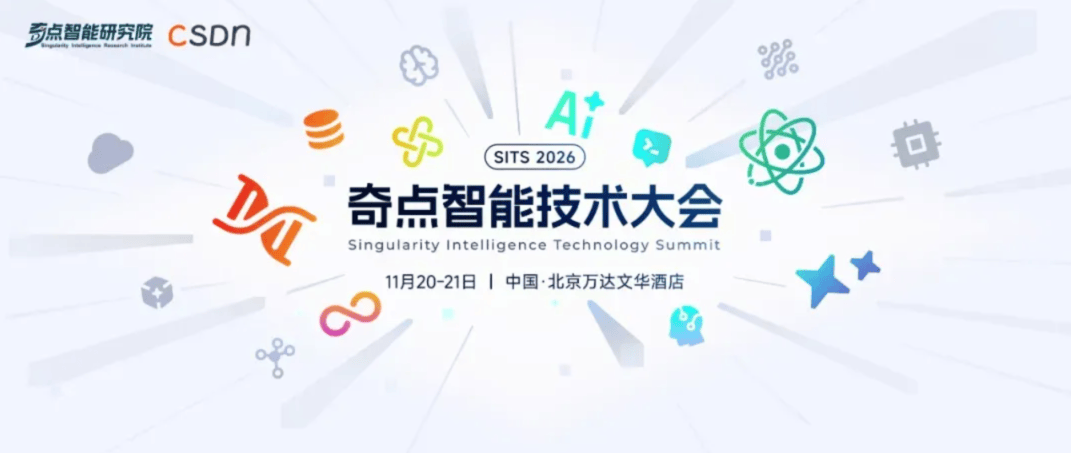
2026 Singularity Intelligence Technology Conference
The C++ and System Software Technology Conference will also be held concurrently at the same venue, covering everything from high-performance computing and modern C++ to system-level software, adding the indispensable low-level technology perspective of the AI era. The conference will bring together 70+ technology speakers, 18 major cutting-edge topics, 70+ presentations, and 1,000+ industry technology professionals.
The full schedule has been announced. Secure your seat now.
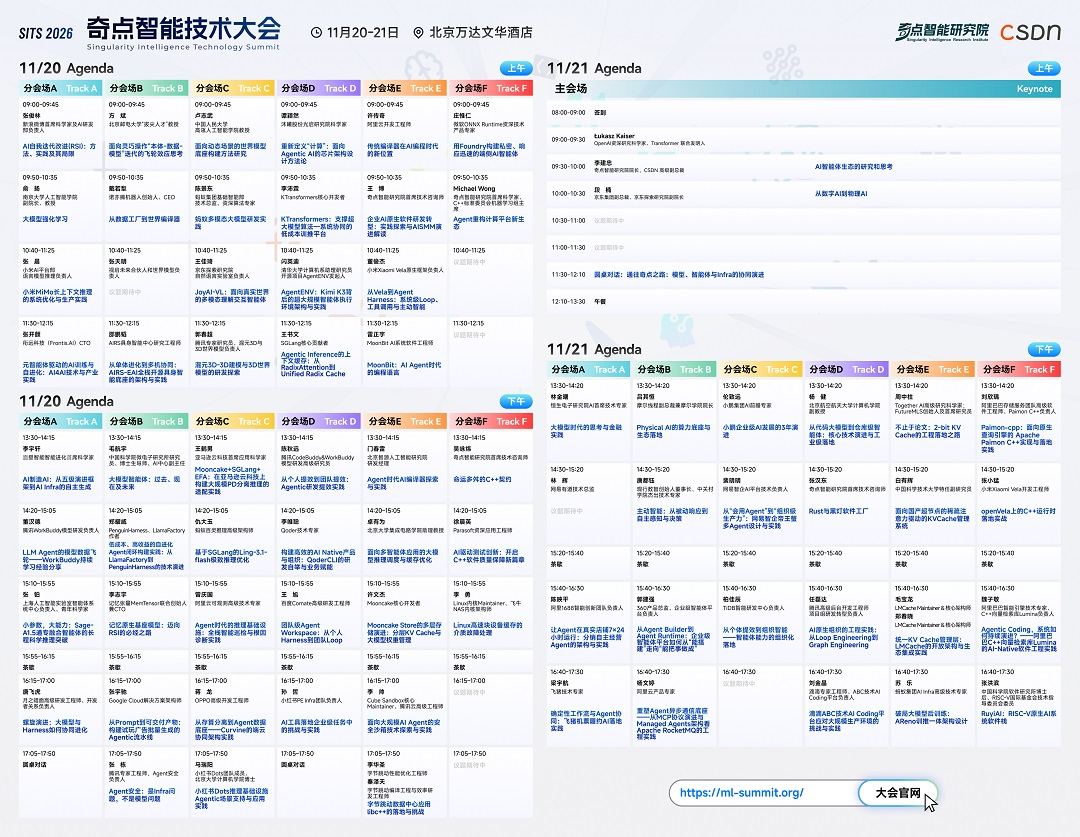
Full Schedule for the 2026 Singularity Intelligence Technology Conference
Six Major Technology Tracks, from RSI and Self-Evolution to Physical AI
Six parallel sessions will open simultaneously on the first morning of the conference.
The large-model track focuses on RSI, self-iterative improvement, reinforcement learning, long-context reasoning, and AI4AI. Zhang Junlin, Chief Scientist and Head of AI R&D at Sina Weibo; Yu Yang, Vice Dean and Professor of the School of Artificial Intelligence at Nanjing University; Zhang Chen, Head of Language Model Reasoning at Xiaomi’s AI Platform Department; Zhang Kaiyan, CTO of Frontis.AI; and others will share their respective perspectives on model capabilities, self-evolution, and systems practice.
The embodied intelligence and world models track brings together Fang Bin, a professor designated as “Top Talent” at Beijing University of Posts and Telecommunications; Dai Ruoli, Founder & CEO of Noitom Robotics; Liu Hao, Co-founder of Shiqi Future and Head of World Models and Embodied Intelligence; Shao Pengtao, Research Engineer at the AIRS Embodied Intelligence Center; Professor Lu Zhiwu of the Gaoling School of Artificial Intelligence at Renmin University of China; Chen Jingdong, Technical Director of Ant Group’s Foundation Intelligence Department and Senior Algorithm Expert; Wang Jiaqi, Head of the Natural Language Laboratory at the JD Explore Institute; Guo Chunchao, Expert Researcher at Tencent and Head of Hunyuan 3D and 3D World Models; and others. They will discuss the ontology–data–model flywheel, world compilers, 3D world models, and multi-machine collaboration.
Meanwhile, the AI Infra and systems software track will cover key topics including KTransformers, AgentENV, SGLang, Agent Harness, MoonBit, C++ standards, and on-device AI.
The afternoon will feature an even denser technical program. Li Yuxuan, Technical Partner and Chief Scientist for Intelligent Evolution at ModelBest; Dong Hande, Head of Model R&D for Tencent WorkBuddy; Zheng Yaowei, creator of PenguinHarness and LlamaFactory; and Tang Feihu, Senior R&D Engineer at Moonshot AI will continue their discussions on AI building AI, the model-data flywheel, and self-evolving Harnesses.
Teams from Shanghai AI Lab, Google Cloud, Tencent, and others will focus on long-horizon Agents, Agentic pipelines, and Agent security. On the AI Infra side, the conference will delve into real-world system practices such as AWS Mooncake + SGLang, Ant Group’s Bailian inference optimization, Alibaba Cloud AgenticOps, and Tencent Cloud.
The AI-native software development subforum will feature frontline teams from Tencent CodeBuddy & WorkBuddy, Qoder, Baidu Comate, Xiaohongshu, and others. From individual Harnesses and team Loops to enterprise-level task execution, they will continue pushing AI Coding into real production environments.
From frontier insights to production deployment, AI technology continues to go deeper
The main conference will begin on the morning of the second day. Łukasz Kaiser, Senior Research Scientist at OpenAI and co-inventor of the Transformer, will share his observations and reflections on the next stage of AI technology development from the perspective of frontier model research.
Li Jianzhong, Dean of the Singularity Intelligence Research Institute and Senior Vice President of CSDN, will discuss “Research and Reflections on the AI Agent Ecosystem,” exploring how the technology ecosystem, software development, and industrial collaboration are changing as Agent capabilities continue to expand.
Duan Nan, Vice President of JD.com and Deputy Dean of the JD Explore Academy, will deliver “From Digital AI to Physical AI,” discussing from the perspective of foundation models how intelligence can truly move from the digital world into real physical environments.
Cheng Yu, Chief Scientist at Kunlun Tech and Associate Professor with a Chair at Nanyang Technological University, will present the latest practices with the Mureka v10 music model, Matrix-Game 4.0 world model, and Riemann-1.0 robot model, demonstrating the further expansion of generative AI from content generation and world modeling to robotic intelligence.
In the afternoon, the conference will return to the deep dives of its multiple subforums, focusing on production, scale, and organizational implementation.
The Enterprise AI and Industry Practice track will focus on finance, e-commerce, mobility, and organizational productivity. Teams from Hundsun Technologies, Alibaba 1688, Fliggy, XPeng, NetEase Intelligence, TiDB, and others will share how Agents can progress from being usable to delivering value in real businesses and at the organizational level.
The Agent, AI-native software development, and AI Infra tracks will continue to explore key issues including Tencent Agent security, Alibaba Cloud MCP and Managed Agents, Rust and lights-out software factories, the evolution from Loop Engineering to Graph Engineering, Mooncake, KV Cache, and integrated model training and inference.
See you in Beijing this November!
Over two days, the 2026 Singularity Intelligence Technology Conference and the C++ and Systems Software Technology Conference aim to go beyond presenting a list of trending keywords. They hope to showcase the changes taking place as these technologies truly enter software development, systems, and organizations.
The conference is just around the corner. If you are interested in foundation models, Agents, AI Coding, embodied intelligence, AI Infra, or systems software, join us in Beijing to engage face-to-face with leading technical teams, researchers, and peers, and hear about real projects, real production environments, and real engineering trade-offs—not merely trend forecasts.
The conference will concurrently open up cooperation opportunities including brand showcasing, technology partnerships, developer outreach, booths, and joint content. Enterprises and teams looking to connect with AI, developers, and technical decision-makers are welcome to participate.
The latest agenda has been released, with registration and cooperation applications open simultaneously. See you in Beijing in November.
Official website: https://ml-summit.org/
Ticket hotline: 400-821-5876
Ticket inquiries: service@boolan.com
Enterprise cooperation: partner@boolan.com
Call for speakers: hemiao@csdn.net
Media contact: media@boolan.com
This article is provided by CSDN. QbitAI has been authorized to reprint it, and the views expressed belong to the original author.