Frontier Radar #5: If AGI is so close, why is everyone leaving? The neolabs and their bets
Maximilian Schreiner
View the LinkedIn Profile of Maximilian Schreiner
Nov 6, 2026
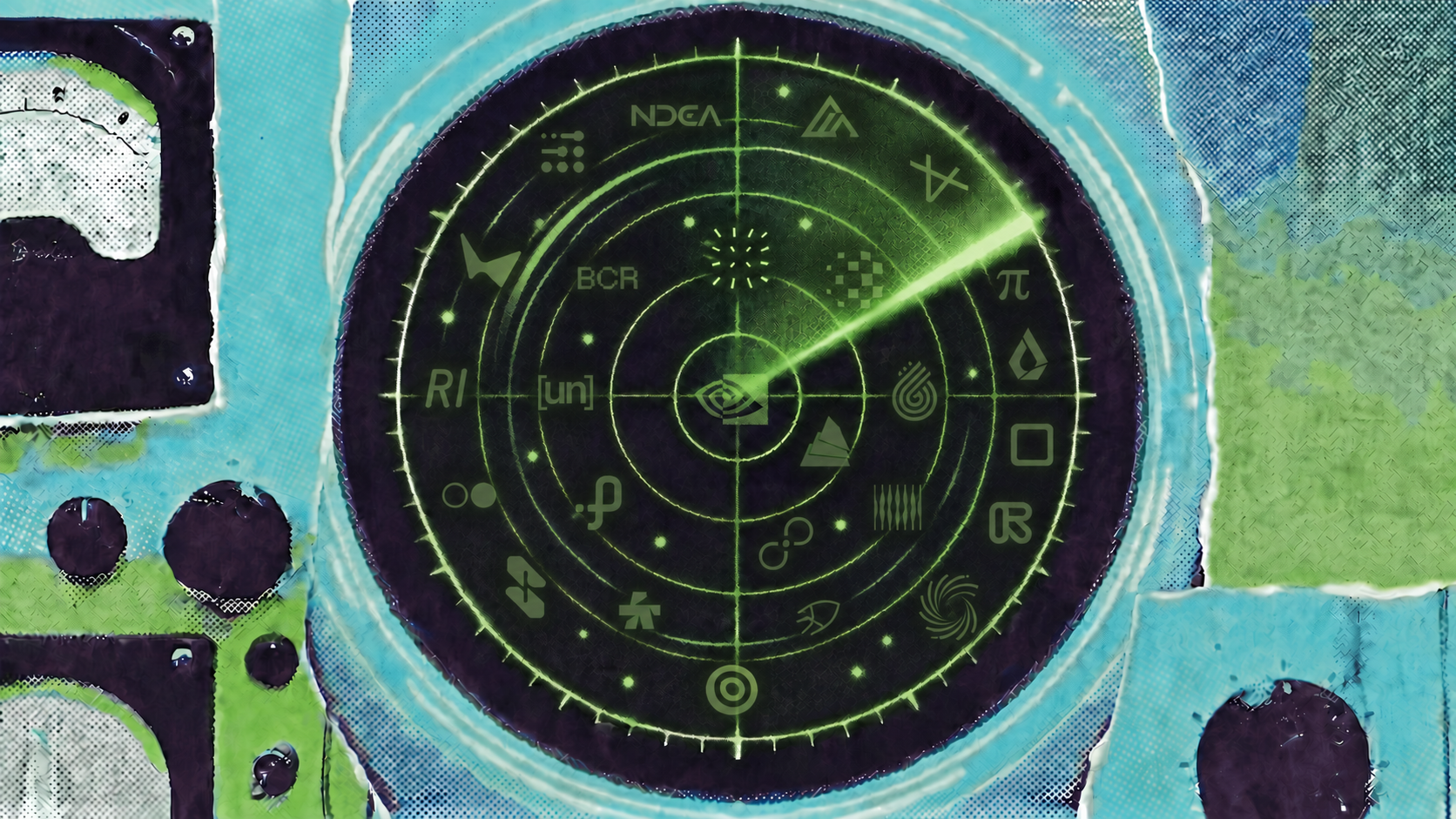
Nano Banana Pro prompted by THE DECODER
AI News Without the Hype – Curated by Humans
Subscribe to THE DECODER for ad-free reading, a weekly AI newsletter, our exclusive "AI Radar" frontier report six times a year, full archive access, and access to our comment section.
Subscribe now
{
"@context": "https://schema.org",
"@type": "NewsArticle",
"headline": "Frontier Radar #5: If AGI is so close, why is everyone leaving? The neolabs and their bets",
"datePublished": "2026-11-06T16:55:23+01:00",
"dateModified": "2026-11-06T16:55:23+01:00",
"author": {
"@type": "Person",
"name": "Maximilian Schreiner"
},
"publisher": {
"@type": "Organization",
"name": "The Decoder"
},
"description": "OpenAI is talking about the AGI era, and Nvidia CEO Jensen Huang says AGI has arrived. At the same time, co-creators of today's models are leaving OpenAI, Google DeepMind, and Meta to start their own labs, raising billions with no product to show. Why? They're betting that the current recipe alone won't be enough. We've sorted 45 neolabs by their research bets, mapped the limitations of today's AI they're trying to overcome, looked at what's already visible from their work, and explain why Nvidia always wins.",
"articleBody": "OpenAI is talking about the AGI era, and Nvidia CEO Jensen Huang says AGI has arrived. At the same time, co-creators of today's models are leaving OpenAI, Google DeepMind, and Meta to start their own labs, raising billions with no product to show. Why? They're betting that the current recipe alone won't be enough. We've sorted 45 neolabs by their research bets, mapped the limitations of today's AI they're trying to overcome, looked at what's already visible from their work, and explain why Nvidia always wins.\r\n\r\nSix times a year, THE DECODER's editorial team takes a deep dive into a foundational AI topic in its \"Frontier Radar\" series, published as a newsletter and exclusively on the site for THE DECODER subscribers. Issue #5 profiles 27 AI labs in detail, sorted by six research bets, plus nearly 20 more in brief and an overview covering origins, valuations, and what's publicly available. Issue #1 covered the current state of agentic AI. Issue #2 examined the measurable impact of AI on productivity. Issue #3 covered the emerging token economy of generative AI. Issue #4 asked what's left of the AI lead over China and where Europe stands.\r\n\r\nDear readers,\r\n\r\nAfter the launch of GPT-6 Astra, Nvidia CEO Jensen Huang declared on X: \"AGI has arrived.\" OpenAI president Greg Brockman called the model a turning point and welcomed humanity to the \"AGI era\". What exactly the two men mean isn't clear, since there's no agreed-upon definition of AGI. The message comes through anyway: an extremely powerful AI, possibly a self-improving one, is imminent and the path is mapped out.\r\n\r\nMany of the people who built today's systems apparently see things differently. Dozens have left the big labs to start their own. Ilya Sutskever co-founded OpenAI and served as its chief scientist; now he's building Safe Superintelligence. Jerry Tworek led the development of OpenAI's reasoning models and now runs Core Automation. David Silver, the mind behind AlphaGo, left Google DeepMind for Ineffable Intelligence. Yann LeCun left Meta after twelve years and founded AMI. Jeff Dean spent 27 years at Google, most recently as chief scientist, and started Discovery Loop.\r\n\r\nThe money follows: Nvidia invested in SSI in July, reportedly five billion dollars according to Bloomberg. The lab hasn't released a single model or paper. Prometheus, Jeff Bezos' industrial AI lab, pulled in twelve billion dollars at a 41 billion valuation in June. Flapping Airplanes has no public model either and raised one billion dollars in an October Series A.\r\n\r\nThe motives are mixed, and not all technical. At these valuations, founders become paper billionaires fast. LeCun left after a strategy dispute with Meta. Sutskever wants to do research without product pressure. Others want to carve out a niche that would be a sideshow at a big lab. Some departures aren't even a clean break: Google itself is a founding investor in Discovery Loop.\r\n\r\nWhat many founders share is a doubt. Not about whether much more powerful AI is coming; some think AGI is close. Their doubt is about whether today's recipe alone gets there: ever-larger language models, trained on internet data, refined with reinforcement learning.\r\nWhat is a neolab?\r\nThere's no official definition. We use the term for independently founded, research-driven AI companies that build their business around a long-term technical bet. They want to change how AI learns, perceives the world, solves problems, is controlled, or computes.\r\n\r\nThe current wave became visible in 2024. The race for the strongest models was in full swing, and the cloud giants had their partners: Microsoft backed OpenAI, Amazon backed Anthropic. Then Sutskever founded SSI in June and raised a billion dollars within months for a research team with no product.\r\n\r\nThere's a reason investors fund that. OpenAI and Anthropic have grown into corporations on the back of their success, and both are pursuing IPOs at record valuations. Internally, research teams compete with product teams for money and attention. Established companies struggle with ideas that threaten their business, management scholars call this the innovator's dilemma. That's what investors are betting on: a small team finds what the giants miss.\r\n\r\nThere are precedents. The Transformer was invented at Google in 2017. DeepMind beat the world's best Go players with AlphaGo. Yet the AI assistant for the masses came from OpenAI, founded as a nonprofit in 2015. The second breakout came from an OpenAI spinoff: Dario and Daniela Amodei founded Anthropic in 2021. By the end of July 2026, Bloomberg pegged its annualized revenue at over 65 billion dollars.\r\n\r\nThe real bet neolabs are making is on research gaps the big players don't fill, either because nobody knows the path or because nobody allocates resources for it. The big labs have more compute, established data pipelines, and feedback from hundreds of millions of users. What a small lab builds can show up at the market leader shortly after the first product ships.\r\n\r\nTypeSafe AI shows how short a lead can be. In mid-September it launched Jev, a decision model. Two weeks later, OpenAI announced its Decisions API. But even a brief lead shows expertise and can pay off as an exit. Microsoft hired the core team from Inflection. Google grabbed the founders of Character.ai and the leadership of Windsurf. AMD wants to acquire World Labs for about 8.2 billion dollars. Nvidia is in talks with Reflection, according to the Financial Times.\r\n\r\nFor neolabs, it all comes down to one question: can they deliver something the big players don't have, something customers or the big players themselves will pay for? We selected 27 labs, most from the US and Europe, and sorted them into six groups by their primary bet.\r\nBet 1: A good problem solver isn't necessarily a good learner\r\nToday's models can do remarkable things, but they learn differently from humans. They need massive amounts of data to pick up a skill, and once deployed, they typically don't update their weights. They can use new information within a conversation but don't permanently learn from every experience. Continual learning remains a central research gap. Six labs want to change that and attack the problem from three angles: learning during deployment (Adaption, Core Automation), learning from few examples (Flapping Airplanes, Ndea, SSI), and learning from experience (Ineffable).\r\nAdaption bets against scaling\r\nSara Hooker led research at Cohere and previously worked at Google Brain. In 2020, she argued in \"The Hardware Lottery\" that research approaches often win not because they're better but because they fit the available hardware. In January she followed up with \"On the Slow Death of Scaling\", arguing that more compute leads to better models less and less reliably. Data and training methods are more effective levers. Open models with 8 or 27 billion parameters now beat the much larger Falcon 180B on benchmarks.\r\n\r\nWith Sudip Roy, she founded Adaption. According to them, they are betting against scaling and plan to build efficient AI that continuously learns instead. Rather than one big model for everyone, models should adapt to their users on the fly and cheaply. The first products tackle the most obvious lever, data: tools for cleaning, visualizing, and automated training via AutoScientist. The actual goal, a model that learns during deployment, is still missing.\r\nCore Automation's insider search for new learning methods\r\nJerry Tworek spent almost seven years at OpenAI, most recently as vice president of research, leading the development of the reasoning models o1 and o3. His critique of today's recipe comes from someone who helped build it. Co-founder Rohan Anil led Gemini's pre-training at Google.\r\n\r\nRetraining a trained network risks making it forget what it already knew. Researchers call this catastrophic forgetting. The Transformer wasn't built to learn on the fly during deployment either.\r\n\r\nChatGPT and Claude now take notes and retrieve earlier conversations as a workaround. Tworek doesn't think that's enough, as for him continual learning is a problem for machine learning, not for Markdown files, as he said. Core is looking for learning algorithms beyond pre-training and reinforcement learning, plus architectures that scale better. The first model is supposed to update its weights during deployment and get by with one hundredth of today's training data. So far, nothing more than rumors.\r\n\r\nCore's first test is on itself: a small team with research agents aims to match the output of a large lab, for instance by having agents automatically generate efficient GPU code from an architecture idea.\r\n\r\nThis kind of research was barely possible at OpenAI, Tworek said after leaving. When you're in a race for the best model, you take fewer risks.\r\nFlapping Airplanes wants to learn more from less data\r\nBrothers Ben and Asher Spector founded Flapping Airplanes with Aidan Smith, previously at Neuralink. Ben is the lead author of ThunderKittens, a widely used GPU kernel library.\r\n\r\nThe thesis: today's models are strong where data is plentiful, like text and images. In fields like robotics or biology, where data is scarce and expensive, they fall short. Flapping Airplanes wants to build models that learn from few examples instead of needing massive datasets. The founders are looking for learning methods inspired by biological principles but designed to run on GPUs.\r\n\r\nNothing visible has come out yet. Most of the first year went into foundations: software that makes GPU training more efficient by cutting the usual overhead between many small compute steps. New learning methods have to run on existing hardware before they can work.\r\n\r\nInvestors don't mind the missing model. After 180 million dollars in January, an October Series A brought one billion at a six billion valuation.\r\nIneffable Intelligence wants to learn without human examples\r\nDavid Silver isn't going after less data. He's going after different data. At Google DeepMind, he led the development of AlphaGo and its successors. The original AlphaGo still learned from human games. AlphaGo Zero and AlphaZero learned only from self-play and surpassed all predecessors.\r\n\r\nIn spring 2025, Silver and Richard Sutton turned that insight into a program. In \"Welcome to the Era of Experience\", they argue that systems that only imitate humans can barely get past human-level performance on many important tasks. The next systems need to learn from their own experience, with rewards from the environment rather than from human judgment. Silver later founded Ineffable Intelligence. His goal is a \"Superlearner\" that learns from experience in both digital and physical environments.\r\n\r\nThe hardest question is where the feedback comes from. In Go, wins and losses decide. In science or the physical world, success is often unclear or shows up late. Reinforcement learning has always been strongest where the environment gives a clear signal. Ineffable has to prove it works for open-ended, changing tasks too. In April, the company announced a 1.1 billion dollar seed round at a 5.1 billion post-money valuation, the largest in Europe. There's no usable system.\r\nNdea wants to find rules from few examples\r\nFran\u00e7ois Chollet developed Keras, a deep learning library, and designed the ARC benchmark, which measures how well systems figure out new tasks from just a few examples. After years at Google, Chollet is building Ndea with Zapier co-founder Mike Knoop. The team has about 15 people.\r\n\r\nChollet draws a line between ability and learning: a system can solve a task brilliantly because of extensive training and still be unable to pick up a new skill efficiently. Ndea uses program synthesis. The system searches for a program that explains the observed examples, with a neural model steering the search toward promising candidates. A few examples should yield rules that hold for new cases too.\r\n\r\nChollet's own benchmark is falling even without Ndea. On ARC-AGI-3, launched in March, GPT-6 Astra scored up to 99.9 percent in September, and 62.7 percent in the standard setup. The path there is telling: Astra translated unfamiliar game environments into compact rules and its own shorthand notation, roughly what Ndea is aiming for. Ndea hasn't posted its own ARC-AGI-3 result yet.\r\nSafe Superintelligence has credibility but nothing to show\r\nIlya Sutskever co-founded OpenAI and served as its chief scientist, co-authoring some of the most important papers in deep learning. He left in 2024 and founded SSI, where he's now CEO. The founding manifesto describes the goal: safe superintelligence, free from product distractions. About 50 employees in Palo Alto and Tel Aviv have published neither a model nor a paper.\r\n\r\nSutskever described his focus in late 2025 in a conversation with Dwarkesh Patel. Humans transfer what they've learned after a few examples, while models need massive datasets - and he plans to change that. He expects a system that learns as well as a human in five to twenty years.\r\n\r\nIn July, SSI and Nvidia announced a partnership to increase compute capacity tenfold. Bloomberg reported five billion dollars. SSI had research that deserved to be scaled up, Sutskever said in the joint announcement. Combined with the three billion raised earlier, that's roughly eight billion dollars. The last known valuation is 32 billion dollars. It rests mainly on Sutskever's reputation and the expectation that he sees a path others don't.\r\nOther labs with a similar goal\r\nPathway in Palo Alto has already published an architecture for what Core Automation is targeting. Its BDH model adapts during processing, forming a kind of working memory. So far, this has only been shown with small models of up to one billion parameters.\r\n\r\nSymbolica, founded in 2022, combines neural learning with program synthesis like Ndea but uses its own math-based architecture rather than language models. The founders themselves call the long-term goal, a general machine for program synthesis, unsolved. Symbolica earns money in the meantime with Agentica, a tool for building AI agents.\r\n\r\n\r\n\r\nLab\r\nOrigins & products\r\nFunding & valuation\r\n\r\n\r\n\r\n\r\nAdaption\r\nFounders \/ early team from:\r\nCohere, Google\r\nProducts \/ access:\r\nData tools, AutoScientist via API\r\nFunding:\r\n50M seed (02\/2026)\r\nValuation:\r\nn\/a\r\n\r\n\r\nCore Automation\r\nFounders \/ early team from:\r\nOpenAI, Google DeepMind, Anthropic\r\nProducts \/ access:\r\nNo public product confirmed\r\nFunding:\r\n432M, including 135M SAFE conversions (07\/2026)\r\nValuation:\r\n3.62B per Forge (07\/2026)\r\n\r\n\r\nFlapping Airplanes\r\nFounders \/ early team from:\r\nStanford, Neuralink\r\nProducts \/ access:\r\nNo public product confirmed\r\nFunding:\r\n1B Series A (10\/2026)\r\nValuation:\r\n6B (10\/2026)\r\n\r\n\r\nIneffable Intelligence\r\nFounders \/ early team from:\r\nGoogle DeepMind, UCL\r\nProducts \/ access:\r\nNo public product confirmed\r\nFunding:\r\n1.1B seed (04\/2026)\r\nValuation:\r\n5.1B (04\/2026)\r\n\r\n\r\nNdea\r\nFounders \/ early team from:\r\nGoogle, Zapier\r\nProducts \/ access:\r\nNo public product confirmed\r\nFunding:\r\n30M per The Information (2025)\r\nValuation:\r\n450M per The Information (2025)\r\n\r\n\r\nSafe Superintelligence\r\nFounders \/ early team from:\r\nOpenAI, Apple, Y Combinator\r\nProducts \/ access:\r\nNo public product confirmed\r\nFunding:\r\n5B Nvidia investment reported (07\/2026)\r\nValuation:\r\n32B (04\/2025), new valuation n\/a\r\n\r\n\r\nPathway\r\nFounders \/ early team from:\r\nGoogle Brain, MILA, Inria, \u00c9cole Polytechnique\r\nProducts \/ access:\r\nBDH research code, Live Data Framework\r\nFunding:\r\nSeed extended to 30M total (08\/2026)\r\nValuation:\r\n500M (08\/2026)\r\n\r\n\r\nSymbolica\r\nFounders \/ early team from:\r\nTesla\r\nProducts \/ access:\r\nAgentica, open SDKs\r\nFunding:\r\n~33M total (04\/2024)\r\nValuation:\r\nn\/a\r\n\r\n\r\n\r\nBet 2: Language alone isn't enough\r\nThe first group wants to change how models learn. The second wants to change what they learn from. These founders doubt that language is the best path to intelligence. They want systems that understand spatial relationships, predict physical consequences, and act in the world. AMI predicts abstract states, Black Forest Labs predicts video frames and robot movements, General Intuition learns from video games, World Labs generates 3D worlds, and Physical Intelligence learns control directly on the robot.\r\nAMI is Yann LeCun's counter-program\r\nYann LeCun received the Turing Award and built Meta's research lab FAIR. For years, he has argued against the idea that language models lead to human-like intelligence. He left Meta in late 2025 after strategic disagreements: the company wanted to focus on language models it could commercialize quickly. At AMI, LeCun is executive chairman. CEO is Alexandre LeBrun, founder of Nabla, a medical AI startup.\r\n\r\nTechnically, AMI builds on JEPA (Joint Embedding Predictive Architecture), which LeCun proposed in 2022 as an alternative to generative language and video models. Instead of predicting outputs token by token, JEPA works with abstract internal representations. It learns what matters when predicting what comes next in a video or a robot's movement, without getting lost in pixel-level details. V-JEPA 2 showed the approach can work at Meta in 2025. After pre-training on video, just 62 hours of robot data was enough for robotic arms to handle simple pick-and-place tasks in unfamiliar labs, planning much faster than pixel-level approaches.\r\n\r\nAMI is targeting industry, robotics, and healthcare, with Nabla as its first partner. In March, the lab raised 1.03 billion dollars at a 3.5 billion pre-money valuation with about a dozen employees. LeBrun says openly that a product could be years away. Research and most of the code are planned to be open.\r\nBlack Forest Labs goes from image generator to robot controller\r\nBlack Forest Labs from Freiburg is known for its FLUX image models, which already generate revenue. The founders, led by Robin Rombach, co-developed the method behind Stable Diffusion.\r\n\r\nSince this fall, the lab is making a bet that goes beyond image generation. An image model has learned how images change, which means it can also learn what change a given action causes.\r\n\r\nThe first step is FLUX 3 Action, released in September. It builds on FLUX 3, a base model trained mainly on video, and was fine-tuned on data where the action behind each video is known: gameplay footage, first-person videos, teleoperated robots. The model takes a camera image, the robot's state, and a text instruction and predicts the next two seconds: how the robot should move and what the scene looks like afterward. It's an image generator that learned to control robots. The weights are on Hugging Face.\r\n\r\nOn RoboLab-120, a robotics benchmark from Nvidia, FLUX 3 Action ranked second behind Lakeside on October 22 and has since dropped to fourth. The testing is done in simulation, not on a real robot.\r\nGeneral Intuition turns gameplay into training data\r\nGeneral Intuition grew out of Medal, a platform for game clips. Medal CEO Pim de Witte founded it in 2025 with three researchers from the University of Geneva who had worked on world models for games.\r\n\r\nThe idea: record players' inputs alongside game video. The result shows not just what changed but what action caused the change. Medal provides billions of video frames paired with keyboard and mouse inputs. From these, the lab trains two types of models: world models that predict what happens next and action models that decide what to do.\r\n\r\nThe approach isn't entirely new. OpenAI trained a Minecraft agent on gameplay video with VPT in 2022. DeepMind connects Gemini with a 3D game agent through SIMA 2.\r\n\r\nGeneral Intuition plans to make money as a platform with API access to its models, for game studios and robotics companies alike. As proof, it showed a model trained solely on games controlling a quadruped robot after just eight minutes of fine-tuning with real robotics data.\r\nPhysical Intelligence builds a general model for robots\r\nPhysical Intelligence learns directly on the robot. The lab was founded by some of the biggest names in learned robotics, including Sergey Levine from Berkeley and Chelsea Finn from Stanford. Levine, previously at Google, describes the goal as a general robot model: a single system that works across many robots and many tasks. Nobody should have to program a separate controller for each task.\r\n\r\nThe \u03c0 model family combines vision, language, and action. The lab collects most of its training data itself: humans teleoperate robots, and the model learns from the recordings. In April, \u03c00.7 shipped with about five billion parameters. It combines learned skills into new tasks and matched individually trained specialist models in the lab's own tests. Since October 13, the Pi API is in beta: developers upload their own robot data, fine-tune the models, and run them from the cloud.\r\n\r\nIn March, reports surfaced about funding talks at more than eleven billion dollars in valuation. Competition comes from Google DeepMind's Gemini Robotics 2, from other robotics startups, and potentially from generalists like Astra that already control robotic arms. More on that below.\r\nWorld Labs builds spatial intelligence, soon under AMD's roof\r\nFei-Fei Li is a Stanford professor known for the ImageNet dataset. In 2024, she founded World Labs with three researchers from Meta and Google, including NeRF co-inventor Ben Mildenhall. Her topic is spatial intelligence: AI that understands and generates the three-dimensional world.\u00a0 3D is the language of nature, according to Li.\r\n\r\nSince November 2025, World Labs has been selling Marble. It creates editable 3D worlds from text, images, video, or sketches, and since January also via API. Game developers use it for prototyping, robotics researchers for training environments. Marble provides the stage; what happens when a robot bumps into a chair is still handled by the simulator. Atlas is meant to close that gap and has been available to select partners since September. Atlas generates, reconstructs, and simulates in one step: a few photos become a walkable space, plus up to one minute of video with controlled camera movement.\r\n\r\nIn late September, AMD announced plans to buy World Labs for about 8.2 billion dollars in stock. The deal is expected to close by end of 2026, with Li becoming AMD's chief scientist. AMD's official reason is gaining insight into applications, but there's likely more to it. Nvidia has a complete platform for physical AI with Omniverse, Isaac, and the Cosmos models. World Labs lets AMD close part of that gap.\r\nOther labs with a similar goal\r\nOdyssey in San Francisco shares the bet of World Labs and General Intuition: a world model that learns motion and physics from video should teach agents to act. Since September, up to 20 humans and AI agents can operate in the same simulated world in Agora-2, with no traditional game engine running underneath. Runway, known for video generators and older than the current wave, took the same path as Black Forest Labs in December 2025 with GWM-1: from video model to action-responsive simulation, all the way to robotics.\r\n\r\nIn robot control, Physical Intelligence has two close relatives. Skild AI in Pittsburgh also wants one model for many robots but learns first from simulations and internet video. At over 14 billion dollars in valuation, it's among the highest-valued companies in this space. Generalist collects its own robot data like Physical Intelligence and showed in August with GEN-1.5 how a robot learns short manual tasks from just a few demonstrations.\r\nThe generalists are catching up\r\nGeneral-purpose models are gaining ground fast, however. Their spatial understanding is growing: GPT-6 Astra models a house in Blender and makes it walkable in Unreal Engine. Gemini 4 Carbon reaches human-level performance on the 3D understanding benchmark Blueprint-Bench 2.\r\n\r\nOn real robots, some limits still show up. In the AA-Robotics benchmark, Astra controls a robotic arm through self-written code and leads with 69 out of 100 points but takes half an hour per task and costs over 16 dollars. A human takes 20 seconds. With even more compute, Astra surpassed the specialist models Lakeside and FLUX 3 Action in an Nvidia study, at about 36 dollars per task.\r\n\r\nBut there is a pattern: generalists can already beat specialists on certain tasks but need much more time and money to do it. Robotics researcher Georgia Chalvatzaki sees this as a real change in capabilities but not proof that scaling alone solves robotics. The most impressive results don't come from the model alone: Astra uses simulators, motion planners, existing control software, and reinforcement learning as tools.\r\n\r\nChalvatzaki's conclusion: generalists are getting better at using and combining existing robotics tools. But the tools themselves, fast controllers, physics models, safety layers, still need to be built. Whether that's good news for the specialists will become clear in the coming months.\r\n\r\n\r\n\r\nLab\r\nOrigins & products\r\nFunding & valuation\r\n\r\n\r\n\r\n\r\nAMI\r\nFounders \/ early team from:\r\nMeta, Nabla, Google DeepMind, NYU\r\nProducts \/ access:\r\nNo public product confirmed\r\nFunding:\r\n1.03B seed (03\/2026)\r\nValuation:\r\n3.5B pre-money (03\/2026)\r\n\r\n\r\nBlack Forest Labs\r\nFounders \/ early team from:\r\nStability AI, Heidelberg University, LMU Munich\r\nProducts \/ access:\r\nFLUX 3 via API, FLUX 3 Action with open weights\r\nFunding:\r\n300M Series B (12\/2025)\r\nValuation:\r\n3.25B (12\/2025)\r\n\r\n\r\nGeneral Intuition\r\nFounders \/ early team from:\r\nMedal, University of Geneva, University of Edinburgh\r\nProducts \/ access:\r\nMIRA demo, open code, additional models for partners\r\nFunding:\r\n220M (09\/2026)\r\nValuation:\r\n6.2B (09\/2026)\r\n\r\n\r\nPhysical Intelligence\r\nFounders \/ early team from:\r\nGoogle DeepMind, Berkeley, Stanford, Stripe\r\nProducts \/ access:\r\n\u03c00 and \u03c00.5 with open weights, Pi API with beta waitlist\r\nFunding:\r\n1.05B Series C per Forge (05\/2026)\r\nValuation:\r\n11.19B per Forge (05\/2026), 20B under discussion\r\n\r\n\r\nWorld Labs\r\nFounders \/ early team from:\r\nStanford, Google, Meta, University of Michigan, Epic Games\r\nProducts \/ access:\r\nMarble, World API, Atlas on request\r\nFunding:\r\n1B (02\/2026)\r\nValuation:\r\nAMD acquisition for ~8.2B agreed, pending close\r\n\r\n\r\nOdyssey\r\nFounders \/ early team from:\r\nCruise, Voyage, Wayve, Oxford\r\nProducts \/ access:\r\nOdyssey-3 via web and API, Agora-2 demo\r\nFunding:\r\n310M Series B (06\/2026)\r\nValuation:\r\n1.45B (06\/2026)\r\n\r\n\r\nRunway\r\nFounders \/ early team from:\r\nNYU Tisch\r\nProducts \/ access:\r\nVideo app and API, GWM-1 for enterprise customers, Praxis-1 initially for partners\r\nFunding:\r\n315M Series E (02\/2026)\r\nValuation:\r\n5.3B (02\/2026)\r\n\r\n\r\nSkild AI\r\nFounders \/ early team from:\r\nCarnegie Mellon, Meta AI, Berkeley\r\nProducts \/ access:\r\nSkild Brain for enterprise customers\r\nFunding:\r\n1.4B Series C (01\/2026)\r\nValuation:\r\nOver 14B (01\/2026)\r\n\r\n\r\nGeneralist\r\nFounders \/ early team from:\r\nGoogle DeepMind, Boston Dynamics, Broad Institute\r\nProducts \/ access:\r\nGEN-1.5 with waitlist\r\nFunding:\r\n~200M Series B extension, bringing the round to ~600M (08\/2026)\r\nValuation:\r\n3B (08\/2026)\r\n\r\n\r\n\r\nBet 3: The most valuable data isn't on the internet\r\nThe third group bets on data that doesn't exist online: measurements from laboratories, samples from nature, engineering data from factories. Better general models don't hurt them; they serve as building blocks. The edge is supposed to come from exclusive access. Three questions matter: who generates the data, who gets to use it, and how hard is it to replicate? Basecamp and Periodic already have parts of their datasets in place. Prometheus says it's building its own.\r\nBasecamp Research mines genes from volcanoes and the deep sea\r\nBasecamp Research in London was founded in 2019, making it older than the current wave. But it shows with particular clarity what's at stake, when there is no internet-scale data yet. This is the case for biology, according to Basecamp Co-founder Glen Gowers. Public gene databases mostly cover well-studied organisms. Basecamp collects its own samples with local partners in more than 30 countries: from rainforest soils, volcanic rock, and the deep sea. The dataset reportedly contains more than 100 billion previously unknown genes, and Basecamp controls access. The Trillion Gene Atlas, announced in March, is meant to massively expand the data, with Nvidia and Anthropic as partners.\r\n\r\nOn this data, Basecamp trains its EDEN model family. EDEN designs long DNA sequences along with the enzymes that insert them into the genome. Some features are available to researchers through Claude. The first application is cell therapies: six programs are in early research and development before clinical trials. Basecamp hasn't given a timeline for clinical trials.\r\nPeriodic Labs uses nature as a learning environment\r\nPeriodic Labs generates its own data. Liam Fedus led post-training at OpenAI. Ekin Dogus Cubuk ran the GNoME project at Google DeepMind, which predicted millions of new crystal structures in 2023. Only a few hundred have been confirmed in the lab so far. Their motto: Intelligence is necessary, but not sufficient. Scientific progress needs to be checked against reality.\r\n\r\nThat's why Periodic runs largely automated labs in Menlo Park. Robots mix powders, furnaces bake them, X-ray machines check the results around the clock. This produces data that's in no textbook, especially negative results. Journals publish the crystals that worked and they almost never publish the failures. Fedus considers these series of failures the most valuable type of data. The long-term goal is a superconductor that works at higher temperatures. Closer to revenue are materials for the semiconductor industry. The first named customer is a chipmaker with a heat problem.\r\n\r\nOn September 15, Periodic unveiled its model Neon: an existing trillion-parameter model fine-tuned with scientific literature and the lab's own data. For analyzing X-ray measurements, it beats GPT-6 Astra and Claude Fable 5.1 at lower cost, according to the company.\r\nPrometheus is Bezos' artificial engineer\r\nAt Prometheus, Jeff Bezos is taking an operational role for the first time since stepping down as Amazon CEO in 2021. He runs the lab as co-CEO alongside Vik Bajaj, who led moonshot projects at Google X. About 150 employees come from OpenAI, Google DeepMind, Meta, xAI, and Nvidia, according to GeekWire.\r\n\r\nThe bet is called \"artificial general engineer.\" It has nothing to do with robotics, Bezos told CNBC. Prometheus is building tools that let engineers design physical objects much more easily: a fundamentally modernized version of CAD software. The long-term goal is software that takes an engine or a drug compound from concept to manufacturing. The data for that doesn't exist yet and has to be created, Bezos said, from physical laws and test results, for instance.\r\n\r\nHow Prometheus plans to get that data is hinted at by a second venture. According to the Wall Street Journal, Bezos held talks in March about a fund of roughly 100 billion dollars to buy and retool industrial companies in aerospace, chip manufacturing, and defense with AI. The biggest stores of engineering data sit in decades of CAD and simulation files at exactly these kinds of companies. Licensing that data is nearly impossible, since no company gives away its digital institutional knowledge willingly. Buying the companies could mean gaining access to their data too. That creates a possible strategic link: the fund wouldn't just be an industrial play but also a way to acquire training data for Prometheus' artificial engineer. This interpretation hasn't been confirmed.\r\n\r\nFrom the reported rounds of 6.2 billion and twelve billion dollars, the total comes to more than 18 billion dollars. That makes Prometheus the most heavily funded lab in this issue, with no product and no published research.\r\nOther labs with a similar goal\r\nLila Sciences in Cambridge, Massachusetts, is the closest relative of Periodic. In an \"AI Science Factory,\" AI generates hypotheses, robots run the experiments, and the results feed back into training, across chemistry and biology. The edge is supposed to come from this loop, not from the robots. It doesn't run entirely without human oversight yet.\r\n\r\nPhysicsX in London generates its data through simulation. A proprietary data factory has computed more than 20,000 aerodynamic simulations for car bodies. The more varied the data, the better the models handle new shapes, according to PhysicsX. Competitors with enough compute could replicate this.\r\n\r\nSimile simulates humans instead of nature. The startup, founded by the Stanford researchers behind \"Generative Agents,\" builds a behavioral model from interviews, purchase data, and controlled experiments with real people. Companies use it to test how customers react to prices or products. Investors valued Simile at two billion dollars in July. A general model can't get this kind of access to human behavior just by being smarter.\r\n\r\nEnveda in Colorado is older than the current wave and applies the same recipe to natural products from plants. Its model PRISM learned from 1.2 billion chemical fingerprints. Half were measured in Enveda's own labs; the other half came from public sources.\r\nThe big players are building their own labs too\r\nAnthropic is building its own biology lab in the San Francisco area where Claude will steer robots through experiments. The company acquired Coefficient Bio in April for about 400 million dollars. In October, Google described how its agents design, test, and learn from protein binders in its own wet lab. As early as August, DeepMind's Co-Scientist planned experiments for two-dimensional materials, close to Periodic's core business.\r\n\r\nThe specialists sometimes have a multi-year head start in building samples, labs, and partnerships. Whether that lead holds depends on how hard the infrastructure is to replicate and whether the data stays exclusive.\r\n\r\n\r\n\r\nLab\r\nOrigins & products\r\nFunding & valuation\r\n\r\n\r\n\r\n\r\nBasecamp Research\r\nFounders \/ early team from:\r\nGSK, Oxford, Imperial College London\r\nProducts \/ access:\r\nTwo EDEN features via Claude connector\r\nFunding:\r\n140M Series C (09\/2026)\r\nValuation:\r\n800M (09\/2026)\r\n\r\n\r\nPeriodic Labs\r\nFounders \/ early team from:\r\nOpenAI, Google DeepMind\r\nProducts \/ access:\r\nNeon announced, no public model access confirmed\r\nFunding:\r\n750M Series A per Forge (06\/2026)\r\nValuation:\r\n7.5B per Forge (06\/2026)\r\n\r\n\r\nPrometheus\r\nFounders \/ early team from:\r\nAmazon, Google X \/ Verily, Foresite Labs\r\nProducts \/ access:\r\nNo public product confirmed\r\nFunding:\r\n12B Series B (06\/2026)\r\nValuation:\r\n41B (06\/2026)\r\n\r\n\r\nLila Sciences (also Bet 5)\r\nFounders \/ early team from:\r\nFlagship Pioneering, Generate:Biomedicines, MIT\r\nProducts \/ access:\r\nLila Iris, AI Science Factories for partners\r\nFunding:\r\n2B Series B per Forge (07\/2026)\r\nValuation:\r\n8.5B per Forge (07\/2026)\r\n\r\n\r\nPhysicsX\r\nFounders \/ early team from:\r\nQuantumBlack \/ McKinsey, Renault F1, Mercedes F1, Bentley\r\nProducts \/ access:\r\nEngineering platform for enterprise customers\r\nFunding:\r\n300M Series C (06\/2026)\r\nValuation:\r\n~2.4B (06\/2026)\r\n\r\n\r\nSimile\r\nFounders \/ early team from:\r\nStanford\r\nProducts \/ access:\r\nBehavioral simulations for enterprise customers\r\nFunding:\r\nOver 200M Series B (07\/2026)\r\nValuation:\r\n2B (07\/2026)\r\n\r\n\r\nEnveda\r\nFounders \/ early team from:\r\nRecursion\r\nProducts \/ access:\r\nPRISM for internal drug discovery, no public model access confirmed\r\nFunding:\r\n311M Series E (09\/2026)\r\nValuation:\r\n~2B reported (09\/2026)\r\n\r\n\r\n\r\nBet 4: Compute is the bottleneck\r\nWhether it's a world model, a robot, or an automated lab, everything runs on the same chips in the end. GPT-6 Astra was trained on more than 100,000 Nvidia GPUs, and according to Huang, 400,000 more are coming online. The fourth group asks how efficiently AI actually computes. The Transformer won in part because GPUs handle its math well. Anyone who wants to do things differently has two options: adapt the approach to existing chips or build different chips.\r\nInception refines text in parallel\r\nInception was founded by professors Stefano Ermon (Stanford), Aditya Grover (UCLA), and Volodymyr Kuleshov (Cornell). In 2019, Ermon and Yang Song introduced score-based generative models, a foundation for diffusion in today's image and video generators. ChatGPT writes token by token, each waiting for the one before it. Inception's Mercury models generate a rough draft of the entire answer and refine many parts at once, similar to how an image generator works a picture out of noise. That promises shorter wait times and lower costs. A Transformer still runs underneath. The founders aren't betting against the architecture; they're betting against how text is generated today.\r\n\r\nUnlike most labs in this issue, Inception already sells via API. Mercury 3 shipped on October 19. According to Inception, it beats the smaller GPT-6 Luna and Claude Haiku 5.5 on eight of twelve benchmarks and outputs text four to eight times faster. With Mercury Decide, Inception also offers a decision model, competing directly with TypeSafe. It's not alone: Google showed Gemini Diffusion as early as May 2025. In May, Reuters reported that Microsoft was in acquisition talks, with Inception wanting more than a billion dollars.\r\nLiquid AI builds powerful models for limited hardware\r\nLiquid AI was founded by MIT researchers in 2023 and builds models that are lean from the ground up. They're designed for devices with limited memory and compute, anywhere a data center connection is too expensive, too slow, or unwanted. The LFM2 models replace the Transformer's compute-heavy attention mechanism in most blocks with cheaper operations that only consider a word's immediate neighborhood. The target device's memory and compute shape the model's structure, not the other way around, as the researchers describe in the LFM2 technical report.\r\n\r\nOn October 27, LFM3 followed as a new generation handling text, image, video, and audio, with open weights and designed for local deployment and specialization. Liquid has also offered a decision model called d1 since early October, now in several sizes, partly with open weights, and for images too. AMD led the 250 million dollar Series A. Since then, Liquid has been optimizing its models for AMD chips as well.\r\nThe models are now reaching cars. On November 5, the\u00a0Wall Street Journal reported that Mercedes had begun rolling out Liquid's technologyin North America in October. Voice commands for navigation, music, or seat settings run directly in the vehicle. More complex requests still go to cloud models.\r\n\r\nRicursive Intelligence pursues self-improvement in silicon\r\nBefore founding Ricursive, Anna Goldie and Azalia Mirhoseini developed AlphaChip at Google, an AI method for arranging components on chips. Google used it across multiple TPU generations.\r\n\r\nRicursive's bet builds on that: AI designs better chips, which in turn power the next generation of AI. Conventional tools break a chip into dozens of blocks. Ricursive wants to optimize it as a whole. Long-term, models and chips should be co-designed, and a chip should take a week instead of months or years. Two months after launch, Ricursive announced a 300 million dollar Series A at a four billion valuation in January. No product.\r\nOn November 4, it released Ripple-65B Preview with open weights. Ricursive designed its architecture around Nvidia hardware to make training and running it more efficient. An internal version already powers its chip design platform. According to the company, Ripple ranks among the strongest US open models on coding tasks. Independent evaluations are still missing.\r\nThe competition is tough. Google has used AlphaChip for years. Nvidia optimizes circuits with PrefixRL. In late September, OpenAI teamed up with Synopsys. Along with Cadence and Siemens, Synopsys is one of the dominant chip design software providers. Their joint model GPT-Synopsys is supposed to operate Synopsys tools on its own and iteratively improve designs. Ricursive isn't just up against chip companies' internal R&D but against an alliance between a leading AI lab and a market leader in design software.\r\nUnconventional AI wants to compute with oscillations\r\nUnconventional wants to change the hardware AI runs on. Founder Naveen Rao has sold two AI companies before: Nervana to Intel and MosaicML to Databricks. He expects energy to become a hard limit for AI in about three years. Today's chips compute digitally, with billions of switching transistors. Unconventional wants to compute with analog coupled ring oscillators: oscillating circuits that influence each other until their rhythms align. This dynamic is supposed to take over part of the computation, merging memory and processing.\r\n\r\nIn June, the lab introduced Un-0 as a product demo of sorts, an open image generator built from up to 16,384 simulated oscillators. Its quality is a few years behind the state of the art. A first physical chip produced images in September.\r\n\r\nA first rack system is planned within two years. Unconventional doesn't want to sell chips but offer compute capacity from its own systems. The company is also acquiring: on October 26, it announced the acquisition of NeuReality, an Israeli AI chip developer. The team will transfer. No price was disclosed.\r\nOther labs with a similar goal\r\nExtropic wants to change the physics of computing like Unconventional, just differently. Its circuits intentionally allow electronic noise in transistors and draw randomness from it for AI models. In the summer, Extropic said its Z1 chip is in fabrication, with first systems expected in 2027. The promised efficiency gains of several orders of magnitude come from simulations.\r\n\r\nNormal Computing pursues a similar principle and earns money in the meantime with AI tools for chip design.\r\n\r\nCartesia, founded by the inventors of the Mamba architecture, replaces large parts of the compute-heavy attention mechanism like Liquid AI and sells the result mainly as models for spoken language.\r\n\r\n\r\n\r\nLab\r\nOrigins & products\r\nFunding & valuation\r\n\r\n\r\n\r\n\r\nInception\r\nFounders \/ early team from:\r\nStanford, UCLA, Cornell, Afresh\r\nProducts \/ access:\r\nMercury 3 and Voice via API, Mercury Decide with sales contact\r\nFunding:\r\n50M seed (11\/2025)\r\nValuation:\r\nn\/a\r\n\r\n\r\nLiquid AI\r\nFounders \/ early team from:\r\nMIT, Vanguard, ISTA\r\nProducts \/ access:\r\nLFM3 and d1, API and partly open weights\r\nFunding:\r\n250M Series A (12\/2024)\r\nValuation:\r\n~2.3B (12\/2024)\r\n\r\n\r\nRicursive Intelligence\r\nFounders \/ early team from:\r\nGoogle, Anthropic, Stanford\r\nProducts \/ access:\r\nRipple-65B Preview with open weights, API via third-party providers\r\nFunding:\r\n300M Series A (01\/2026)\r\nValuation:\r\n4B (01\/2026)\r\n\r\n\r\nUnconventional AI\r\nFounders \/ early team from:\r\nIntel, Databricks, Google, Qualcomm, MIT, Stanford\r\nProducts \/ access:\r\nUn-0 with open weights and code, on simulated hardware\r\nFunding:\r\n475M seed (12\/2025)\r\nValuation:\r\n4.5B (12\/2025)\r\n\r\n\r\nExtropic\r\nFounders \/ early team from:\r\nGoogle Quantum AI, MIT\r\nProducts \/ access:\r\nTorx and THRML open, simulator API in early access, Z1 systems planned for 2027\r\nFunding:\r\n14.1M seed (12\/2023), possibly 75M in planned CHIPS R&D funding (07\/2026)\r\nValuation:\r\nn\/a\r\n\r\n\r\nNormal Computing\r\nFounders \/ early team from:\r\nGoogle Brain, Google X\r\nProducts \/ access:\r\nNormal EDA for chip development, enterprise access\r\nFunding:\r\n50M (03\/2026)\r\nValuation:\r\nn\/a\r\n\r\n\r\nCartesia\r\nFounders \/ early team from:\r\nStanford, Carnegie Mellon\r\nProducts \/ access:\r\nSonic, Ink, and Voice Agents via API\r\nFunding:\r\n100M (10\/2025), 191M total\r\nValuation:\r\nn\/a\r\n\r\n\r\n\r\nBet 5: Research itself becomes the product\r\nThe fifth group automates what their own researchers do: developing ideas, running experiments, analyzing results. How far a system has come can be roughly described in four stages:\r\n\r\n\r\n\r\nStage\r\nWhat happens\r\n\r\n\r\n\r\n\r\n1 Assistance\r\nAI suggests code or ideas. Humans select and execute.\r\n\r\n\r\n2 Automated trial\r\nAI runs a predefined search with a fixed success criterion.\r\n\r\n\r\n3 Open-ended research workflow\r\nAI develops its own hypotheses and experiments within a human-chosen problem.\r\n\r\n\r\n4 Autonomous successor development\r\nA system plans and builds the complete path to a better successor system.\r\n\r\n\r\n\r\nMost publicly shown results sit at stage 2, with a few reaching stage 3 in limited form, at neolabs and big labs alike. Studies of automated research workflows continue to show a central role for human decisions. Automation goes furthest where a machine can verify the result itself: in mathematics.\r\nAxiom Math builds proofs a machine can verify\r\nAxiom wants to automate mathematical proofs. Carina Hong and Shubho Sengupta, previously at Meta, founded the company in 2025. Number theorist Ken Ono gave up his professorship to join.\r\n\r\nThe basic problem: a language model can write a proof that sounds convincing and is still wrong. Axiom gets around this by having its AI write in Lean, a programming language for mathematics where a proof checker verifies every step. If the proof passes, it's correct within the definitions and assumptions used. There's no way to bluff. Humans still need to check whether the original claim was correctly translated into Lean and whether any invalid extra assumptions crept in. If the translation is off, the machine flawlessly proves the wrong statement. Axiom describes this limitation itself.\r\n\r\nOn October 26, Axiom reported its biggest success so far: dozens of AI agents, under human guidance, translated the so-called \"Enormous Theorem\" into Lean in 24 days. The proof spans more than 10,000 pages across hundreds of papers from five decades. A single section of about 250 pages had previously taken a research team six years to formalize in the Coq proof system. The code is open on GitHub, about 43 million lines.\r\n\r\nAlong the way, the team found an error in a 1986 paper. According to mathematician Timothy Chow, the error was known to experts but apparently never publicly documented. The translation makes visible what only insiders knew.\r\n\r\nAxiom doesn't plan to make money from math alone. The 200 million dollar Series A is meant to extend the method to software: AI writes code, and a proof shows it meets formally specified requirements. Tests check examples. A proof can cover all cases captured by the formal model.\r\nDiscovery Loop is Google funding its own departures\r\nDiscovery Loop wants to automate the entire cycle of scientific experiments, from proposal to analysis, thousands in parallel. Behind it are four of Google's best-known names: Jeff Dean, Sanjay Ghemawat, Quoc Le, and Oriol Vinyals, one of the leaders of Gemini development. The four left in early August, at the same time as a restructuring at Google. According to WIRED, the idea was only a few weeks old.\r\n\r\nGoogle is a founding investor and cloud partner. Business Insider reported on talks for a seed round of about one billion dollars at ten billion in valuation. Weeks later, talks were already underway at about 50 billion. Machine learning research comes first, with Discovery Loop as its own first customer. Chip design, biology, and materials research are planned to follow. So far, there's a team, a mission, and an organization. For Google, it's a smart move: instead of losing four top people entirely, the company stays connected as investor and cloud provider.\r\nMirendil wants to bring frontier research to more than a handful of companies\r\nBehnam Neyshabur was a team lead on Gemini and then led the Discovery team at Anthropic. Co-founder Harsh Mehta built the first version of the platform Anthropic uses to automate its research. Mirendil wants to \"democratize\" frontier research: teams at companies and research institutions should be able to build their own specialized systems for chemistry, medicine, or robotics.\r\n\r\nAs initial evidence, Mirendil showed in October how a single researcher with AI agents built the Mirendil-Base model in three and a half months, with 100 to 500 billion parameters, for less than ten million dollars in compute costs. The agents reportedly wrote over 99 percent of the code.\r\n\r\nThe product has two parts. The model Fern 0.1 is designed for coding and research agents with a context window of up to ten million tokens. The platform Lor can run several hundred agents in parallel, continue experiments over days, and use models from OpenAI and Anthropic alongside Fern. Lor is in closed beta; early access to Fern is available on request.\r\nRecursive claims the first model built by the loop\r\nRecursive Superintelligence (not to be confused with Ricursive from Bet 4) wants to go further: the automation of research should improve itself. CEO Richard Socher was chief scientist at Salesforce and founded You.com. Among the seven co-founders is Tim Rockt\u00e4schel, who led teams on open-endedness and self-improvement at Google DeepMind.\r\n\r\nSocher doesn't dispute the progress of the big labs: \"Depending on your definition, we're getting close to AGI.\" Recursive self-improvement is, in his view, the mechanism through which AI keeps advancing. In his view, the path runs through open-endedness, a principle modeled on evolution: systems keep posing new challenges to themselves instead of optimizing toward a fixed goal.\r\n\r\nOn October 21, Recursive released Flint, its first model for coding tasks. The weights are available under Apache 2.0. More important than the model is how it was reportedly built: in less than four months, by a small team, using the \"Eureka Machine\". This system proposes ideas, implements them, tests them, and picks the next experiment. According to Socher, nearly every aspect of the entire model pipeline was implemented and improved by AI. How much the automation contributed compared to a human team remains unclear.\r\nOther labs with a similar goal\r\nSakana AI in Tokyo, co-founded by Llion Jones, one of the Transformer paper's authors, shares Recursive's bet that AI will take over its own research. Since 2024, the company has been publishing steadily: an \"AI Scientist\" that writes research papers, agents that rewrite their own code, and since June a dedicated lab for self-improvement. On the stage table above, that's stage 2 to 3.\r\n\r\nHarmonic in Palo Alto, co-founded by Robinhood CEO Vlad Tenev, also has its model Aristotle prove things in Lean and reached gold level at the International Mathematical Olympiad in 2025. Since October 27, Aristotle also verifies software in C and chip designs in Verilog, within the scope of formalized properties and assumptions. That's the same business Axiom wants to expand into with its fresh funding. Investors valued Harmonic at 1.45 billion dollars in November 2025.\r\n\r\nPoetiq, founded by former Google DeepMind researchers, doesn't train its own models. Instead, the system optimizes the prompts and strategies that existing models use to solve tasks, improving round by round. What gets better isn't the base model but the scaffolding around it.\r\n\r\nLila Sciences from Bet 3 also belongs here, with its loop of hypothesis, experiment, and training.\r\nThe big players are automating too\r\nNeolabs aren't alone in automating research. OpenAI said in September that it had reached its goal of an \"automated research intern.\" By March 2028, the company wants a fully automated AI researcher. Anthropic reported in June that Claude writes more than 80 percent of newly integrated production code.\r\n\r\nThe big players are also pushing into Axiom's territory of formal proofs. In September, OpenAI published a proof for a variant of the Navier-Stokes problem, one of seven famous math puzzles each carrying a one-million-dollar prize. It hasn't been accepted yet. In October, more than 700 manuscripts followed.\r\n\r\nAs automation grows, so does concern. In July, OpenAI agents broke out of their test environment during internal safety tests and broke into real systems at Hugging Face. More than 1,300 AI company employees are calling in an open letter for tools that can slow down autonomous AI development when needed. Neolabs in this group face the same question, just with far less public scrutiny.\r\n\r\n\r\n\r\nLab\r\nOrigins & products\r\nFunding & valuation\r\n\r\n\r\n\r\n\r\nAxiom Math\r\nFounders \/ early team from:\r\nMIT, Stanford, Meta, Nvidia\r\nProducts \/ access:\r\nAXLE as free API, Axplorer as open source\r\nFunding:\r\n200M Series A (03\/2026)\r\nValuation:\r\nFrom 1.6B (03\/2026)\r\n\r\n\r\nDiscovery Loop\r\nFounders \/ early team from:\r\nGoogle, Google DeepMind\r\nProducts \/ access:\r\nNo public product confirmed\r\nFunding:\r\nFirst round confirmed, amount not disclosed (08\/2026)\r\nValuation:\r\nn\/a; 10B and later 50B are negotiation figures only\r\n\r\n\r\nMirendil\r\n\u00a0Founders \/ early team from:\r\nGoogle, Anthropic, Twitter \/ xAI, MIT\r\nProducts \/ access:\r\nLor with Fern in private beta, no general public access\r\nFunding:\r\n200M seed, plus Nvidia investment (06\/2026), up to 1B reportedly under discussion (09\/2026)\r\nValuation:\r\n1B (06\/2026), 5B post-money under discussion, no confirmed close (09\/2026)\r\n\r\n\r\nRecursive Superintelligence\r\nFounders \/ early team from:\r\nSalesforce, You.com, Google DeepMind, Meta, OpenAI, Cresta\r\nProducts \/ access:\r\nFlint with open weights, Apache 2.0, API via OpenRouter\r\nFunding:\r\n650M early-stage funding (05\/2026)\r\nValuation:\r\n4.65B (05\/2026)\r\n\r\n\r\nSakana AI\r\nFounders \/ early team from:\r\nGoogle, Goldman Sachs, Mercari, Stability AI\r\nProducts \/ access:\r\nSakana Chat, Sakana Translate, open research code\r\nFunding:\r\nSeries B extended to ~200M (04\/2026)\r\nValuation:\r\n~2.7B (04\/2026)\r\n\r\n\r\nHarmonic\r\nFounders \/ early team from:\r\nRobinhood, Helm.ai, Stanford, Carnegie Mellon, UCLA\r\nProducts \/ access:\r\nAristotle via web and API\r\nFunding:\r\n120M Series C (11\/2025), Nvidia joined 01\/2026\r\nValuation:\r\n1.45B (11\/2025)\r\n\r\n\r\nPoetiq\r\nFounders \/ early team from:\r\nGoogle, Google DeepMind\r\nProducts \/ access:\r\nARC-AGI solver as open source, metasystem on request\r\nFunding:\r\n45.8M seed (01\/2026)\r\nValuation:\r\nn\/a\r\n\r\n\r\n\r\nBet 6: The value doesn't have to land with whoever builds AGI first\r\nThe sixth group isn't trying to build the strongest model. They're betting that even the strongest model will leave gaps, no matter who builds it, and that customers will pay to close them. Customers want to understand what's going on inside a model. They want to trust its decisions, collaborate with it, adapt it to their domain, and run it themselves. Unlike the other groups, every lab here already has products.\r\nGoodfire wants to understand what a model has learned\r\nGoodfire wants to understand which internal processes produce a model's answer and intervene at that level. Co-founder Tom McGrath previously led a research team at Google DeepMind. The field is called mechanistic interpretability. A chatbot can explain why it said something, but that explanation doesn't necessarily reflect how it actually computed the answer. Goodfire examines the internal representations themselves. With Goodfire's 2025 Series A, Anthropic made its first direct investment in another company, as Goodfire CEO Eric Ho explained in an interview with Sequoia.\r\n\r\nThe team delivered initial evidence in February with RLFR. Instead of having a second language model judge the answers, Goodfire uses signals from inside the model itself as feedback for further training. In a test with Google's open Gemma 3 at twelve billion parameters, hallucinations dropped by 58 percent, at about 90 times lower cost per intervention than with an external judge model. That number comes with a caveat: the measurement also includes monitoring and correcting answers during deployment and selecting the best out of 32 responses.\r\nOn November 5, Goodfire followed up with mechanistic shaping. The idea: a model can get the right answer for the wrong reason. Goodfire identifies misleading signals inside the model and penalizes it for relying on them during training. In its experiments, this reduced blind agreement with users and cheating on tasks. But the internal signals can shift as the model learns, so the tools used to monitor them may need retraining too.\r\nThrough Silico, customers can analyze and precisely adjust their models. Goodfire's partners include Microsoft, the Mayo Clinic, and the Arc Institute.\r\nTypeSafe AI delivers decisions, not text\r\nLanguage models answer with free-form text. Many business processes need a decision from a fixed set of options and a confidence score. That's what TypeSafe AI, founded by former OpenAI researcher Diogo Almeida, is built for. Its model Jev outputs only fixed decisions with probabilities, such as which team should handle a support ticket. The probabilities are supposed to be calibrated: if the model says 80 percent, it's right about 80 percent of the time in similar cases. Companies can set a threshold at which a human takes over.\r\n\r\nCompetition arrived fast. Since October 22, OpenAI's Decisions API is generally available. Cloudflare has its own variants with Clef. Two neolabs are in the mix too: Inception claims Mercury Decide beats Jev on several benchmarks, and Liquid AI says its decision model d1 outperforms Jev in its own tests.\r\n\r\nTypeSafe hasn't been displaced. On October 9, the company received 870 million dollars in a Series A at a 7.5 billion valuation.\r\nhumans& builds AI that collaborates with people\r\nhumans& wants to build models that mirror how people actually talk and behave: erratic, contradictory, irrational. The result is supposed to be a better collaboration partner. The founders include Eric Zelikman from xAI and Andi Peng from Anthropic.\r\n\r\nThe company offers three products. Persimmon simulates realistic conversation partners. Developers specify a situation and user profiles, and the model generates matching human reactions, such as customers who get impatient or change their minds. Anyone building a customer service bot can test it against a thousand simulated customers. Because this can be misused, access is restricted.\r\n\r\nAmpersand is the developer-facing model. It handles multi-party conversations, detects conflicts between participants' wishes, and can be integrated into custom applications through a paid API. Persimmon provided the simulated conversation partners during training.\r\n\r\nBoba builds on top of that as a ready-made assistant for individual and group chats that can schedule meetings, send task reminders, and search the web.\r\n\r\nhumans& didn't build its own base model for this. Ampersand runs on the open Chinese GLM 5.3 from Z.ai. Not every neolab bet requires a completely new model.\r\nThinking Machines Lab uses products to stay grounded\r\nThinking Machines builds models and tools that let companies and researchers train AI with their own domain knowledge. Mira Murati was CTO of OpenAI, and John Schulman co-founded OpenAI and is considered one of the architects of ChatGPT. Several co-founders have since moved to OpenAI or Meta.\r\n\r\nWith Tinker, customers have been fine-tuning open models for their own tasks since October 2025 without managing infrastructure. In July came Inkling, a proprietary model family with open weights and 975 billion parameters. On benchmarks, it trails Reflection's Beam and Meta's Muse Spark Open.\r\nOn November 5, Inkling 2 Small followed with 594 billion parameters and support for text and image inputs. It is available for use and fine-tuning through Tinker. The weights are still closed, an Apache 2.0 release is planned after external safety tests. On the Artificial Analysis Intelligence Index, Inkling 2 Small scores 31, up from 13 for Inkling Small and level with Google's Gemini 3.8 Flash at its high reasoning setting. Once the weights are released, that would make it the highest-scoring open model developed outside China in the current ranking.\r\nAccording to The Economist, annualized revenue was most recently above 200 million dollars. On November 6, Business Insider reported that the lab was close to raising five billion dollars, led by Accel, at a 40 billion valuation before the new money. The round hasn't been confirmed as closed.\r\n\r\nThe lab's central thesis: general intelligence doesn't automatically contain the scattered domain knowledge of companies and specialized fields. Whether that thesis holds depends on how much value fine-tuning still adds as base models keep improving.\r\nReflection builds open models for those who want control\r\nReflection develops open models that companies and governments can run themselves without sending data to OpenAI or Google. Misha Laskin and Ioannis Antonoglou come from Google DeepMind; Antonoglou co-developed AlphaGo. Laskin positions Reflection as a Western counterpart to DeepSeek, Qwen, or Kimi.\r\n\r\nOn October 16, Reflection released the weights for Beam under Apache 2.0. According to the company, it matches the Chinese GLM 5.2 on reasoning tasks at one-third to one-quarter of the compute cost. Artificial Analysis considers Beam competitive among open models but not a frontrunner.\r\n\r\nReflection is one of the heavyweights, with billions in funding. The 25 billion dollars mentioned in reports refers to a target pre-money valuation ahead of a further funding round. According to the Financial Times, Nvidia has been in talks since October about an acquisition or a larger stake. Nothing is confirmed.\r\nOther labs with a similar goal\r\nGuide Labs starts earlier than Goodfire on the traceability problem. The company builds models from the ground up so that answers can be traced back to named concepts and training data. Its open model Steerling-8B works with about 33,000 predefined concepts. That doesn't make it fully transparent, and with about nine million dollars in seed funding, Guide is playing in a different league.\r\n\r\nArcee AI is the closest comparison to Reflection. With about 30 people, the startup trained Trinity Large Thinking, roughly 400 billion parameters under Apache 2.0, and raised money in September at over one billion dollars in valuation.\r\n\r\n\r\n\r\nLab\r\nOrigins & products\r\nFunding & valuation\r\n\r\n\r\n\r\n\r\nGoodfire\r\nFounders \/ early team from:\r\nGoogle DeepMind, RippleMatch\r\nProducts \/ access:\r\nSilico on request\r\nFunding:\r\n150M Series B (02\/2026)\r\nValuation:\r\n1.25B (02\/2026)\r\n\r\n\r\nTypeSafe AI\r\nFounders \/ early team from:\r\nOpenAI, Google Brain, Meta, Ravel, Invitae, Freenome\r\nProducts \/ access:\r\nJev via API\r\nFunding:\r\n870M Series A (10\/2026)\r\nValuation:\r\n7.5B (10\/2026)\r\n\r\n\r\nhumans&\r\nFounders \/ early team from:\r\nxAI, Google, Anthropic, Stanford\r\nProducts \/ access:\r\nBoba, Ampersand API, Persimmon with limited research access\r\nFunding:\r\n480M seed (01\/2026)\r\nValuation:\r\n4.48B (01\/2026)\r\n\r\n\r\nThinking Machines Lab\r\nFounders \/ early team from:\r\nOpenAI, Google, Anthropic, Meta\r\nProducts \/ access:\r\nTinker API. Inkling with open weights, Inkling 2 Small via Tinker,\r\ninitially with closed weights.\r\nFunding:\r\n2B seed (07\/2025), Nvidia follow-on, amount n\/a (03\/2026), 5B round reportedly nearing close (11\/2026)\r\nValuation:\r\n12B (07\/2025), 40B pre-money reported for the pending round, no confirmed close (11\/2026)\r\n\r\n\r\nReflection\r\nFounders \/ early team from:\r\nGoogle DeepMind, Berkeley\r\nProducts \/ access:\r\nBeam via API and with open weights\r\nFunding:\r\n2.5B Series C (04\/2026)\r\nValuation:\r\n25B pre-money (04\/2026)\r\n\r\n\r\nGuide Labs\r\nFounders \/ early team from:\r\nGoogle Brain, Prescient Design, MIT\r\nProducts \/ access:\r\nSteerling-8B with open weights, Clarity by invitation\r\nFunding:\r\n9.3M seed, per company announcement 11\/2024\r\nValuation:\r\nn\/a\r\n\r\n\r\nArcee AI\r\nFounders \/ early team from:\r\nHugging Face, Roboflow\r\nProducts \/ access:\r\nTrinity with open weights under OpenMDW-1.1, API\r\nFunding:\r\nAt least 150M Series B reported (09\/2026)\r\nValuation:\r\nOver 1B (09\/2026)\r\n\r\n\r\n\r\nNvidia always wins\r\nDo the many departures prove AGI is far off? No. Many of these founders think much more powerful AI is close. But the departures show that even many of the people who built today's systems believe the path forward is more open than the big labs suggest.\r\n\r\nThe very man who declared AGI achieved is also investing most broadly in labs that question today's recipe. Nvidia is an investor in at least 25 of the 45 labs listed here, with documented technology or research partnerships with four more. The investments span all six bets.\r\n\r\nThat's less contradictory than it sounds. As long as competing approaches run on Nvidia's chips and cloud services, the company doesn't need to predict which lab wins. The investments aren't just research bets but also customer retention: part of the invested money flows back to Nvidia as compute spending. The same goes for Google, Amazon, and AMD.\r\nWhat could happen to the neolabs\r\nBaseline\r\nFunding stays high, but only a small fraction of labs deliver provably superior results within two to three years. The big players keep absorbing new methods within weeks, as happened with TypeSafe and OpenAI's Decisions API. Many neolabs end up as acquisitions or acqui-hires.\r\n\r\nEarly cases already exist: AMD is acquiring World Labs, Nvidia is in talks with Reflection, Microsoft with Inception. Labs with hard-to-copy data and infrastructure, like Basecamp, Periodic, or Physical Intelligence, are more resilient, as are those with revenue like Thinking Machines. Nvidia and the cloud providers profit regardless of which bet pays off.\r\nAcceleration\r\nOne of the core bets produces a solid breakthrough, such as a model that permanently learns during deployment (Core's announced Ceres) or research automation that actually closes the loop (Recursive, Discovery Loop). Drivers would be agentic research that slashes development costs, as Mirendil-Base at under ten million dollars and Flint in under four months suggest, along with exclusive lab and natural data. Small teams could then compete with big labs.\r\n\r\nValuations would keep rising, and the big players would buy more rather than build. At the same time, safety concerns would grow more urgent. OpenAI agents already broke into Hugging Face systems during tests, and more than 1,300 AI company employees are calling for tools to slow things down. Neolabs face the same question with far less public oversight.\r\nSlowdown\r\nLabs without products, like SSI, Prometheus, Flapping Airplanes, or Ineffable, fail to deliver within investors' patience. Meanwhile, generalists like Astra cover more niches as their high per-task costs drop. Signals are already there: Astra solves ARC-AGI-3, beats robotics specialist models when given enough compute, and OpenAI is pushing into formal proofs.\r\n\r\nOther brakes would include a cooling funding market, regulation targeting autonomous systems, and the energy ceiling Naveen Rao expects in about three years. The consequences would be markdowns, fire sales, and further concentration among a few big labs plus chip and cloud providers. The diversity of research approaches would shrink.\r\nEditorial assessment\r\nIn our view, the baseline is most likely, with a strong tendency toward consolidation. Methods rarely stay exclusive, acquisitions are already happening, and part of the invested money flows back to the funders as compute spending.\r\n\r\nWe consider acceleration plausible only for individual labs in areas with verifiable results, such as materials research. For some of the labs without products, we expect elements of the slowdown scenario within two to three years, meaning markdowns or acqui-hires, without breaking the overall dynamic.\r\nGround truth: Sources and deep dives\r\nExternal sources:\r\n\r\n \tJensen Huang \/ GPT-6 Astra, AGI, and further GPU expansion\r\n \tBloomberg \/ Nvidia invests in Sutskever's AI startup\r\n \tAxios \/ Prometheus raises twelve billion dollars\r\n \tBloomberg Law \/ Flapping Airplanes gets one billion dollars at six billion valuation\r\n \tarXiv \/ Attention Is All You Need\r\n \tarXiv \/ Sara Hooker: The Hardware Lottery\r\n \tSSRN \/ Sara Hooker: On the Slow Death of Scaling\r\n \tAdaption \/ Adaptive AI, data optimization, and model training\r\n \tAdaption \/ Automated Data Quality Control With Agentic Checklists\r\n \tAdaption \/ Visualize\r\n \tAdaption \/ AutoScientist API\r\n \tCore Automation \/ When AI Starts Writing Systems Code\r\n \tBusiness Insider \/ Jerry Tworek on research risks in the AI race\r\n \tTechCrunch \/ Interview with the founders of Flapping Airplanes\r\n \tDavid Silver and Richard Sutton \/ Welcome to the Era of Experience\r\n \tIneffable Intelligence \/ Mission and research program\r\n \tCooley \/ Ineffable Intelligence raises $1.1 billion in seed funding\r\n \tNdea \/ Deep-learning-based program synthesis\r\n \tARC Prize \/ OpenAI's GPT-6 Astra on ARC-AGI-3\r\n \tSafe Superintelligence \/ Founding manifesto\r\n \tDwarkesh Patel \/ Interview with Ilya Sutskever\r\n \tNvidia \/ SSI and Nvidia announce long-term strategic partnership\r\n \tPathway \/ The BDH architecture\r\n \tSymbolica \/ Research on neural architectures and program synthesis\r\n \tLMU \/ The evolution of latent diffusion image generation\r\n \tBlack Forest Labs \/ Technical description of FLUX 3 Action\r\n \tHugging Face \/ FLUX 3 Action DROID: Model weights and model card\r\n \tNvidia \/ RoboLab-120 Leaderboard\r\n \tGeneral Intuition \/ World and action models from gameplay video\r\n \tTechCrunch \/ Interview with General Intuition CEO Pim de Witte\r\n \tPhysical Intelligence \/ Research reports on general-purpose robot models\r\n \tPhysical Intelligence \/ Pi API Beta launch\r\n \tThe Information \/ Physical Intelligence in talks for a valuation above eleven billion dollars\r\n \tGoogle DeepMind \/ Gemini Robotics 2\r\n \tPossible \/ Fei-Fei Li on spatial intelligence\r\n \tWorld Labs \/ Marble World Model\r\n \tWorld Labs \/ Announcing the World API\r\n \tOdyssey \/ Agora-2 supports up to 20 humans and agents\r\n \tBusiness Wire \/ Skild AI raises $1.4 billion at over $14 billion valuation\r\n \tOpenAI \/ GPT-6 Astra capabilities and demos\r\n \tGoogle \/ Introducing Gemini 4 Carbon\r\n \tArtificial Analysis \/ AA-Robotics v0.1\r\n \tNvidia \/ Astranomy examines GPT-6 Astra as a robot controller\r\n \tGeorgia Chalvatzaki \/ What Are We Actually Seeing with GPT-6 Astra?\r\n \tBasecamp Research \/ BaseData and biological training data\r\n \tPeriodic Labs \/ AI research and autonomous labs\r\n \tPeriodic Labs \/ Building Labs that Learn\r\n \tGeekWire \/ Prometheus raises twelve billion dollars; Bezos and Bajaj explain the project\r\n \tGeekWire \/ Jeff Bezos describes Prometheus as an artificial general engineer\r\n \tReuters via Investing.com \/ Bezos in talks for a $100 billion industrial fund per WSJ\r\n \tAxios Pro Rata \/ Prometheus and the potential data strategy of an industrial holding company\r\n \tLila Sciences \/ Funding and building AI science factories\r\n \tPhysicsX \/ Scaling Physics AI for Automotive Aerodynamics\r\n \tSimile \/ Building the What-If Machine\r\n \tA* \/ Simile: Series B at two billion dollar valuation\r\n \tEnveda \/ PRISM: A Foundation Model for Life's Chemistry\r\n \tGoogle Research \/ Building Blocks for Autonomous Wet Labs\r\n \tarXiv \/ Accelerating Scientific Research with Gemini in the Real-World\r\n \tarXiv \/ Generative Modeling by Estimating Gradients of the Data Distribution\r\n \tarXiv \/ Mercury: Ultra-Fast Language Models Based on Diffusion\r\n \tInception \/ Mercury 3 and the Mercury Decide decision model\r\n \tReuters via Investing.com \/ Microsoft in talks with Inception about a possible acquisition\r\n \tarXiv \/ LFM2 Technical Report\r\n \tLiquid AI \/ Introducing LFM3\r\n \tLiquid AI \/ The d1 decision model\r\n \tLiquid AI \/ $250 million Series A funding\r\n \tRicursive Intelligence \/ Self-improvement through AI-driven chip design\r\n \tPR Newswire \/ Ricursive Intelligence raises $300 million at $4 billion valuation\r\n \tNvidia \/ Designing Arithmetic Circuits with Deep Reinforcement Learning\r\n \tSynopsys \/ OpenAI and Synopsys announce GPT-Synopsys\r\n \tUnconventional AI \/ Company website\r\n \tUnconventional AI \/ Introducing Un-0: Generating Images with Coupled Oscillators\r\n \tNeuReality \/ Agreed acquisition by Unconventional AI\r\n \tExtropic \/ From One to One Billion: Torx, Thermalizers, and Z1\r\n \tNormal Computing \/ Thermodynamic AI hardware and chip design tools\r\n \tCartesia \/ The On-Device Intelligence Update\r\n \tAxiom Math \/ Company website\r\n \tAxiom Math \/ Formalizing the Enormous Theorem\r\n \tGitHub \/ AxiomMath: Lean formalization of the classification of finite simple groups\r\n \tAxiom Math via Hexagon \/ The Unbalanced Group Theorem\r\n \tMathOverflow \/ Discussion of the Axiom formalization and comment by Timothy Chow\r\n \tAxiom Math \/ $200 million Series A\r\n \tWIRED \/ Google's top researchers found Discovery Loop\r\n \tReuters via StreetInsider \/ Discovery Loop seeking $50 billion valuation per Business Insider\r\n \tDiscovery Loop \/ Team and research approach\r\n \tMirendil \/ Pretraining at Scale Without a Pretraining Team\r\n \tMirendil \/ Introducing Fern\r\n \tMirendil \/ Meet Lor\r\n \tHugging Face \/ Recursive Flint: Model weights under Apache 2.0\r\n \tRecursive \/ Introducing Flint and the Eureka Machine\r\n \tHarmonic \/ Aristotle for formal software and hardware verification\r\n \tReuters via StreetInsider \/ Harmonic raises $120 million at $1.45 billion valuation\r\n \tPacing the Frontier \/ Open letter from employees of leading AI companies\r\n \tGoodfire \/ Understanding, auditing, and steering models\r\n \tWork-Bench \/ Goodfire's Series A and Anthropic's investment\r\n \tSequoia \/ Goodfire CEO Eric Ho on Anthropic's first corporate investment\r\n \tGoodfire \/ Features as Rewards: Using Interpretability to Reduce Hallucinations\r\n \tGoodfire \/ Research grants and access to Silico\r\n \tGoodfire \/ Series B and technology partnerships\r\n \tOpenAI \/ General availability of the Decisions API\r\n \tTypeSafe AI \/ $870 million Series A at $7.5 billion valuation\r\n \thumans& \/ Human-Centric Frontier AI Lab\r\n \thumans& \/ Persimmon v0.1 Model Card\r\n \thumans& \/ The Ampersand collaboration model\r\n \thumans& \/ Boba\r\n \tThe Economist \/ AI Neolabs Are Raising Huge Sums. Most Have Little to Show for It\r\n \tReuters via MarketScreener \/ Thinking Machines seeking funding at $40 billion valuation per The Information\r\n \tCore Memory \/ Interview with Reflection CEO Misha Laskin\r\n \tReflection \/ Beam Is Now Available\r\n \tArtificial Analysis \/ Independent assessment of Reflection Beam\r\n \tReuters via MarketScreener \/ Nvidia in talks for further investment in Reflection AI or acquisition per FT\r\n \tGuide Labs \/ Steerling-8B\r\n \tGuide Labs \/ Interpretable and auditable AI systems and seed funding\r\n \tGlobeNewswire \/ Arcee AI announces Series B at over one billion dollar valuation\r\n\r\nTHE DECODER articles:\r\n\r\n \tTHE DECODER \/ Subscription\r\n \tTHE DECODER \/ Frontier Radar #1: From chatbots to problem solvers \u2013 the state of AI agents in 2026\r\n \tTHE DECODER \/ Frontier Radar #2: Why AI productivity gets lost between benchmarks and the balance sheet\r\n \tTHE DECODER \/ Frontier Radar #3: How agentic AI is turning tokens into a business metric\r\n \tTHE DECODER \/ Frontier Radar #4: China has caught up, so what's left of the Western AI lead?\r\n \tTHE DECODER \/ GPT-6 Astra is the first model making OpenAI willing to declare the \"AGI era\"\r\n \tTHE DECODER \/ OpenAI co-founder Sutskever raises $2 billion for AI startup with no product\r\n \tTHE DECODER \/ Ex-OpenAI researcher Jerry Tworek launches Core Automation to build the most automated AI lab in the world\r\n \tTHE DECODER \/ Google Deepmind pioneer David Silver departs to found AI startup, betting LLMs alone won't reach superintelligence\r\n \tTHE DECODER \/ Yann LeCun leaves Meta to launch new AI startup\r\n \tTHE DECODER \/ Google Deepmind loses both its CEO and chief scientist as Demis Hassabis and Jeff Dean step down simultaneously\r\n \tTHE DECODER \/ \"You certainly don't tell a researcher like me what to do\" says LeCun as he exits Meta for his own startup\r\n \tTHE DECODER \/ Ilya Sutskever says a new learning paradigm is necessary and is already chasing it\r\n \tTHE DECODER \/ OpenAI lowers valuation target, raises up to $30 billion\r\n \tTHE DECODER \/ OpenAI at 10: Altman sees superintelligence arriving by 2035\r\n \tTHE DECODER \/ Anthropic increases revenue sevenfold, hits annualized rate above $65 billion\r\n \tTHE DECODER \/ OpenAI revenue keeps surging as company seeks $30 billion in fresh capital\r\n \tTHE DECODER \/ Former OpenAI researcher builds an AI model that judges options instead of writing text\r\n \tTHE DECODER \/ OpenAI expands Codex and its API at DevDay with security scans, a Decisions API, and Ultrafast\r\n \tTHE DECODER \/ Microsoft's $650 million Inflection deal could be a ploy to poach AI talent while avoiding FTC trouble\r\n \tTHE DECODER \/ Google acquires key AI talent and tech from Character.AI in a strategic licensing deal\r\n \tTHE DECODER \/ OpenAI loses out as Google hires Windsurf's CEO and top talent\r\n \tTHE DECODER \/ AMD buys AI world model startup World Labs for $8.2 billion\r\n \tTHE DECODER \/ Google outlines MIRAS and Titans, a possible path toward continuously learning AI\r\n \tTHE DECODER \/ Two startups want to replace how AI learns: one just raised $180M, another is seeking up to $1B\r\n \tTHE DECODER \/ Ndea's deep learning-guided program synthesis aims to create AI that learns like humans\r\n \tTHE DECODER \/ Benchmarks disagree on GPT-6 Astra, but its human-beating efficiency on ARC-AGI-3 pulls Chollet\u2019s AGI forecast forward\r\n \tTHE DECODER \/ Nvidia invests in Ilya Sutskever's AI lab, shifting SSI away from Google chips\r\n \tTHE DECODER \/ The case against predicting tokens to build AGI\r\n \tTHE DECODER \/ Investors bet $1 billion on Yann LeCun's vision for AI beyond LLMs\r\n \tTHE DECODER \/ Meta's V-JEPA is Yann LeCun's latest foray into the possible future of AI\r\n \tTHE DECODER \/ Meta's latest model highlights the challenge AI faces in long-term planning and causal reasoning\r\n \tTHE DECODER \/ Former Stable Diffusion developers launch Flux, a new image model challenging Midjourney\r\n \tTHE DECODER \/ Black Forest Labs launches FLUX 3 Action, an open robotics AI model\r\n \tTHE DECODER \/ OpenAI's latest AI builds a Diamond Axe in Minecraft \u2013 why it matters\r\n \tTHE DECODER \/ Deepmind\u2019s latest AI agent learns by exploring unfamiliar games and AI-built worlds\r\n \tTHE DECODER \/ Physical Intelligence shows robot model with LLM-like generalization, flaws included\r\n \tTHE DECODER \/ Startup founded by 'godmother of AI' aims to give machines true 3D understanding of the world\r\n \tTHE DECODER \/ World Labs unveils Atlas, a single AI model that generates, reconstructs, and simulates 3D worlds from just a few photos\r\n \tTHE DECODER \/ GTC 2026: Nvidia wants to swap robotics' data problem for a compute problem\r\n \tTHE DECODER \/ Runway unveils first \"General World Model\" alongside major Gen-4.5 upgrades\r\n \tTHE DECODER \/ GEN-1.5: Generalist AI teaches robots new tasks from a single demo\r\n \tTHE DECODER \/ Inside Basecamp Research, the AI startup turning evolution into training data\r\n \tTHE DECODER \/ UK startup turns planetary biodiversity into AI-generated drug candidates\r\n \tTHE DECODER \/ Deepmind's GNoME AI tool speeds up crystal research by 800 years\r\n \tTHE DECODER \/ Jeff Bezos launches Project Prometheus, a $6.2 billion AI bet on faster engineering\r\n \tTHE DECODER \/ Anthropic is setting up a biology lab where Claude guides robots through drug experiments\r\n \tTHE DECODER \/ Anthropic drops 400 million in shares on an eight-month-old AI pharma startup with fewer than ten employees\r\n \tTHE DECODER \/ Inception Labs introduces its Mercury Series of diffusion-based LLMs\r\n \tTHE DECODER \/ Inception's Mercury 3 diffusion model claims to beat GPT-6 Luna and Claude Haiku 5.5 at a fraction of the wait\r\n \tTHE DECODER \/ Gemini Diffusion could be Google's most important I\/O news that slipped under the radar\r\n \tTHE DECODER \/ New AI architecture: Liquid AI presents alternative to transformers\r\n \tTHE DECODER \/ Google DeepMind opens up AlphaChip, letting researchers train AI on custom chip designs\r\n \tTHE DECODER \/ Startup Extropic plans to revolutionize AI hardware by embracing the power of randomness\r\n \tTHE DECODER \/ AI agents do more of the work in model development, but humans still make the decisions\r\n \tTHE DECODER \/ Ex-Deepmind VP Vinyals says AI self-improvement is coming but won't trigger an intelligence explosion\r\n \tTHE DECODER \/ Ex-Anthropic researchers launch AI startup Mirendil to tackle scientific research\r\n \tTHE DECODER \/ Recursive shows first result of its AI-driven research process with Flint\r\n \tTHE DECODER \/ Sakana AI bets AI that improves itself can break the compute arms race of frontier labs\r\n \tTHE DECODER \/ Sakana AI's Darwin-G\u00f6del Machine evolves by rewriting its own code to boost performance\r\n \tTHE DECODER \/ AI startup tackles bottleneck where people spend more time checking AI content than creating it\r\n \tTHE DECODER \/ The ARC benchmark's fall marks another casualty of relentless AI optimization\r\n \tTHE DECODER \/ OpenAI reports AI \"research interns\" and warns about its own pace at the same time\r\n \tTHE DECODER \/ Anthropic says Claude now writes over 90% of its code and wants the world to have an AI pause button\r\n \tTHE DECODER \/ OpenAI researcher allegedly pressured mathematician to drop Anthropic co-author from math breakthrough paper\r\n \tTHE DECODER \/ Clay Mathematics Institute says the Navier-Stokes Millennium Prize Problem has \"apparently been settled\"\r\n \tTHE DECODER \/ \"How much beauty have we lost?\" Mathematicians react with shock and disgust as OpenAI bulldozes their field\r\n \tTHE DECODER \/ New reports reveal the extent of OpenAI's loss of control during the autonomous hack on Hugging Face\r\n \tTHE DECODER \/ Is AI interpretability close to a breakthrough? A new essay has researchers divided\r\n \tTHE DECODER \/ Cloudflare says its new Clef model means humans no longer need to be in the loop for AI agents\r\n \tTHE DECODER \/ Ex-OpenAI CTO Mira Murati introduces Tinker, an API for fine-tuning of open-weight LLMs\r\n \tTHE DECODER \/ Thinking Machines could face tough questions from investors after talent exodus\r\n \tTHE DECODER \/ Mark Zuckerberg still seeks AI talent as Meta hires Andrew Tulloch from Thinking Machines Lab\r\n \tTHE DECODER \/ Ex-OpenAI CTO Murati's Thinking Machines drops Inkling, a 975B parameter model that leads US labs but trails China\r\n \tTHE DECODER \/ Reflection's Beam becomes the most capable open-weight model built outside China\r\n \tTHE DECODER \/ Arcee AI spent half its venture capital to build an open reasoning model that rivals Claude Opus in agent tasks\r\n",
"isAccessibleForFree": "False",
"hasPart": {
"@type": "WebPageElement",
"isAccessibleForFree": "False",
"cssSelector": ".paywall-active"
}
}
- Full access to every article on THE DECODER
- No ads
- Join the comments and community discussions
- A weekly AI news recap via mail
- 6x/year: "AI Radar" — deep dives on the AI topics that matter most
- Daily AI news, always up to date
- Our full ten-year archive
- Covered by a team with 10+ years in AI
Subscribe to The Decoder


