Google Cloud has introduced the "Gemini agent", a new artificial intelligence solution for the corporate market. Described by the company as a unique and universal agent for work, the system is designed to perform knowledge tasks, create media, and write and execute code.
The novelty will be integrated into Gemini Enterprise, Google Workspace, and third-party services. The proposal is to change the way users interact with AI: the user sets the goal and lets the system determine the necessary steps to complete the task.
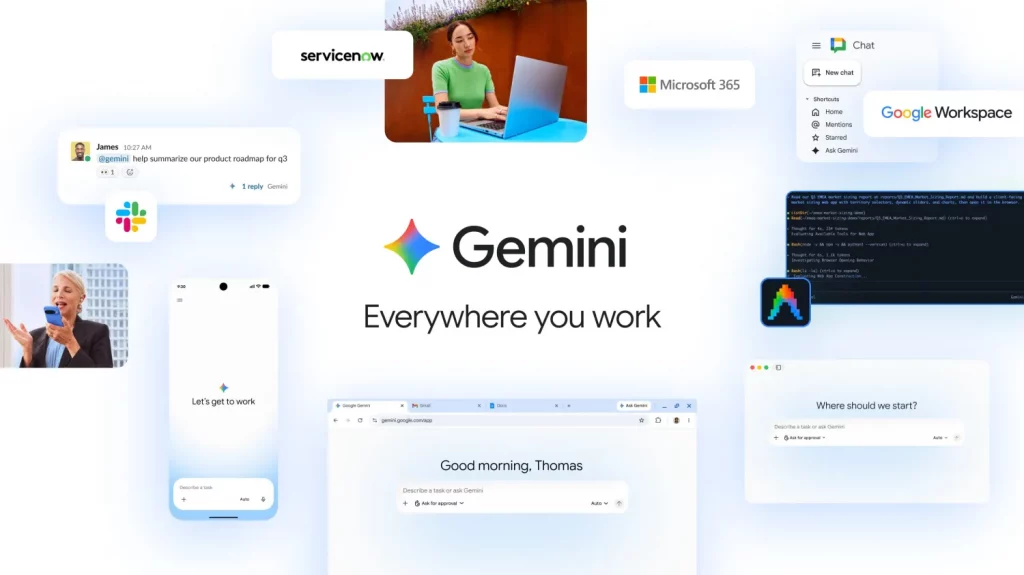 The Gemini agent is in private preview and will have broad availability soon for certain Google Workspace plans. – Image: Promotion/Google
Smart automation and teamwork
In daily use, the Gemini agent can identify tasks that can be delegated. For example, if a manager sends an email asking for the latest project update in a slide presentation, Workspace Intelligence recognizes the request and offers the option to delegate it to Gemini with a single click.
The tool can also schedule meetings without the user needing to provide names or email addresses. From the conversation space and the history of a previous event, the system identifies who should participate, checks calendars, and initiates a message exchange to find a suitable time, including external participants.
This role is not limited to individual tasks. The Gemini agent can also work on behalf of a group, such as a project manager, or assume a specific function within an organization, such as a financial analyst.
How the Gemini agent works
To execute each task, the system selects the model it considers most suitable. AI models are trained systems designed to process information and generate results, such as answers, texts, or codes. Currently, the Gemini agent uses the Gemini and Claude families, while Google plans future support for other proprietary and open-source models.
When an activity requires multiple steps, the Gemini agent can rely on subagents, AI systems that work together with the main agent, to divide the work. They can act in parallel or sequentially, including in processes that span hours or days.
The structure also maintains in the cloud a single set of memories, context, and personalization. Google divides this system into four categories:
- Session Memory: tracks the ongoing task, even when it lasts several days;
- Semantic Memory: builds a knowledge base from documents, conversations, and interactions with other agents; Procedural memory: records how certain tasks are performed, including skills that the system itself can create;
- Episodic memory: gathers the history of previously performed activities.
 The tool can be activated in Google Workspace and also work with services such as Slack and Microsoft 365. – Image: Mijansk786/Shutterstock
Integration with other services
In Gmail, Google Docs, Sheets, Slides, and Chat, the Gemini agent can be activated by mentioning @Gemini. The feature can also be used across different devices and channels, including command line, Slack, and Microsoft 365.
Read more:
- Google will limit access to Gemini models to free users and AI Plus
- Gemini gets a face: Google's new artificial intelligence speaks, reacts, and synchronizes lips in real time
- Google's new AI model promises advancement in programming and cybersecurity
An API, a resource that allows connecting different software, enables integrating the technology into third-party applications. In this format, called "headless agent" by Google, Gemini can operate behind the scenes, without needing its own interface.
Currently in private preview, a testing phase with limited access, the Gemini agent will have wide availability soon for Google Workspace customers with certain Business and Enterprise plans.

Valdir Antonelli is a journalist with specialization in digital marketing and consumption.