 © Google
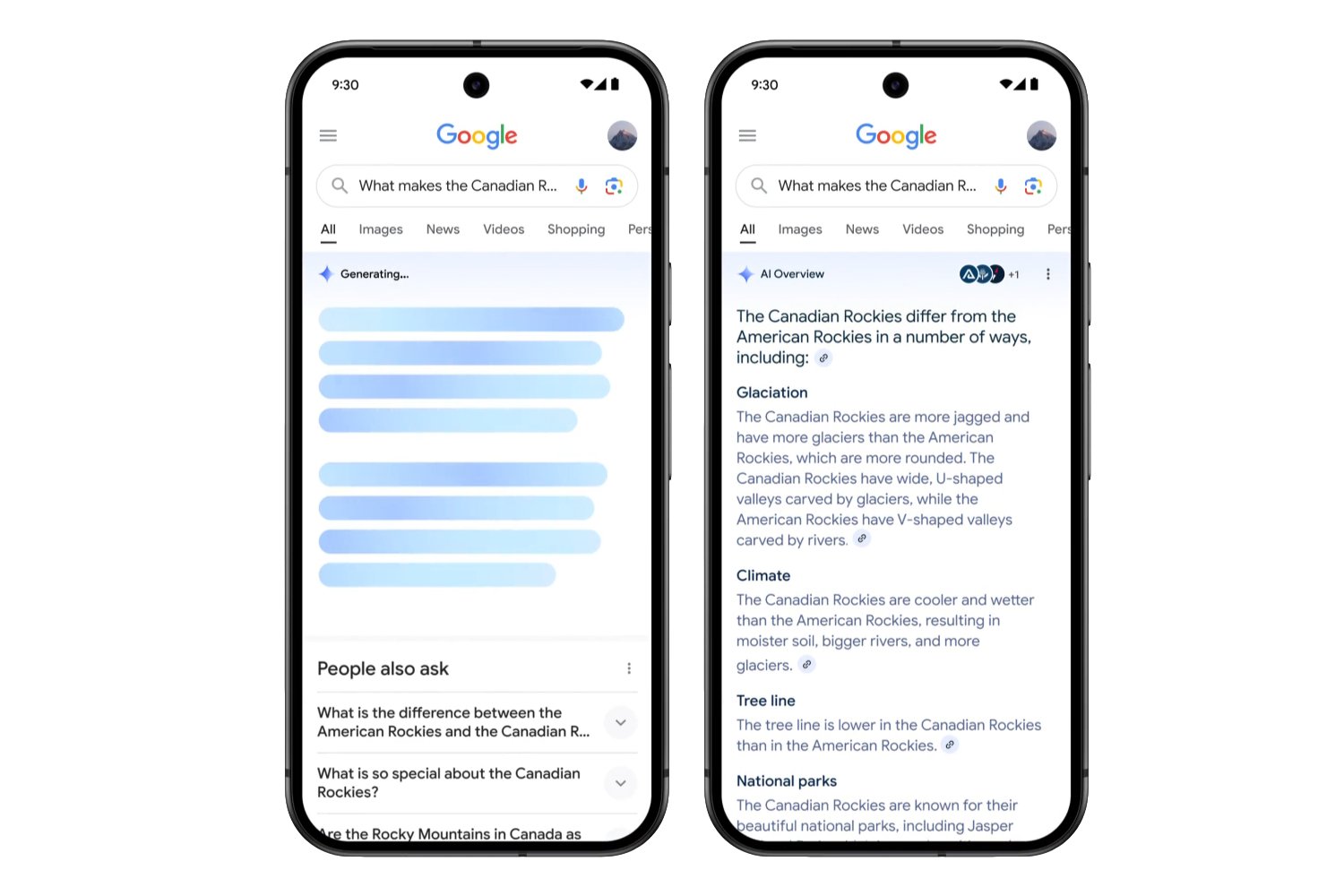
It's a little tune that is resonating more and more strongly, as generative AI takes hold in the landscape and particularly on Google. Website editors bitterly lament that the volume of clicks coming from the search engine is deflating due to AI Overviews, these AI-generated responses that sit at the top of the results. Google insists, however, that it is not the case.
Google defends its AI Overviews, its AI mode, and its various initiatives to integrate (sometimes with a kick and to tell anything) generative artificial intelligence into its search engine." The editors bitterly note that internet users often stop at these pre-written answers from Gemini, and no longer bother to click on the links leading to their sites… and thus to their ads.
Google promises that clicks are always there
A study conducted by the Pew Research Center in March 2025 among 900 American internet users confirmed these fears: only 8% of these users clicked on links when the Google page featured an AI Overview, compared to 15% without the AI-generated response. Only 1% of users clicked on the links present in the AI Overview. And 26% of searches stopped at the display of the AI Overview, compared to 16% with traditional searches.
Google does not want the idea to take root that its search results are less interesting for editors and websites. If these entities rely on Google traffic, the reverse is also true: without high-quality websites, the company's AI will be far less effective. That is why Liz Reid, head of Google Search, has come to the aid of various AI tools within her company that do not "kill" clicks, she says.
She assures that the overall volume of organic clicks from the search engine has remained stable year after year. The average quality of these clicks has even increased, with more visits considered "useful" (i.e., without immediate backtracking by the user). This trend contradicts surveys that alarm over a significant drop in traffic. Google finds them inaccurate or based on biased methodologies.
AI Overviews would actually encourage users to do more research, often longer and more complex, and to click on a greater number of links on the page. In some cases — such as for quick information (« when is the next full moon? ») — the user is satisfied with the answer without clicking further, a phenomenon already observed with other features like the Knowledge Graph. But for more in-depth research, clicks would be there, and even more qualitative.
If overall traffic remains stable, it is redistributed: some sites lose traffic, others gain it. Internet users now prefer authentic content, such as forums, videos, podcasts, or more personal and in-depth analyses. Sites that meet these needs see an increase in their traffic, according to Liz Reid.
« As a research company, we care deeply — perhaps more than any other — about the health of the web ecosystem. We continue to send billions of clicks to websites every day and believe that the value exchange between search and the web remains strong. »
It now comes down to convincing many publishers who, with numbers in hand, clearly see that something is wrong.
👉🏻 Follow real-time tech news: add 01net to your Google sources, and subscribe to our WhatsApp channel.
Source : Google







- Google Play Store
- 4K Video Downloader Plus
- VLC Media Player
- Adobe Reader
- uTorrent
- WinRAR
- Xender
- Google Chrome
- CCleaner
- Mozilla Firefox
- ChatGPT
- Microsoft 365
- Opera One
- Avast One



