

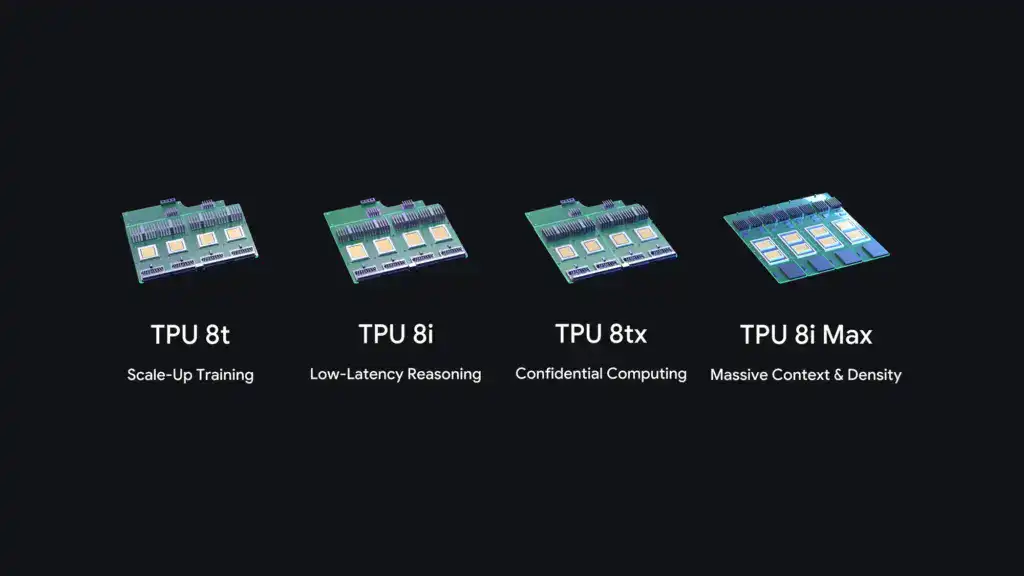
Google announced two new artificial intelligence (AI) chip systems, the TPU 8tx and TPU 8i Max, which expand the eighth generation of its processors. One was developed to protect data during processing; the other, to handle large volumes of information used by AI agents.
With the launches, the company now offers four eighth-generation TPU systems in a single year, each tailored to different needs for model training and execution.
 The launch of the 8tx and 8i Max models marks Google's introduction of four TPU architectures in a single year. – Image: jetcityimage/iStock)
New chips meet different needs
The systems join the TPU 8t and TPU 8i, introduced in April during Google Cloud Next. The first is designed for large-scale model training; the second, for tasks requiring rapid responses. According to Google, they offer up to 2.7 times more training performance and an 80% better price-performance ratio for inference than the previous generation, respectively.
The TPU 8tx serves companies and governments that need to work with sensitive information without exposing it during processing.The TPU 8i Max, by contrast, was designed for applications that need to analyze large amounts of data all at once, such as AI agents that examine extensive codebases or hours of video.
TPU 8tx protects data during processing
The TPU 8tx incorporates confidential computing capabilities directly into the hardware. In practice, this makes it possible to keep data and models’ internal information protected even while they are being used by the system. The feature can serve organizations that handle private information or need to meet strict security requirements.
The system uses the same processing technology as the TPU 8t, combined with fifth-generation AMD EPYC processors and the Boardfly network. According to Google, this configuration delivers response times as low as half those of the TPU 8t, with almost no impact on performance.
The architecture also makes it possible to adapt AI models with private data, create smaller versions from larger models, and train agents without transferring information between different sets of servers.
 Google says that nearly 100 customers already use its TPU processors, including laboratories, retailers, and universities. – Image: Provided by Google
TPU 8i Max expands processing capacity
The TPU 8i Max combines two TPU 8i chips in the same physical structure. As a result, it offers twice the processing capacity and memory resources of the conventional model.According to Google, the system also packs twice as many processing components into the same rack space, allowing more computing capacity to be installed in data centers.
In addition to the hardware, the company introduced tools to make developers’ work easier. TorchTPU, released as open source, enables applications created with PyTorch and Hugging Face models to run on TPUs without rewriting the code.
Another new feature is TPU Sync, which improves communication between chips, servers, and storage systems. The tool also optimizes access to information that the AI reuses while generating responses. According to Google, this can reduce the time required to transfer such data and the wait for the first word or part of a response by more than 90%.
Cloud Pathways, meanwhile, became generally available in Google Kubernetes Engine (GKE). The tool makes it possible to coordinate multiple sets of TPU processors as if they were a single machine, making it easier to run tasks that require substantial processing capacity.
Google says that nearly 100 customers are already using its TPUs, including AI laboratories, financial institutions, retailers, and universities. The company also uses artificial intelligence tools such as AlphaChip and Gemini to accelerate the development of its own processors.
TAG65@@

Valdir Antonelli is a journalist specializing in digital marketing and consumer topics.


