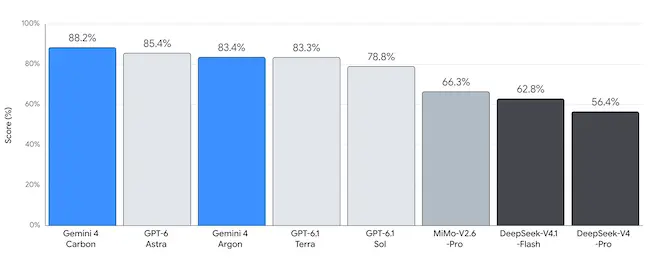
Google officially launched its top-tier AI model, “Gemini 4 Carbon.” It recently ceded the top spot in AI performance evaluations to Anthropic’s new model, but is targeting the developer and enterprise markets with API pricing at one-quarter the level.
Google announced on the 10th (local time), via its official blog, that it has begun making Gemini 4 Carbon available to general developers, enterprises, and paying subscribers. This comes just two weeks after the model was first unveiled on March 28.
At the time, it was made available only to a select group of cybersecurity experts participating in the “Fairwind” program, but its range of use has now been expanded to ordinary development and business purposes.
Developers can access the model through paid APIs in Google AI Studio and Android Studio. Enterprise customers can access it through “Gemini for Business,” while it will be rolled out to general users through “Google AI Ultra,” the highest-priced paid subscription plan, in the Gemini app and Google Search’s AI Mode, among other services.
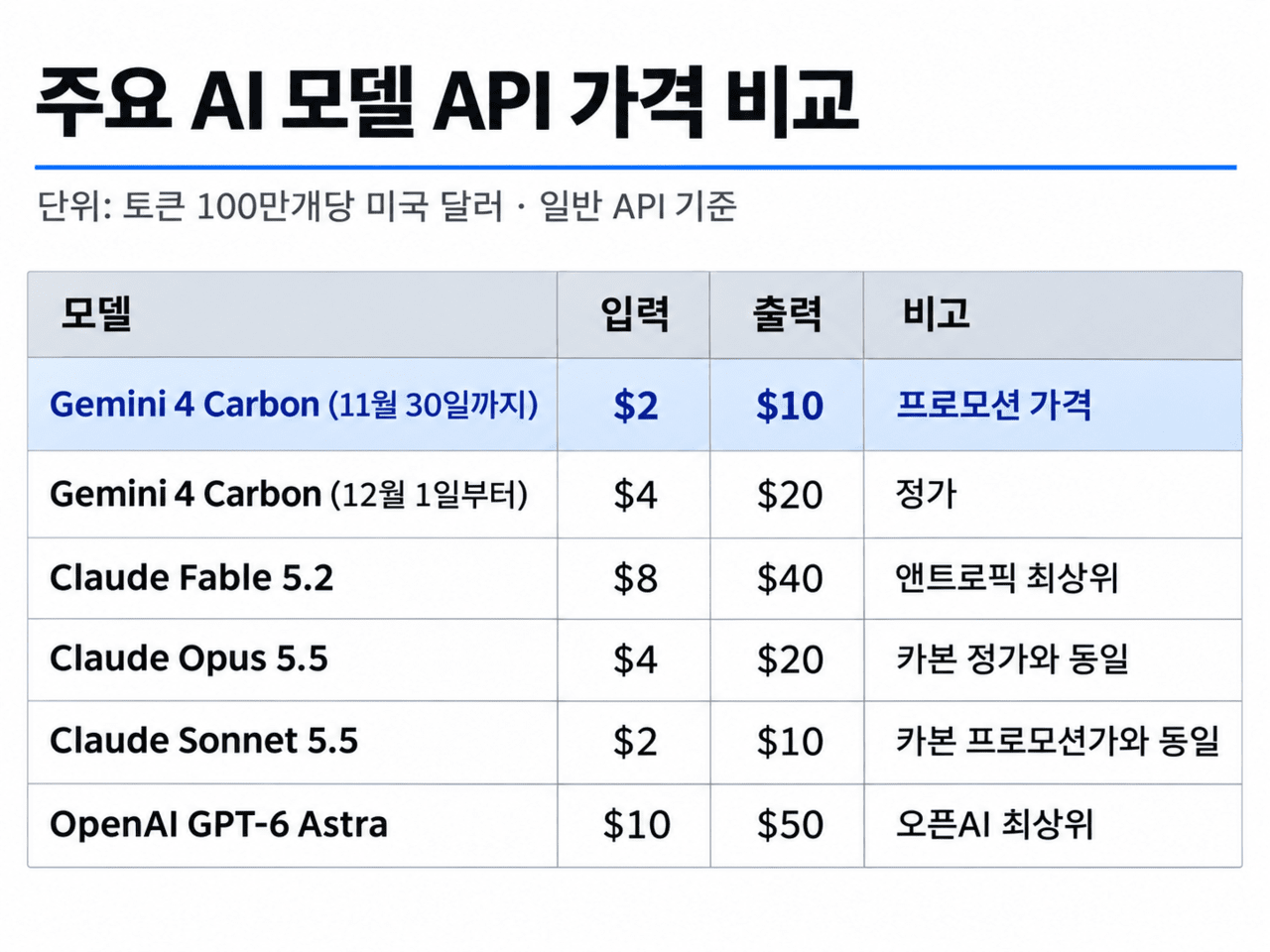
In particular, it set API pricing below that of competing models. Through November 30, the rates are $2 per 1 million input tokens and $10 per 1 million output tokens. From December 1, they will rise to $4 and $20, respectively.
Compared with the $8 input and $40 output pricing for Anthropic’s “Claude Fable 5.2,” released on the 9th, the current rates are about one-quarter as much. Even after the discount period ends, they will remain at half the price, matching the pricing of “Claude Opus 5.5.”
Although Carbon’s API unit price is lower than those of competing models, it has also been pointed out that actual work costs can vary depending on the number of tokens required for a task and the number of repeated attempts.
The rankings shifted in the performance race. When it was unveiled last month, Carbon took the top spot in the Artificial Analysis (AA) Intelligence Index, but it ceded the lead to Claude Fable 5.2, which was released on the 9th.
In the current evaluation, Fable 5.2 ranks first with 65 points, followed by Carbon with 60. Claude Opus 5.5 has 59 points, while OpenAI’s “GPT-6 Astra” has 57.
Separate from overall performance evaluations, the company emphasized real-world task performance and cost efficiency. It said Carbon ranked first in the software development benchmark “CursorBench 4.0,” Perplexity’s information research benchmark “WANDR,” and Zapier’s enterprise business automation benchmark “AutomationBench,” while costing less than half as much per task as competing models.
In particular, Carbon recorded a 53.88% success rate and a cost of $2.12 per task in AutomationBench, outperforming Fable 5.2’s 51.45% success rate and $4.64 cost per task.
For your biggest builds, we're previewing /swarm in @Antigravity, turning one prompt into a coordinated team of agents you can track in real time.
Assign Carbon to high-level roles like architectural design, coordination, and auditing while parallel agents build and test every… pic.twitter.com/c5IOJQy2gv
— Google (@Google) November 10, 2026
Along with this launch, the AI coding platform “Antigravity” also introduced a trial “/swarm” feature in which multiple AI agents collaborate. This feature allows multiple agents to divide up and carry out a single instruction while verifying each other’s results.
Carbon can be assigned complex software design, task coordination, and verification, while relatively lightweight models handle other tasks in parallel. It explained that this enables complex development projects requiring lengthy execution times to be handled efficiently.
Meanwhile, “Carbon for cyber,” which specializes in cybersecurity, will be made available only to approved experts, as before. Google also expanded its researcher support program, which provides Carbon and Argon free of charge for six months to selected scientists.
Reporter Im Dae-jun ydj@aitimes.com