Reported by Synced

In multi-stage reasoning, local misjudgments can become premises for subsequent judgments and continue to influence later steps.
This problem is particularly prominent in empathetic speech dialogue: perception, psychological-state inference, and response generation are closely interconnected, and early biases may ultimately lead to misunderstandings of the speaker’s needs and inappropriate responses. Even if the subsequent analysis is logically coherent and appropriately expressed, it may be built on a faulty foundation.
Relying solely on an overall evaluation of the final response makes it difficult to locate errors and provide targeted feedback.
How to model dependencies between stages and apply feedback to the corresponding steps has become key to reducing the propagation of errors in multi-stage reasoning.
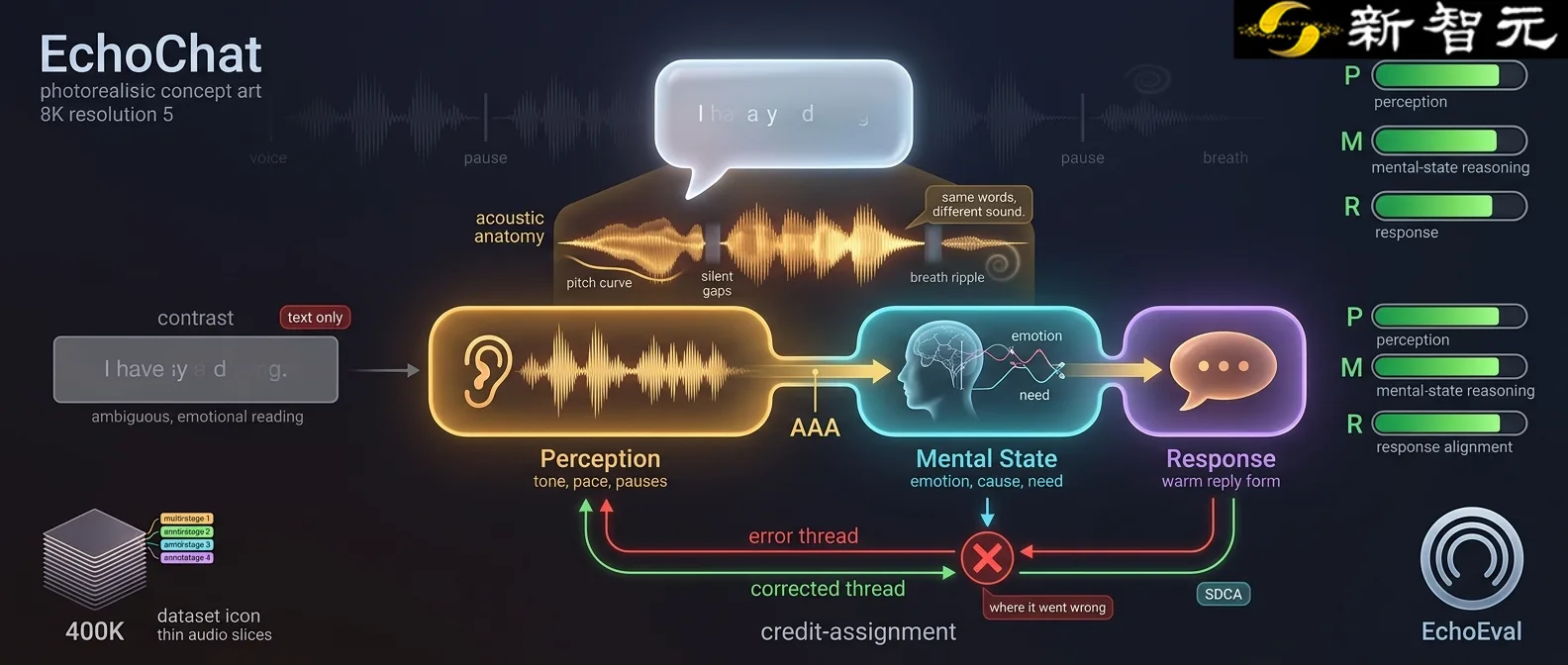
To address this challenge, research teams from the Chinese University of Hong Kong and Microsoft proposed EchoChat. The team pointed out that reducing empathy to a direct mapping from input to response can easily trap the model in “empathetic mimicry”: the response appears warm in wording but does not match the speaker’s underlying psychological state and actual needs. Therefore, improving empathy requires delving into the cognitive processes underlying responses.
EchoChat incorporates perception, theory-of-mind reasoning, and spoken-response generation into a unified optimization framework, constrains dependencies between stages through cascaded gating rewards, and uses step-level credit assignment to provide targeted update signals, mitigating the propagation of errors through the reasoning process. This work was published at NeurIPS 2026.
Paper link::https://arxiv.org/abs/2610.04826

Reasoning now has intermediate steps
Training also requires more fine-grained feedback
In empathetic dialogue, underestimating emotional intensity may cause the model to overlook the speaker’s urgent need for support; misunderstanding psychological needs may cause the response strategy to deviate from the problem the conversation actually needs to address.
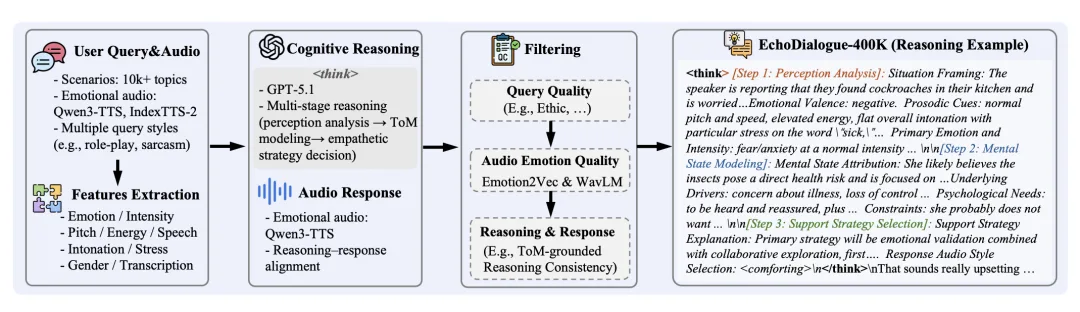
EchoChat explicitly organizes this process into perception, psychological state inference, strategy planning, and response generation, giving the different components distinguishable structures.
However, clearly structured reasoning does not automatically guarantee reliable judgments: subsequent analyses may continue from incorrect premises even if they are logically coherent.
Training therefore needs to distinguish performance at each stage, identify which components provide reliable evidence and which introduce biases, and provide corresponding feedback.
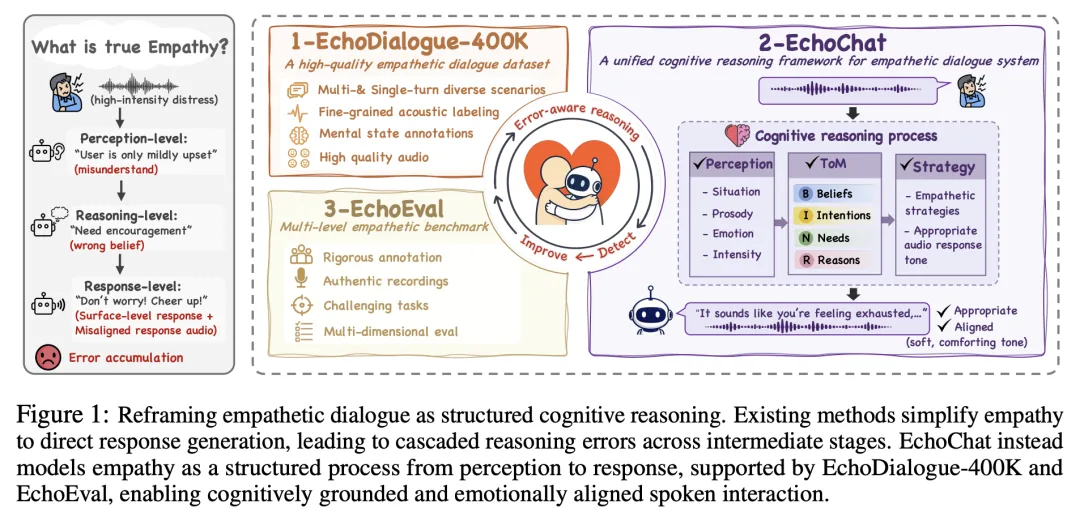
Rewards reflect dependencies; feedback corresponds to steps.
During the reinforcement learning stage, EchoChat addresses this issue at two levels: reward design and credit assignment.
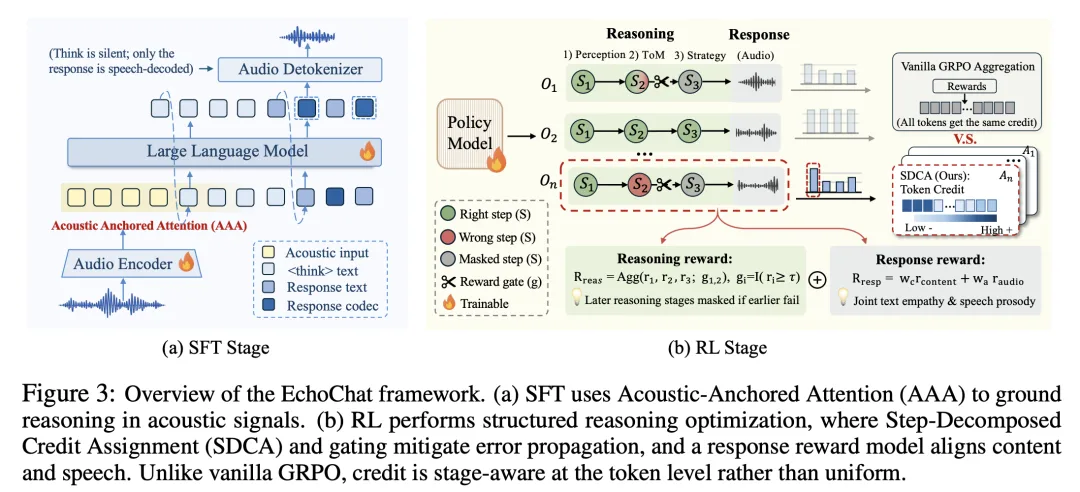
Cascade gating: subsequent rewards require reliable evidence from preceding stages.
Scores at different stages cannot simply be treated as independent. If perception is already biased, the psychological analysis generated based on that perception lacks a reliable premise, even if it appears plausible on the surface. If subsequent stages can still receive high rewards, the overall score may mask upstream errors.
EchoChat therefore introduces cascade gating into reasoning rewards, constraining the rewards for psychological state inference and strategy planning by the performance of preceding stages. This reduces the possibility that the model will compensate for upstream errors through subsequent analyses that merely appear plausible.
SDCA: Assigning stage-level feedback to the corresponding generated segments.
Even when rewards already account for dependencies between stages, it remains necessary to specify which steps these feedback signals should apply to. Standard GRPO typically computes a uniform advantage signal based on the total reward for the entire trajectory and applies it to all generated tokens, making it difficult to adequately distinguish the contributions of different stages.
To address this, EchoChat proposes Step-Decomposed Credit Assignment (SDCA): it separately computes within-group relative advantages for different stages and assigns them to the tokens in the corresponding generated segments, so that each step receives a training signal that matches its own performance.
On this basis, EchoChat combines response-level multimodal rewards to jointly optimize the reasoning process, response content, and speech expression.
Keeping Long CoT Reasoning Acoustically Grounded
Reducing error propagation also requires paying attention to the information on which reasoning initially relies.Long-chain reasoning (Long CoT) often faces an important risk: as generated text continues to accumulate, the model may increasingly rely on its own existing judgments and gradually pay less attention to the original input.
This issue is particularly noteworthy in empathetic speech conversations. Intonation, rhythm, pauses, and vocal intensity carry emotional information that is difficult to preserve fully in text. When reasoning gradually becomes dominated by the generated text, these acoustic cues may be overlooked, and initial misjudgments may also be more likely to carry over into subsequent mental-state inference and strategy selection.
For this purpose, during the supervised fine-tuning stage, EchoChat introducesAcoustic-Anchored Attention299@@ (AAA)305@@. Through attention constraints, it strengthens the focus of perception-stage reasoning on acoustic representations, enabling emotional judgments to be more fully grounded in acoustic evidence and providing a reliable foundation for subsequent reasoning and responses.
To provide corresponding learning signals, the research team constructed theEchoDialogue-400K dataset. It covers diverse dialogue scenarios, language styles, and fine-grained emotional expressions, and links perception, mental-state analysis, strategy selection, and responses, providing structured supervision for multi-stage learning.
EchoEval
Multidimensional Evaluation from Perception to Response
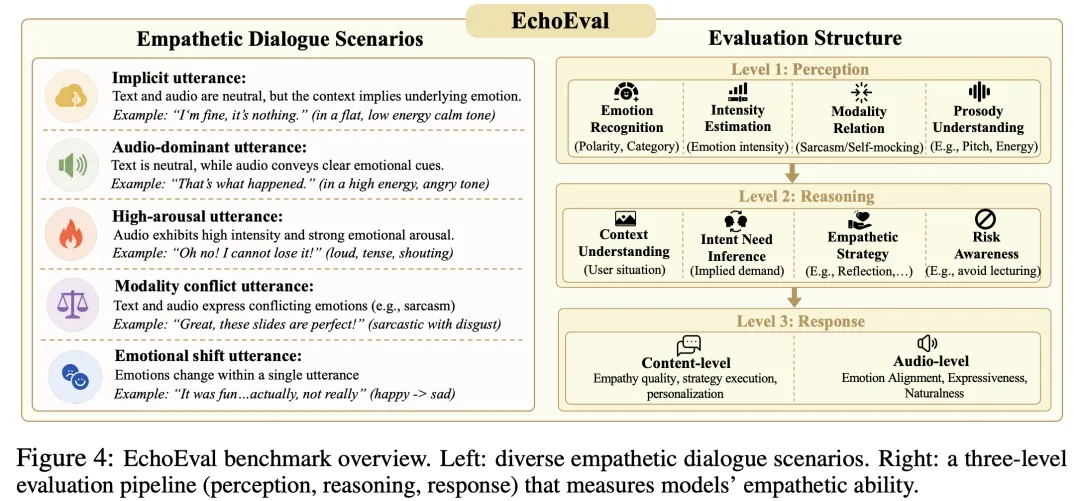
To measure empathic ability as objectively as possible, in addition to subjectively evaluating final responses, the team further examined whether the model accurately perceives emotions, reasonably infers psychological states and support needs, thereby establishing clearer and more analyzable grounds for empathy evaluation.
To this end, the research team introduced EchoEval, which uses speech recorded by real people and annotations from psychology experts, covering complex expressions such as implicit emotions, semantic and tonal conflicts, and emotional shifts. Through hierarchical evaluation using expert annotations as a reference, EchoEval breaks down the overall assessment of empathy into a systematic evaluation of perception, reasoning, and response quality.
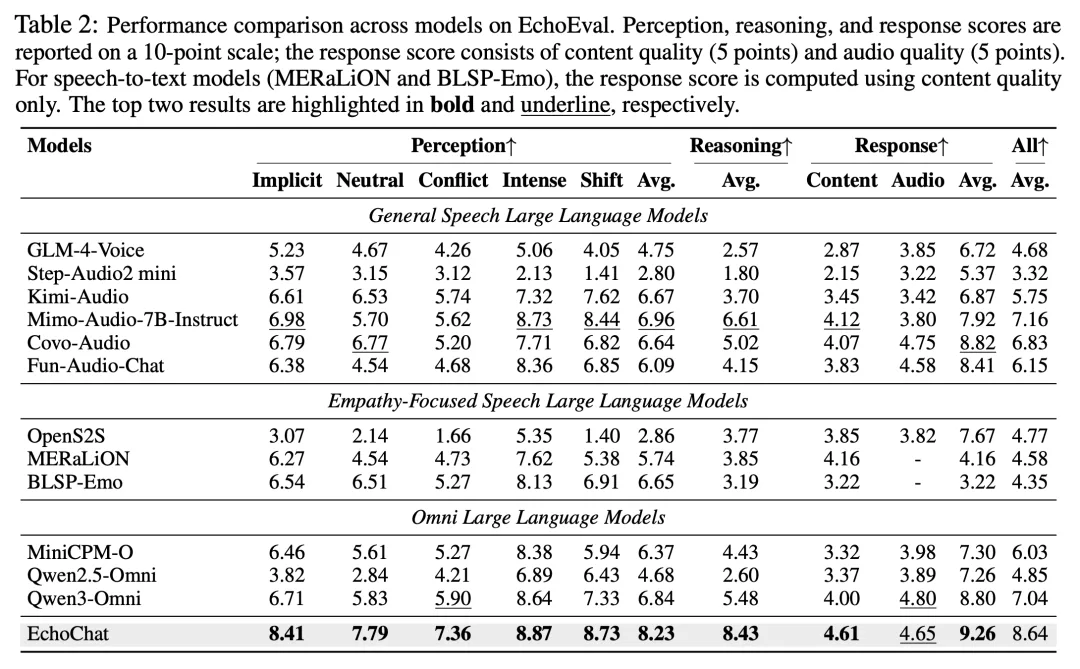
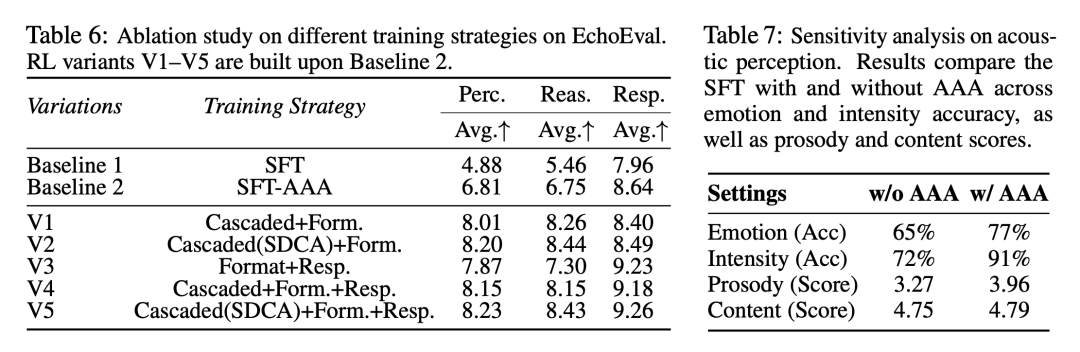
EchoChat achieved leading performance in aligning perception, reasoning, and response. Ablation and error-propagation analyses further show that cascaded gating and step-level credit assignment improve coordination between different stages, mitigate the impact of intermediate misjudgments on subsequent reasoning and responses, and support the effectiveness of this training method.
Summary
TAG405@@
Empathetic speech dialogue is essentially a cognitive process in which perception, inference, and decision-making are interdependent. Warm expressions, if they lack an understanding of the speaker’s psychological state and actual needs, may remain at the level of “empathetic mimicry.”
By explicitly modeling and jointly optimizing this process, EchoChat explores how to reduce the propagation of intermediate misjudgments, enabling responses to be grounded in more substantial acoustic evidence and more reliable reasoning.
TAG425@@
TAG429
References:
https://arxiv.org/abs/2610.04826
TAG457@@
Editor: LRST
TAG469@@
Follow ASI instantly
⭐Like, share, and view—all in one click⭐
Tap the star to never miss Synced’s lightning-fast updates!TAG500@@
TAG510@@