PPIO Sandbox: Turning the “Cloud Computer” into a Ready-to-Use API
Recently, “Personal Agent” has been one of the hottest topics in the agent field.
Most of the discussion has focused on the product side, but the key to supporting Personal Agents lies in the “execution layer.”
Each of these Agents capable of “taking action” has an independent execution environment belonging to the user behind it: Meta provides every user with a Muse Secure VM, Manus assigns an independent cloud VM to every task, and OpenAI gives every dot a cloud computer and a virtual browser.
The normal operation of a Personal Agent cannot bypass the Agent-specific “cloud computer.” That is exactly what the PPIO Sandbox does: turn this “cloud computer” into a ready-to-use API, providing dedicated solutions for Personal Agent scenarios such as personal office assistants, personal research assistants, and personal coding assistants.
01 From Conversation to Action: What Changes for Personal Agents?
General-purpose Agents have continued to evolve. How does a Personal Agent differ from previous Agent products?
First, a Personal Agent is user-centered rather than task-centered.
Take Manus as an example. The previous generation of Manus was a task-oriented Agent: a user submits a request, and it launches a virtual machine, completes the task, delivers the results, and reclaims the machine—everything resets when the task ends. Manus’s official team has also admitted that “every regular conversation starts from scratch; it cannot access what you did yesterday.” By contrast, a Personal Agent serves the same user over the long term. Preferences, accounts, and ongoing work all remain tied to the user and accumulate across tasks.
Second, building on the premise of being user-centered, Personal Agents need to support long-running operation.
Conventional task-oriented Agents are “summoned on demand and leave once they finish,” whereas Personal Agents are always-on. OpenAI’s official definition of dots is always-on: “continues advancing work between conversations.” Meta describes Muse as “a personal assistant that completes tasks for you around the clock.” It keeps working after you close the app and contacts you only when there is progress to report or something needs your confirmation.
There is another dimension that is easy to overlook but equally crucial:it proactively advances work instead of passively responding. It remembers your preferences and what you are working on, moves forward without waiting for instructions, and proactively reports back. Being always-on solves “it is still there”; being proactive solves “it moves forward on its own.”
These differences ultimately come down to a single product prerequisite:the ability to take action.To take action, you need a computer within reach of your “hands.”
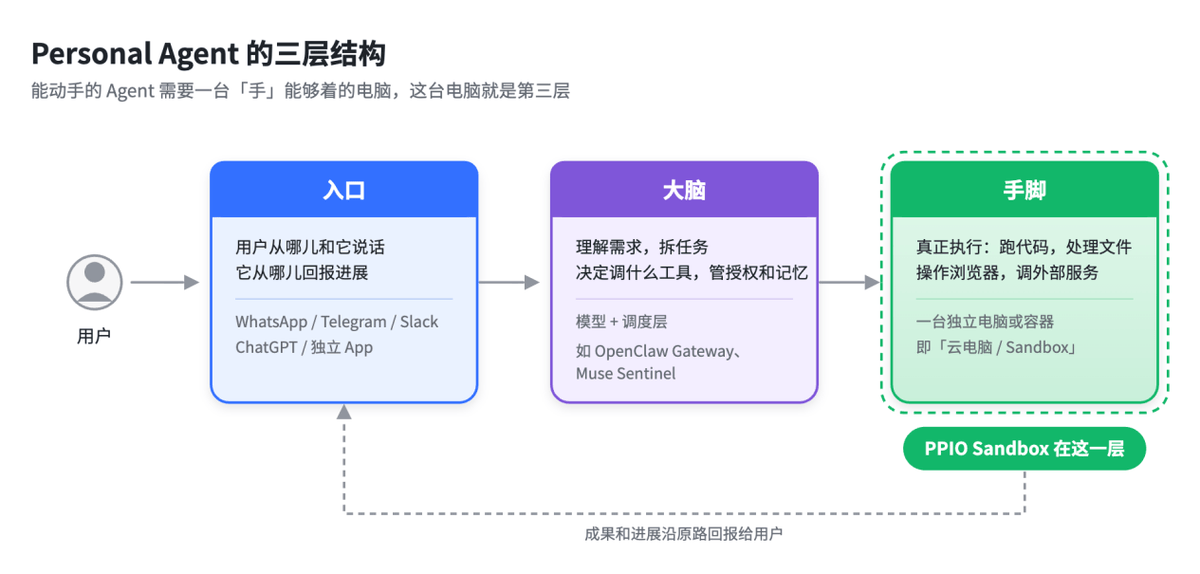
Breaking down the architecture of a Personal Agent, it typically consists of three layers: Entry Point, which determines where users interact with it—commonly WhatsApp, Telegram, Slack, or a standalone app; Brain, which understands requirements, breaks down tasks, decides which tools to invoke, and manages permissions and memory, consisting of a model plus an orchestration layer, such as OpenClaw’s Gateway and Muse’s Sentinel; and Hands and Feet, which perform the actual execution on a standalone computer or container.
Where this computer is located, who manages it, and how far the impact extends if something goes wrong are architectural choices that every Personal Agent product will have to make in 2026.
02 Every Personal Agent Needs a “Cloud Computer” Behind It
Looking at Personal Agents on the market today, every product that can actually take action and run persistently gives each user a dedicated execution environment. Depending on who provides this “computer” and where it is located, there are essentially two options: local execution or cloud execution.
The first option is local execution:There is no dedicated cloud computer; the Agent runs directly on the user’s own machine or a server they rent themselves, leaving the user responsible for finding a computer, setting up the environment, and managing security. The open-source OpenClaw and Hermes, as well as Anthropic’s desktop Agent Claude Cowork, all fall into this category.
However, running an Agent locally carries certain security risks, depending on how the isolation solution is implemented. For example, the OpenClaw community has previously exposed 42,000 publicly accessible Gateway instances and more than 300 malicious skills mixed into its skill marketplace. Users are also responsible for costs such as keeping the device online and maintaining its security.
More importantly, a locally running machine generally cannot remain online indefinitely. Once the computer is shut down or goes to sleep, the Agent stops working. In this respect, local execution cannot meet the long-running requirements of a Personal Agent.
The second option is cloud execution, which follows two paths. One is building it yourself: vendors construct and maintain the infrastructure themselves, and most of the specific specifications are not publicly disclosed. Representative products include Meta Muse, OpenAI dots, Manus, and others.
Meta Muse gives every user a dedicated Muse Secure VM—a cloud Linux VM with Chromium, a Debian runtime container, and local storage. It can compile code, run sub-Agents in parallel, and execute cron jobs. The core Agent runs inside an unprivileged container, while outbound communications pass through a host-side Sentinel process that uses eBPF for taint tracking. Credentials are injected by authd at the network boundary, so the model never has access to the original passwords.
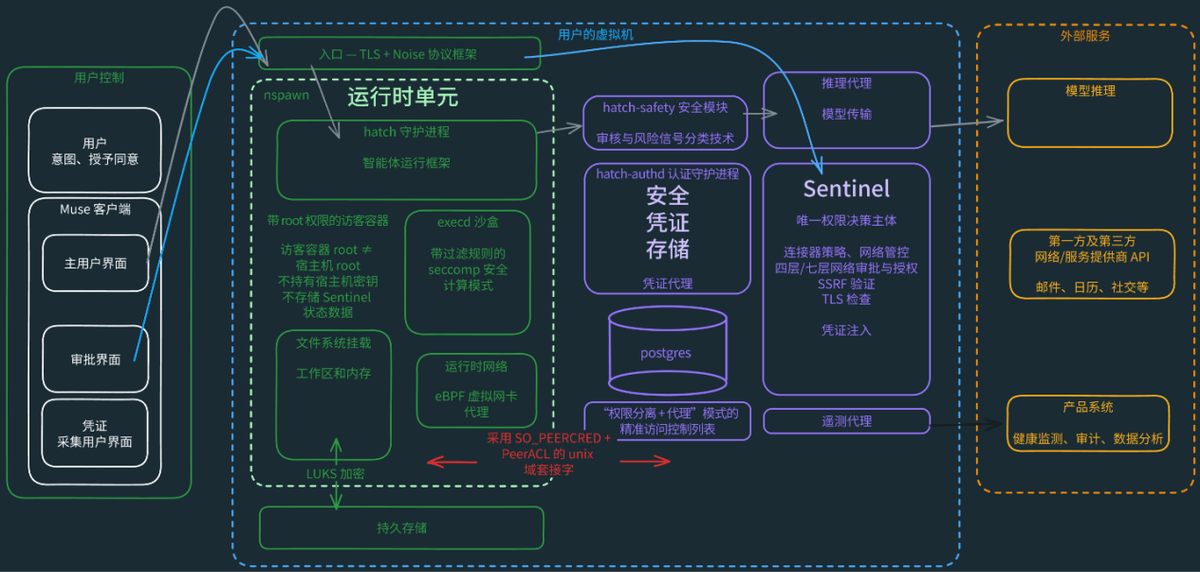
Each OpenAI dot also has its own cloud computer and virtual browser. It continues running while the user is offline, inherits ChatGPT memory, and, when there is no human collaboration, proactively conducts research in read-only mode and cannot send messages without authorization. Manus is even more granular: each task is assigned a fully isolated cloud VM with network access, a file system, a browser, and root privileges. It automatically goes to sleep when idle and is reclaimed after remaining asleep for a period of time. A persistent Cloud Computer is also available as a separate offering.
The other path is to use a third-party Agent Infra company, such as PPIO.Users move an open-source or internally developed Agent framework to a third-party cloud hosting platform and can run it with zero configuration.
At the beginning of this year, when OpenClaw triggered a “shrimp-raising” boom, many companies rushed to launch their own cloud-based shrimp-raising solutions.For example, with Kimi Claw, Moonshot AI has hosted OpenClaw within Kimi, running it directly in a browser tab. Each user gets a cloud instance that is online 24/7, with 5,000+ ClawHub skills built in and support for scheduled tasks and persistent memory; PPIO has also launched its own cloud sandbox hosting solutions, PPClaw and PPHermes, offering one-click deployment and going live in ten minutes, remaining online whenever needed and stopping charges as soon as they are paused.
In the Personal Agent era, this cloud hosting model is equally applicable.
Large companies usually treat the “execution environment” as an internal product implementation and do not disclose its specifications. Developers who want to replicate this experience must find the execution layer themselves. Developers of Personal Agent products and small and medium-sized teams, have neither the infrastructure of large companies nor the ability to push the burden of environment setup onto users, making finding a suitable ecosystem partner for execution environments the most appropriate option.
PPIO’s job is to make the “cloud computer” capability essential to Agents available to developers as an API.
03 PPIO Sandbox: Turning the “cloud computer” essential to Agents into an API
PPIO only handles the hands-and-feet layer, leaving the entry point and brain to developers’ own Agents. With a single API call, developers get an independent sandbox with a preconfigured environment, allocated by user or task, released after use, and equipped with pause, resume, and cloning support.
As a cloud execution environment built specifically for Agents, PPIO Sandbox provides Personal Agent developers with at least five core capabilities tailored to their needs:
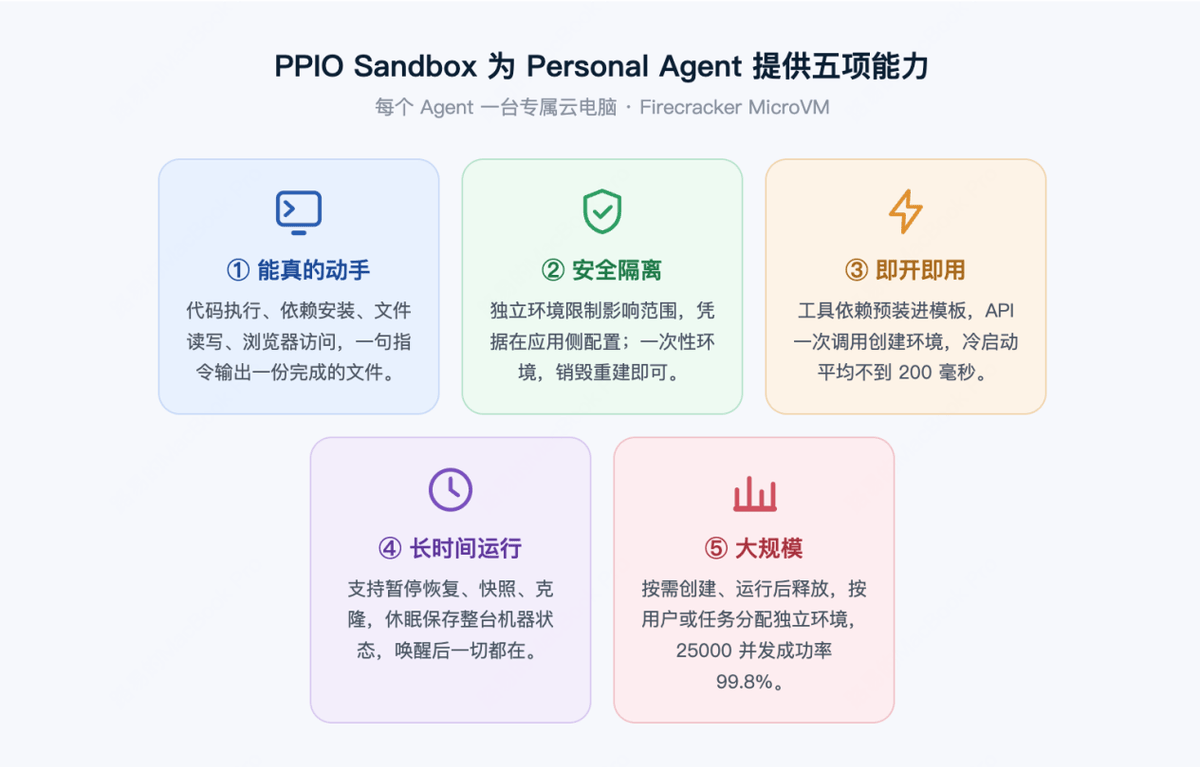
First, it must be able to actually take action—process Excel files, PDFs, and images, run scripts, and open a browser. This is the prerequisite that distinguishes a Personal Agent from a chatbot.
PPIO Sandbox is a complete micro-VM runtime environment. Code execution, dependency installation, file reading and writing, and browser access can all be performed within the sandbox; tools and dependencies can be preinstalled into templates; and after the Agent receives a single instruction, it can output a completed file—from “being able to chat” to “being able to get things done,” what is missing is precisely a practical execution environment.
Second, secure isolation, giving the Agent an independent workspace.When an Agent takes action, it necessarily comes with permissions and a radius of impact; the industry consensus is to place execution in an isolated environment.
PPIO Sandbox is an independent runtime environment that limits the Agent’s scope of impact. Credentials and permissions are configured on the application side, and the environment itself does not hold any permissions on the user’s local machine. The environment is also disposable: if the Agent accidentally deletes files, corrupts dependencies, or even brings down the system, simply destroy that instance and create a clean one; neither the user’s local machine nor other users are affected.
Third, the execution environment must be immediately usable and reproducible; reducing setup effort is a reason users are willing to pay.Self-hosting OpenClaw requires Node.js 22+, a VPS, and 30 to 60 minutes of configuration; Kimi Claw turns it into something that runs “instantly in a browser tab” and can be sold for CNY 199 per month—developers are willing to pay for less setup.
PPIO Sandbox preinstalls tools and dependencies into templates. A single API call creates an environment with an average cold-start time of under 200 milliseconds, eliminating the need to wait for a machine—you can start working immediately.
Fourth, long-running tasks must be supported, so tasks can pick up where they left off and their results can be preserved.This is an advantage of cloud execution environments over local execution: once the local computer shuts down, the Agent stops. Manus’s per-task VMs also have a sleep-and-reclamation cycle (Free 7 days / Pro 21 days), and temporary files are reclaimed.
PPIO Sandbox supports pausing and resuming, snapshots, and cloning, in conjunction with external storage and application-side state management. Hibernation preserves the state of the entire machine; after wake-up, processes, dependencies, and files are all still there, and users return to the same computer.
Fifth, it must support serving users at scale.Muse, dots, and Kimi Claw all use a “one-per-user” model, while Manus goes one step further with a “one-per-task” model—when building Personal Agent products, the number of environments grows on the same order as the number of users, making it impossible to manually provision VPS instances.
PPIO Sandbox supports on-demand creation and release after execution, assigning an independent environment per user or task. In a concurrent test with 25,000 instances, it achieved a 99.8% success rate—one machine per user, with the capacity to handle a growing user base.
For Personal Agent developers focused on use cases such as personal office assistants, personal research assistants, and personal coding assistants, the most immediate value of PPIO Sandbox is that it lets you “avoid reinventing the wheel.”
As China’s first sandbox compatible with the E2B interface, PPIO Sandbox allows customers to get their workloads running by changing just a few lines of configuration, with virtually no changes to their business code. Since its launch, the number of PPIO Sandbox instances created has grown more than 120-fold, with millions of sandboxes running every day.
To help more developers run real-world tasks, PPIO has introduced the “Personal Agent Developer Boost Pack,” which includes a RMB 100 Sandbox credit voucher redeemable for approximately 27,800 minutes of 1-core, 2 GiB runtime, enabling you to successfully complete your first Agent task using PPIO Sandbox.
For more information, visit the official PPIO website.
This article is provided by PPIO Cloud and reprinted by QbitAI with authorization. The views expressed belong to the original author.