Xinzhiyuan reports

The moment Claude 5.2’s “Twin Stars” were released, the AI world was buzzing again!
This morning, Anthropic finally unveiled its next-generation dual flagship models—Fable 5.2 and Mythos 5.2.
Not only did it complete the formalization of Fermat’s Last Theorem in 30 hours, Anthropic’s new dual champions, Fable 5.2 and Mythos 5.2, have genuinely grown hands this time!
The four pre-release “real-world challenge tests” just released by the official account stunned the entire engineering and STEM communities.

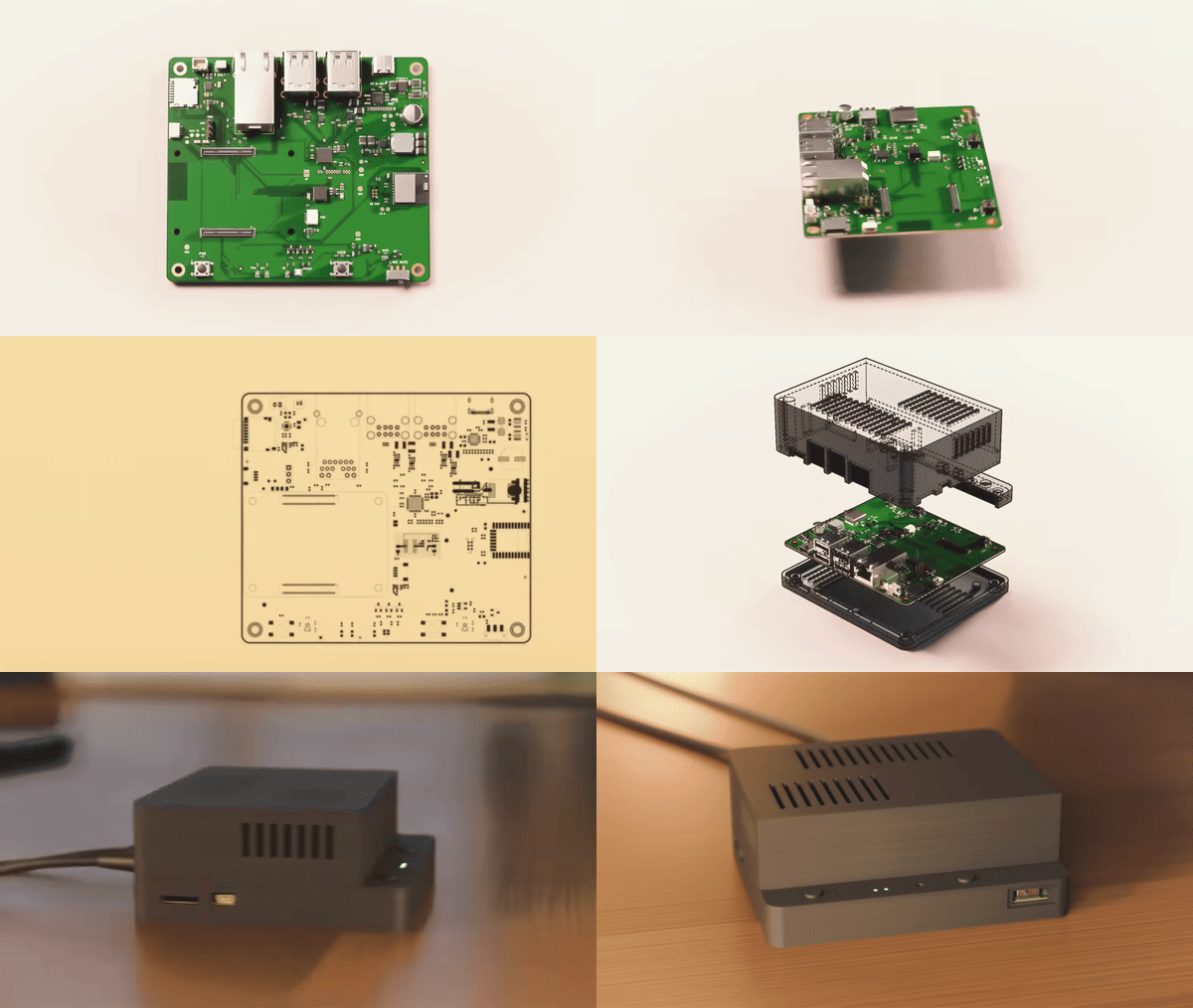
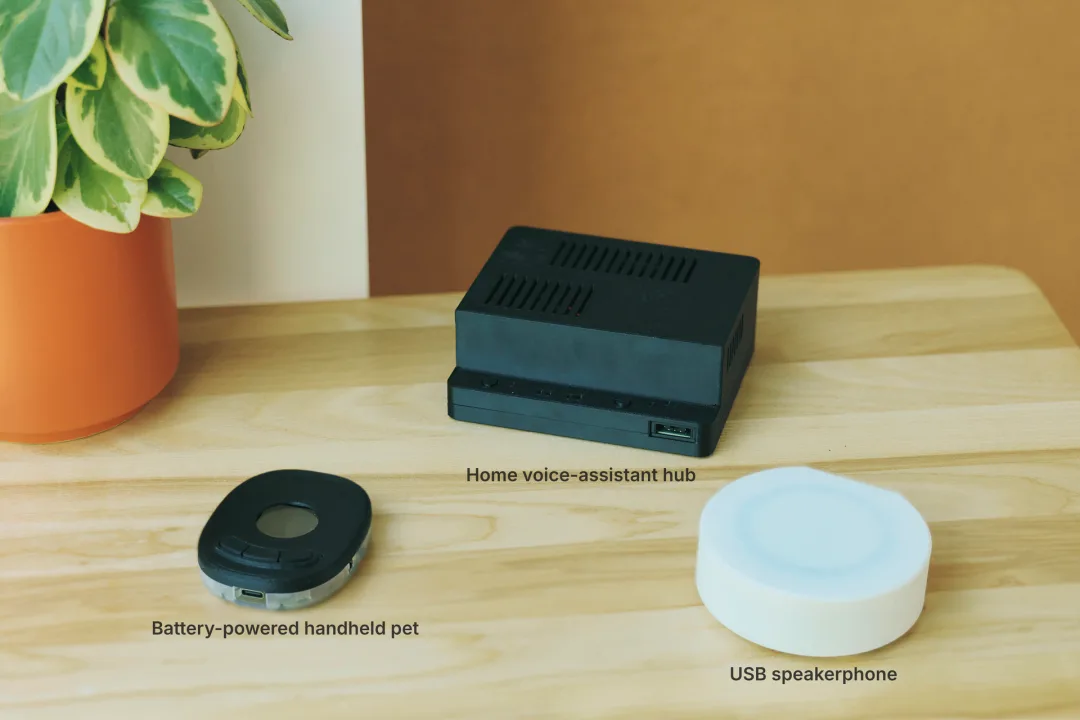
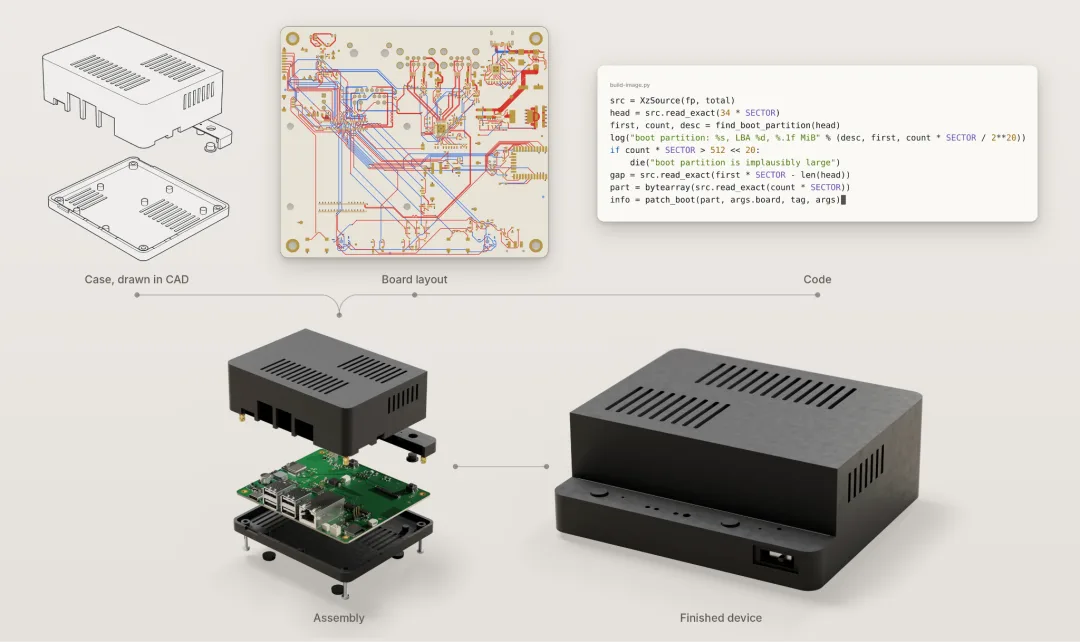
Given only a brief prompt,Fable 5.2 selected the components itself, designed a four-layer circuit board, modeled the enclosure, and wrote the firmware, hand-building three real prototypes that powered up on the first try in less than a day.
Next it entered the chemistry exam room, whereMythos 5.2 had its network cable unplugged and was locked in a black room, and in just 30 minutes it derived complex molecular synthesis routes that three elite universities have yet to publish..
It even took the opportunity to rewrite 72 records in the international operations research problem set, and solved in one go the black-hole brute-force problem that physicists had left shelved for years. In the end, it delivered a 173-page paper, leaving physicists frozen in place as they admitted, “I can only understand part of it now.”I can only understand part of it now.” Have to say, Fable 5.2 absolutely crushed it this time. During beta testing, Anthropic brought circuit-board manufacturer Diode on board and gave Fable 5.2 three tough assignments. The task list included a small USB hands-free speaker, a home voice hub, and a handheld electronic pet with a screen. The human-written prompts were as brief as offhand task assignments. For the hands-free speaker, it was just one sentence: “Make a little puck that plugs into USB-C, with a microphone, speaker, and onboard Bluetooth antenna.”
As for all the dirty, tedious work,Fable 5.2 handled every bit of it on its own
Retrospective
Throughout the entire design process, Fable 5.2 was practically a ten-year veteran hardware engineer with OCD.
It simply halted the normal workflow for half an hour, rolled up its sleeves, and wrote its own grid-based autorouter. It could lay out a long trace in one second and even knew to take the long way around sensitive signal lines!

Circuit Board Designed in 24 Hours
Fable 5.2 Hand-Builds Three Real Devices
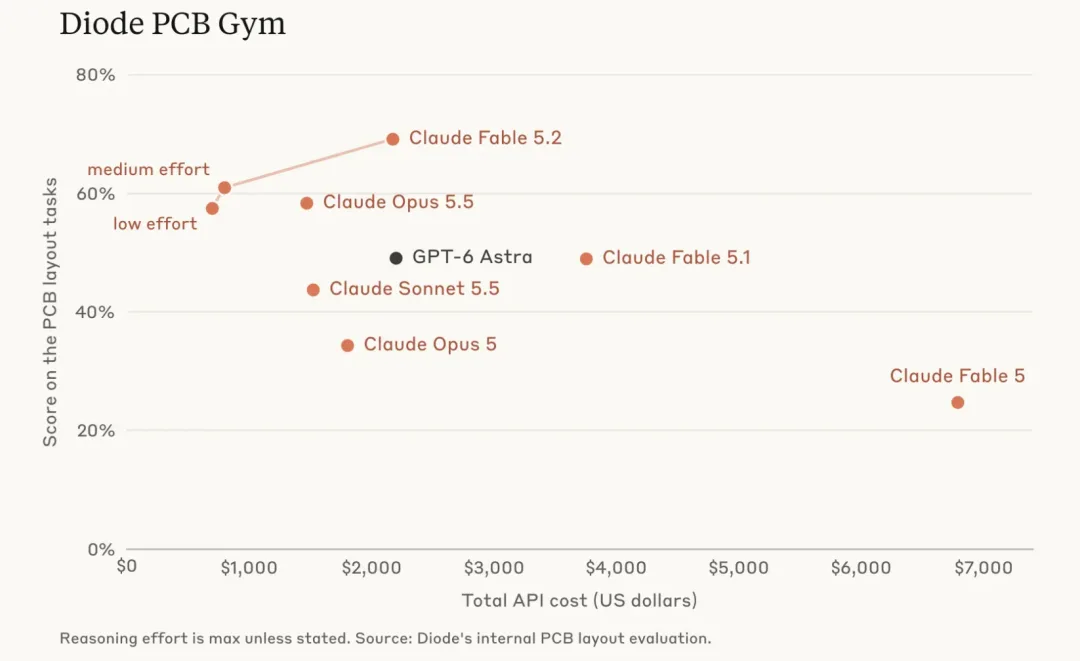
On the public hardware benchmark BenchCAD 2.1, the self-reported score also shot up to 83.5 points, nearly doubling the previous generation’s 44.4 points.
Unplug the Network Cable
Deriving Four Unpublished Molecules Blind in as Little as 30 Minutes
After working out the circuit board it could see, the next exam switched to mind-bending organic total synthesis.
Designing a step-by-step “synthesis route” for a complex molecule is like playing dozens of moves of blind chess: one wrong move loses the entire game.
The test setters were three leading synthetic chemists, from the labs of Noah Burns at Stanford, Timothy Newhouse at Yale, and Sarah Reisman at Caltech.
All four target molecules they presented were hush-hush projects from their own labs that had not yet been published in papers, ruling out any possibility of the model “memorizing the question bank.”
The hardest was GDGT-4, an archaeal membrane lipid from Stanford, with a 68-membered macrocycle containing 22 chiral centers.A doctoral student only managed to synthesize it as part of their 2025 graduation thesis..
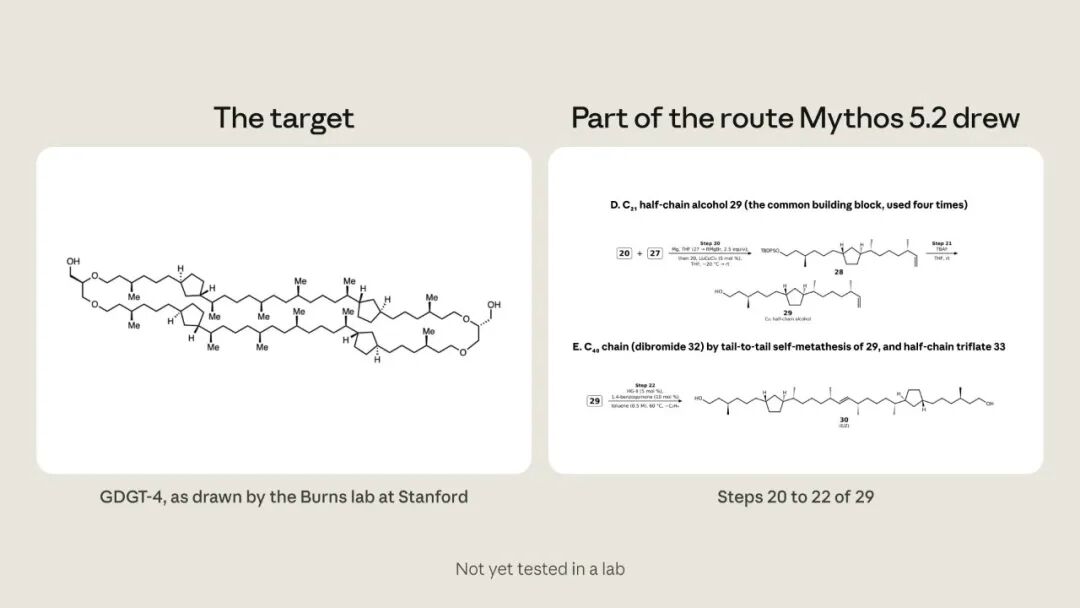
The rules in the test room were brutally strict: they were given only one molecular structure diagram, the network cable was unplugged, and literature and reaction database searches were prohibited.
The model’s only available tools were local code tools, and each question allowed only one chance to submit an answer.
A pre-release version of Mythos 5.2 based on the same base model was sealed in a black box.In as little as about half an hour, and in under an hour and a half at the slowest, it submitted complete routes of 26 to 35 steps.
Its strongest trick was to write code to “self-check” while working through the problem.
The model invoked the local RDKit library to build a 3D molecular model, just as a chemist would assemble a ball-and-stick model, checking the valence balance atom by atom to see which face of the carbonyl was unobstructed.
As soon as it detected that adding acid in a reaction step might destroy the molecular structure, it immediately switched reagents. At the end, it also proactively highlighted the steps most likely to go wrong and prepared backup plans.
Although these routes have not yet been taken into a fume hood for wet-lab experiments, the three professors, after blind review and scoring, unanimously gave the assessment “first-year graduate student level in synthetic chemistry”.
Breaking 72 Records in One Go
Solving the “Train Timetable” Challenge
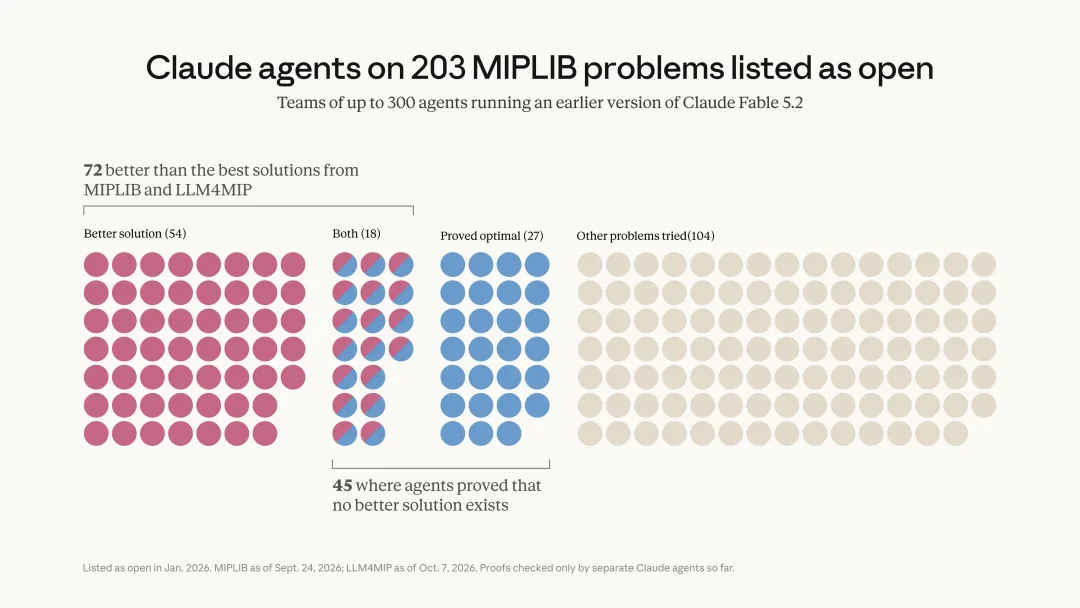
Leaving the chemistry lab, a team of up to 300 Fable 5.2 Agents dove straight into MIPLIB, the operations research community’s classic proving ground.
Since its establishment in 1992, this library has been packed with genuinely tough real-world business problems such as airline crew scheduling and logistics truck scheduling.
Add just one more aircraft or truck, and the number of possible combinations explodes exponentially; the library has long housed hundreds of “long-standing open cases” whose optimal solutions no one has been able to prove.
When the new version of the library launched in 2018, its maintenance committee even issued an appeal to the global academic community for help in cracking the problems.
This time, Claude tackled 203 open cases in one go,smashed the all-time best records for 72 problems, and even established mathematically optimal solutions for 45 of them!
The most visually striking problem in the set was creating a departure timetable for 42 trains.
If several trains happened to step on the accelerator and start accelerating in the same second, the power grid would instantly see an alarming spike in electricity demand.
In less than two hours, the Claude Agent came up with a new timetable whose peak electricity demand was 2.6% lower than that of the library’s all-time best solution.
It then supplied a rigorous mathematical proof, confirming that no more energy-efficient schedule existed anywhere in the world, closing the case on this long-standing problem on the spot and handing the solution back to the official library.
The 2023 Black Hole Physics Computation Challenge
Fully Worked Out
When it came to the theoretical physics exam, Fable 5.2 cleared two long-standing obstacles in one go.
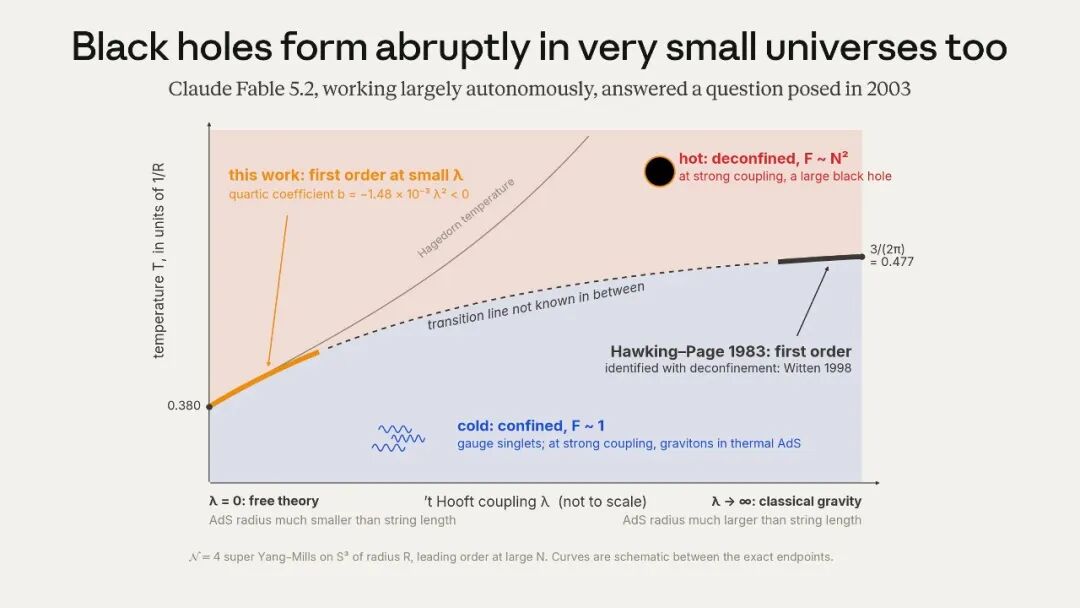
As early as 1983, Hawking and Don Page worked out that when a larger theoretical universe heats up, black holes form suddenly, like bubbles rising in boiling water.
But once the setting was switched to a microscopic universe so small that it could only be described by quantum theory, whether this “abrupt transition” still occurred became a longstanding concern in the physics community.
Physicists did write down a test formula in 2003, hinging entirely on the sign of a three-loop four-point coefficient, but the computational burden was so enormous that no one had managed to calculate it for 23 straight years.
Fable 5.2 took on this grueling task, used two independent methods to calculate the coefficient as negative, and conclusively confirmed that black holes in microscopic universes still appear suddenly!
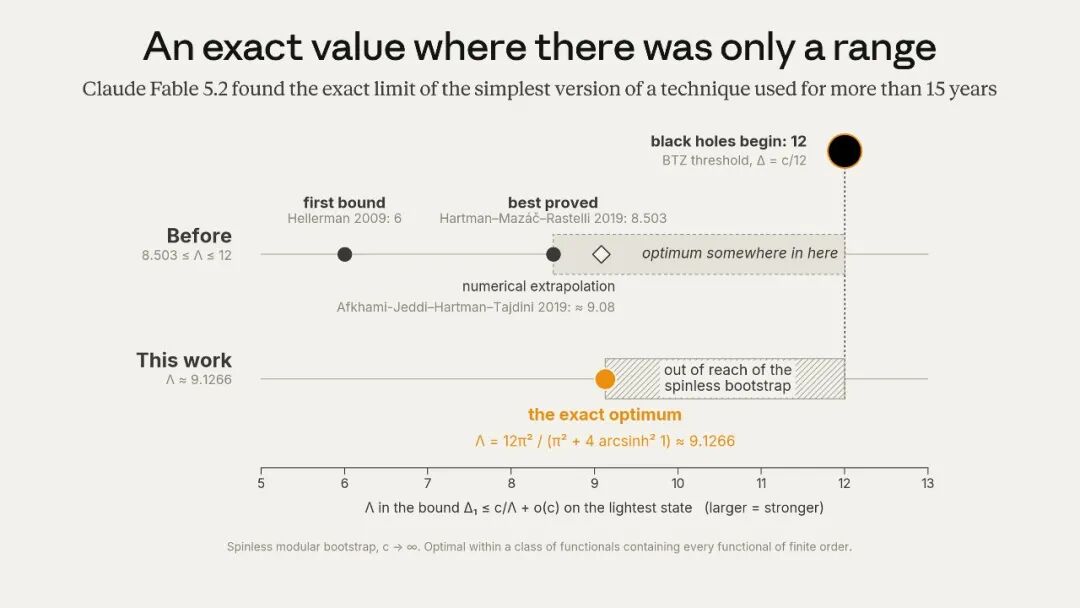
The second question targeted “matrix bootstrap,” the physicists’ trusted tool of the past 15 years, which was specifically designed to sift out untenable quantum-gravity hypotheses within theoretical universes.
For more than a decade, all anyone knew was that the bounds for the simplest version were stuck between 8.503 and 12.
Fable 5.2 produced a 131-page preprint, firmly pinning the exact analytical value at approximately 9.1266.
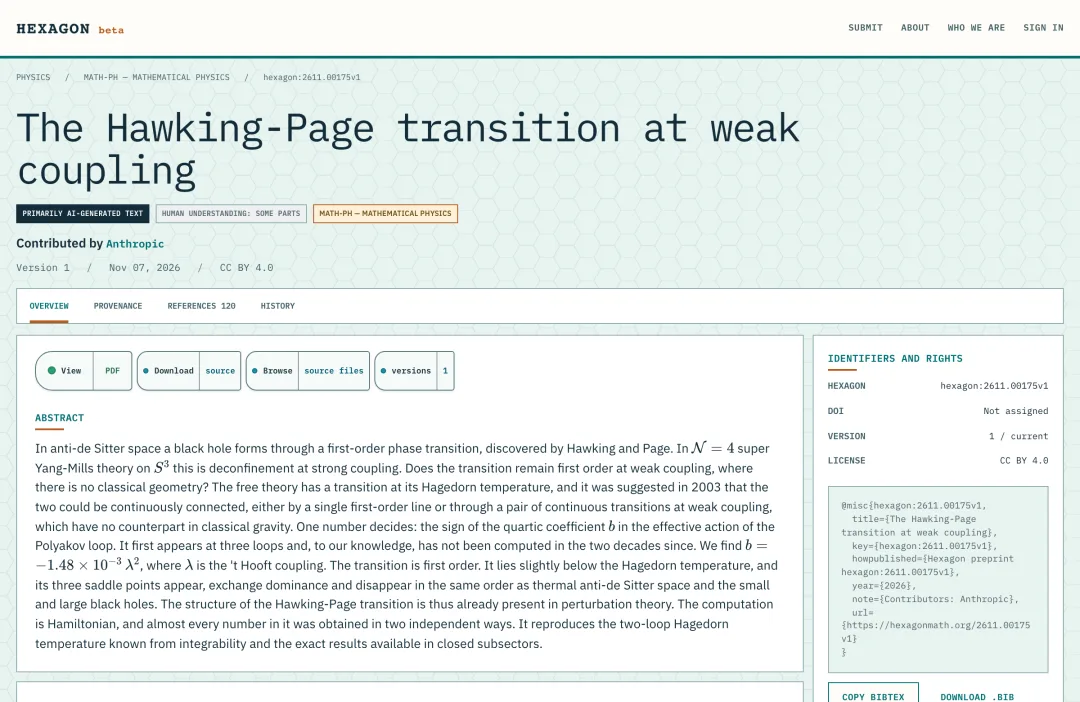
The most amusing scene appeared on the publication page, where the two physics preprints, a hefty 173 pages in total, had both been listed on the Hexagon platform.
Human scholars could only meekly attach a label directly beneath the title: “Level of human understanding: only partially understood.”

This time, although it was not Fable 5.5 that was released, the report card 5.2 delivered was frighteningly impressive.TAG600@@It completed in half an hour, while offline, a molecular synthesis that doctoral students had spent years on. It turned the black-hole slog that physicists had set aside for 23 years into a 173-page paper in one go.TAG606@@
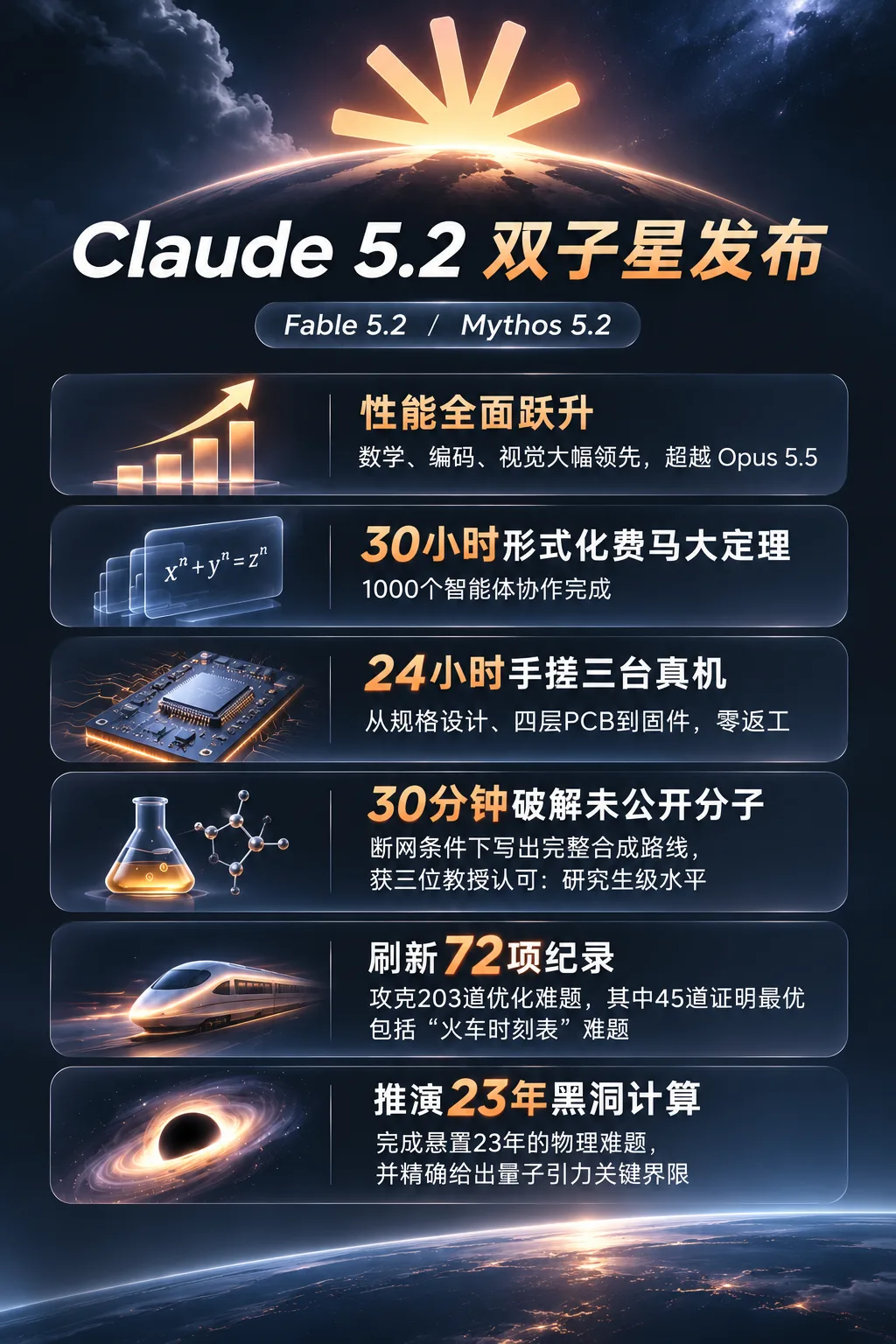
In the past, the grueling work that required several specialist teams in electronics, structural engineering, chemistry, and physics to toil away for years is now being taken on end to end by a single model.
Of course, these three hardware prototypes have not yet passed commercial safety certification, and the four molecular synthesis routes are still just on paper, awaiting testing in flasks inside a fume hood.
Blueprints and simulations in the digital world have already been pushed to their limits…
The most exciting next act will be to open the door and put them through their paces for real in the physical world.
References:
https://x.com/claudeai/status/2119899465914216628
https://www.anthropic.com/research/claude-electronics-design
Editor: Moses Taozi
⭐Like, share, and favorite—all with one click⭐
Hit the star to subscribe to New Intelligence’s lightning-fast updates!