
The results of the United States' midterm elections, taking place this Tuesday (3), may influence the progress of a bill proposing changes to federal environmental permitting rules for energy infrastructure projects, at a time of growing demand for electricity to supply the data centers that support the expansion of artificial intelligence.
What are the midterm elections:
- Management barometer: They take place halfway through the four-year presidential term and serve as a popular assessment of the administration in office.
- Composition of Congress: All 435 seats in the House of Representatives and one-third of the 100 seats in the U.S. Senate are up for election.
- State races: They also include elections for governors and other state offices in different parts of the country.
- Room to govern: The results influence the president's ability to pass laws and budgets and advance their legislative agenda.
 The Midterms (Midterm Elections) reshuffle Congress's seats and state governments, testing the White House's strength during the second half of the term. – Image: AI-generated
Drafted by Republican and Democratic lawmakers, the American Bipartisan Economic Accessibility and Jobs Act (BAAJA, by its English acronym) seeks to amend environmental assessment and permitting procedures for major projects. The initiative brings together changes to various laws and seeks to reduce the time needed to move infrastructure projects off the drawing board.
The text is the result of negotiations among four senators who hold leadership positions on the Environment and Public Works and Energy and Natural Resources Committees: Shelley Moore Capito and Mike Lee, Republicans, as well as Sheldon Whitehouse and Martin Heinrich, Democrats.
What changes under the reform proposal
One of BAAJA’s main objectives is to establish deadlines for federal environmental reviews. Under the bill, reviews of major projects would generally be completed within one to two years. The proposal also calls for greater coordination among government agencies, limits certain avenues for judicial challenge, and establishes conditions to provide greater certainty for permits issued.
The bill amends provisions in three federal environmental laws: the National Environmental Policy Act (NEPA), which guides the assessment of the impacts of construction and projects; the Clean Water Act, which protects water resources; and the Endangered Species Act, which focuses on the conservation of animals and plants at risk of extinction.
According to an analysis, the reform may change how projects that affect natural areas, waterways, and animal habitats are reviewed.The stated goal of proponents is to prevent successive administrative stages and court disputes from indefinitely delaying project approvals. Environmental organizations, however, question whether reducing these stages will also reduce opportunities for public participation and oversight.
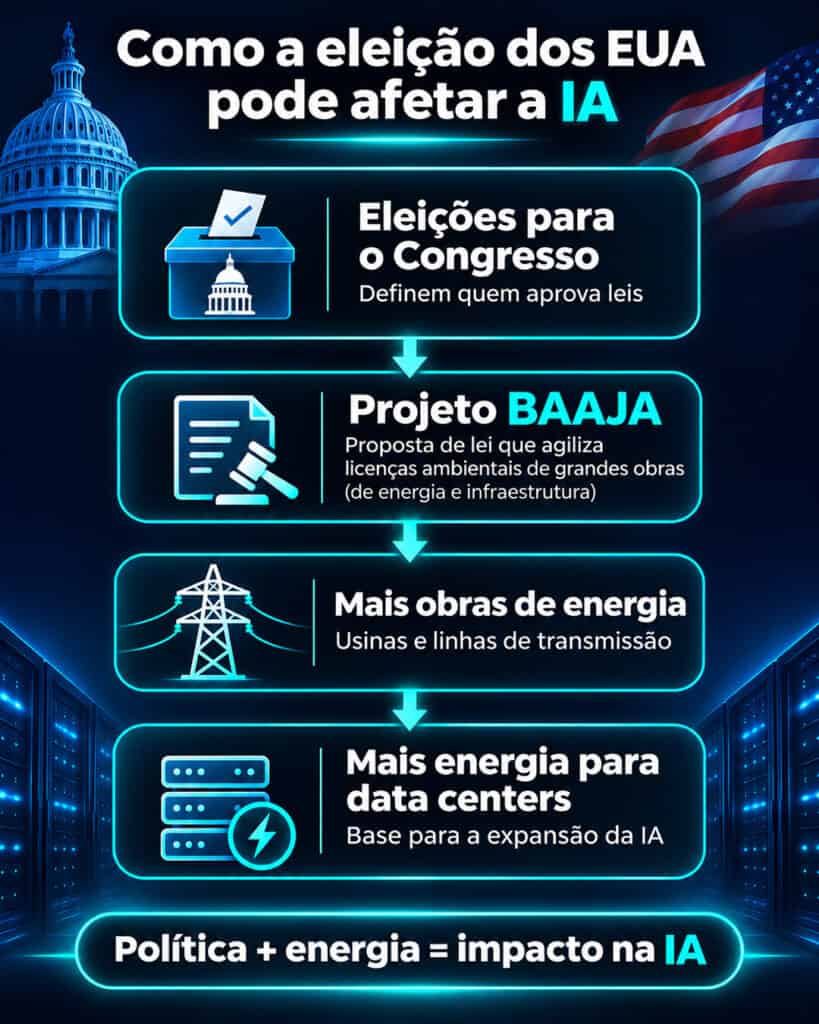 Infographic shows how U.S. elections can influence energy projects and the expansion of artificial intelligence. – Credit: AI-generated image
The proposal also addresses electricity transmission. BAAJA provides for changes in the role of the Federal Energy Regulatory Commission (FERC), expanding its ability to authorize certain interstate lines when state-level proceedings fail to advance. The initiative also changes the criteria for these developments and seeks to facilitate interconnection between producing and consuming regions.
This aspect is particularly relevant because expanding electricity generation alone does not resolve supply problems. Energy produced at a power plant must reach consumers through a network capable of transporting large volumes over long distances. When transmission lines are lacking, new generation projects may face difficulties connecting to the system, even when available generating capacity exists.
For Thiago Maia, a physicist with a master’s and doctorate in Nuclear Physics, a petroleum engineer, and an MBA in Project Management, simplifying licensing may help overcome some of these obstacles.In an interview with Olhar Digital, he explained that the construction of power plants, substations and transmission lines may gain speed by reducing approval deadlines.
“BAAJA may accelerate the construction of power plants, substations and transmission lines by simplifying permitting processes and reducing approval timelines. This will facilitate the supply of electricity to data centers, which require large amounts of energy on a continuous basis,” the specialist said.
Maia emphasizes, however, that changes to the rules do not, by themselves, guarantee an expansion in electric power capacity. The execution of projects also depends on investments, equipment availability and grid planning—factors necessary for energy to actually reach new consumers.
Artificial intelligence increases pressure on the grid
The need to expand and modernize this infrastructure is related to the growth in electricity consumption in the United States. For years, national demand remained relatively stable, but the expansion of industrial activities, electrification and, especially, the construction of data centers changed that trajectory.
A report from the International Energy Agency (IEA), published in 2026, estimates that U.S. consumption will increase by more than 420 terawatt-hours between 2025 and 2030. Data centers are expected to account for approximately half of this growth, driven by the expansion of artificial intelligence and cloud computing services.
The U.S. Energy Information Administration (EIA) also projects record levels of consumption.In its September forecast, the agency estimated electricity sales of 4,135 billion kilowatt-hours in 2026 and 4,211 billion in 2027. The expansion of data centers and industrial activities is among the main factors behind these figures.
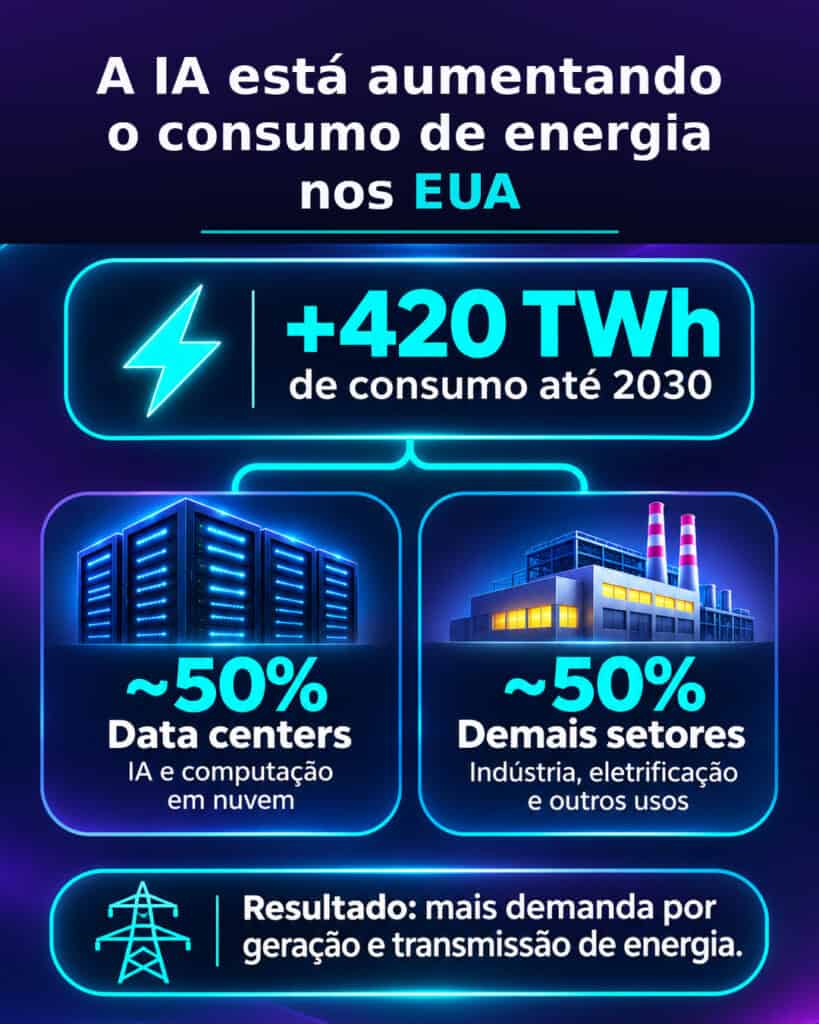 Infographic shows how the expansion of artificial intelligence is driving electricity consumption in the United States. – Credit: AI-generated image
Growth, however, raises an economic question: who should pay for the infrastructure needed to serve new consumers? Connecting large-scale facilities may require additional transformers, substations, and transmission lines. If these investments are spread among all users, families and small businesses may end up bearing part of the costs generated by large technology companies.
BAAJA itself seeks to address this issue by anticipating that data centers will bear the power transmission costs necessary for their facilities to operate. In June, FERC also ordered the six regional grid operators under its jurisdiction to justify or review the rates charged to large consumers, including data processing centers.
The competition for electricity may also increase technological inequality between countries. In Maia’s assessment, nations with greater energy availability, modern grids, and financial capacity will be better positioned to develop their own technologies and attract investment in AI. “Countries with abundant energy, modern infrastructure, and greater financial capacity will have advantages in the development of artificial intelligence.Countries with expensive electricity or deficient grids may already depend on foreign technologies, widening economic and technological inequalities.”
In this context, energy infrastructure will also influence international competitiveness. Countries that fail to keep pace with growing consumption may face difficulties developing their own data processing centers and become more reliant on services offered by foreign companies.
Elections may change the future of the proposal
The new composition of Congress may directly affect the progress of the BAAJA. The outcome will determine which party will control both chambers during the final two years of Donald Trump’s term.
This composition affects committee leadership, the setting of agendas, and the ability to pass bills. If Democrats win control of either chamber, they may increase oversight of government decisions and demand changes to the proposal. If Republicans retain control, they will have more latitude to steer the administration’s legislative agenda.
The possible consequences also extend beyond U.S. borders. Maia believes that changes to U.S. permitting rules may serve as a model for other governments interested in accelerating energy infrastructure projects.
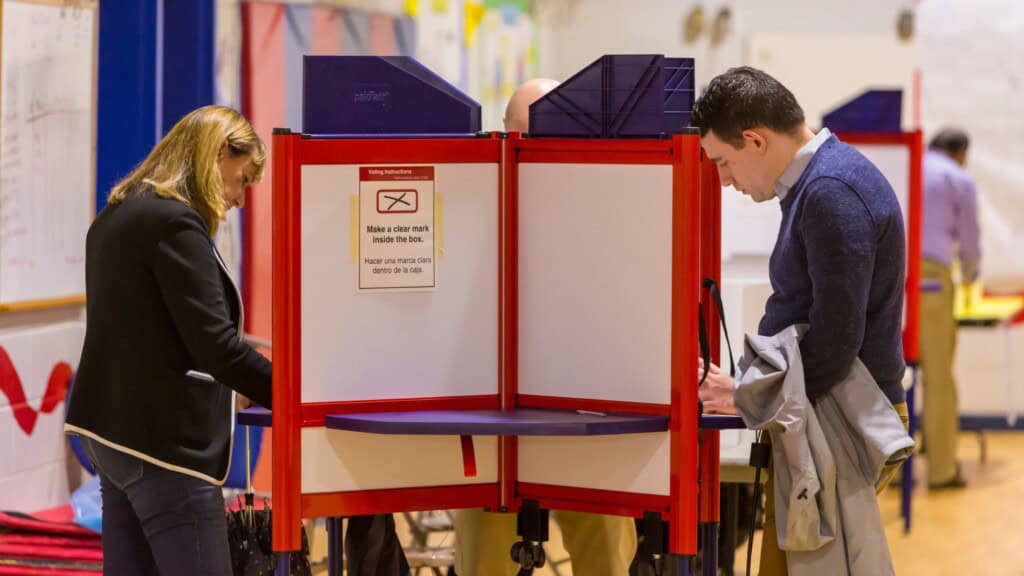 In the U.S., midterm elections renew Congress and test presidential popularity. – Credit: Rob Crandall/ShutterstockHowever, reducing requirements or assessment stages may raise concerns about environmental preservation and the participation of affected communities."The main challenge will be reconciling investment agility with oversight and environmental protection. The changes may serve as a reference for other governments seeking to accelerate energy infrastructure projects," says Maia.
According to Reuters, the negotiators' intention is to place the proposal among the first matters analyzed when work resumes after the elections. The Chamber has not yet approved the bill, so its conversion into law will depend on new negotiations and its processing in both Houses.
Another point involves the energy sources that will be used to meet growing demand. Since data centers need electricity continuously, an insufficiency of other sources may lead countries to expand the use of fossil fuels, mainly natural gas and coal, to avoid interruptions in supply.
Maia considers this risk to be greater in the short term, when the available infrastructure cannot keep up with the increase in consumption. At the same time, the expansion of AI may also stimulate investments in alternative sources and storage systems.
"Since data centers need electricity continuously, countries may expand the use of natural gas and coal when there is not enough infrastructure to meet demand with other sources. However, the expansion of artificial intelligence may also drive investments in solar, wind, nuclear power and storage," he explains.
The outcome of the elections will not, by itself, determine the future of the United States' energy infrastructure.However, it will establish the balance of power responsible for discussing the limits of the reform, overseeing its implementation, and deciding which projects will be prioritized. Congressional decisions will have consequences not only for the expansion of the power grid, but also for environmental protection, the energy mix, and the distribution of costs between companies and consumers.

Flávia Correia is a journalist at Olhar Digital, covering Science and Space.

