
Meta launched Muse Ember, the lightest and most cost-efficient AI model from its Superintelligence Labs. The new model was developed to perform recurring tasks for AI agents that require complex reasoning.
Applications include tool calls, programming subtasks, routing, data extraction, and the analysis of long documents. The model costs US$ 0.10 per million input tokens (around R$ 0.54).
 Meta presents Ember as its lightest and most cost-efficient model to date. The model was designed for tasks such as programming, routing, and data extraction. – Image: davide bonaldo/Shutterstock
Model focuses on low cost for operations at scale
Meta highlighted the cost per task as one of the main differentiators of Ember. To demonstrate its competitiveness, the company used the Artificial Analysis composite score, which served as a benchmark for comparing the cost and performance of different models.
According to the comparison presented, Ember is cheaper and smarter than competitors such as Anthropic's Haiku and OpenAI's Luna. Its price is also competitive with open-source alternatives such as DeepSeek V4.1 Flash and GLM 5.3 Flash.
The proposal is to use the model together with larger systems, such as Muse Wonder, in an AI agent execution framework.In this setup, the most advanced model plans the operation and sets the rules, while Ember carries out the instructions at scale.
One example would be a customer service agent: Wonder would define how to solve a particular problem, while Ember would apply those guidelines across tens of thousands of customer service interactions. Meta summarized this division of roles in the announcement: “Muse Wonder plans, Muse Ember handles the volume”.
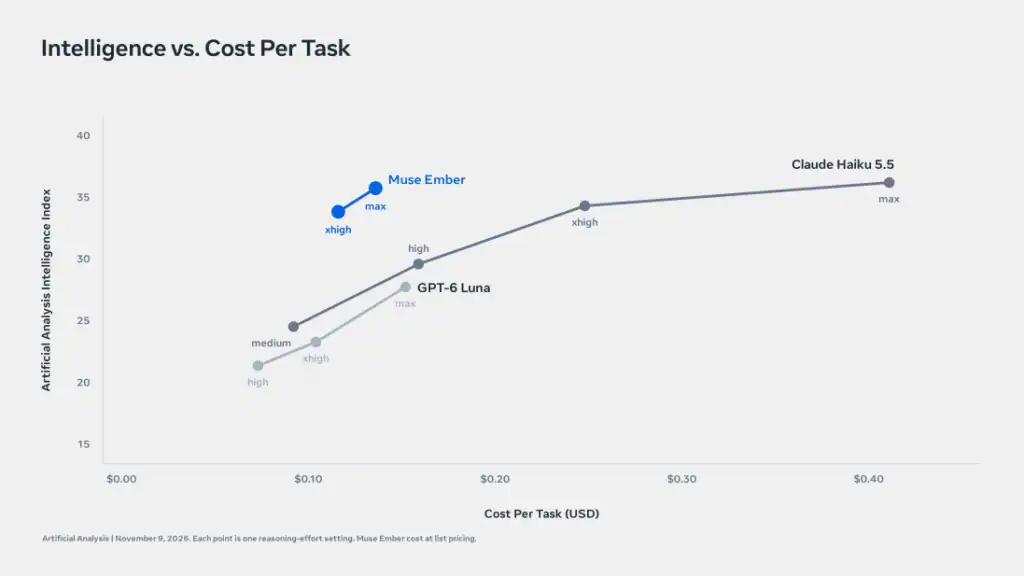 At a cost of US$0.10 per million input tokens, Muse Ember offers lower prices than competitors such as Haiku. – Image: Meta Superintelligence Labs
Ember also processes images and audio
The model's training also covered different information formats. In addition to text, Ember can work with images and audio, allowing agents to process different data sources without relying on a separate system for each media type.
Among the types of content the model can analyze are:
- Screenshots and graphics;
- Scanned documents;
- Voice messages;
- Meeting recordings;
- Videos.
Fourth model in the Muse family
Ember is the fourth release in the Muse line. The sequence began in April with Spark, the mid-tier model. In August, the company introduced Glimmer, the open-source version of Spark. In October, Muse Wonder arrived, the family's most advanced model.
Muse Agent, Meta's main consumer-facing AI product, was launched in September and achieved unexpected success.In early November, it received new features such as Spaces and video calls.

Valdir Antonelli is a journalist specializing in digital marketing and consumer behavior.


