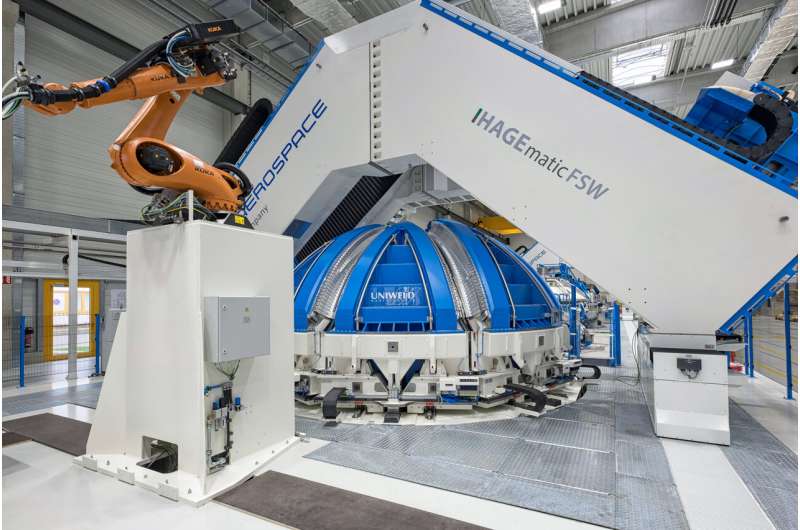
 Friction stir welding machine at MT Aerospace. Credit: MT Aerospace
Artificial Intelligence, or AI, promises many benefits in all domains, and rocketry is no different. The European Space Agency's Future Launchers Preparatory Program (FLPP) is investigating the use of AI to develop better processes and even whole new shapes in materials that could be used on rockets or spacecraft of the future.
Together with MT Aerospace in Germany the Agency is looking at adapting material process techniques across the industry.
Shot peen forming
Shot Peen Forming is a process whereby metal is shot with small balls to bend it into shape. As the formation is done without heating, the resulting metal shape stays strong and is more resistant to metal fatigue. It is a commonly used process and is how MT Aerospace shapes the dome heads of Ariane 6 rocket's fuel tanks.
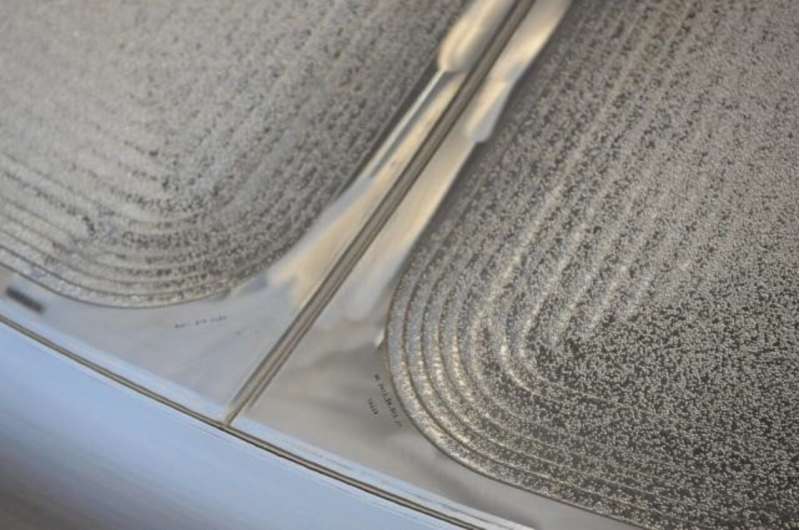 Shot peen formed surface. Credit: MT Aerospace
As the balls hit the metal at high speed, each impact is unpredictable. For the first time, machine learning is being used to predict how the metal will deform next, providing a fast and precise method to reach the desired shape with a tolerance of just 2 millimeters.
Friction stir welding
Once a metal part is made, it often needs to be joined to other components. In the space industry, friction stir-welding is replacing traditional arc welding done by humans or robots. Friction stir welding heats up the metals by simply rotating a pin over the welding area at high speeds, thereby using friction to stir the materials together. This precise welding technique fuses metals, allowing for stronger structures, such as those used to make the tanks for Ariane 6.
With new digital monitoring technologies for weld force, temperatures and other machine telemetry, machine learning is now helping set up the machines faster, support documentation efforts and automatically check the shape of the final weld. This automatic evaluation of weld seams has reduced analysis time by 95% compared to the traditional process.
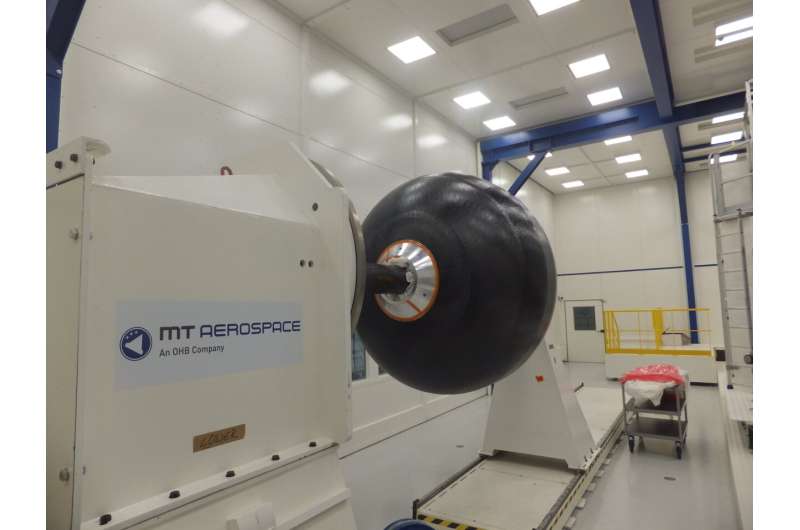 Phoebus hydrogen tank during production at MT Aerospace in Augsburg, Germany, October 2025. This tank will hold almost 2,600 liters and is 2 m in diameter. The tank completed the first manufacturing steps on its inner tank pressure vessel at MT Aerospace in Augsburg, Germany in September 2025. Credit: MT Aerospace
Automated fiber placement
It's not all metal though—carbon-fiber reinforced plastic offers new shapes that are lighter and stronger. Built in layers, the Phoebus project is exploring the use of carbon-fiber tanks for Ariane 6.
Here MT Aerospace is integrating new laser sensor technology that, powered by machine learning models, will detect and classify defects on the fly, which keeps production going and shortens production times significantly.
"Artificial intelligence, such as machine learning, in combination with new digital technologies is transforming launcher manufacturing," says Daniel Chipping ESA project manager for software-centered and digitalization activities at the Future Launchers Preparatory Program in Space Transportation. "From automating complex analysis tasks to reducing tedious machine stop-starts, we are starting to see the benefits across all materials and shaping processes."
These projects are part of ESA's Future Launchers Preparatory Program (FLPP), that helps develop the technology for future space transportation systems. By conceiving, designing and investing in technology that doesn't exist yet, this program is reducing the risk entailed in developing untried and unproven projects for space.

