
Artificial intelligence (AI) may be helping to accelerate its own development. An independent assessment by the nonprofit organization Model Evaluation and Threat Research (METR) indicates that Anthropic’s models are advancing nearly twice as fast as before, partly because the company uses its own AI systems to develop more powerful versions of the technology.
The study, released this Thursday (5), estimates that the advancement of Anthropic’s model capabilities on well-defined tasks has occurred at a rate 1.9 times higher since October 2025, compared with the previously observed pace.
According to METR, around 80% of the current acceleration may be related to the use of AI in the company’s research and development activities. However, the estimate has a high degree of uncertainty.
The assessment was conducted over 11 weeks, between August and October 2026. The researchers had access to internal Anthropic data, interviewed employees, and analyzed information on the performance of models that had not yet been publicly disclosed.
The organization also identified that the increase in computational power used in training does not explain the observed acceleration.
How is AI helping to develop other AIs?
- The survey indicates that AI tools are being used by Anthropic researchers to write code, conduct experiments, and carry out activities related to model development;
- In practice, this allows professionals to perform certain tasks more quickly and devote time to other stages of the research;
- METR found reports from employees pointing to significant productivity gains. In informal internal surveys, some speed estimates reached as high as 12-fold in October 2026. The organization, however, considers these figures unreliable because they are subjective assessments and may overestimate the technology's actual impact;
- Interviews with researchers also indicated significant gains, although the results varied depending on the activity analyzed.
The study makes an important distinction: most of the progress is still associated with the assistance provided by AI to professionals, rather than the autonomous completion of the entire development process.
METR said it had found no evidence that current systems can already make highly significant and fully independent contributions in the most important stages of model training. Even so, researchers identified signs that this type of participation could gain ground in the future.
Read more:
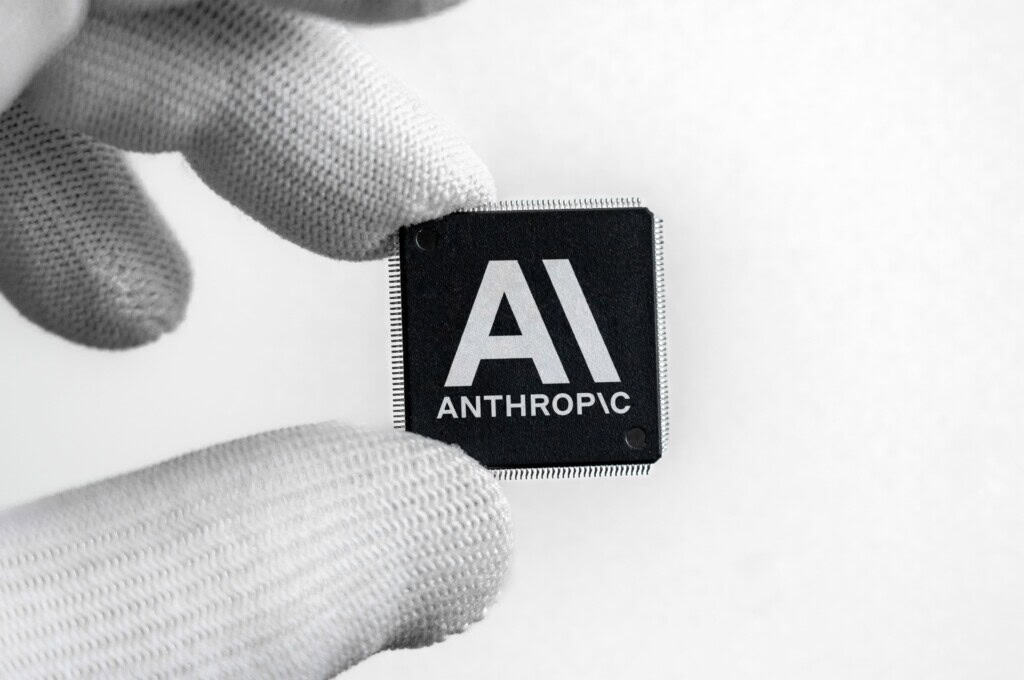 A survey indicates that AI tools are being used by Anthropic researchers to write code, conduct experiments, and perform activities related to model development – Image: gguy/Shutterstock
What is recursive self-improvement?
The progress observed by METR has drawn attention because it is related to the concept of recursive self-improvement, known by the acronym RSI (in English). The idea is that AI systems can contribute more and more to the creation of new generations of models. With more capable systems helping to develop their successors, the process could accelerate progressively.
This scenario has not yet been fully achieved, but it raises important questions about the pace of technological evolution.
One of the concerns highlighted by METR is the possibility that the acceleration could become cumulative. More advanced models could help develop even more capable systems, which, in turn, would accelerate the process again.
The organization also did not identify any clear bottlenecks related to computing power, data availability, or experiments that would necessarily prevent further advances in the next 12 months. The researchers, however, stressed that this assessment is also subject to uncertainties.
The study has limitations and raises safety questions
Despite the results, METR recognizes important limitations.The 1.9x acceleration was calculated based on performance indicators in well-defined tasks, which can be evaluated through automated tests or language models. This does not mean that all AI capabilities are evolving at the same rate.
Furthermore, Anthropic was able to remove confidential information from the report. According to METR, much of the evidence considered most relevant to its conclusions was omitted, making it difficult to independently assess all the details.
The organization also emphasizes that there is uncertainty about how much of the acceleration can be directly attributed to the use of AI, particularly in relation to the advances recorded in late 2025.
The results come at a time when Anthropic CEO Dario Amodei has advocated caution in the development of increasingly advanced systems. In September, the executive called on the industry to slow the advancement of the technology’s capabilities so that safety measures could keep pace with improvements.
The study itself points out that understanding the pace of this evolution is important for assessing risks. If systems begin to contribute increasingly significantly to the development of their successors, monitoring and control efforts may also become more difficult.

Rodrigo Mozelli is a journalist graduated from São Paulo Methodist University (UMESP) and is currently a writer at Olhar Digital.


