Founded only four months ago and already raised over US$100 million: TensorWorld Wuyuan Technology is making its “physically realistic” approach work
TensorWorld Wuyuan Technology has already raised over US$100 million in funding within one month
Imagine this scenario: a humanoid robot stands in a kitchen, facing a glass cup near the edge of a table. It extends its robotic hand to push the cup farther in—apply slightly too much force, and the cup slips, falls to the floor, and shatters. For humans, the prediction that “a cup near the edge of a table will fall, and glass will shatter when it hits the ground” is nearly instinctive. For robots, however, such a prediction requires a complete physical logic system: they must not only know “what is in front of them” but also understand “what will happen next if I do this.”
This is precisely one of the AI industry’s most urgent battlegrounds today. As large language models propel the rapid development of intelligence in the digital world, the boundaries of AI’s capabilities are extending into the physical world—embodied intelligence, autonomous driving, industrial simulation, and so on. But the physical world does not operate by token-based rules; it has its own immutable laws: gravity, friction, collisions, fluids, and more. The difficulty rises exponentially compared with language.
On this harder, more foundational track, TensorWorld Wuyuan Technology, a startup founded only four months ago, has already raised over US$100 million in just one month. Behind this capital bet is the scarcity value created by its combination of academic pedigree, technical approach, and ability to reproduce results in real-world deployments.
What problem does the industry need to solve?
At present, in the public’s general understanding, AI is already extremely intelligent. It can not only write code and find vulnerabilities, but even solve mathematical problems that have troubled humans for hundreds of years. Yet when it comes to enabling robots to predict the trajectories of real-world objects and interact with them, it is difficult to achieve a “reliable” standard. The reason is that AI does not yet understand the laws of physics, and moving from the “software interface” into the “physical world” is an absolutely unavoidable hurdle.
To cross this chasm, the industry faces extremely demanding conditions: high-fidelity physics-annotated data is shockingly expensive, and a single industrial-grade aerodynamic simulation sample often requires tens of thousands of CPU hours. Data collected in 100 scenarios is difficult to generalize to 10,000 unknown scenarios. Simulators also struggle to fully reproduce real-world friction and deformation. A Stanford HAI report shows that robots can achieve task success rates of up to 89.4% in software simulations, while the success rate for the same type of task in real home environments is only about 12.4%.
How does Wuyuan Technology solve this problem? The evolution of the field presents a clear path
At present, world models in the industry can generally be divided into two paradigms: vision-driven and physics-driven two paradigms.The former is the industry mainstream, represented by video generation. Its goal is to “look realistic”, optimizing the pixel-level plausibility between frames. Its advantages are that data is relatively easy to obtain and the visuals are lifelike. It is widely used in video generation, data factories, scene previews, and front-end perception for VLAs. But for robots to reliably perform tasks in the real physical world, language and visual understanding alone are far from sufficient.
Therefore, another paradigm is increasingly recognized by the industry, focusing on modeling according to physical laws, with the goal of making predictions “more realistic”. Its advantages are that it is verifiable, measurable, and able to support action planning. Traditional industrial simulation software, such as MuJoCo and Isaac Sim, represents the “handcrafted school” on this route—the laws of physics rely heavily on engineers hand-coding them one by one. Predictions are accurate but expensive, and handling irregular shapes, soft bodies, and fluids requires enormous engineering effort.
Origyn Technology, meanwhile, follows the path of a physical foundation model. The company proposes “building physical reality in a tensor world,” with the goal of enabling models to learn the evolutionary laws of the physical world from data and achieve a human-like ability to “generalize beyond the examples”:
For example, vanilla Transformers lack the ability to decompose temporal sequences: how can a model correctly understand “time” in the physical world? Autoformer substantially improved the accuracy of long-term time-series forecasting, while TimesNet further made time-series data more intuitive and visualizable. Similarly, how can a model understand “space”? Uni3D extended three-dimensional representation learning to the billion-parameter scale, enabling models to form concepts of objects, geometry, and spatial relationships.
Building on this foundation, GeoPT answers the defining question of the field: can “physical intuition” be pre-trained into a model? The answer is yes. Through innovative pretraining that combines geometry with synthetic dynamics, it enables models to acquire transferable physical representations. In industrial physics-simulation tasks, this approach reduced the amount of labeled data required by 20% to 60% and accelerated convergence by up to 2×. Transolver goes a step further, enabling models to understand forces, flows, and deformation in irregular spaces and comprehend more complex physical evolution. EfficientZero, meanwhile, enables agents to simulate the future using learned world models and plan accordingly.
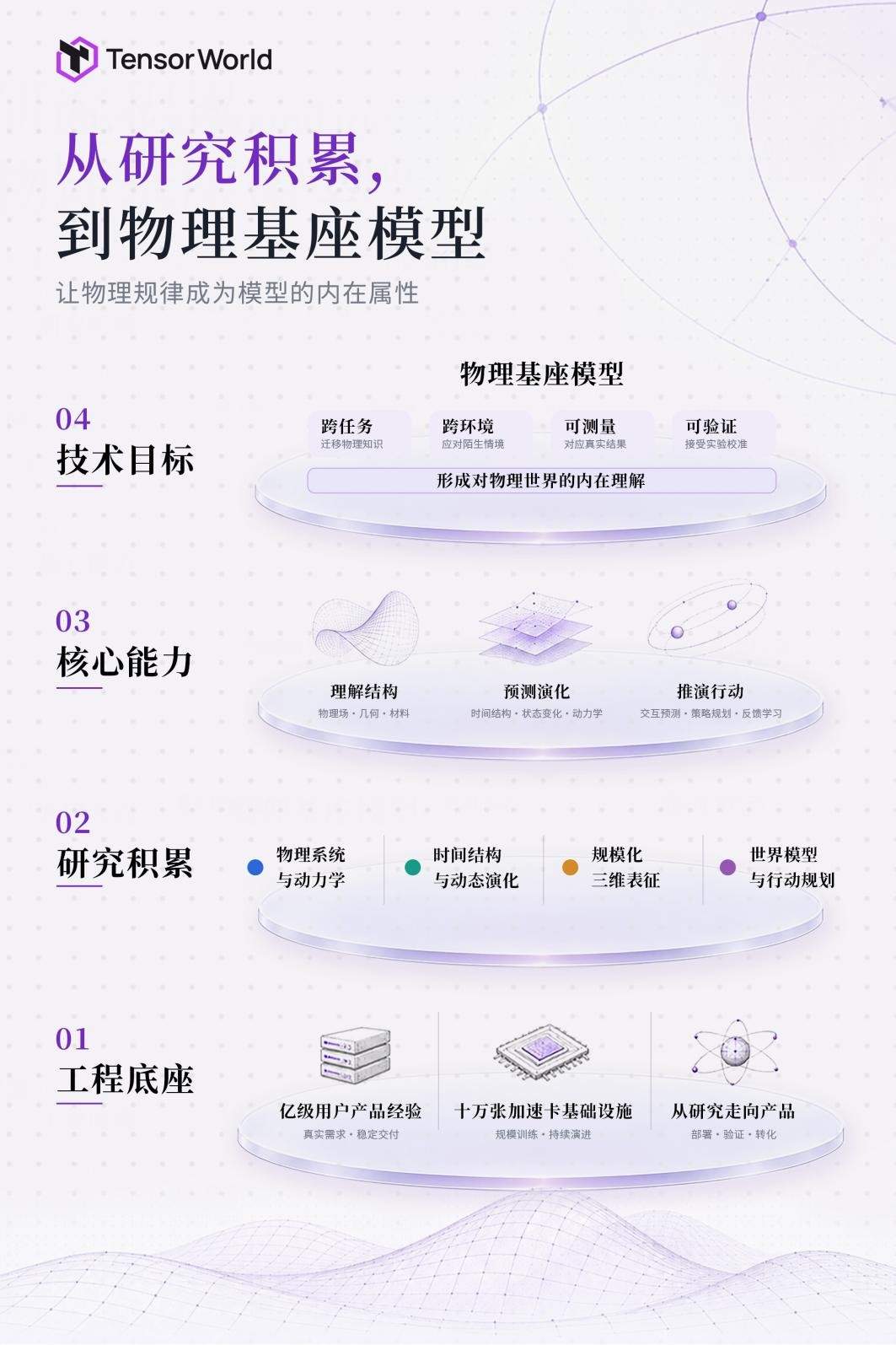
Supporting these advances is the founding team’s long-standing accumulation of expertise across Tsinghua, MIT, and other leading international academic institutions. Following the progressive path of “temporal evolution—spatial representation—physical laws—action planning,” they have not merely piled up isolated papers; instead, they have remained committed to starting from the laws of physics to achieve genuine “higher-order physical intelligence,” ultimately bringing together the complete picture of a physical foundation model. In addition, Origyn’s founding team previously led products serving hundreds of millions of users and managed computing infrastructure with 100,000 accelerator cards, giving it extensive hands-on industrial experience. If academic research determines how far a model’s capabilities can go, engineering capability determines whether the model can be used in real business scenarios. Together, the two constitute the “two sides of the same coin” of a physical foundation model.
Why is Origyn Technology so highly regarded? The rarity of a physics-driven paradigm
Origyn’s technical roadmap maps almost directly onto the three major pain points of physical AI: on the data side, it uses synthetic dynamics in place of physics labels, sharply reducing reliance on costly real-world data; on the generalization side, it deeply integrates spatial structures, temporal evolution, and physical dynamics, enabling general physical laws to emerge spontaneously within the model; and on the deployment side, underlying architectures such as Autoformer and Transolver have already been widely validated and adopted across industry, such as in NVIDIA PhysicsNeMo, easing concerns about deploying AI in real-world scenarios.
The rarity of this convergence—“a true understanding of physical systems + planning capability driven by world models + engineering capability to deploy frontier research at scale”—quickly attracted investors’ attention.Within a month of its founding in July, Origyn Technology completed back-to-back angel and angel+ rounds raising more than US$100 million. The angel round was jointly led by Cathay Capital and Sequoia China, with IDG Capital, CDH VGC, Xinglian Capital, and Ant Group participating; the angel+ round was jointly led by Ant Group, Hony Capital, and Meituan Strategic Investment, with Fortune VC, NIO Capital, Jinghe Capital, and several existing shareholders continuing their participation.
This investor list also conveys a great deal of information: Meituan Strategic Investment, with its vast array of consumer-facing use cases; Ant Group, with serious industrial scenarios; and NIO Capital, with autonomous-driving scenarios—all corroborate that Origyn Technology’s approach has strong generalization properties and can meet the needs of a broader range of industries.
The world-model field is already becoming “crowded,” but issues such as error accumulation in long-term time-series forecasting, the final gap between simulation and reality, and unified evaluation standards still need to be addressed. If Origyn Technology’s approach proves successful, it will mean that models truly understand how the world operates and can predict the consequences of actions. Its value would extend beyond individual applications such as robotics or autonomous driving; it could become an underlying standard and foundation for the Physical AI ecosystem, paving the way for AI’s future transition from the digital world to the physical world.
This article was provided by Origyn Technology. QbitAI is authorized to reprint it, and the views expressed are those of the original author.