

Google has opened the SynthID website to the general public, its tool for checking AI-generated content. The service analyzes images, audio, and video in search of digital watermarks that help verify if that material was created by a compatible tool.
Previously restricted to researchers, journalists, and other selected professionals for testing, the platform is now available to anyone. This new feature expands access to a technology created to help investigate the origin of content that is increasingly difficult to distinguish from real records.
 Google's technology is already used in tools such as Gemini, Veo, and Lyria to mark AI-generated content. – Image: Mijansk786/Shutterstock
How does media tracking work
Identifying synthetic content has become a challenge on the internet. With increasingly precise generators, SynthID looks for an imperceptible watermark to the human eye, inserted into the file at the moment it is generated.
The method, however, depends on a condition: the tool used to create the content must incorporate SynthID. Without this identification, the system cannot perform the same verification.
The site was also prepared to work with different types of files:
- Images: JPG, JPEG, PNG, BMP, WEBP, AVIF, HEIC, HEIF, TIFF, TIF, and GIF;
- Videos: MP4, MOV, and WEBM;
- Audios: WAV, MP3, OGG, FLAC, AAC, and M4A.
Adoption in the market and major partners
The technology is already present in Google's ecosystem models and tools, including Gemini, Veo, and Lyria, as well as features like Flow, ProducerAI, and Vids. The verification was also integrated into the Gemini app and Google Chrome. According to the company, the system currently receives about 1 million requests per day.
Read more:
- Google will limit access to Gemini models for free users and AI Plus
- SpaceX launches Google AI chips into space for testing future orbital data centers
- European Union plans a tax to charge Big Techs without irritating the US
The scope of the standard goes beyond Google. OpenAI, Nvidia, and Kakao also support SynthID, while Apple is set to incorporate the technology into Apple Intelligence "soon".
OpenAI still maintains its own site to verify content.
Microsoft and Meta, for example, have standards for marking and verifying AI-generated content. These tools, however, are not infallible and may fail to identify materials generated by their own company's models.
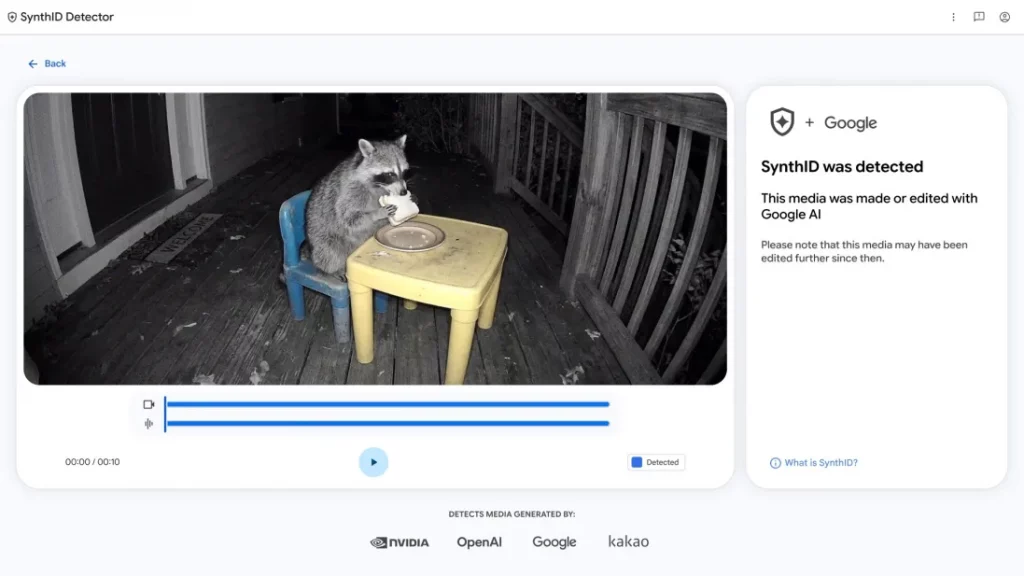 Images, videos and audio can be analyzed by the SynthID website in search of invisible watermarks. – Image: Reproduction/Google
The limits of verification
The arrival of SynthID to the public broadens the possibilities of checking, but does not make the tool a universal detector of artificial intelligence. Its functioning continues to depend on the presence of the watermark in the material being analyzed.
Therefore, the usefulness of the system grows as more generation tools adopt the standard. For the user, the technology offers an additional way to investigate the origin of images, videos and audio found on the internet, without relying solely on the appearance of the content.

Valdir Antonelli is a journalist with specialization in digital marketing and consumption.

Ana Figueiredo is the technology editor at Olhar Digital. She is a Journalism graduate from the Federal University of Uberlândia (UFU).



