AI summaries in AI Overviews cards are still being tested and are not visible for every query
Summaries in source cards are still being tested. Topvisor Journal writes that Google has not announced an official launch, and the feature does not appear in every search. Barry Schwartz of Search Engine Roundtable also saw summaries only for some of his test queries. The countries, languages, and devices included in the test were not specified in the publications about it.
I would not wait for the official launch before working on the page: the AI Overviews block itself is appearing more often. According to Comscore, it appeared in 39.4% of Google desktop searches in the United States in June, and in 25.8% in July 2025. The block where summaries are being tested is already visible in two out of five searches.
Which sites should care about Google’s AI answer in search results (AI Overviews), and whether it is visible from Russia
This matters to sites that receive a substantial share of their traffic from Google: those with international or English-speaking audiences, and those in niches where customers specifically search on Google. If your customers rely on Yandex and Alice AI, there is no urgency.
There is no definitive answer to whether users in Russia have AI Overviews. According to a study by Aral, Li, and Zuo, AI Overviews’ coverage expanded from 7 countries in 2024 to 229 in 2025. France, Turkey, China, and Cuba did not get the feature, while the study’s abstract does not mention Russia.There are no official details on whether AI Overviews are being shown in Russia, so check for yourself whether the block appears in your queries.
The easiest way to see what Google says about your page is in the search results themselves: run your queries and open the source cards in the AI Overviews block. Google says the block cannot be disabled. However, the Web filter shows only text links without AI blocks, making it easy to compare the regular search results with the AI answer.
Checklist: what to test on your page to make the AI summary in the source card encourage clicks
Focus on what the AI model will pull from the page: the first screen and the direct answers under the subheadings. The summary in the source card works like a new snippet written by the AI model; it is unknown what text it draws from, so test the page itself, not just the description. A site that states its core value and the benefit of clicking right at the beginning of the page will get a clear summary. A site with vague introductory text will be devalued by the summary even before the click: people will read an empty paraphrase and open the neighboring source.
It is not yet known whether the summary can be controlled through search settings for displaying descriptions, so the only way to influence it is through the page copy itself. Pages that rank both for the question itself and for its subtopics are more likely to appear as sources. According to data cited by Search Engine Land, across 173,902 URLs, such pages are 161% more likely to be cited in AI Overviews than pages that rank only for the main query.
Hide the title and description and read only the first screen of the page. In two sentences, write what it is about, who it is for, and what people will get by going to it.It didn’t work for you, and it won’t work for an AI model either.
Find the first sentence of the main text. If it is about the company’s history or general market talk, and the substance begins in the fourth paragraph, move the substance up.
List what is on the page beyond what will fit into the summary: the price, table, calculator, file, and terms. That is the reason to click. If everything important fits into two sentences and there is nothing to add, the summary will replace the click.
At the beginning of each section, under the subheading, put the direct answer in the first sentence, followed by the rationale. Make the subheading a reader’s question or a thesis that makes sense without the neighboring sections.
If the figures, terms, and names are currently only in an image or PDF, duplicate them as text on the page.
Compare the title, description, and first paragraph: they should all say the same thing. If they promise different things, the summary will be a mess.
Put the first screen into any AI model and ask it to retell it in two sentences to someone looking for your topic. Google generates the summary with its own model and for a specific query, so the text will be different, but you will see what a reader takes away from the page.
Enter your queries in Google, open AI Overviews, and look at the cards on the right or below.Try a few variations: summaries are not shown for all queries.
My checklist is based on how Google describes the answer’s grounding in web pages; there are no measurements for the summaries in the cards behind it.
Will people click your site less often if it appears among the sources for AI Overviews?
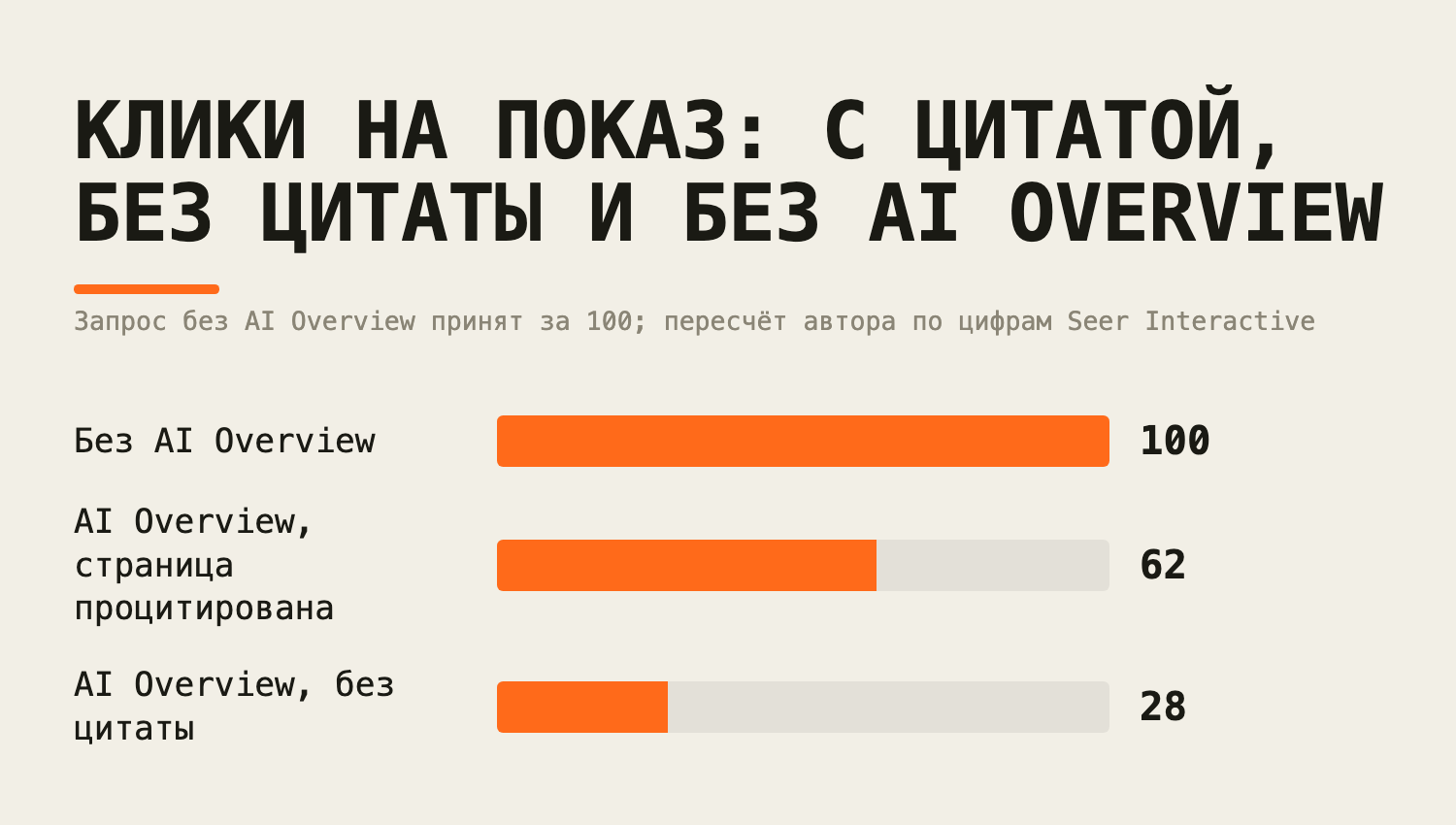
There are no click data for the summaries in the cards themselves yet; there are data for the block as a whole. According to Seer Interactive, as summarized by Search Engine Land, a citation in an AI Overview generates 120% more organic clicks per impression than appearing in the SERP with that block but without a citation. However, queries with a citation still receive 38% fewer clicks per impression than queries without an AI Overview.
If clicks without an AI Overview are taken as 100, pages with a citation come out at 62, while pages without a citation get around 28. This is my recalculation from Seer’s two figures; it shows the magnitude. Appearing among the sources is beneficial: it generates more than twice as many clicks. The unfortunate part is that even with a citation, a page loses more than a third of its clicks compared with the SERP without the AI block.
The summary in the card adds another filter after the citation: the page is already among the sources, but the summary may not provide a reason to visit. The site whose first screen immediately tells visitors what is there and why they should go there will get the click.It’s interesting whether such summaries match the first screen of the page for people who already see them in their search results.


