In this update, robot control capabilities also attracted considerable attention. In the official announcement post, the Science and Engineering section includes a dedicated “Hardware and Robotics” subsection.
In the official demo video, Claude Fable 5.2 controls a robot to complete tasks such as manipulating puzzle pieces, unscrewing bottle caps, and drawing a robot image.
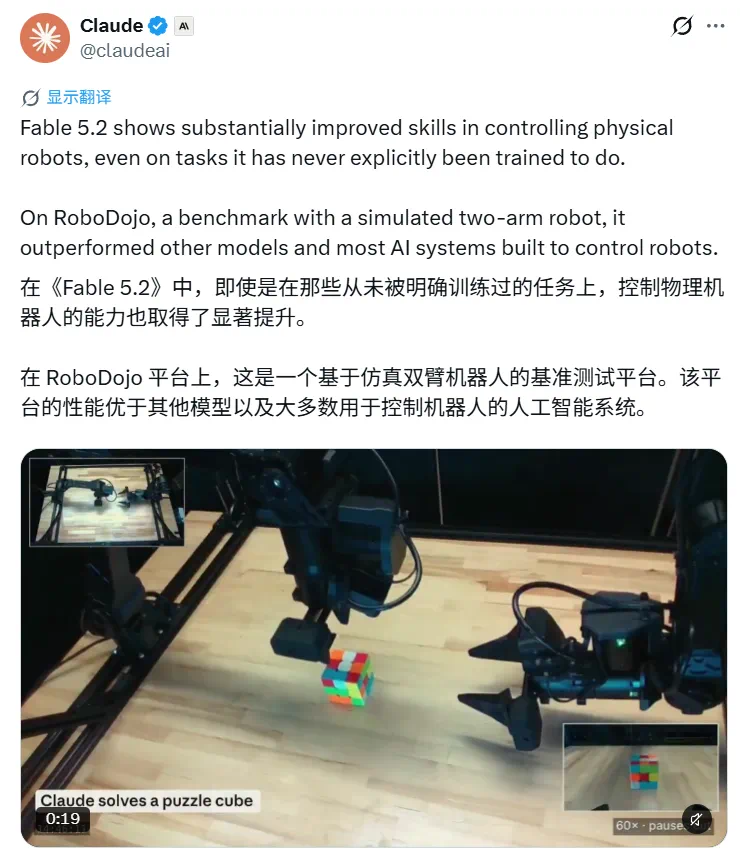
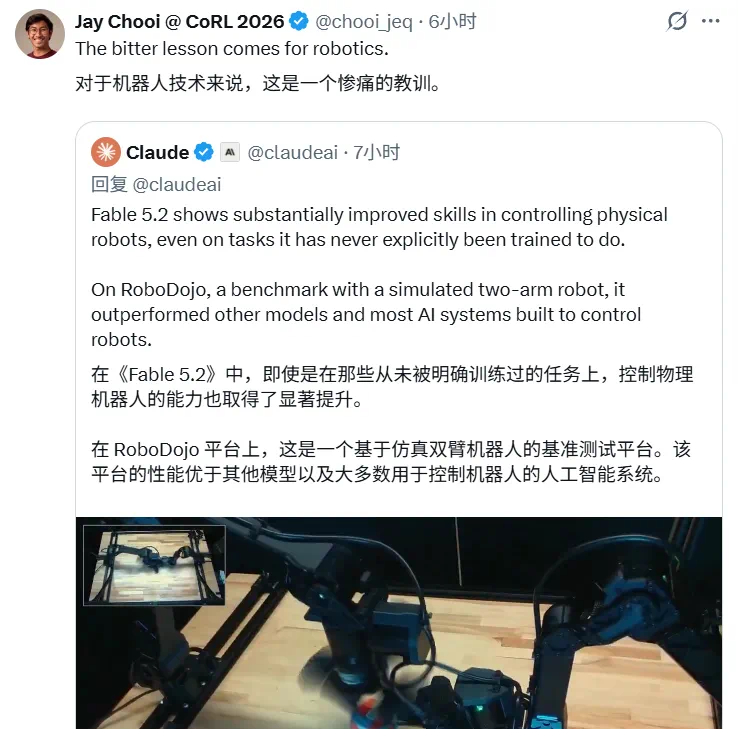
According to data published by Anthropic, Claude Fable 5.2 scored 64.9% on RoboDojo Sim, up 37.3 percentage points from the previous generation, Fable 5.1 (27.6%), and surpassing Claude Opus 5.5 (39.4%) and GPT-6 Astra (29.8%).
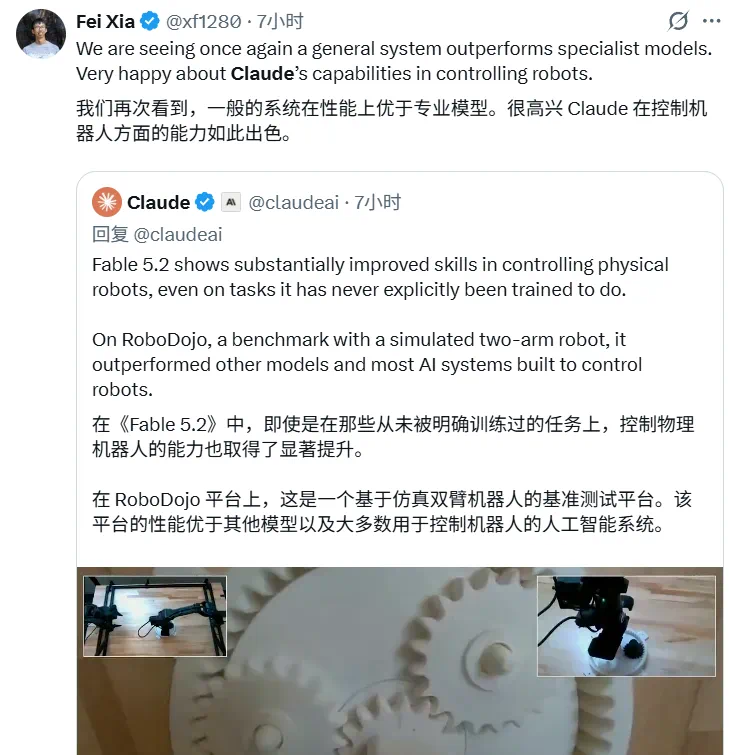
Anthropic also stated that Fable 5.2 outperformed most AI systems developed specifically for robot control in this evaluation.
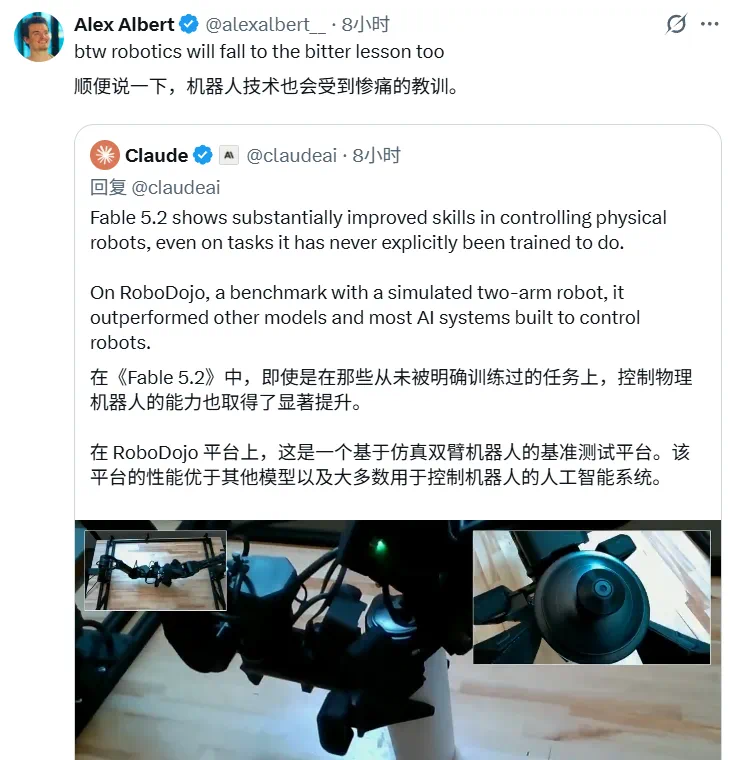
Anthropic product manager Alex Albert bluntly said that the “bitter lesson” has arrived for robotics.
Meanwhile, Bingjie Tang, a researcher who previously worked on Tesla’s Optimus humanoid robot, has joined Anthropic. She previously focused primarily on dexterous robot manipulation, policy learning, and real-world deployment, creating a noteworthy overlap with the robotic capabilities Anthropic has recently demonstrated.
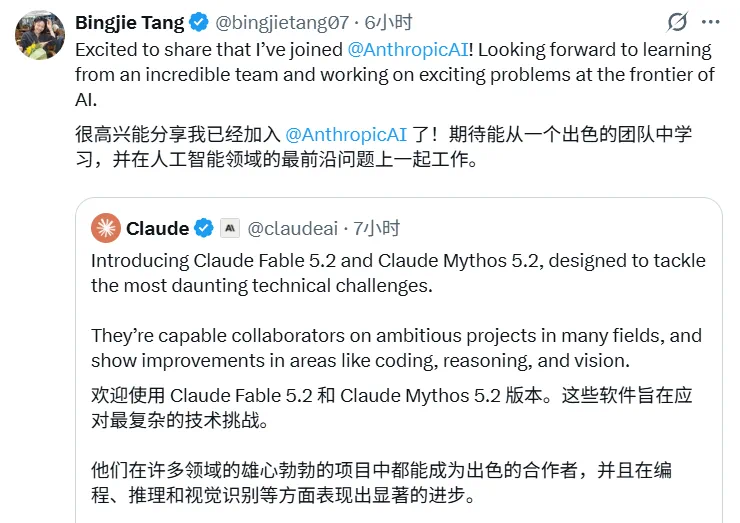
Anthropic is expanding Claude’s robot control capabilities
In fact, Anthropic has publicly presented its robotics research several times this year.
In July, Anthropic published “Claude plays robotics,” testing Claude’s performance on simulated robots, robotic arms, and a real-world quadruped robot.
Researchers tried a variety of control methods, including generating low-level control commands, writing control programs, and leveraging pretrained robot policies.
The experiments found that Claude already has a degree of ability to understand robotic environments and plan manipulation tasks, while its performance is affected by factors such as the control interface, action precision, and inference latency.
By October, research institutions such as Robocurve had published the paper “The Bitter Lesson Comes to Robotics,” further evaluating the ability of frontier general-purpose multimodal models to control real robotic arms.
The study found that general-purpose models can already complete a variety of real-world robot manipulation tasks, with the relevant capabilities continuing to improve over the course of a few months. At the same time, manipulation precision, execution speed, and inference cost remain significant constraints in practical applications.
One of the paper’s authors, Jay Chooi, also mentioned the “bitter lesson” in the field of robotics on social media after Fable 5.2 was released.
The “bitter lesson” stems from a classic idea in machine learning: as computational resources and model scale increase, general-purpose learning methods can often become competitive across an increasing number of tasks.
Today, this discussion is beginning to extend into the field of robotics.
As the visual understanding, spatial reasoning, and task-planning capabilities of general-purpose models continue to improve, researchers are exploring how much work they can take on within robotic control systems.
Former Tesla Optimus researcher joins Anthropic
Just as Anthropic was showcasing its robotic capabilities, news of a talent move also attracted attention.
Bingjie Tang, a researcher who previously participated in the development of Tesla’s Optimus humanoid robot, recently confirmed that she had joined Anthropic as a Member of Technical Staff.
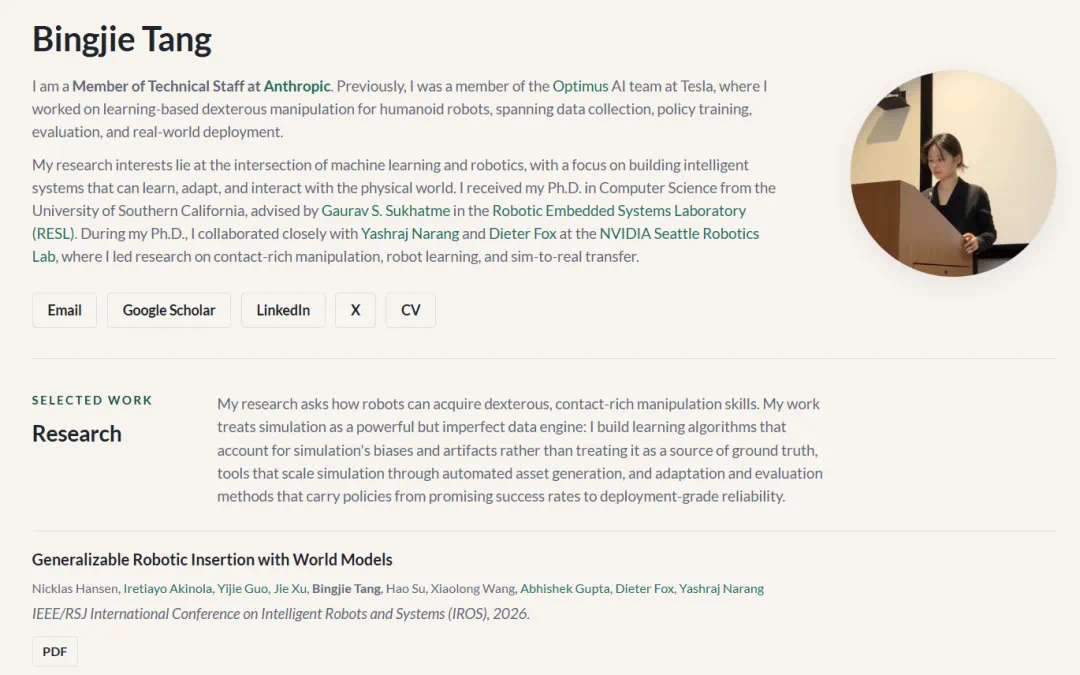
Personal website: https://bingjietang718.github.io/
Previously, she worked on learning-based dexterous manipulation research on Tesla’s Optimus AI team, covering data collection, robot policy training, evaluation, and deployment on real robots.
Before joining Tesla, Bingjie Tang earned a Ph.D. in Computer Science from the University of Southern California. During her doctoral studies, she closely collaborated with researchers at NVIDIA’s Seattle Robotics Lab on contact-rich robotic manipulation, robot learning, and Sim-to-Real research.
Sim-to-Real is currently one of the key areas of robot learning, focusing primarily on transferring manipulation policies trained in simulated environments to real robots.
Friction, contact conditions, object properties, and hardware discrepancies in real-world environments can all affect robot performance. As a result, numerous technical challenges remain between simulation-based training and real-world deployment.
Previous research involving Bingjie Tang, including Refinery and FORGE, has also addressed robot policy learning, real-world interaction, and manipulation adaptation.
Her background gives her research experience spanning data, algorithm training, and deployment on real robots, creating strong technical connections with the robotic capabilities Anthropic recently demonstrated.
In 2026, embodied intelligence continues to gain momentum. From world models and spatial intelligence to robot foundation models, an increasing number of AI companies are exploring the physical world, while the robot-control capabilities of general-purpose large models are advancing rapidly.
As the capabilities of general-purpose large models continue to improve, what roles will they play in future robotic intelligence systems? What new developments will Anthropic introduce next? It is worth looking forward to.