 Why We Recommend This Book
Readers can study the core theories of modern deep learning, from the fundamentals of neural networks to transformers and LLMs, implement them directly in PyTorch, and grow into an AI engineer with a practical focus through a personalized voice assistant project.
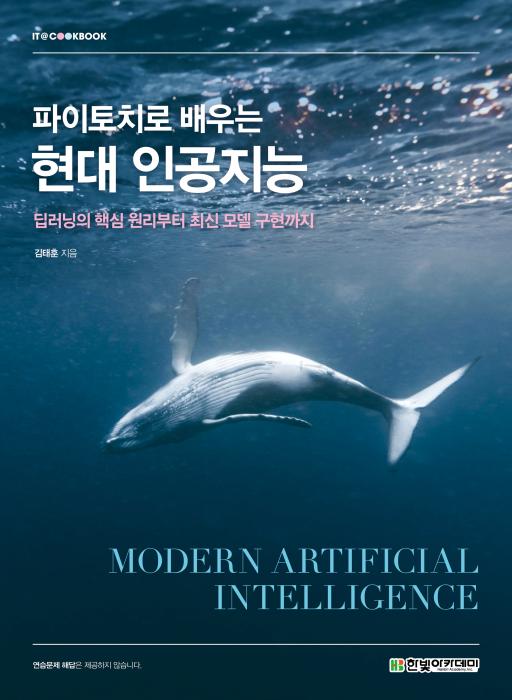
“I’ve built a few services with the LLM API. But I don’t know how it works internally. If I want to study the fundamentals all over again, what book should I read?” If a Youngpoong Bookstore book advisor hears this question, Hanbit Academy would recommend Learning Modern Artificial Intelligence with PyTorch, published last July. It is the definitive textbook covering everything from the basic architecture of neural networks to today’s generative models, explaining the theory and immediately putting it into practice with PyTorch code.
The author’s background explains the essence of this book. Kim Tae-hun, an assistant professor at Sogang University’s Graduate School of Virtual Convergence, has worked as an AI research intern at NAVER CLOVA AI and as a principal researcher at LG AI Research. He has researched training and inference optimization for multimodal AI and large-scale models and participated in the commercialization of vision-language models. In his general-audience book The Age of Imitating Machines, published this January, he traced the history of AI in broad strokes. In this book, released six months later, readers build that same trajectory with their own hands. In effect, the researcher who drew the map in a history book now leads the way in a textbook.
Across 17 chapters, the book moves from CNNs and LSTMs to YOLO and U-Net, VAEs and GANs, and onward to transformers and GPT, diffusion models, and Stable Diffusion. It covers distributed training and mixed-precision training, LoRA fine-tuning, and language-model alignment through PPO, RLHF, and Direct Preference Optimization. In the final two chapters, readers create and deploy a personalized voice assistant that combines RAG with speech transcription and synthesis.
The book’s organization is also worth noting. Readers first understand model architectures through equations and diagrams, then implement the same concepts themselves in the hands-on exercises that follow. Starting with Chapter 7, readers also practice real-world prompts and learn how generative AI writes code. Although it runs to 560 pages, practical exercises are interspersed throughout, making it easy to read in chapter-sized chunks.
Lee Won-jun, MD of Youngpoong Bookstore’s Technology Division, said, “Chapter 1 begins with installing the development environment, making it a textbook, but the scope it covers extends as far as RLHF and MCTS,” adding, “It is ideal for developers who have merely used LLMs and want to fill in the gaps.”
Kwon Gi-won, head of Youngpoong Bookstore’s Books Team, said, “Each chapter comes with review questions and hands-on problems, making it well suited as course material for an in-company study group,” adding, “Since no answers are provided, it is even better if you have colleagues to solve the problems with.”
■ Recommended Books
- 『Learning Modern Artificial Intelligence with PyTorch』
- Written by Kim Tae-hoon
- Hanbit Academy | Published July 3, 2026 | 560 pages | List price: 34,000 won
- ISBN 9791173400681
Youngpoong Bookstore has connected books and readers for 34 years since opening its doors in Jongno in 1992. It currently operates 46 locations nationwide and an online store, providing books and cultural content to 1 million members.
AI Times news@aitimes.com