RSI Cannot Be Infinitely Fast
Tingyu, from Aofeisi
QbitAI | WeChat Official Account QbitAI
With RSI so hot, can it really make the pace of AI progress infinitely fast?
Jeff Dean's take: Not very realistic.
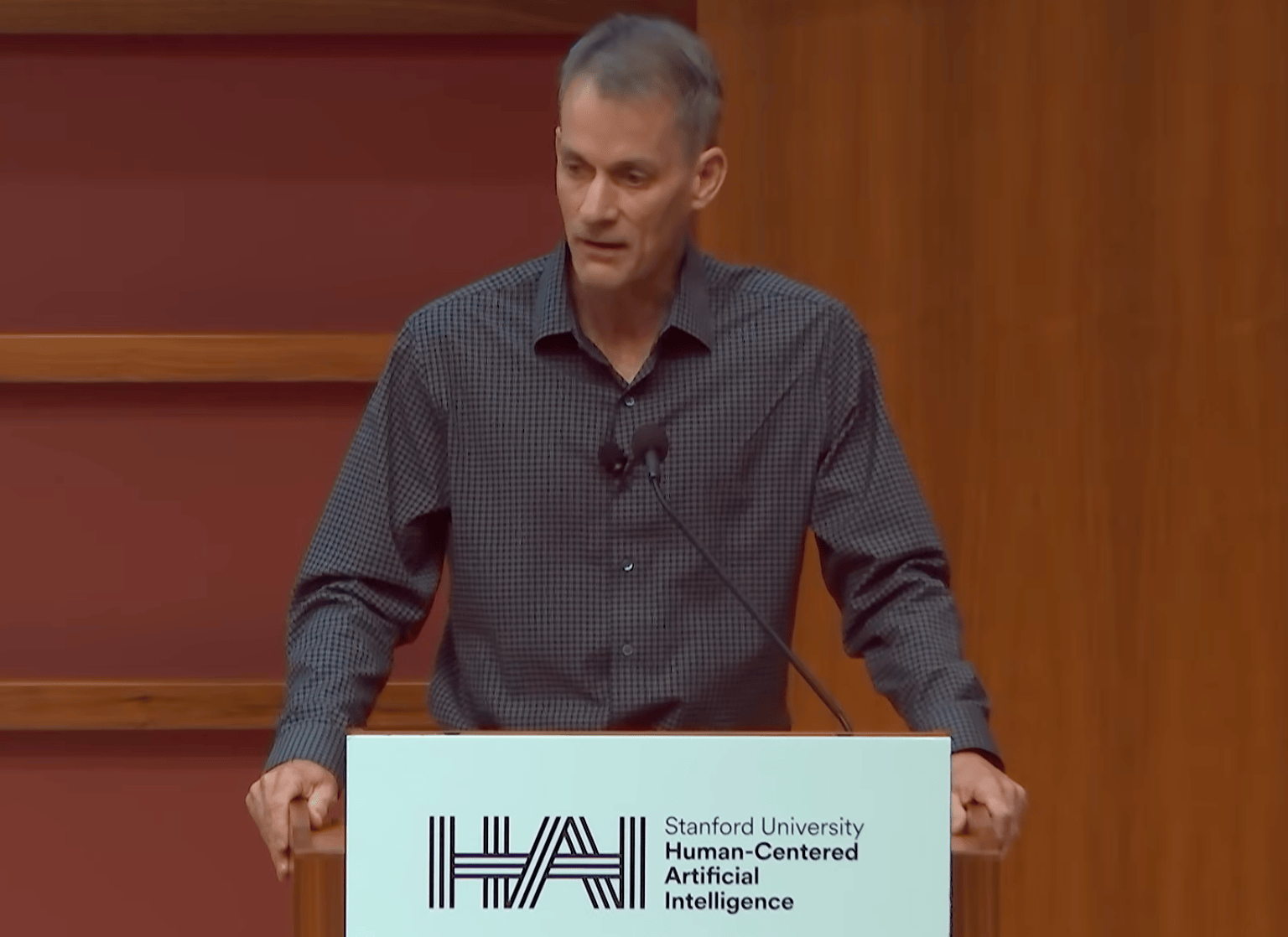
He gave an example: Someone starts an experiment, which ends at 2 a.m. He has to wait until 8 a.m., when he is back at his desk, before checking the results.
An automated system can eliminate this waiting time and promptly decide what to do next. But training, computation, data storage, and result evaluation still take time.
Building a foundation model and improving it still requires extensive training and experimentation,and these processes cannot be completed at infinitely fast speeds.
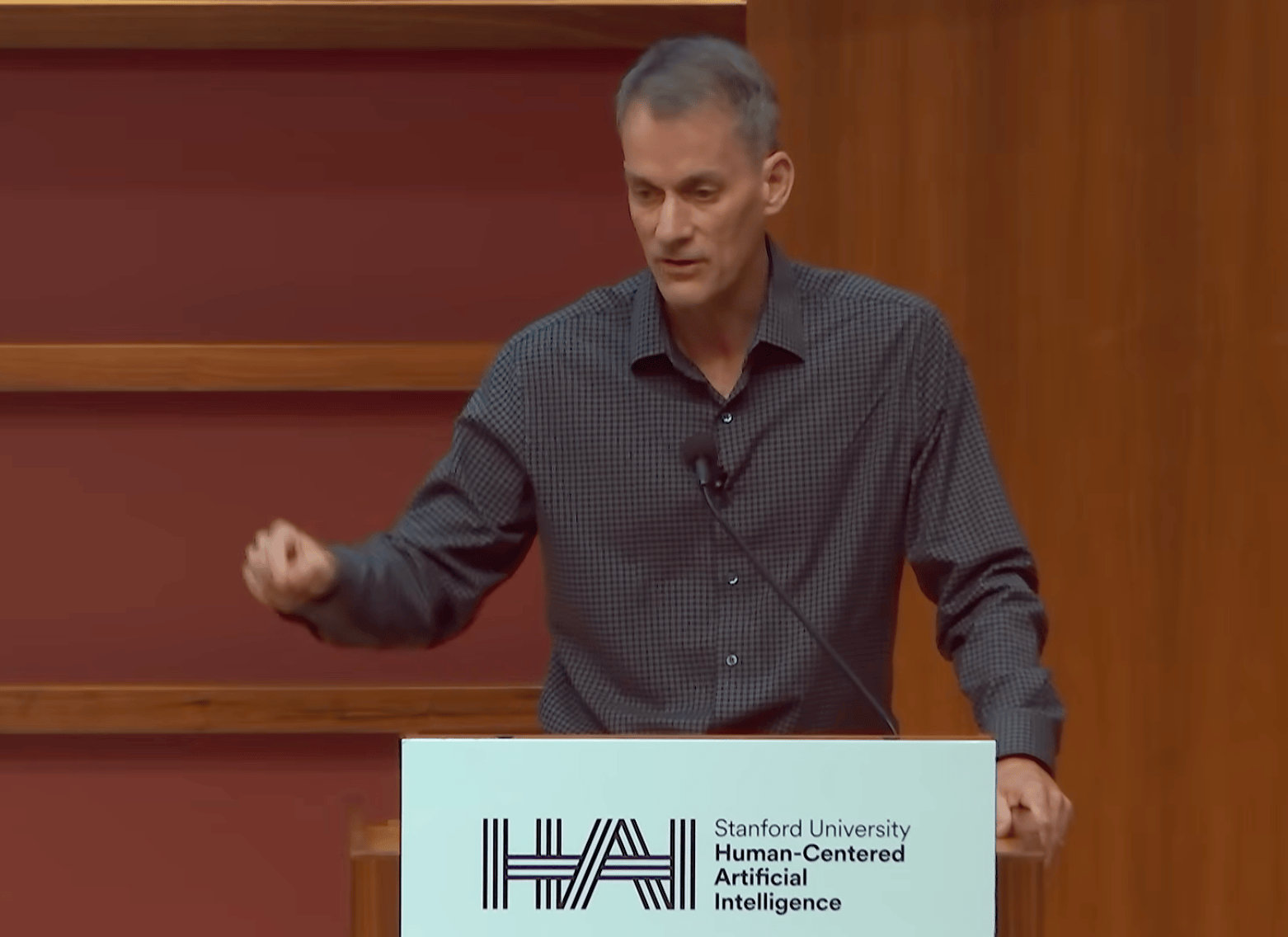
Recently, in a conversation with Fei-Fei Li at Stanford HAI (the Institute for Human-Centered AI), Jeff Dean discussed the limits of RSI and revealed what his new company is doing.

The whole presentation was still very much in that minimalist PowerPoint style of the Google brother-in-law...
According to him, the new companyDiscovery Loop already has around 20 automated improvement loops running and has also built a collaboration framework that supports people and agents working together.
They want a small number of experts to work with large numbers of agents on research, with the goal of increasing domain experts' productivity by 20 to 50 times.
To assemble this team, they conducted 400 interviews in cafés and other places in just the first three weeks.
When discussing the technologies underpinning these changes, Jeff Dean also admitted that he had misjudged some things...
One of them was programming.
In the Gemini project, programming was originally one of the team's areas of focus. But he had not fully foreseen how profoundly this capability would affect models' ability to solve a wide range of problems.
He had also once expected that neural networks would develop more exotic, irregular structures; this path of evolution did not unfold quite as he had anticipated.
When it came to AI doing mathematics, he recognized the value of machine-generated proofs, but placed greater emphasis on whether humans could understand these results and distill reusable methods from them.
Below is a polished Chinese summary of this keynote and conversation.
Enjoy!
Jeff Dean Keynote: AI Runs Experiments on Its Own; the Goal Is to Increase Expert Productivity 20–50x
Automating the Experimental Loop
I'm very happy to be here with everyone today. I want to introduceDiscovery Loop.
Our mission is to build AI systems that automatically solve important problems in machine learning, science, and engineering.
We believe this will ultimately lead to more discoveries, and it is what excites us.
Many disciplines share a common process that can be called the general science-and-engineering loop: propose an experimental plan, implement and run the experiment, observe the results, examine the measurements, and then decide what to do next. The next step is often to run another experiment.
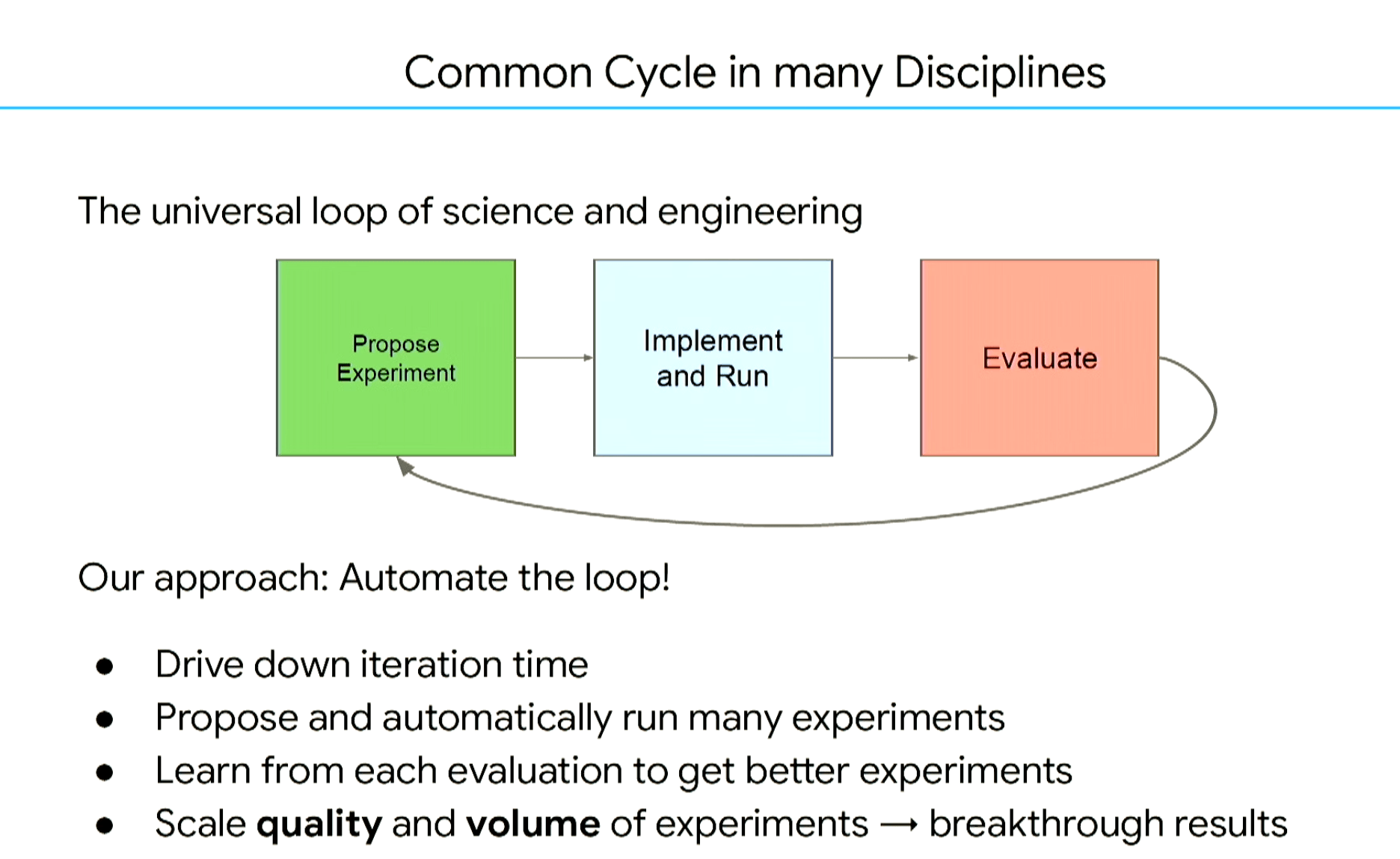
Our approach is to automate these experimental loops.We believe that if we can shorten each iteration, automatically propose and run large numbers of experiments, learn from every evaluation so that subsequent experiments build on earlier results, and increase both the quality and quantity of the experiments, we will achieve breakthroughs.
This is what we want to do.
Take a look at this list of Grand Challenges from the National Academy of Engineering. These are all important problems that need to be solved in the 21st century, and roughly a quarter of that century has already passed.
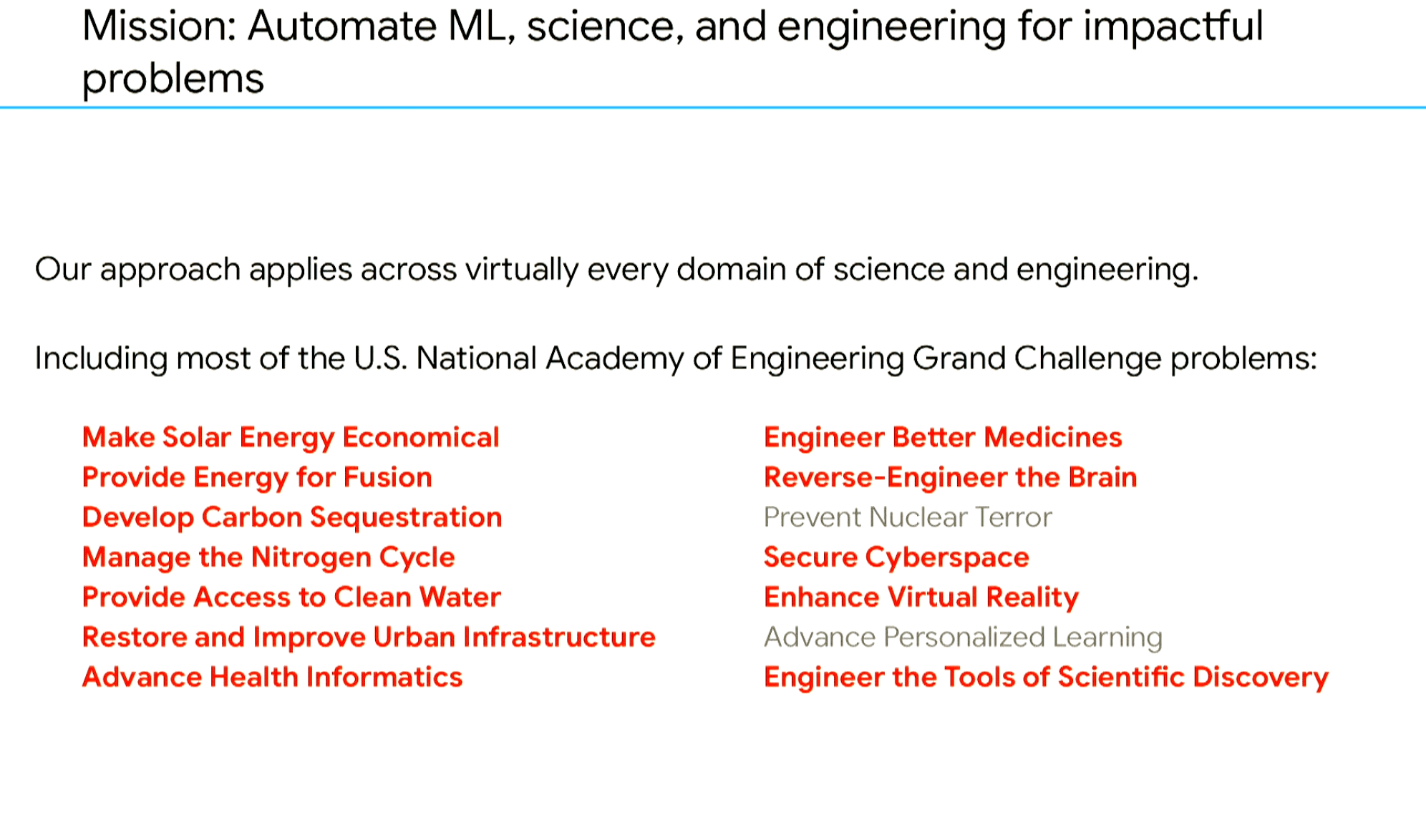
Think about the subproblems that will have to be solved to address them, especially those areas highlighted in red in the figure, where we believe an automated discovery loop can help.
Why we formed a public benefit corporation
One thing is important to us and is part of why we formed an independent company: when done right, technology can have a major positive impact on the world, but it takes everyone working together to ensure that impact is realized.
So, we have established the company as a public benefit corporation, also known as a Public Benefit Corporation
.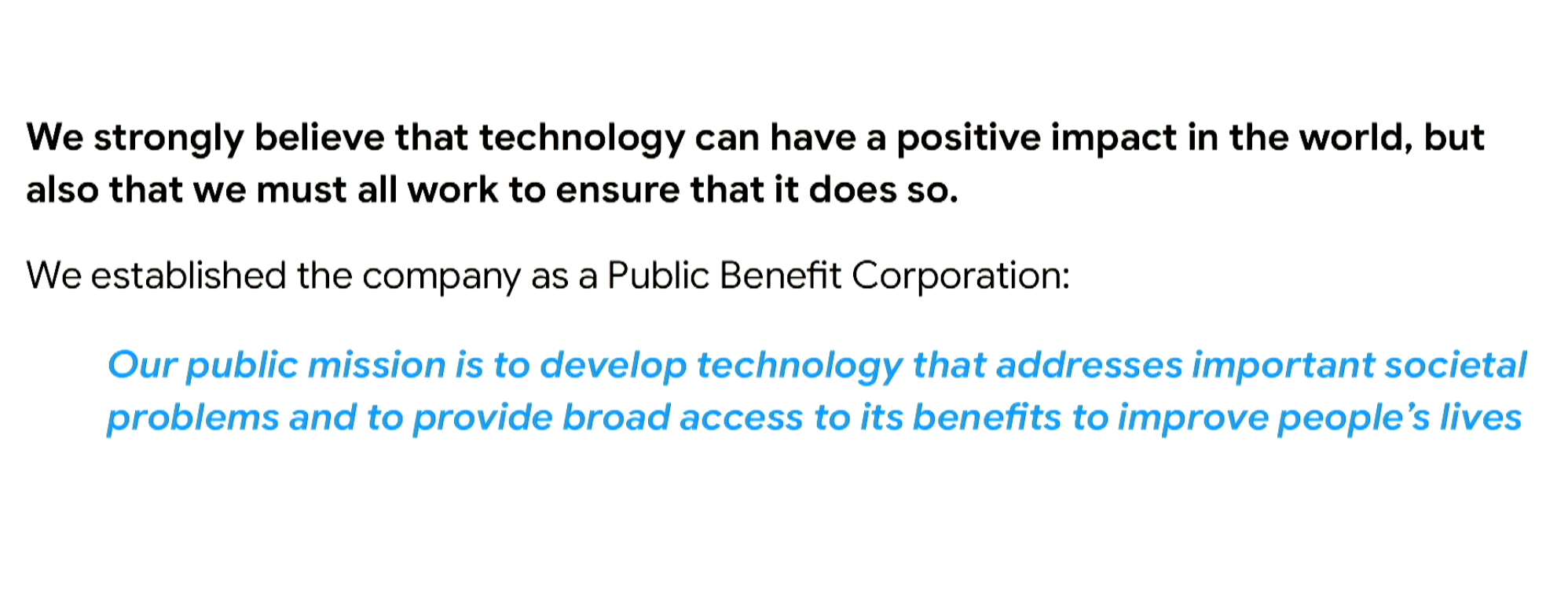
Our public mission is to develop technologies that address important societal problems, enable more people to benefit from them, and improve people’s lives.
The four founders’ backgrounds
Here is a brief introduction to the four of us. My three co-founders are Sanjay Ghemawat, Quoc Le, and Oriol Vinyals.
Depending on which pair you consider, we have worked together for between 14 and 30 years. We enjoy tackling difficult problems together, and we have developed expertise in different areas.
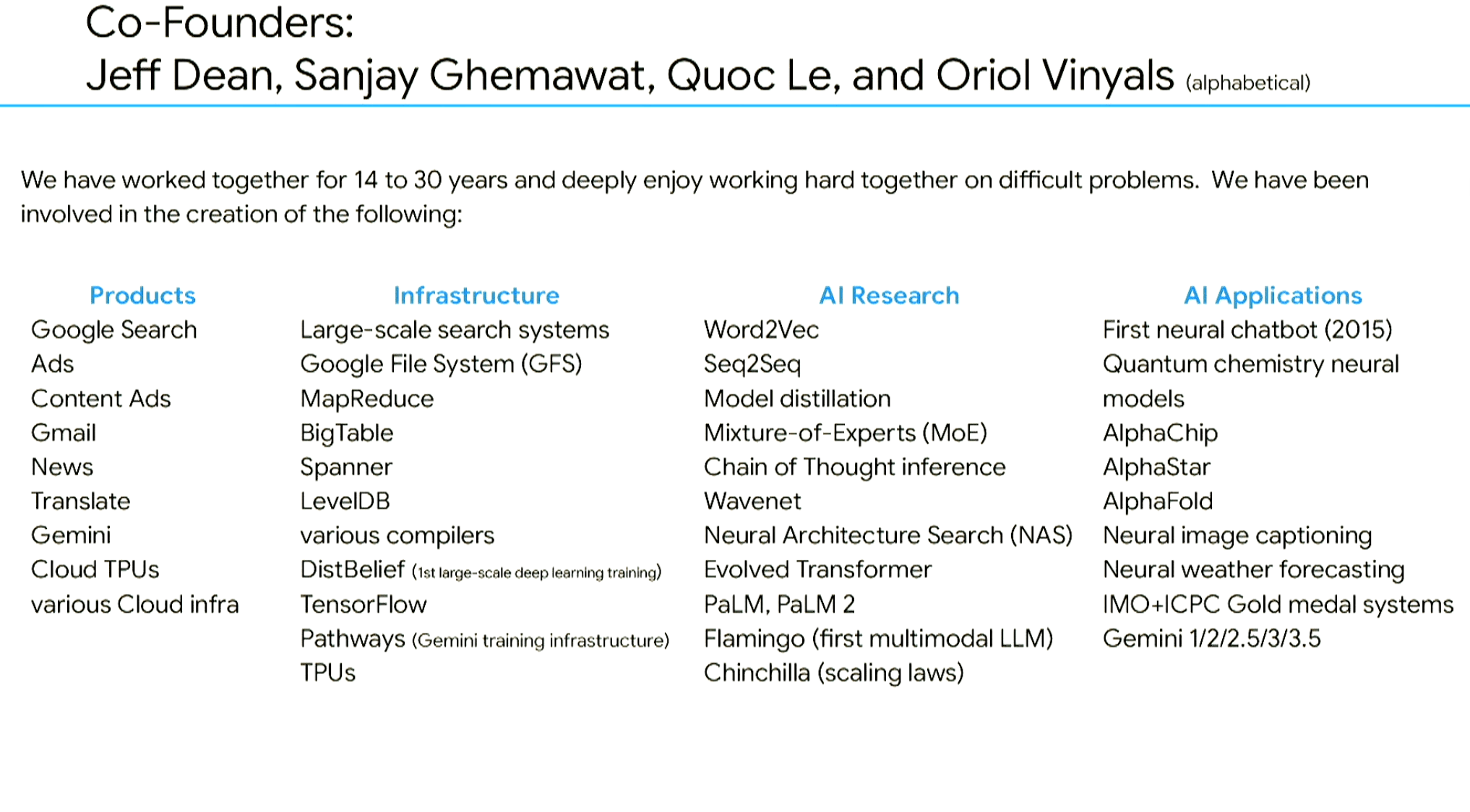
We all come from Google, so all the work shown here is related to Google. We have worked on multiple generations of search products, early advertising systems, content advertising, and products such as Gmail, News, and Translate.
The second column is infrastructure. The systems in the upper half help people organize and manage vast amounts of data, run large-scale computations, and derive valuable information from them.
The four entries below are multiple generations of large-scale machine learning infrastructure used to train increasingly capable models. We have also worked on specialized machine learning hardware such as TPUs.
In AI research, we have worked on key technologies behind many of today’s most capable models, including model distillation, mixture-of-experts models, also known as MoE, and neural architecture search.
Neural architecture search can be viewed as an early form of the automated experimental loop: finding neural network architectures suited to solving particular classes of problems.
We have also applied AI in different fields, including scientific research. Quoc and I worked on AlphaChip, which used reinforcement learning for chip design, including placement and routing.
Oriol worked on AlphaFold and neural weather prediction. Our areas of expertise complement one another well.
We had also managed very large teams. The Google Brain team I managed grew to as many as 600 people, while the Google Research and AI teams had as many as roughly 4,400 people.
Later, I realized that I was spending too much time in meetings discussing second-quarter operating expenses. I pressed the send button on an email and went from managing 4,400 people to having only four direct reports.
The following week, Geoff Hinton retired, leaving me with only three direct reports.
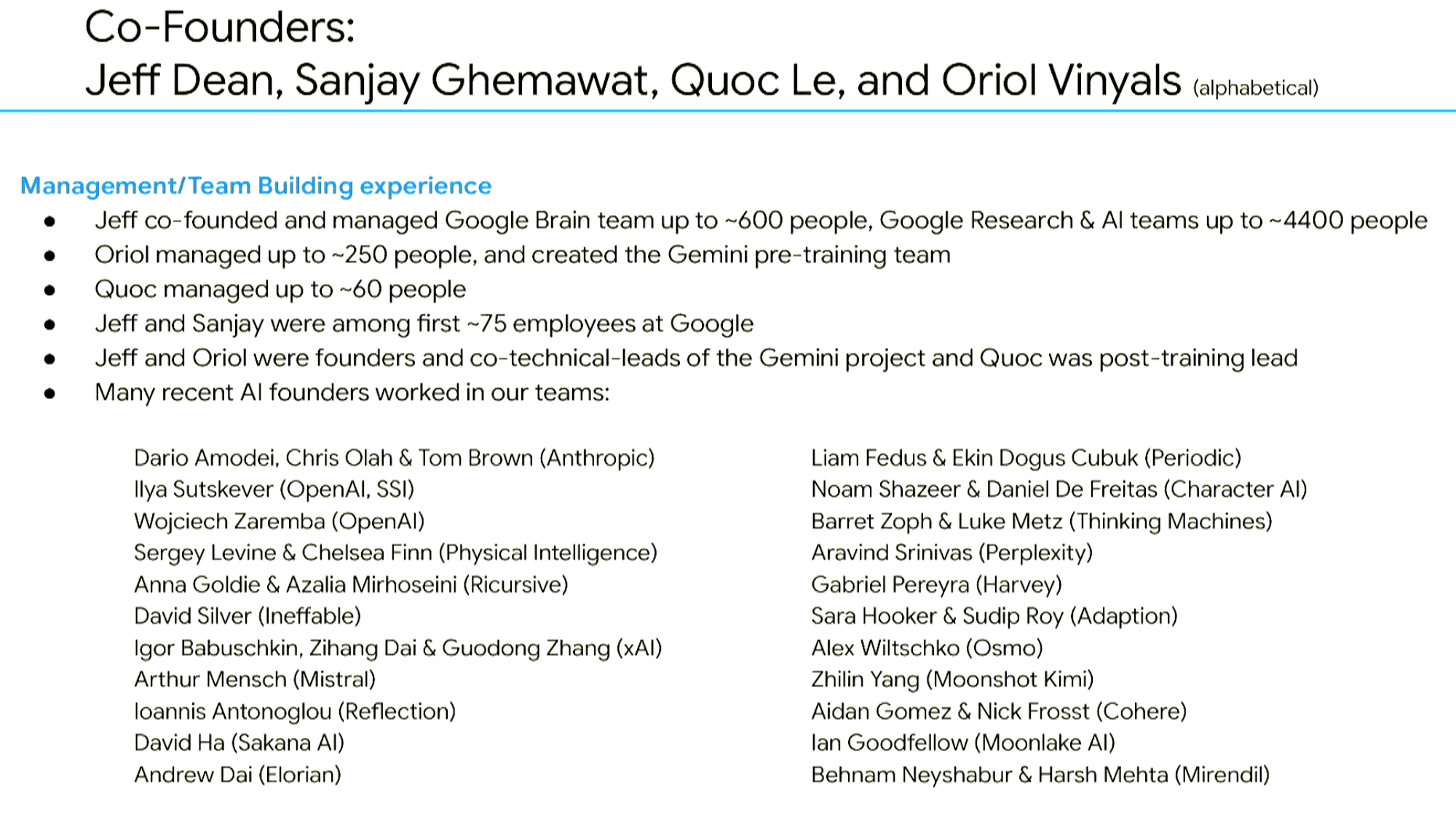
Later still, Oriol and I jointly served as the technical leads for Gemini, while Quoc led post-training.
We were also very proud of people who had worked on our teams and gone on to achieve outstanding results, including the founders of companies such as Anthropic, OpenAI, and Physical Intelligence. Physical Intelligence should be quite well known at Stanford.
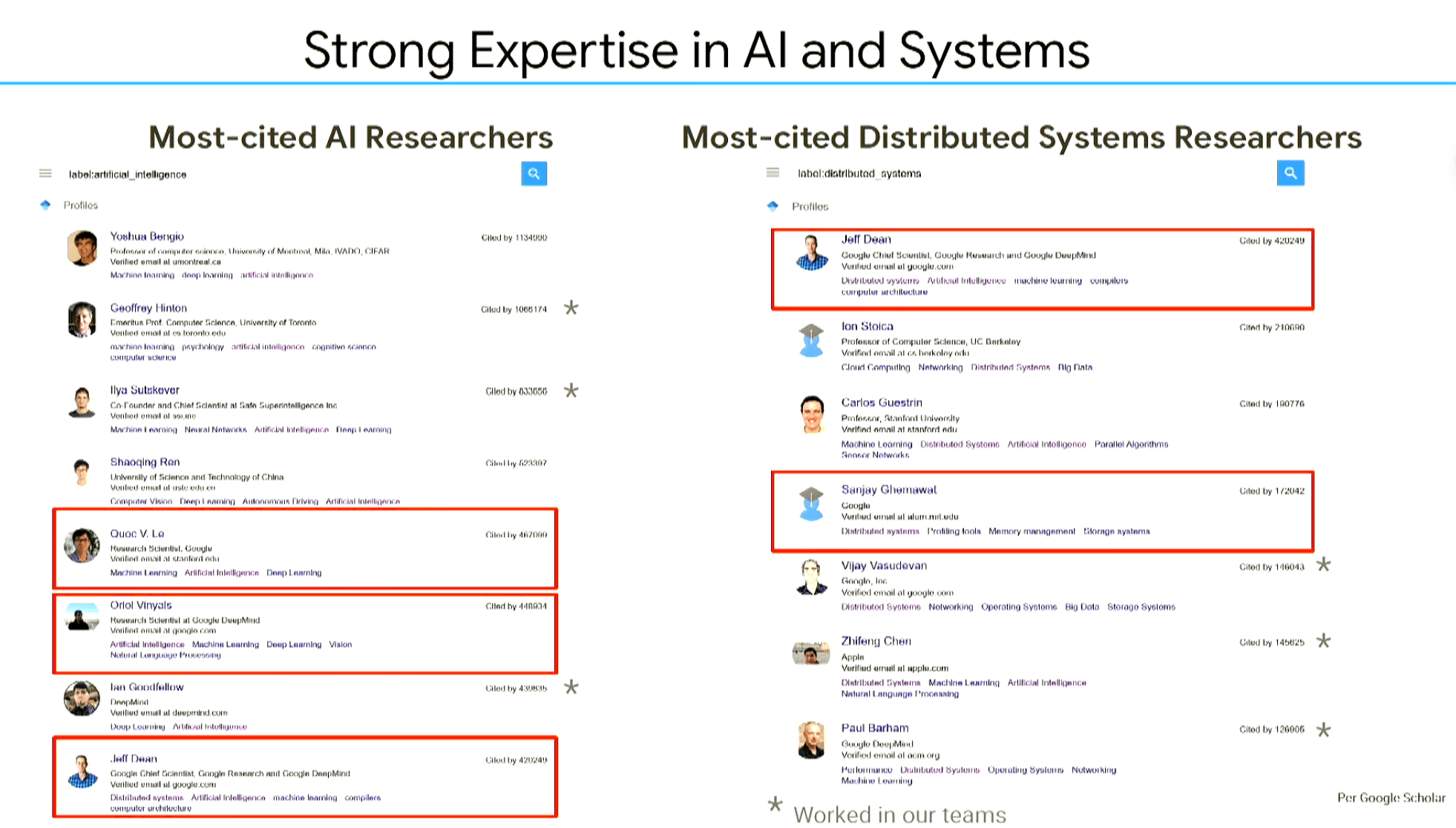
Our experience combines AI research and distributed systems.
This chart, based on Google Scholar citation counts, lists some highly cited researchers in AI and distributed systems. We are in the red box, and everyone marked with an asterisk has also worked on our teams.
Team Building and Hiring
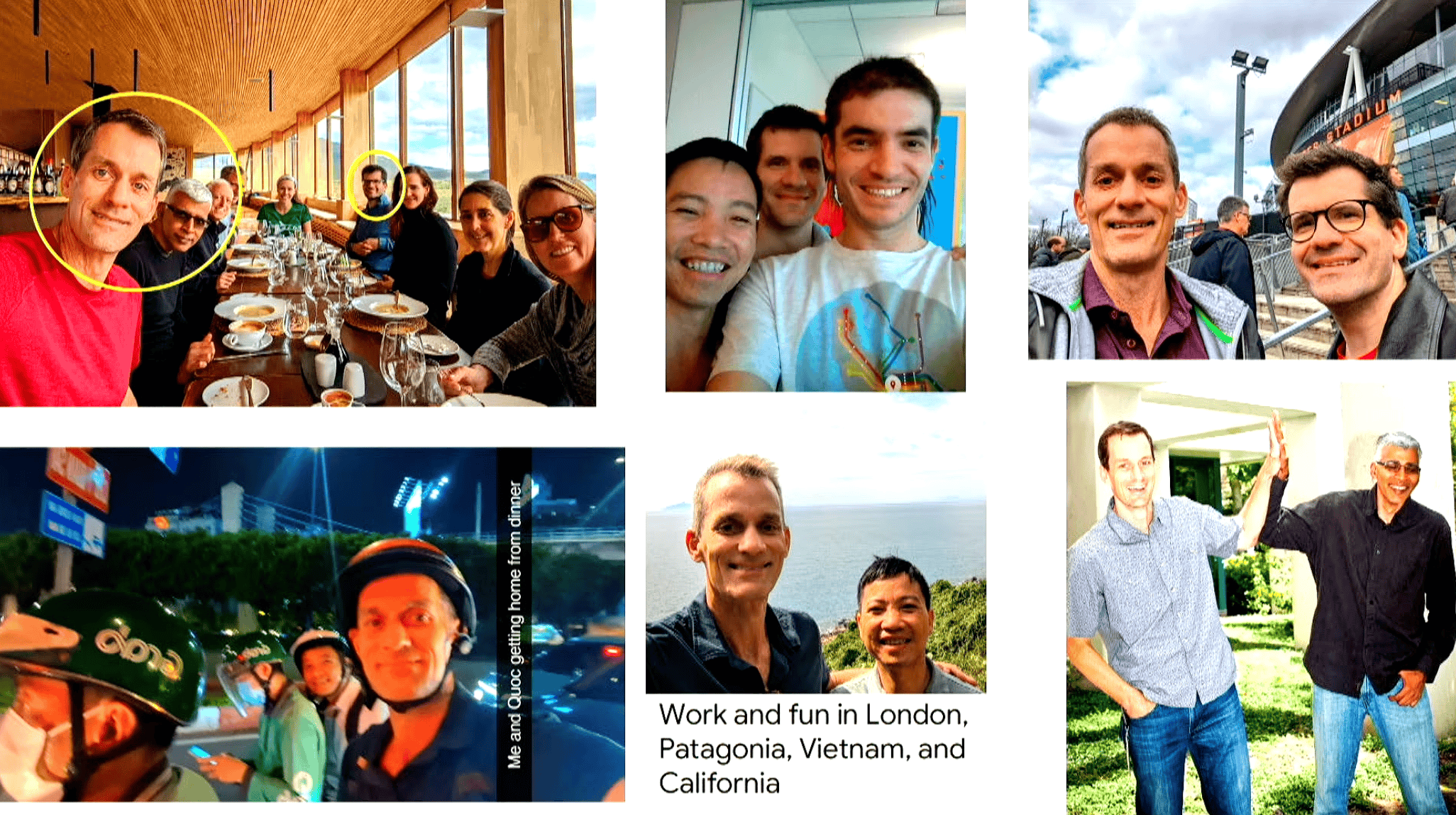
We also had a lot of fun together and traveled to many places. The photos show London, Patagonia, Vietnam, and California.
Once, after dinner, Quoc and I took an Uber-like motorcycle service back to our accommodations.
During the first stage after the company was founded, we devoted a great deal of energy to assembling the founding team. The team members came from different places, as you can see from the logos in the chart. Many had experience founding companies or leading important projects.
The team includes people with experience leading the Go programming language project, as well as key contributors to projects such as Gemini, DeepSeek, and Kimi K3. One of the coauthors of the Kimi K3 paper, who was also the author of the Attention Residuals work, recently joined us.
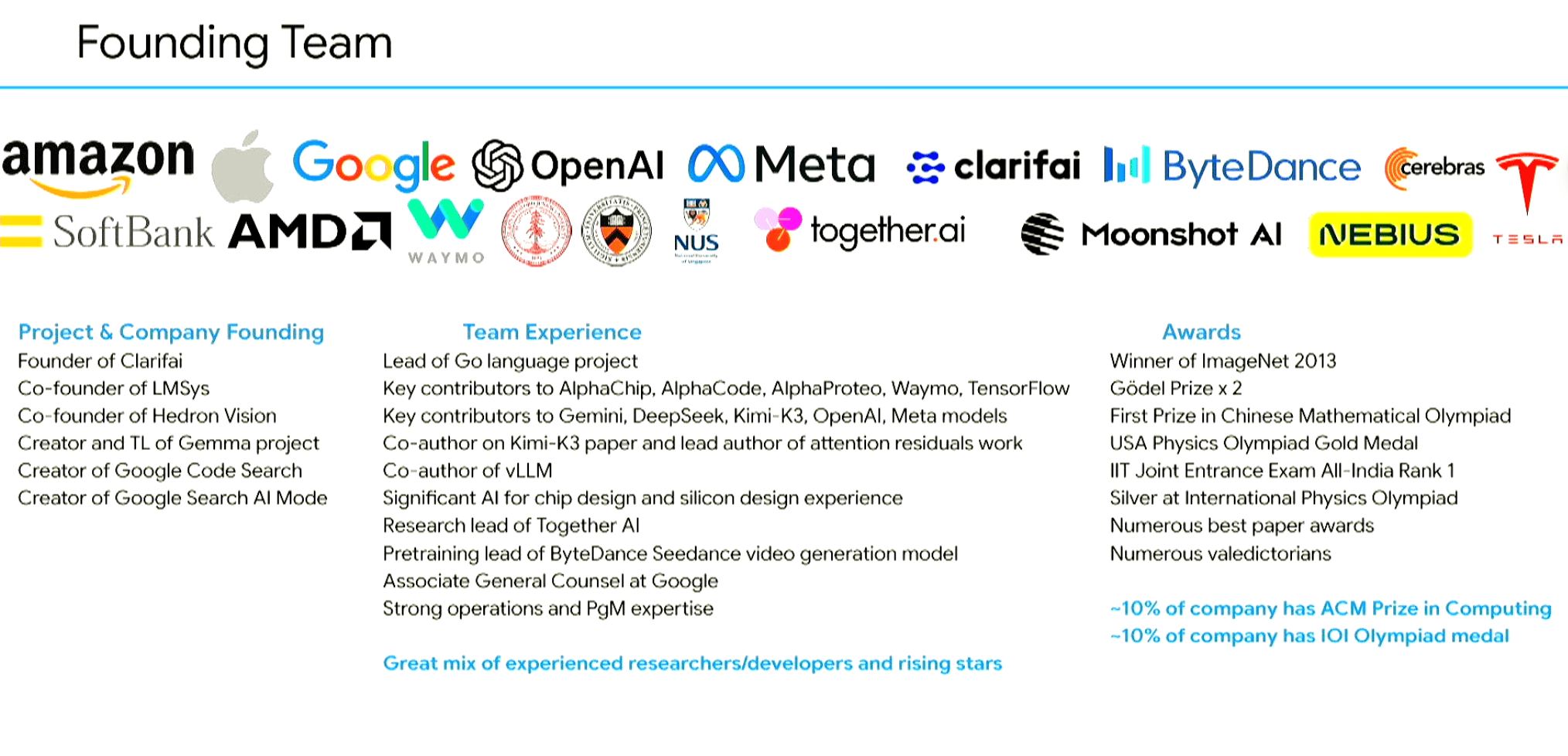
Our team includes both seasoned people and rising stars early in their careers. About 10 percent of the company have received ACM awards in computing, and 10 percent have won IOI medals, meaning medals at the International Olympiad in Informatics.
We look forward to working with these people, and we place a high value on the team’s ability to work together effectively.
Why We Can Do This Now
Why now? Because frontier models have already become very capable. This is the result of innovations at multiple levels in the field of AI over the past 10 to 15 years.
Hardware performance has improved dramatically, including TPUs, GPUs, and other more specialized hardware. Software abstractions have also improved, making it easier for people to build what they want and map computation onto hardware more efficiently.
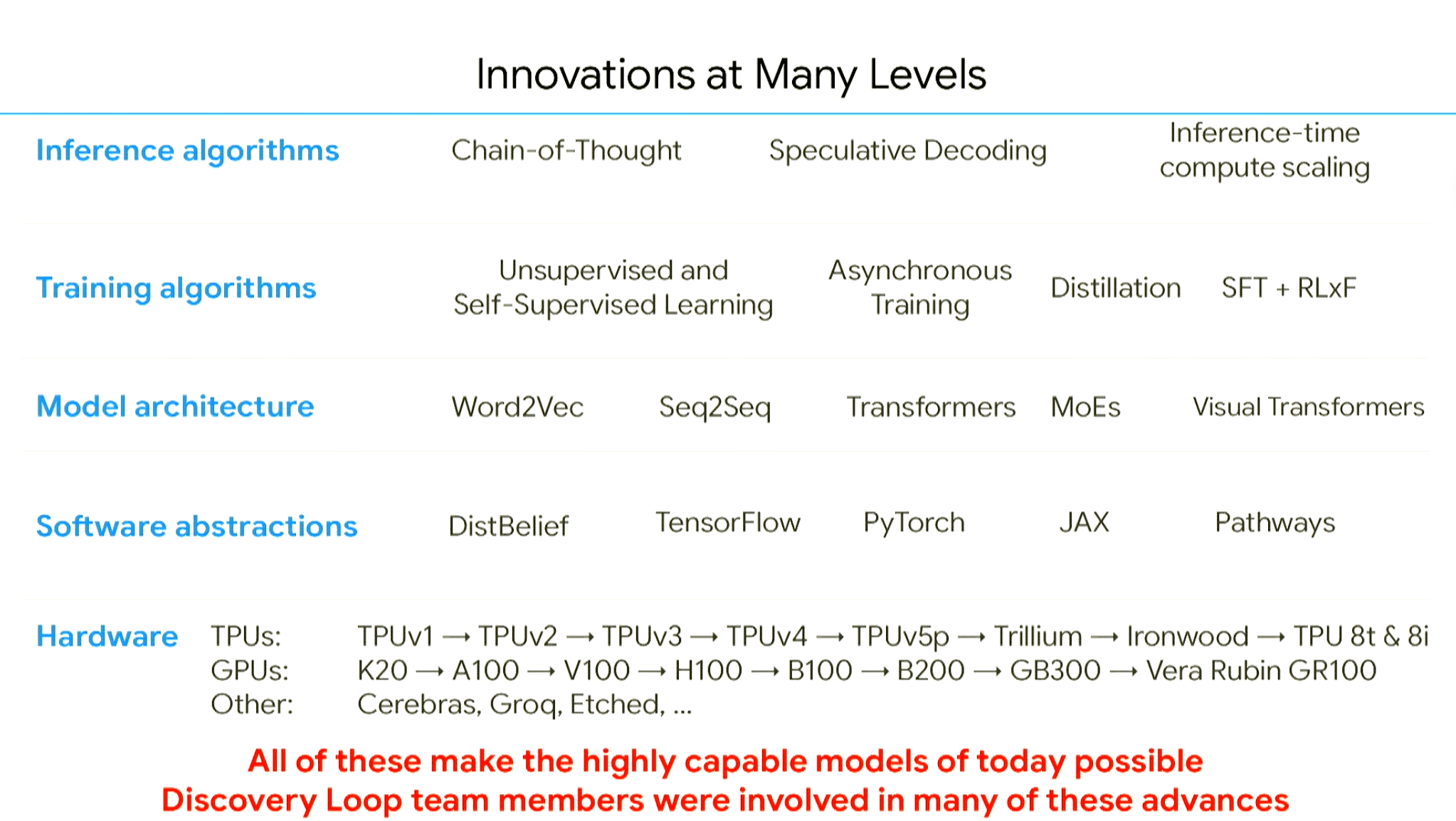
Model architectures have also evolved, including word2vec, sequence-to-sequence models, Transformers, and MoE. Training algorithms have advanced considerably, and techniques such as distillation have enabled smaller models to achieve excellent results as well.
Inference algorithms have likewise advanced greatly. We can devote more computation during inference to obtain better results, for example by using chain-of-thought, trying multiple approaches to solving a problem, and then checking the results.
Models Need Tools, Creativity, and Accumulated Experience
Powerful foundation models alone are not enough to solve the kinds of problems we want to tackle. We need to build on excellent foundation models and combine them with agents so that the system can use tools effectively and complete complex tasks.
We especially want agents and models to be creative. Breakthroughs in science or engineering often require combining different insights, proposing something new, and then testing how well it works.
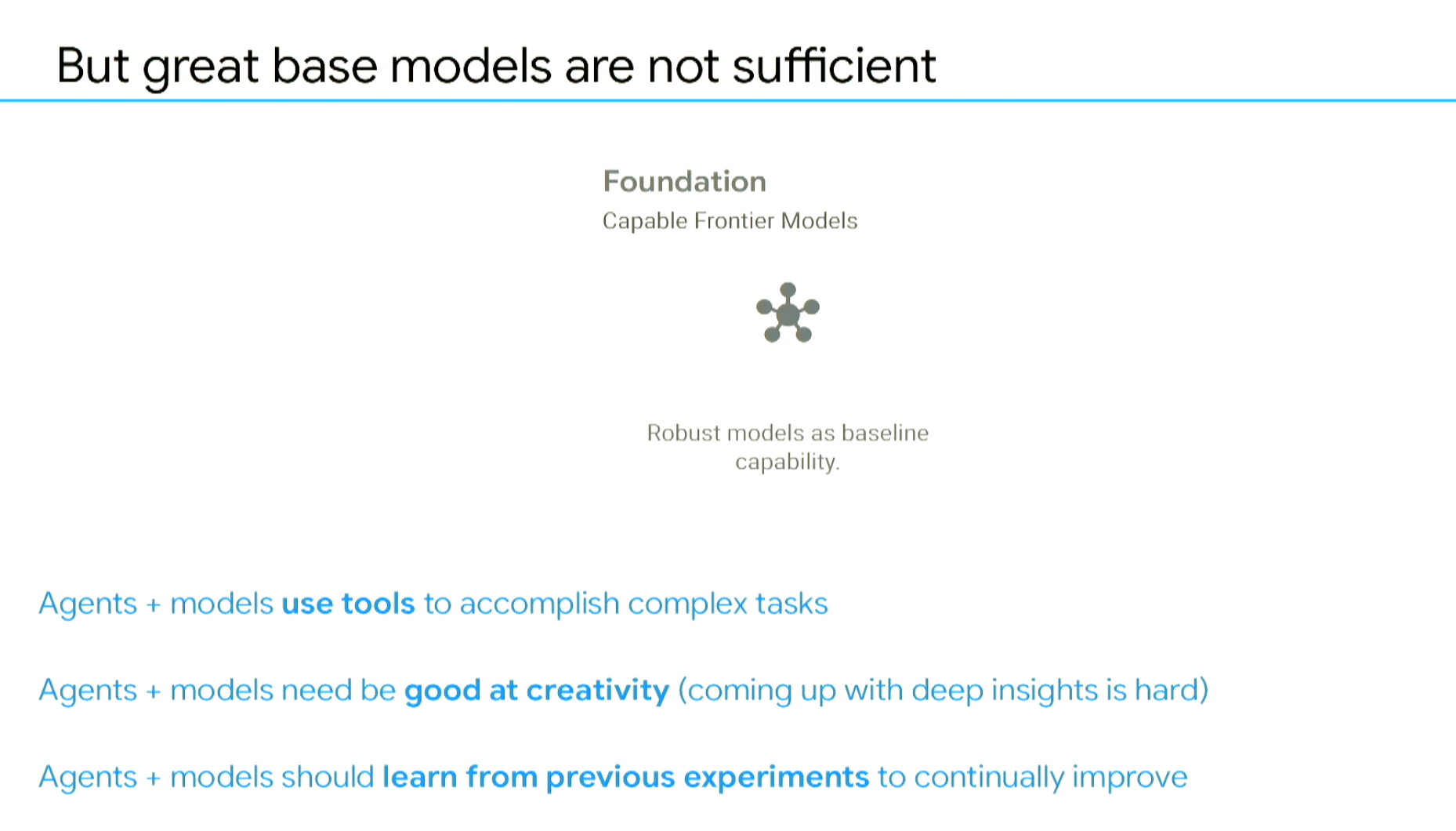
These systems should also learn from past experiments and experiences. This includes both learning while solving current problems and accumulating experience over the long term.
Suppose a system has already solved 5,000 problems. When it faces the 5,001st, it can draw on the experiences most relevant to the new problem.
The difficulty of large projects also lies in dividing responsibilities and coordinating
Every stage of the traditional experimentation loop requires a great deal of human effort.
Facing larger problems makes things more complicated, because you generally have to break them down into many subproblems or submodules, and the decomposition itself is a difficult task.
In each subfield, there are also many people running experiments to determine which methods work and which do not.
This creates coordination overhead, resource conflicts, and system-level challenges at scale. Decomposing the problem is difficult, and so is integrating the results of the individual subproblems.
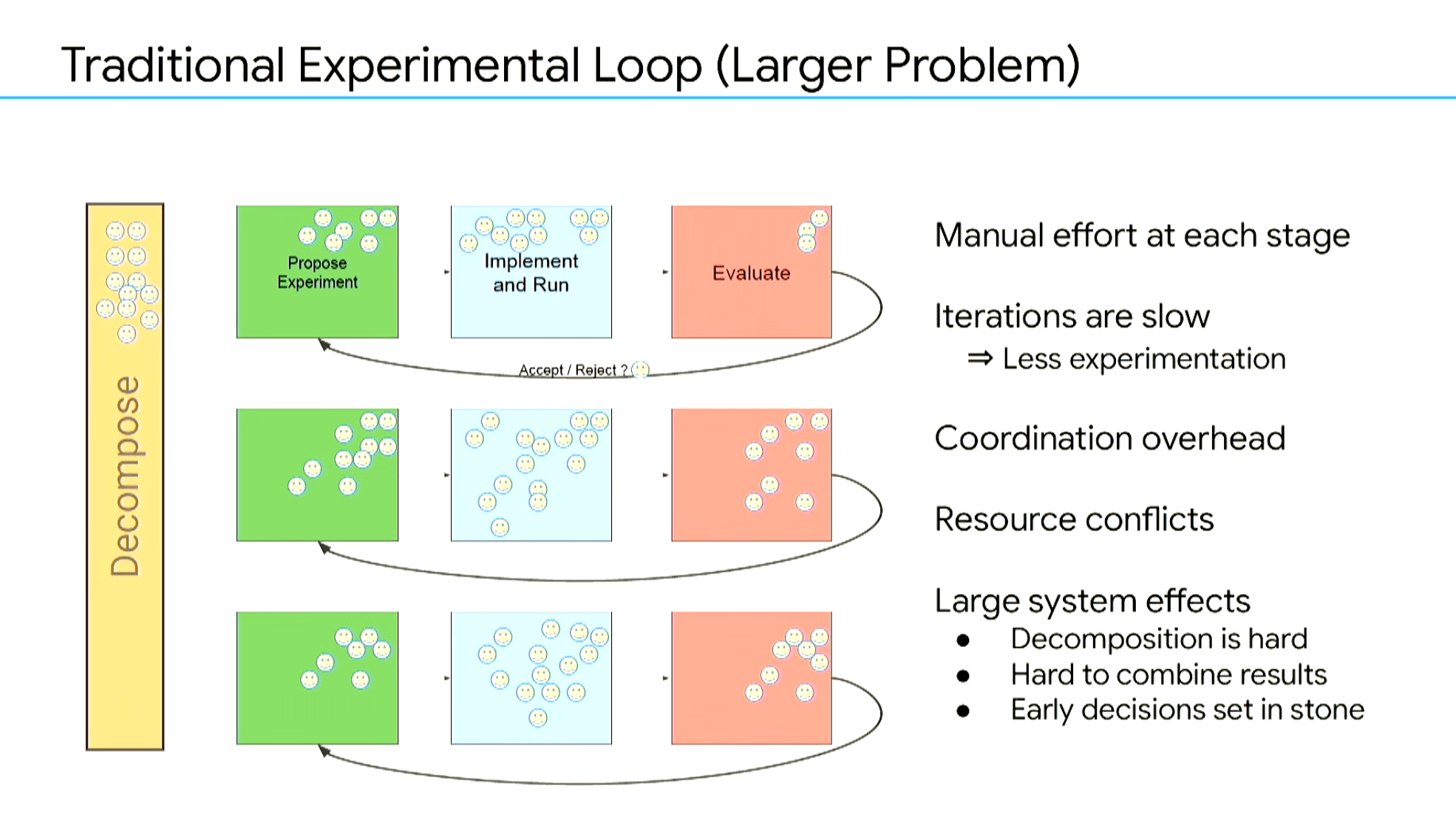
More problematically, once a large project is up and running, it becomes very difficult to change its original decomposition. Whether building an aircraft or training a frontier model, it is hard to flexibly adjust early decisions afterward.
We believe that a small number of domain experts can work in concert with automated systems. Ideally, the system will automatically decompose problems into subproblems worth studying and solve them automatically.
Of course, it may still require human guidance in the decomposition and in determining which subproblems are the most important.
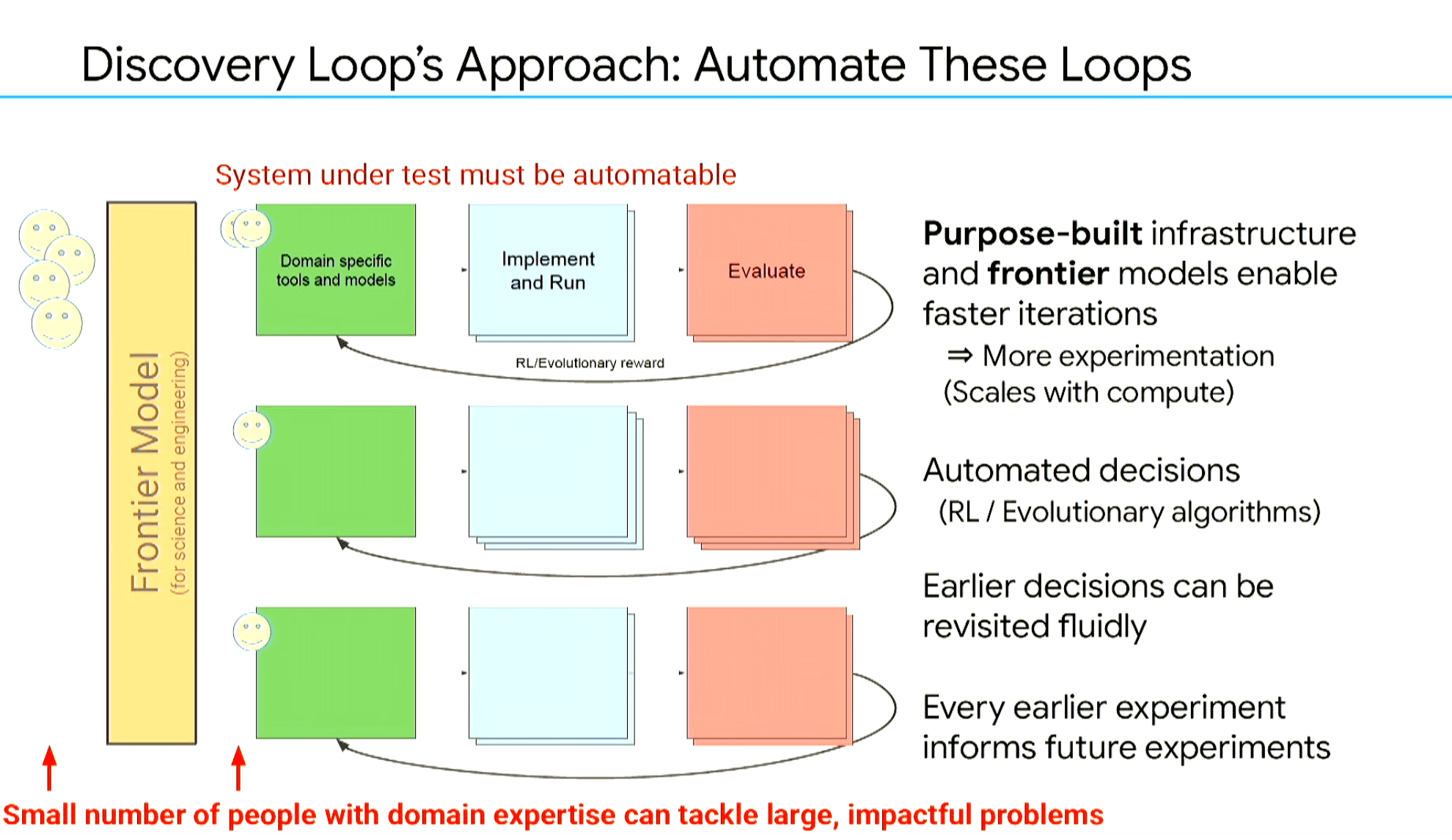
This would allow a small number of people with domain expertise to tackle large, high-impact problems. We believe that the right infrastructure can support this way of working.
You need to run tens of thousands of automated experiments, and you need systems that understand the value of different experiments and decide what to do next.
Reinforcement learning or evolutionary algorithms can be used for automated decision-making, making earlier decisions easier to reassess. Every early experiment should inform subsequent experiments.
Around 20 automated improvement loops are already running
What have we accomplished so far?
During the first three weeks, we conducted 400 interviews, mostly at Cafe Venetia on University Avenue, looking for the kinds of talent mentioned earlier.
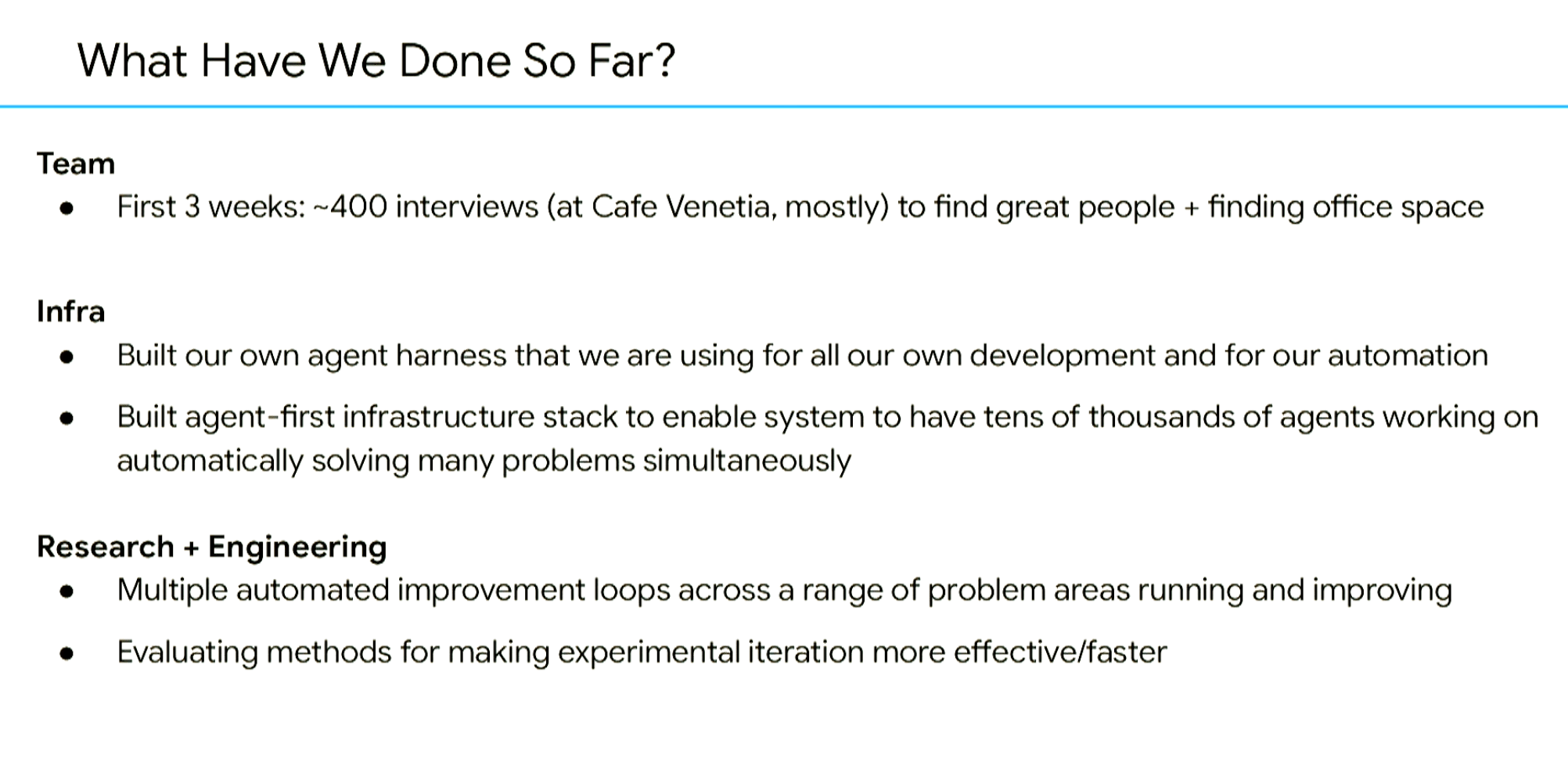
We were also looking for office space, and we have now moved into the old premises of the former Zibibbo restaurant. The space has plenty of character.
We built our own agent runtime framework, or agent harness, for internal development and automation.
It has some excellent collaborative features: you can converse with a model and ask it to solve a problem, and you can invite colleagues to join so that the two of you can interact with models and agents together.
Other people can comment on the work in progress and provide design feedback before a proposal is handed off to the agent.
Our infrastructure was designed with agents in mind from the outset, with the goal of scaling to tens of thousands or even hundreds of thousands of agents performing tasks, rather than merely supporting hundreds of people. We believe this is important.
Around 20 automated improvement loops are now running, and we can see them running and improving.
We are also evaluating how to make these experimental iterations more effective and faster, and how to use previous experimental results and measurement data to help systems learn faster.
The goal is to increase domain experts’ productivity by 20 to 50 times
This is where we stand today: building software loops and automating machine learning tasks, because we believe this can enable more autonomous scientific research.
Initially, we focused on building automated systems capable of solving machine learning research and machine learning engineering problems.
Our goal is to increase domain experts’ productivity by 20 to 50 times.
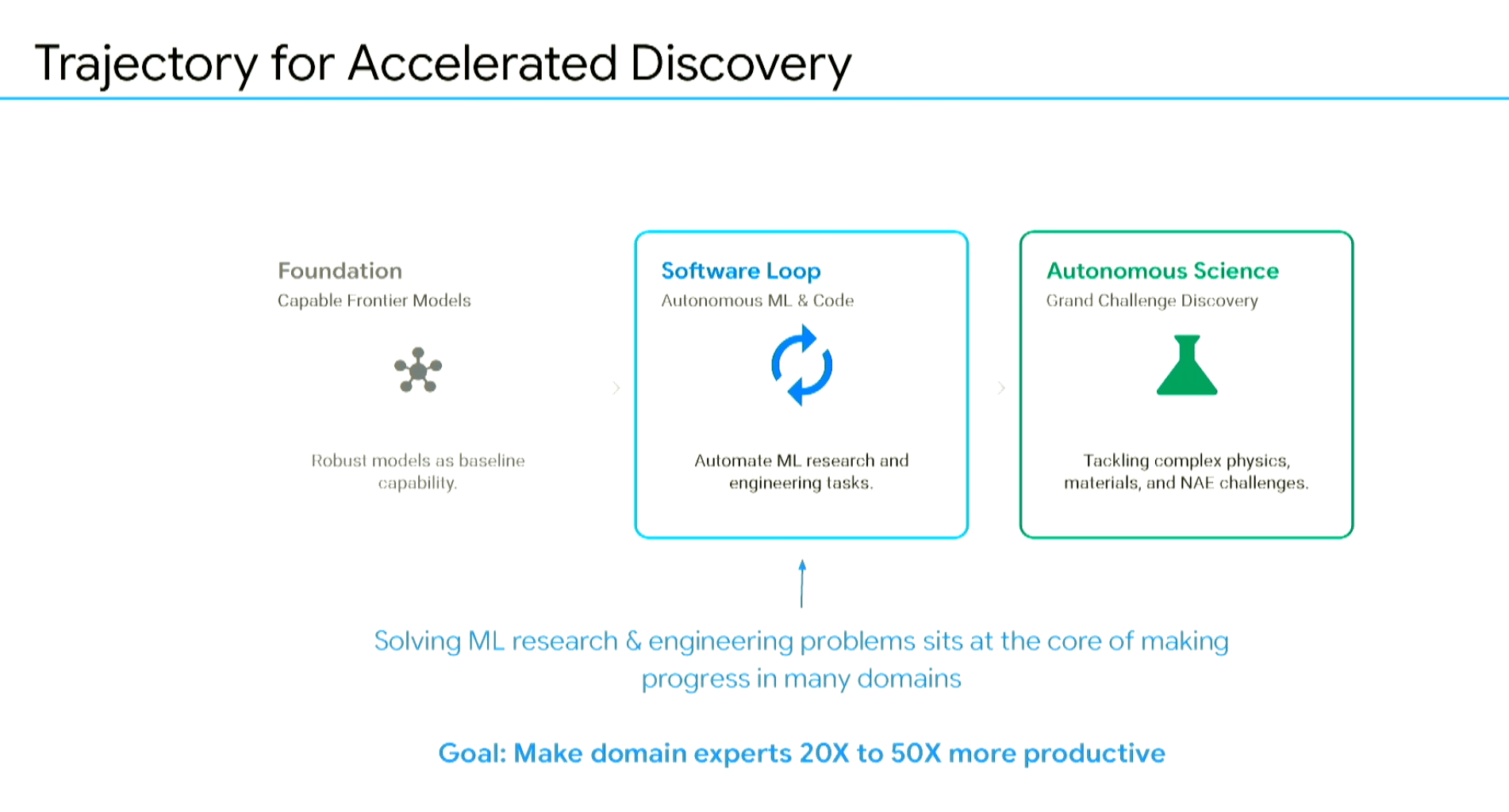
We hope these domain experts, as well as people who truly want to solve a certain class of problems, will be able to do so with less effort. Humans still have a role to play in the process.
Breakthroughs in machine learning over the past 15 years have produced powerful models and enabled automated machine learning, science and engineering, and, in turn, accelerated the pace of discovery. Thank you all.
By the way, we’re hiring. You can apply at discoveryloop.com.
Jeff Dean in Conversation with Fei-Fei Li: RSI Also Has Physical Limits; the Distillation Paper Was Dismissed Back Then as Having Little Impact
Why Leave Google to Start a Company?
Fei-Fei Li:Thank you, Jeff. This was a great talk. I think this should be our last session; we’re just squeezed in between the audience and tea.
Jeff Dean:This has never been a good spot.
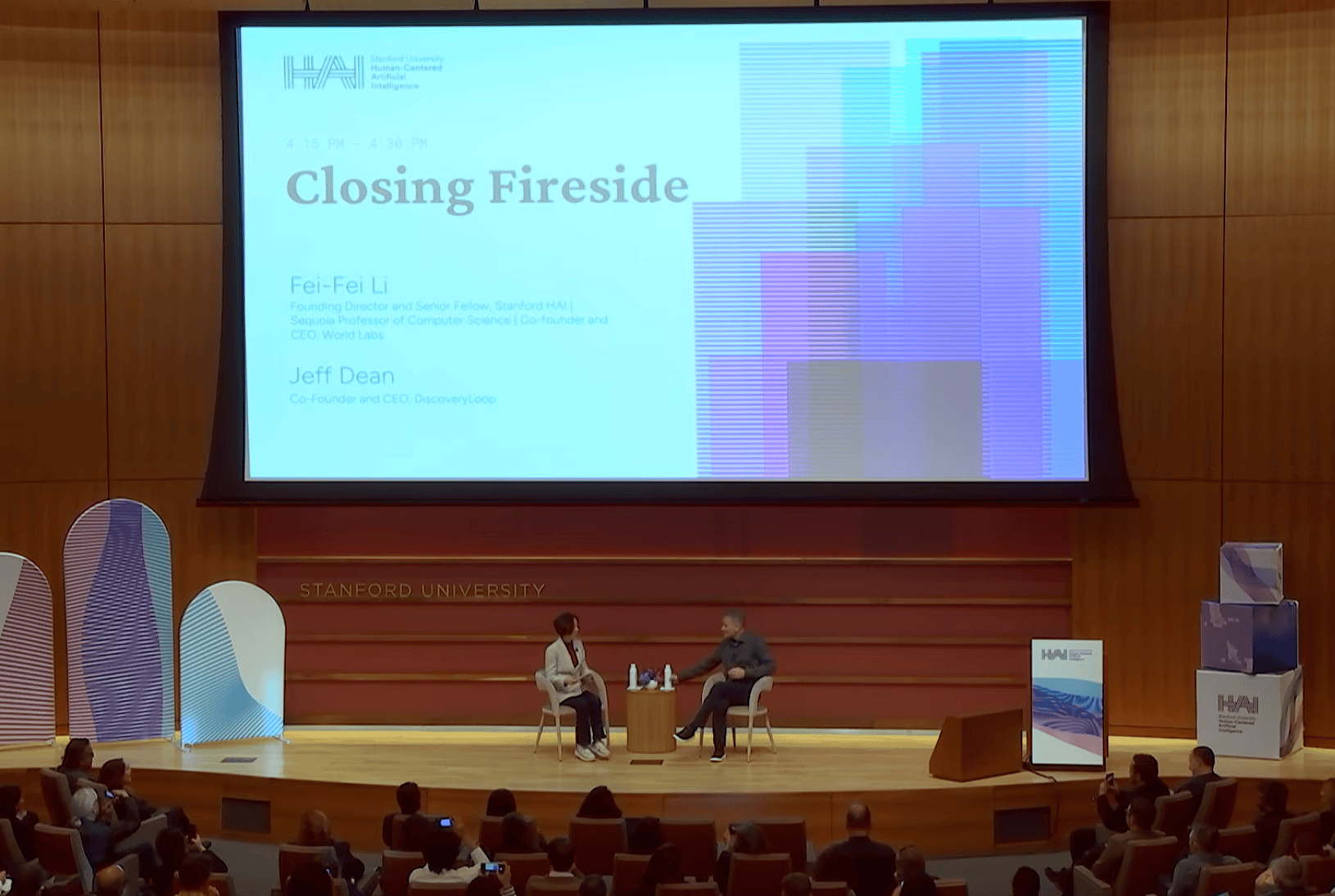
Fei-Fei Li:I had originally hoped this discussion would be a bit more technical. But since it’s a conversation, I’ll be both asking questions and taking part in the discussion.
Thank you for your talk. My first question was actually: Why did you found Discovery Loop? Congratulations.
Jeff Dean:Thank you.
Fei-Fei Li:All four of you have worked at Google for a long time, especially you, who joined Google back in 1999.
We’ve all seen the technological advances of the past few years, but I’m still curious: Was there a moment, perhaps in the past year or two, when you, Quoc, Sanjay, and Oriol felt that you had to do something different, and that doing so required leaving Google?
Jeff Dean:We’ve been excited to see automated systems increasingly help people develop software.
Quoc was doing a great deal of work on neural architecture search ten years ago. You can think of it as a kind of early recursive self-improvement system: one that searches for model architectures suited to computer vision or language problems.
We knew these kinds of methods worked. Back then, though, you needed a pile of rather messy Python code to define the search space.
Now you can make requests in natural language to a capable model or agentic system—for example, ask it to explore model architectures that help interpret MRI images—and then it carries out the work.
This has changed how we imagine the capabilities of computers and AI systems. If we can get these systems to run reliably, there is so much we can do. We think science and engineering are particularly well suited to having a positive impact through this.
Fei-Fei Li:So it was these loops and self-improvement capabilities that gave you the idea to start a company.
Jeff Dean:Some people might say we’re a little “loopy.”
[Note: “Loopy” is a pun on “loop,” used here with the joking sense of “a little crazy, a little eccentric.”]
Jeff Dean:One other important point: We’ve been through the process of starting from a very small project many times, and we love how that feels: five people at the beginning, then the sixth, the seventh, the tenth. It’s really fun.
You can have that kind of experience at a large company too. But we want to build it as a public-benefit company because that reflects our values.
Starting a company also means taking on greater challenges. You have to deal with office space and other things involved in setting up a company, which is also interesting.
Fei-Fei Li:I had a similar technological moment when I founded World Labs.
We were focused on a different direction, but what triggered us was the convergence of computer vision and generative models, allowing us to see the possibility of creating generative models that go beyond text.
Jeff Dean:The generative models you have created, and the capabilities they can now achieve, are truly impressive.
How do you distinguish self-improvement from recursive self-improvement?
Fei-Fei Li:Let’s talk about self-improvement and recursive self-improvement a little more deeply. We received our machine-learning education around the same time.
I was just thinking about all the names this concept has gone through: incremental learning, continual learning, meta-learning, lifelong learning, neural architecture search, and now self-improvement and RSI.
Could you give the audience—especially those with a technical background—a more rigorous definition?What is self-improvement, and what is recursive self-improvement?I’d like to separate imagination from fact.

Jeff Dean:The loop I mentioned earlier can be applied to many problems. As I understand self-improving systems, you give the system a goal, usually a measurable metric, such as the accuracy of a particular machine-learning model. The system tries different model architectures to improve that metric.
Fei-Fei Li:Hold on. Many machine-learning algorithms can do that.
Jeff Dean:Right.
Fei-Fei Li:That isn’t recursive in itself, right?
Jeff Dean:As an example, we give a system a set of MRI data and corresponding outcomes, and ask it to develop a model that helps interpret MRI images. The system can automatically develop models, try different approaches, and hope that accuracy improves as the experiments progress.
But this does not improve the underlying system responsible for proposing the next experiment.Recursive self-improvement is about how to apply the same self-improvement process to the underlying system responsible for proposing improvements itself.
Why can’t the self-improvement loop run infinitely fast?
Fei-Fei Li:I understand. But this concept is easy for many people to confuse. Especially in Silicon Valley, people use the term quite casually, which makes me a little uncomfortable as a scientist. I hope we can define RSI clearly here.
Let’s talk about the physical limits of RSI as well. It is now portrayed as an endless system that can continually accelerate toward infinity. What is hype, and what is speculation?
Jeff Dean:Think about how humans have improved model capabilities over the past 10 to 15 years: researchers and machine-learning engineers have conducted many small-scale experiments together, determined which ideas worked and which did not, and then applied the effective methods to the next generation of models.
That is how Gemini 2 came about after Gemini 1.
This is the normal research and engineering process. Adding automation can indeed speed up some parts of it. For example, someone launches an experiment, and it finishes at 2 a.m. They then have to wait until 8 a.m. to return to their workstation and look at the results.
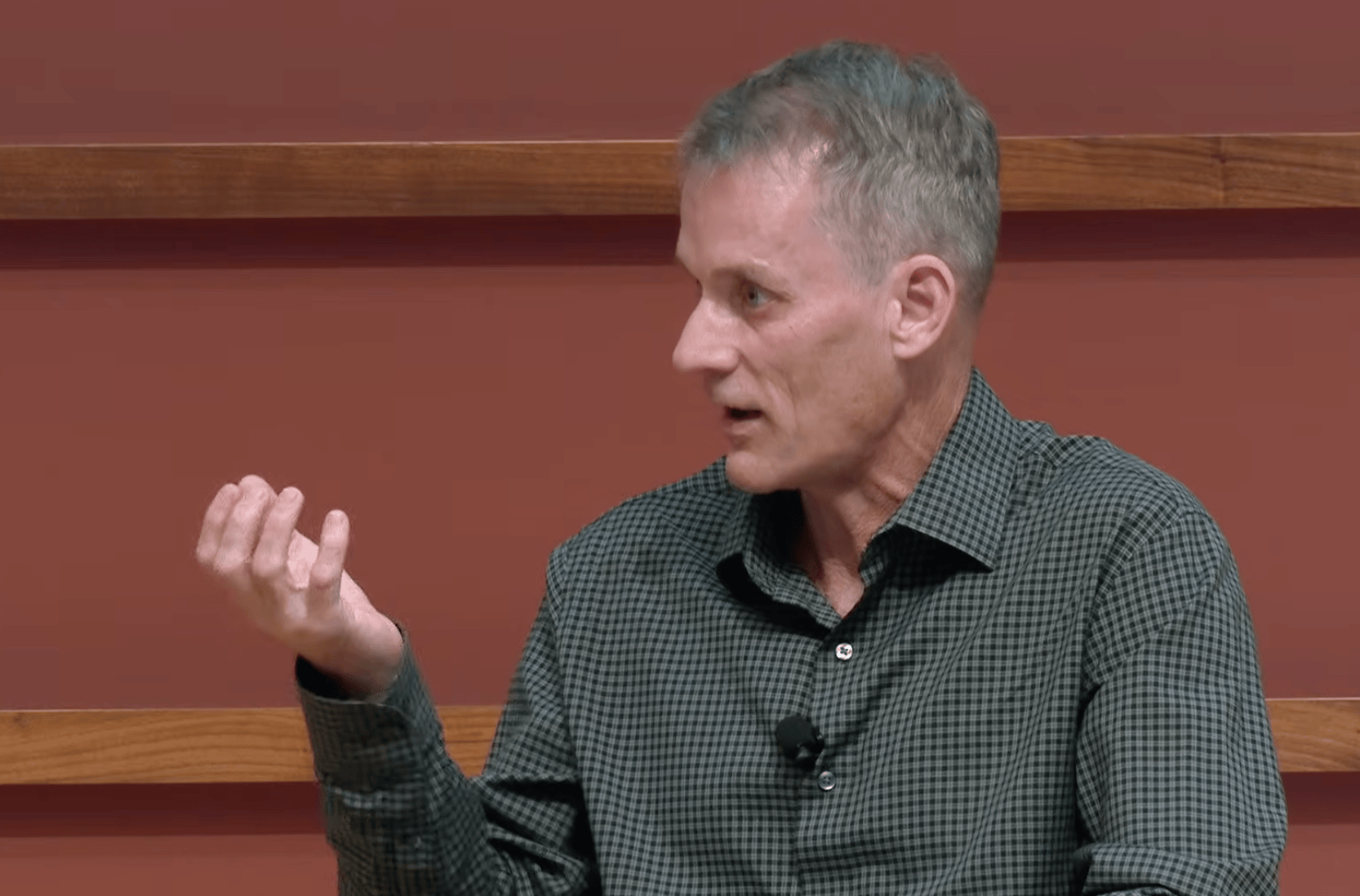
An automated system can check the results promptly and determine what to do next. At the level of an entire large project, it may also make better decisions about the next steps than individuals deciding separately.
But building a foundation model and improving it still require extensive training and experimentation, and these processes cannot be completed at infinitely fast speeds.
There are real physical processes here: computers need to perform calculations, results need to be checked, data need to be stored, and another model needs to analyze the results before deciding the next step.
Some people think this loop can run infinitely fast, but I don't think that's realistic. We need to be realistic. Automated systems can definitely speed up the process of improving these systems, but they cannot make it infinitely fast.
Are humans also recursively self-improving?
Fei-Fei Li:I think this point is important. Actually, I didn't apply for a job at Discovery Loop, but I did have coffee with Jeff at Cafe Venetia.
Jeff Dean:There were many reasons we had coffee, because we like coffee.
Fei-Fei Li:We kept talking about the hype around RSI versus the facts, so apparently we were already preparing for this conversation back then. I thought of an analogy you haven't heard yet, and you can either agree with it or reject it.
Are humans self-improving systems or recursively self-improving systems? I think humans certainly self-improve.
My cooking is terrible. The first time I made an omelet, I might have burned everything; the second time, I would learn from my experience and do a little better. Maybe after ten tries, I could make an omelet that I could barely bring myself to eat but that my children wouldn't eat.
That's self-improvement.
But recursive self-improvement involves the brain. In the process of learning to make an omelet, my brain has to undergo some kind of change, and neural connections need to be adjusted so that I have a better system for getting the job done.
If we're talking about hardware improvements, maybe I could even grow a sixth finger.
Jeff Dean:Maybe you're AI-generated.
Fei-Fei Li:Exactly. Keep making omelets, and the brain improves further. If such a loop occurs, humans are RSI systems. Is this analogy correct?
Jeff Dean:I think it's both. People learn many things over their lives, such as making omelets and solving calculus problems; that's self-improvement. People also learn how to learn.
Fei-Fei Li:And learning how to learn enables people to improve recursively. Once you understand how you most effectively receive knowledge and information, you can learn more things faster.
Jeff Dean:Right.
Fei-Fei Li:Recursive self-improvement might also be an evolutionary algorithm, right? Let's not go any deeper for now. I think it's rare that we can discuss this openly, because there's so much hype around it right now.
Jeff Dean:There are many claims that it will become infinitely fast and is therefore terrifying. If you understand it as an engineering system in operation, there will be less fear and it will be easier to understand.
Research in digital environments first; healthcare is the direction for the future
Fei-Fei Li:You've talked a lot about Discovery Loop, but it's still somewhat unclear which scientific problems it is meant to solve.
I'd like to follow up within the range you're willing to share: With so many scientific problems that could benefit society, which one do you most want to research now?
Jeff Dean:I've long been interested in the application of AI in healthcare. We will work on it in the future, but not now. The field is important and also strongly aligns with our mission as a public-benefit corporation.
Currently, we are focusing on scientific and engineering problems for which the entire experimental cycle can be completed in a digital environment. Such problems are better suited to accelerating the entire cycle.
If physical experiments or other real-world processes are involved, it is harder to speed things up. Of course, many important disciplines require physical processes, and we also have hybrid approaches that can help accelerate research in these fields.
Initially, we focused on three areas: machine learning research, machine learning engineering, and hardware design. It makes sense to focus on a few areas first; we have experience in those areas, and the work can help enable other research.
For example, a system capable of automatically solving machine learning engineering tasks could be used in areas such as healthcare and materials science to develop models suited to particular tasks. This is self-improvement, not recursive self-improvement.
We are now focusing on these three areas and hope to expand into more areas in the future.
Can automated experimentation systems conduct theoretical research?
Fei-Fei Li:I studied physics as an undergraduate. Physics distinguishes between experimental and theoretical research. The cycle you drew begins with “proposing an experiment,” whereas in physics we would normally say “formulating a hypothesis,” then conducting an experiment and evaluating the results.
Whether recursive or not, these powerful AI agents and self-improvement cycles place great emphasis on formulating hypotheses and running experiments in parallel. Does this tilt the approach toward experimental research? The process of theoretical discovery seems more difficult to describe.
Theorists like Newton and Einstein did not personally conduct so many experiments themselves. They read experimental results, but their working methods are different. Would your approach be more oriented toward experimental research?
Jeff Dean:Not necessarily, although it might lean slightly in that direction. But I do think such a system could also do excellent theoretical research.
You can ask it whether it can propose a theory that explains the data. The system can try repeatedly, looking for a theory that explains the experimental data while being as concise as possible.
Many physicists also follow advances in experimental fields and try to explain phenomena that people have observed but do not yet understand. I think that is possible, and these disciplines should not be completely separated either.
Imagine a system that has conducted 100 million experiments across 100 scientific fields and solved one million problems. It has seen all kinds of experimental results and knows which methods work and which do not in fields relevant to future questions, and it is likely to gain many insights from them.
This experience need not have the strict disciplinary boundaries of human academic departments. One thing I like about HAI is that it can cross organizational boundaries and enable people from different fields to interact.
The value of AI mathematical proofs and the role of elegant solutions
Fei-Fei Li:Then let’s talk about mathematics. When preparing this conversation, I also invited Terence Tao and gave him a call, but he was unable to come.
Seeing these recent developments has left me with mixed feelings. First there was the Navier-Stokes-related work, then more than 720 mathematical manuscripts, and yesterday OpenAI released some results on AI solving mathematics problems.
I of course welcome these discoveries. Mathematics—and the problems that have existed for hundreds or even thousands of years—are an important manifestation of human intelligence. Mathematicians see solutions, but they also see beauty.
Now, we have a completely different mechanism for addressing these problems.
I have spoken with Terence Tao quite a few times. He recently discussed “Mathematics 2.0” as well, including which problems AI can help solve.
According to him, some problems remain beyond the capabilities of AI, especially those for which no solution yet exists or data are scarce.
How do you view the changes that have taken place in mathematics over the past few weeks?
Jeff Dean: These models, along with agentic systems that enable models to work in a highly parallel way, have demonstrated an ability to solve difficult open problems in mathematics. This shows us what is possible now.
I think people are sometimes dissatisfied, even uneasy, because some proofs take the form of 500-page-long Lean code.
Machines can check it, but people still do not really understand how to arrive at that result in an elegant, concise way.
Knowing that a problem has been proved or disproved is certainly valuable. But when human mathematicians work on a problem, they also develop elegant methods. These methods often yield new mathematical tools for other problems.
Fei-Fei Li: Do you mean that new mathematics can only come from elegant solutions?
Jeff Dean: No. What I mean is that an elegant solution often leads to a useful method that can be applied to other problems.
In some of these very long machine-generated proofs, people may not necessarily see such a clear, elegant method.
But knowing that something is possible is important in itself.If people know that a problem is solvable, they will work harder and may find another, more elegant solution.
The solving of so many problems at once may be a little unsettling, but it is now a possibility. We need to figure out how to harness these capabilities to conduct more mathematical research.
A Pop Quiz on the Transformer Paper
Fei-Fei Li: We could talk about a lot more. But I promised to spring a pop quiz on Jeff here onstage, without warning him of the questions in advance. It is okay if you cannot answer, because I do not remember them myself.
Jeff Dean: Okay, no pressure.
Fei-Fei Li: Do you remember what the significance of June 12, 2017, was? No cheating with AI.Jeff Dean: Was it the day the Transformer paper was posted to arXiv?
Fei-Fei Li: Excellent, an A+! I would have to look it up to know the date too. Did you read the paper on June 12?
Jeff Dean: No, possibly June 10.
Fei-Fei Li: Oh, right, you may have had to approve it as well.
Important Technological Advances, and Unrealized Architectural Expectations
Fei-Fei Li: Looking back over your career, the four of you did a great deal of work at Google and for the field as a whole. Let us take that day as a historical marker, in some sense the beginning of the era of generative models.
Over the past roughly nine years, which technological moments have been most important to you? And please be candid about which predictions were right and which were wrong.
Jeff Dean: Several things stand out. Many of the things we did brought about major improvements, as the previous slide showed.
The Transformer is a more efficient model architecture for handling these problems. The idea of preserving the previous state and then accessing it through an attention mechanism is very valuable.
Earlier approaches instead updated a smaller vector at each step and forgot the previous state. Compared with earlier models such as LSTMs, Transformers can learn more with less computation.
Then came the distillation work by Oriol, Geoff Hinton, and me. It was rejected by NeurIPS in 2016, with the reviews saying it was unlikely to have much impact.
[Note: This refers to “Distilling the Knowledge in a Neural Network” (“Knowledge Distillation in Neural Networks”), coauthored by Geoffrey Hinton, Oriol Vinyals, and Jeff Dean]
Fei-Fei Li:
We should create a website that collects all those rejected papers.Jeff Dean:
This one would be a good one to include. We put it on arXiv, and it now has about 40,000 citations.Distillation is important for building models that are powerful and efficient at inference. You can have a trained, large, expensive model serve as the teacher and teach a lightweight student model. It is a good metaphor to use in a university setting.
There have also been advances in architecture. I originally thought we would see more unusual neural network architectures. An MoE splits into a group of experts and then combines them, before splitting and combining them again, and learns which experts are good at which tasks.
This is useful: a model can have a great deal of capacity while activating only a small part of it for each token or task. But it is still very regular. In most architectures, the experts are the same size, and they merge back together quickly.
I had originally hoped to see more irregularly shaped, more “organic” networks: ones where certain neural activity forms columnar structures, and where some places have only a few but large-scale cross-connections that link parts of the network that are far apart. We have not achieved that yet.
Fei-Fei Li:We thought about these things when we were doing neural architecture search too, but in the end we were not able to achieve them, right?
Jeff Dean:The models produced by neural architecture search really are more irregular than manually designed architectures. Manual design is often layer after layer, with the occasional skip connection. Architectures found through search can have very unusual connection patterns.
Fei-Fei Li:
For example, connecting this layer to the 17th layer above and doing something strange.Jeff Dean:
Yes.Fei-Fei Li:
So this is one thing you got wrong in your predictions?Jeff Dean:
I have predicted a lot of things wrong. This one stands out, because I had originally thought architecture would develop more in that direction.Underestimating the importance of programming ability
Jeff Dean:Programming ability was later shown to be extremely important. At the time, I did not fully anticipate that it would become a key capability for models to solve many different problems.
Fei-Fei Li:I agree with that. We had some sense that it was important, but we did not foresee that the impact would be so profound.
Jeff Dean: In the Gemini project, programming was one of the areas we were focusing on, but at the time it was not our primary focus.
How to address AI’s societal impact
Fei-Fei Li:Since this is the HAI conference, we have to talk about the H in HAI—humans.
What social impacts brought by AI—including changes in employment, psychological anxiety, and debates about human extinction, alignment, and related issues—have you anticipated? What worries you most right now?
Jeff Dean:AI is an extremely powerful and general-purpose technology that can play a role in almost every aspect of society. Whether it’s mathematics, programming, image generation, or autonomous driving, it can make a difference.
Some technological revolutions in the past mainly had a profound impact on five or ten fields. AI affects many more fields simultaneously, so it can make people excited and concerned, while also giving rise to fear.
I wrote a paper with some coauthors called “Shaping AI’s Impact on Billions of People,” which discusses how AI affects the lives of billions of people.
It’s the only paper I’ve written that has a dedicated website, because one of my coauthors created shapingai.com.
[Note: shapingai.com is the website of a research project by Jeff Dean and others on AI’s social impact, exploring how AI can better serve fields such as education, healthcare, and science.]
We studied seven areas, including employment and the economy, AI research, misinformation and media, and spoke with experts in each field to understand the impact AI has already had and the changes it may bring. It was a very valuable experience.
What I care about most is how we can maximize AI’s benefits across different fields while minimizing the negative impacts it may cause. This requires the participation of technologists, regulators, policymakers, and the public.
For example, when people’s work is affected, they need ways to adapt to new demands, continue to earn a living, and live prosperous lives. This is a multifaceted issue that requires many people to work together to solve it.
Advice for Young People
Li Fei-Fei:For the final question, many people don’t know that you care deeply about the younger generation. We don’t often share the stage, and I remember the last time was at the Grace Hopper Conference.
Jeff Dean:You attended several years in a row.
Li Fei-Fei:We’re now on a university campus. This generation of students is anxious about the job and economic outlook, and Stanford students feel the same way.
As an AI pioneer and someone who was able to see technological changes early on, what would you say to students who are both anxious and hopeful?
Jeff Dean:I understand this anxiety. The world is changing rapidly, and it is indeed difficult to make plans when the future is changing so quickly.
My advice is to learn as much as you can about emerging technologies, or technologies that will emerge soon, and learn how to use them for whatever you are most passionate about.
You might want to become a doctor, pursue literature, or develop software more efficiently. AI can help with all of these.
People still need to decide what we want to do together. You should also think carefully about what you want to do and strive to do your best, which includes making good use of the various tools that have already emerged.
Li Fei-Fei: So, in the age of AI, human passion will never become obsolete. Thank you, Jeff.
Jeff Dean: Thank you.
Interview link:
https://www.youtube.com/watch?v=ooGKNwJWdb8&t=1s
@@