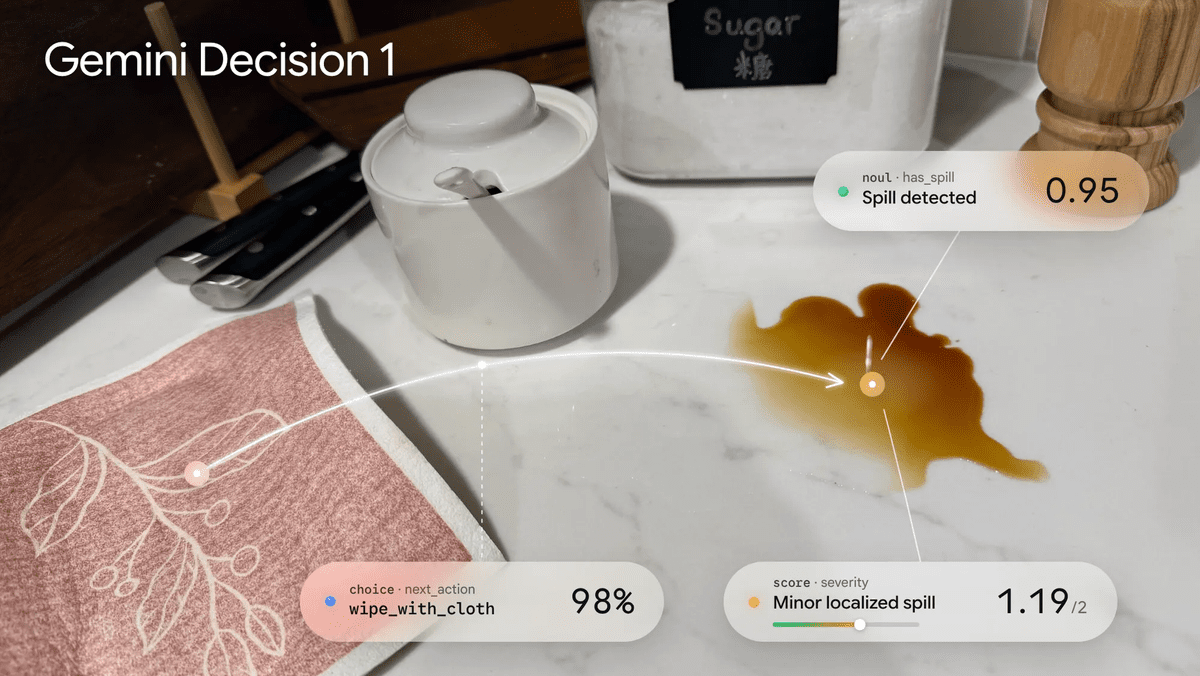
Since the launch of “Jev,” an AI model that solves tasks through an approach different from large language models (LLMs), a succession of models that guide the decisions of AI agents—similarly called “decision-making models”—have appeared. Google has now introduced “Gemini Decision 1,” a decision-making model.
Gemini Decisions API: Fast multimodal decisions
https://blog.google/innovation-and-ai/technology/developers-tools/gemini-decisions-api/
The Gemini Decisions API is now in preview in @GoogleAIStudio, bringing our new Gemini Decision 1 model to workflows that need fast, closed-set decisions.
— News from Google (@NewsFromGoogle) November 11, 2026
Built for workflows that need a quick, reliable call rather than a generated text answer, it scores multimodal inputs… pic.twitter.com/zLoe8biT4f
TAG38@@
Gemini Decision 1 (gemini-decision-1) is based on Gemini’s multimodal architecture and can produce the optimal response even when multiple pieces of content—such as text, images, audio, video, and PDFs—and multiple questions are submitted together.
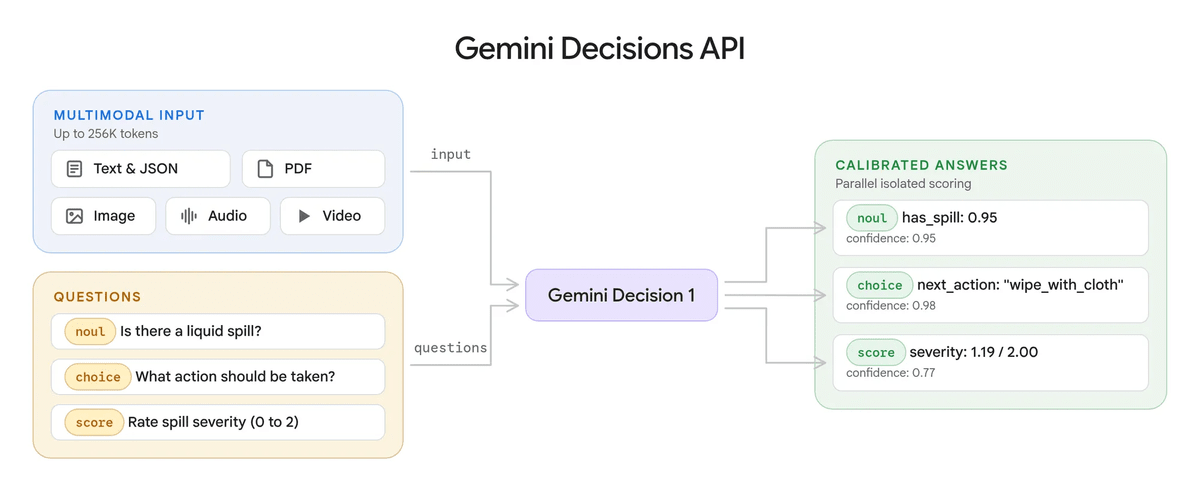
Gemini Decision 1 evaluates the available options without token-by-token decoding, reportedly keeping the model’s median computation time to 50–100 ms for multimodal inputs with a context of up to 16K tokens (150–250 ms end to end). It is also said that latency barely changes when the number of questions per request increases from one to 100.
A new endpoint, the “Gemini Decision API,” which supports Gemini Decision 1, has also been announced, allowing users to access Gemini Decision 1 in Google AI Studio via the API.
With the Gemini Decisions API, you can submit a single multimodal input spanning text, images, audio, video, and PDFs (up to 256K tokens), along with up to 1,000 independent questions. Instead of generating the answer text token by token, Gemini Decision 1 scores the candidate options in a single forward pass and returns probability and confidence scores with end-to-end latency of 150–250 ms.Pricing is $0.10 per 1 million input tokens (approximately ¥16), with no charge for output tokens, so Gemini Decision 1 using the Decisions API is said to cost about one-fifth as much as Gemini 3.5 Flash-Lite using the Interactions API.
In benchmarks measuring AI agent routing, reasoning, ranking, and multimodal understanding, Gemini Decision 1 recorded the lowest calibration error and delivered the best performance across all tests.
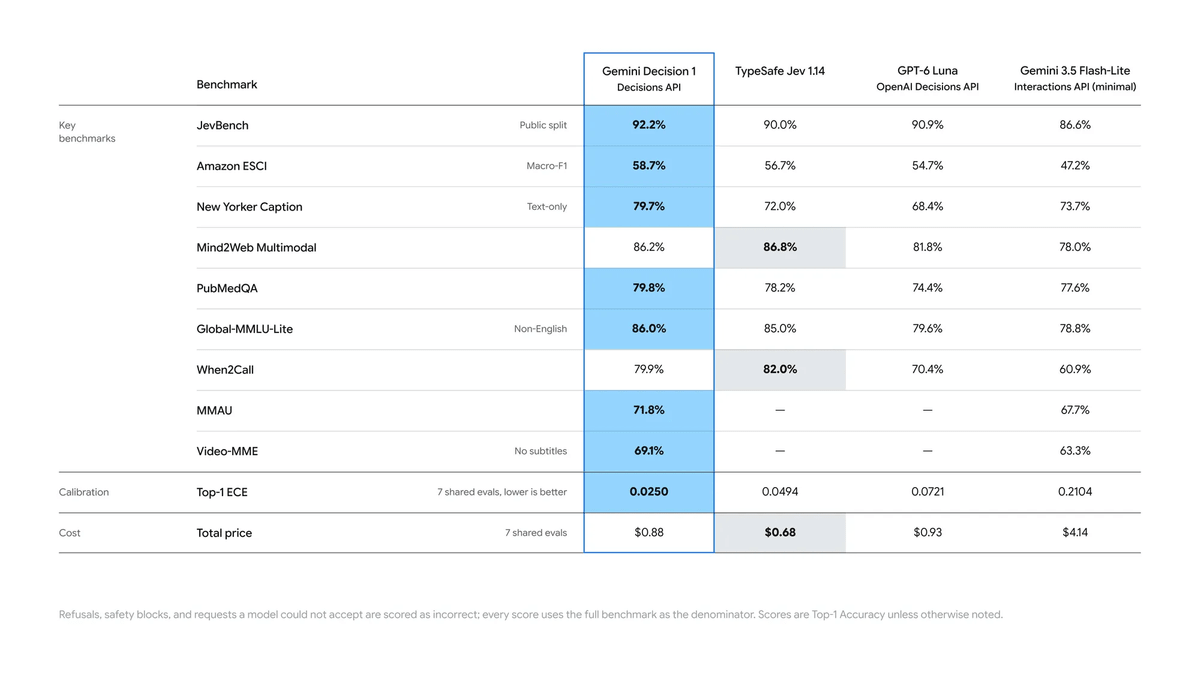
On Artificial Analysis, it earned a high score of 66 on the Artificial Analysis Decision Index v2.1. This is on par with Elephant 9B and Jev 1.14, and seven points lower than Drex Max v1.1 and GLiDE v1.2.
Google has released its first decision model, Gemini Decision 1, scoring 66 on the Artificial Analysis Decision Index and leading in knowledge and reasoning benchmarks
— Artificial Analysis (@ArtificialAnlys) November 11, 2026
Gemini Decision 1 from @GoogleDeepMind scores 66 on the Artificial Analysis Decision Index v2.1, in line with… pic.twitter.com/CpaEdYZsbW
Google is already using Gemini Decision 1 internally, and CEO Sundar Pichai has shared a video of creating a UI design in just around 10 seconds.
Today we’re launching the Gemini Decisions API, powered by our new Gemini Decision 1 model in @GoogleAIStudio.
— Sundar Pichai (@sundarpichai) November 11, 2026
Instead of generating text token by token, it’s built for closed-set choices scoring up to 1,000 questions across text, images, audio, video + PDFs in a single pass. A… pic.twitter.com/7itBuv7Eu2
Google said, “You can start developing today by obtaining an API key in Google AI Studio, trying the Doorstep Parcels, Speed Sketch, and Find the Zoo Keeper demo apps, and following the Python, JavaScript, and REST guides in the Decisions API documentation.”




