The spread is almost fivefold, and it is all about a single search engine. AI answers appear for more than 80% of queries only in Semrush’s commercial dashboard.
Long and informational queries are the ones most likely to receive AI answers in Google Search.
At Pew, query length noticeably changes the picture. AI summaries appear for 8% of one- to two-word queries, but for 53% of queries of 10 words or more. SE Ranking’s data shows a similar pattern with frequency: AI Overviews appear in 30–31% of cases for keywords with a frequency of 0–10, and the more frequent the query, the less often an AI answer appears.
The figures differ by query type even within a single study. According to the seoClarity page, transactional queries—where a person intends to make a purchase—receive AI Overviews in 12.54% of cases as of September 2025. SE Ranking, citing the same seoClarity, reports 1.2% and says that more than 96% of AI answers are triggered by informational queries, where a person wants to find something out. The difference is tenfold; only the direction matches. Queries about nearby locations almost never receive an AI answer from seoClarity: just 0.01% of local keywords.
Meanwhile, in Semrush’s commercial dashboard, as of August 2026, AI answers were present for 88% of keywords. This cannot be compared directly with seoClarity: the datasets are different, and the measurements are almost a year apart.Therefore, the share in any report depends to a large extent on how many long informational questions are in the sample and which commercial keywords it contains.
Alice AI in Search: Yandex put the share of answers at 44%, but only for Search as a whole
How often Alice AI in Search answers on its own, Yandex said in its report for the third quarter of 2026: the share of queries for which Alice AI provides an answer in Search reached 44%. This figure is for Search as a whole, without a breakdown by topic or query type. The Webmaster documentation only says that Alice AI’s answer is displayed when the search algorithms consider it useful and that it supplements the regular search results but does not replace them.
Before that, Yandex had provided only a relative figure—in an April 2026 news release: updated models increased by a factor of 1.5 the share of queries for which Alice AI immediately gives a quick answer. The baseline was not stated, so the share could not be estimated from this release.
Third-party measurements for Yandex are indirect. Topvisor calculated, on one premium e-commerce project (2,909 queries over 1.5 years), how often Yandex’s AI answer cites a site that has a position in organic search. For question queries (how, where, how many, which), the figure was 28.2%; for the rest, 21.4%. This is the site’s citation share: it does not show how many queries received an AI answer in the first place.
At the same time, the AI answer does not make optimizing for Yandex’s organic search pointless. Yandex says that Alice AI relies on sources that rank highly in search. According to an Ashmanov & Partners report, as summarized by Kommersant, from August 2025 to January 2026 the share of sites outside Yandex’s top 10 in Alice’s answers fell from 40% to 10%.Mikhail Slivinsky from Yandex says in the same article that a quick answer is built from an average of roughly ten sources and that inclusion in it determines the authority of the content. Organic search remains the foundation, but the question is which queries a site also appears for in AI answers.
How many clicks does a regular link beneath a Google AI answer lose?
Open figures are available only for Google. According to Pew, when search results included an AI summary, users clicked a regular link on 8% of visits, compared with 15% without one—almost twice as often. Links within the summary itself were clicked on just 1% of visits.
A study using Wikipedia data estimated that the launch of AI Overviews reduced search traffic to one site, the English Wikipedia, by approximately 5%. Kommersant reports that informational sites lost up to 30% of their organic traffic after AI answers appeared, but it does not provide the methodology or a breakdown for Yandex and Google. There are no open measurements of losses specifically beneath Alice AI answers.
How to check which queries your site appears for in Alice AI answers
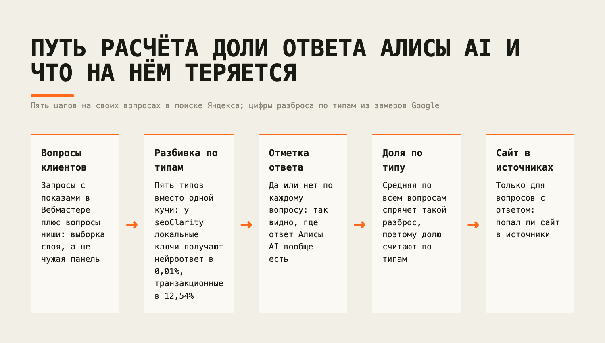
The share is calculated using your own queries and by type. I have logs from a previously conducted measurement of Alice AI answers for one of my clients, covering queries on its topic. I did not run a new measurement for this article: I only use Alice AI data from these logs.The figure among them applies only to this niche: I don’t carry it over to an adjacent niche, just as I don’t carry over Semrush’s 88% figure for the Runet.
Take several dozen queries for which the site already gets impressions in Yandex Webmaster, and add the questions customers ask in the niche.
Break them down by type: how to do it, how much it costs, what to choose, where to buy, near me.
Enter each question into Yandex Search and note whether there is an Alice AI answer above the search results.
Calculate the share for each type separately: the overall average mixes informational and commercial questions, as happens in Google reports.
For questions with an AI-generated answer, check whether the site is among the sources. How many pages are included and how often the list changes—I covered this in the Alice AI answer measurement.
The Google measurements in this article were taken on the US search results, so they are compared with Alice AI by share and question type: nobody has cross-checked the exact same questions in the two search engines.
The share of Alice AI answers across several dozen questions in its niche will tell you more about the project than any Google report: it is measured where the traffic comes from and on the questions customers ask.If the AI-generated answer ranks above a small portion of these queries, there’s no need to overhaul your Yandex organic search efforts because of Semrush’s 88%.


