Mitsubishi Electric announced on November 10 that it had developed an antenna called “Liqutenna” (Rikutena), which uses tap water filled inside an acrylic pipe to transmit and receive radio waves, and had successfully tested its connection with mobile terminals. It claimed this was the first such antenna in the communications industry.
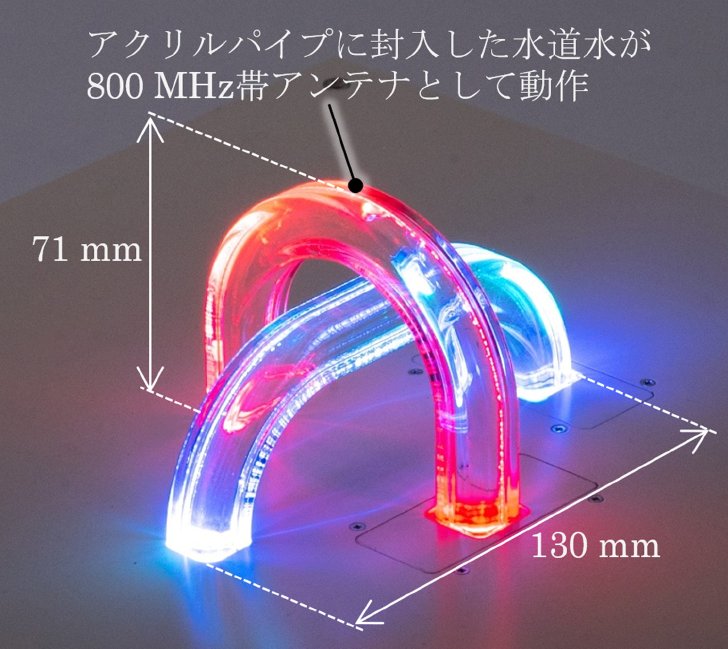 Prototype Liqutenna for 800 MHz mobile communications
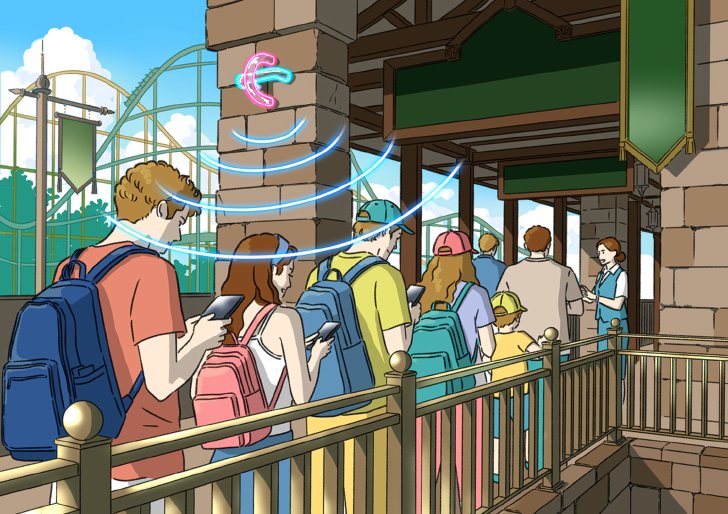 Concept image showing application at an amusement facility
Liqutenna is distinguished by a design that offers transparency unlike a metal antenna. It can satisfy both communication quality and consideration for the surrounding landscape, leading to what the company calls a “new style of antenna installation.”
In an indoor verification environment used to evaluate KDDI’s wireless communications equipment, the company tested communication between an 800 MHz prototype of Liqutenna and a mobile terminal. It confirmed that there was no difference in connection performance compared with a conventional metal antenna.
Liqutenna was developed based on insights gained from “Sea Aerial,” a seawater antenna announced by the company in 2016 that transmitted and received radio waves using a column of seawater. While using tap water, which has far lower conductivity than seawater, the company adjusted the acrylic pipe’s inner diameter and innovated its shape to secure connection performance equivalent to that of a metal antenna.
For real-world implementation, the company will proceed with demonstration evaluations in areas where radio waves have difficulty reaching, with the cooperation of KDDI.
Details of the technology will be exhibited at the “Microwave Exhibition 2026” (November 25–27, PACIFICO Yokohama).

