Such frames were placed in living rooms or set aside separate rooms, often on the upper floor, with large windows to let in daylight. There were also workshops in attached buildings or separate structures in the yard, but in general, housing was adapted to this kind of production: the work area occupied part of the house. The sizes of the machines varied and, by today's standards, were enormous, ranging from one to two meters in each dimension.
A costly knitting machine usually belonged to an entrepreneur who sold socks and provided workers with orders. He supplied the knitter with yarn, collected the finished products, and paid for the work—typically, one shilling per dozen pairs. Production often involved the whole family: one worked on the machine, the others sewed parts or wound threads. At the same time, workers had to pay the entrepreneur rent for using the machine, since only a few knitters owned their own machines.
Although knitters worked at home, they depended on the entrepreneur, who determined the volume of orders and the payment amount, and from the earnings, they had to pay the machine rent even when there was no work. If the demand for socks dropped, the family would have no income, but still had to pay the rent, and thus all the risks of trade fell on the workers, although they could not influence either the number of orders or the price of their work.
Note the paradox: the machine was already part of the worker's life, but it did not give him any independence or control over his earnings. He knew how to use it, sometimes better than anyone in the vicinity. But another person controlled it. Orders were distributed by another person. And the decision about how much his work now cost was made by another person.
The problem was not that the worker had not mastered the new technology. He had mastered it long ago.
Entrepreneurs found a way to produce socks more cheaply: instead of knitting each sock individually, they began using wide knitting machines that allowed them to make large pieces at once, which were then cut and sewn. Such socks were called cut-ups, and they were inferior in quality to traditional ones, but they were cheaper, so other manufacturers had to lower their prices and reduce wages for the workers. As a result, experienced knitters who continued to produce high-quality socks earned less and less.
Negotiations and initial attacks
By spring 1811, the dispute over prices had already become a subject of negotiations between entrepreneurs and the workers' committee. Some employers were willing to agree, but only if competitors did the same. The committee collected signatures for the agreement, but an agreement could not be reached. Thus, before the mass protests, workers tried to resolve the conflict peacefully.
On March 11, 1811, hundreds of weavers from the surrounding areas gathered on Nottingham's market square, where speeches about workers' conditions were held all day, to which the authorities called in police and cavalry. After this, part of the weavers went to the neighboring village of Arnold, where the machines of those entrepreneurs who particularly heavily reduced wages were located. Ironically, but the crowd stormed into the homes and workshops of other weavers and 63 looms were destroyed overnight. In the following weeks, attacks spread to other nearby settlements.
It is unknown who exactly organized the March gathering, however weavers were already connected through workers' committees and local communities, therefore they could quickly negotiate and spread information. Machine destructions had occurred before, but it is customary to consider March 11, 1811 as the beginning of mass protests, which continued in spring, temporarily subsided in summer, and resumed in autumn.
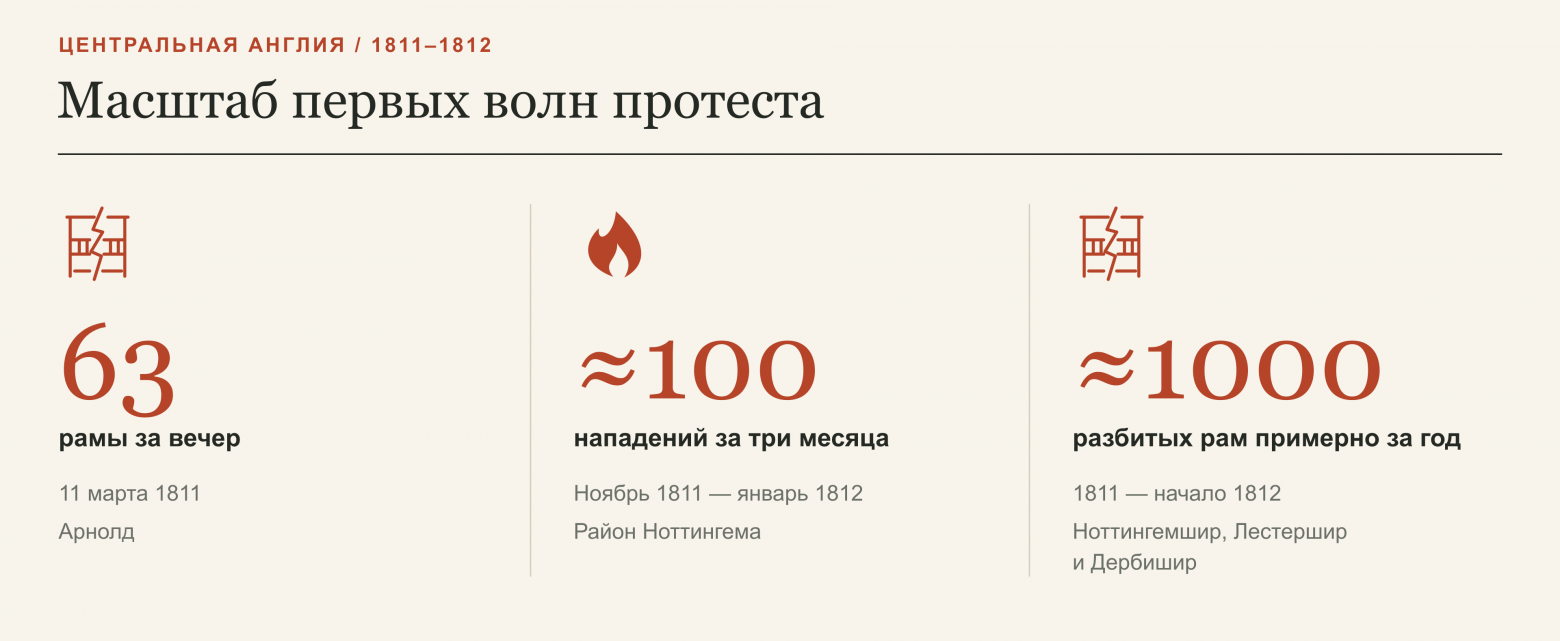
During the early waves 1811 — beginning of 1812 in the hosiery districts of central England, about a thousand looms were smashed. In total, there were approximately 25 thousand looms in those years: that is, the damage was serious, but it was not about destroying the entire industry.
Different machines — different conflicts
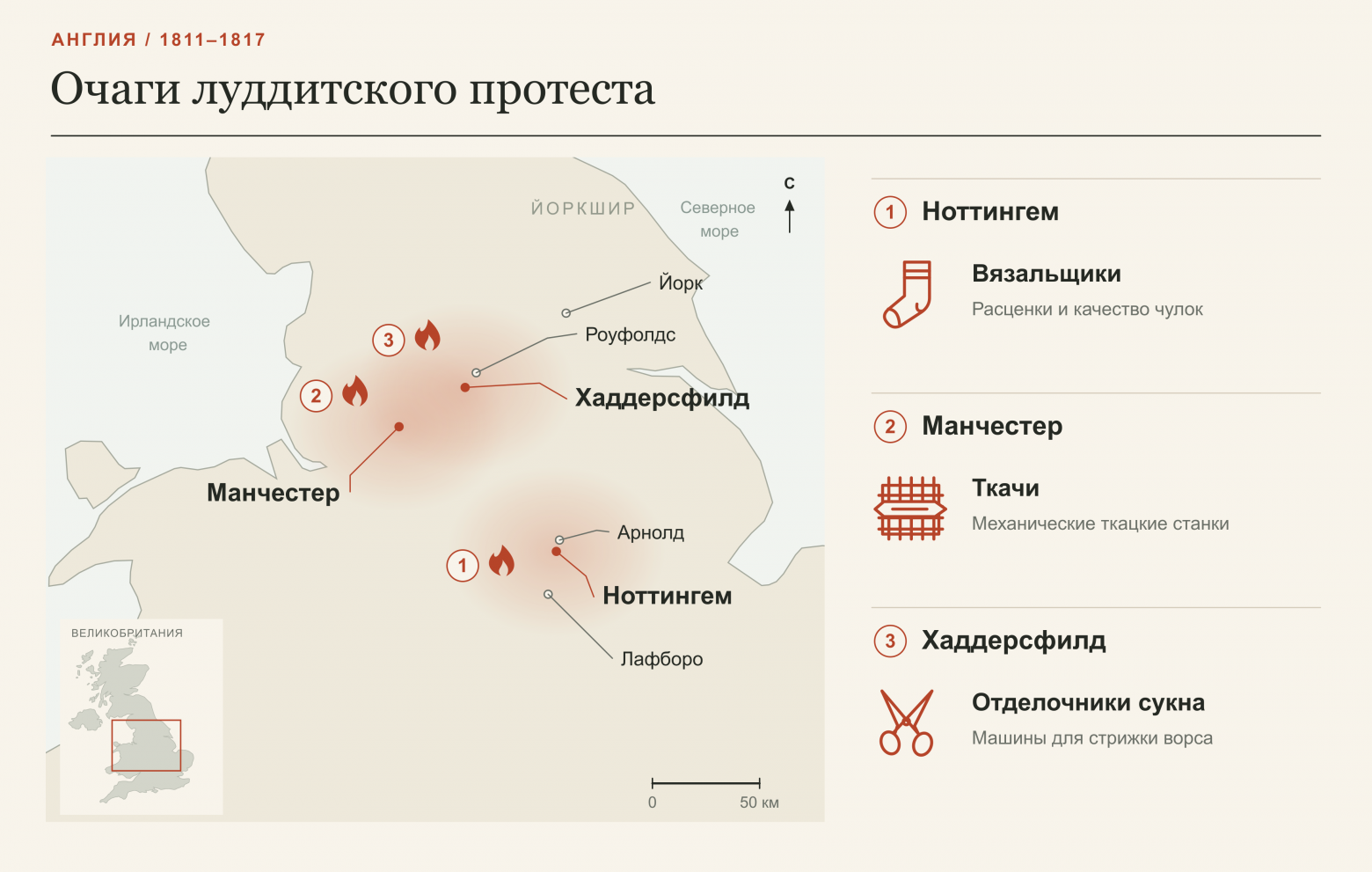
In Nottinghamshire, weavers fought against the reduction of wages and the production of cheap stockings, while in Yorkshire, workers who manually finished woolen cloth protested against machines that directly replaced their entire labor.
The mechanization began long before the Luddites: as early as 1712 (a hundred years before!) Thomas Newcomen invented a steam engine for pumping water out of mines, and then the gradual spread of machines and the reorganization of production around them was called the Industrial Revolution.
In the Manchester area, hand-loom weavers faced competition from factory looms, driven by steam engines among other things. Other workers, dissatisfied with high food prices, often joined the protests.
Thus, behind the general name of the movement were different conflicts: some workers fought for fair wages, others protested against machines that made their profession unnecessary.
Ned Ludd, whom no one could find
So why are they called the Luddites?
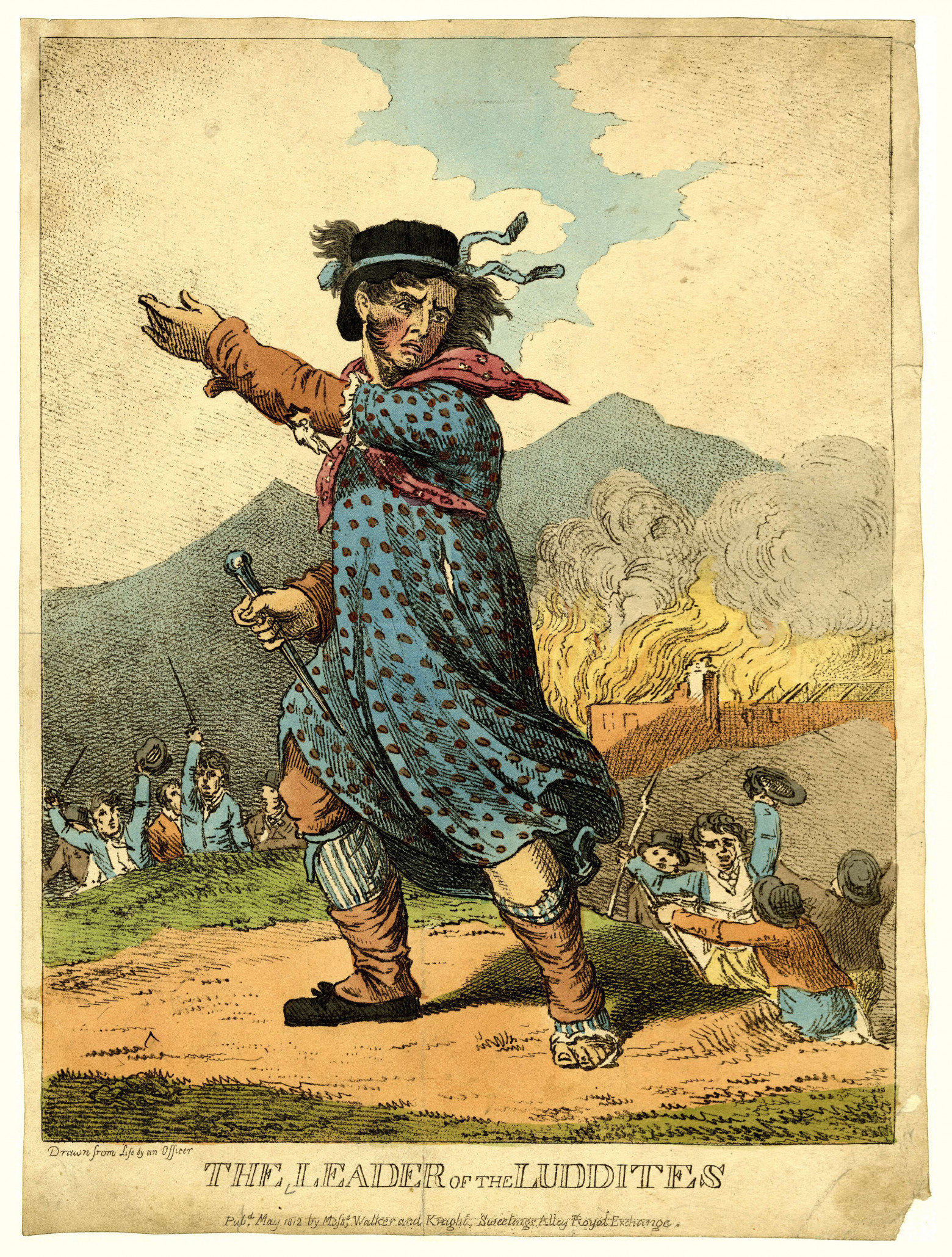
The movement got its name from Ned Ludd, the legendary worker, who smashed a stocking frame after a conflict with his employer. Some stories claimed he was punished for poor work, others said he refused to obey the employer's order. But all inevitably associated Ludd's name with disobedience and destruction of machinery, and even nicknamed him "General Ludd".
However, there are no verified records of such a person existing. "General Ludd" was a fictional leader, very convenient for the underground movement: different groups could act under one name without revealing their real organizers. Gradually, Ludd became a symbol of general resistance.
He became a captain, general, and king; his imagined headquarters were placed in Sherwood Forest, where, according to English legend, Robin Hood—the outlaw who protected the poor from the tyranny of the rich and authorities—lived. The protesters had a similar defender, along with his own orders and a mocking version of power.
The legend did not merely adorn the protest; it allowed strangers to feel a sense of involvement in the common cause.
How they chose their goals
The Luddites did not wage war against machines per se. They primarily attacked the equipment of entrepreneurs accused of lowering prices and violating established production rules. At the same time, they continued to break into the homes of their colleagues to destroy the property of specific entrepreneurs, without touching the workers themselves (except those who agreed to work for reduced wages), but inevitably depriving them of any income.
Sometimes attacks were preceded by warnings: machine owners received letters demanding the removal of equipment, threatening to destroy it and burn down the workshop otherwise.
How the underground was organized
Luddism is difficult to imagine as an organization with a president, treasurer, and subordinate branches. Surviving evidence indicates a network of local groups: workers' unions, supporters of political change, participants in machine-breaking incidents, and sympathetic neighbors, but their connections and level of involvement varied.
Over time, attacks became more organized, as machine-breakers hired guards, and "just breaking in" was replaced by armed robbery.
Connections between districts also existed. In the archives, there is a intercepted letter from May 1, 1812: the "secretary" of the senior general Ludlow in Nottingham addressed the junior general in Huddersfield, but it only indicates contact and exchange of information.
Fundraising took place, but it was too varied to be incorporated into a general budget.
The fear also helped maintain secrecy: in a written communication in the name of "King Ludd," threats of death were issued to those who passed information about machine-breakers to the authorities.
Negotiators and armed men
Within the workers' movement, there was no unity regarding methods of struggle: some aimed to achieve fair wages through negotiations and parliament, while others believed that without threats and destruction of machines, employers would not make concessions.
One representative of the first approach was Grayvenor Henson, who represented the combined committee of weavers and sought legislative regulation of the industry. Authorities suspected him of connections with the Luddites, although there is no convincing evidence that he directed the attacks.
In a letter to the Home Secretary in 1817, Henson claimed that radical participants in the movement even threatened to kill him for opposing their plans. Although this declaration might have been invented and served a protective role, it rather shows the huge disagreements and visions of the future among the Luddites.
Rowfold and York hangings
In the night of April 11–12, 1812, a group of Luddites approached the Rowfold factory in Yorkshire. Here, machines not only allowed fabric to be produced more cheaply, but they also replaced the work of skilled weavers.
The factory owner was prepared, and armed guards awaited outside. A shootout began, two attackers received mortal wounds.
Two weeks later, the conflict crossed another boundary: a manufacturer opposing the Luddites was mortally wounded. For his murder, three participants of the movement were later condemned.
The state responded not only with soldiers and investigations. In 1812, the British Parliament made the destruction of certain types of machinery a crime, with the death penalty as punishment. Although the law had many opponents, because poverty drove workers to crime, the law was still passed.
In January 1813, in York, a dozen people were executed for crimes related to the Luddite movement. It all began with negotiations about stocking prices, but now behind this story stood armed groups, killed people, and hangings. Machines remained, but here, not all people.
The Decline of the Movement
Hangings greatly tempered the Luddites' fervor. The main wave of the movement occurred in 1811–1813. Later outbreaks continued: after the 1816 attack on the Loughborough factory, which produced lace, new executions followed. Therefore, the history of the Luddite movement itself usually ends in 1816–1817, not several centuries later.
The industrializationcontinued longer — the restructuring of production and life around machines and factories.
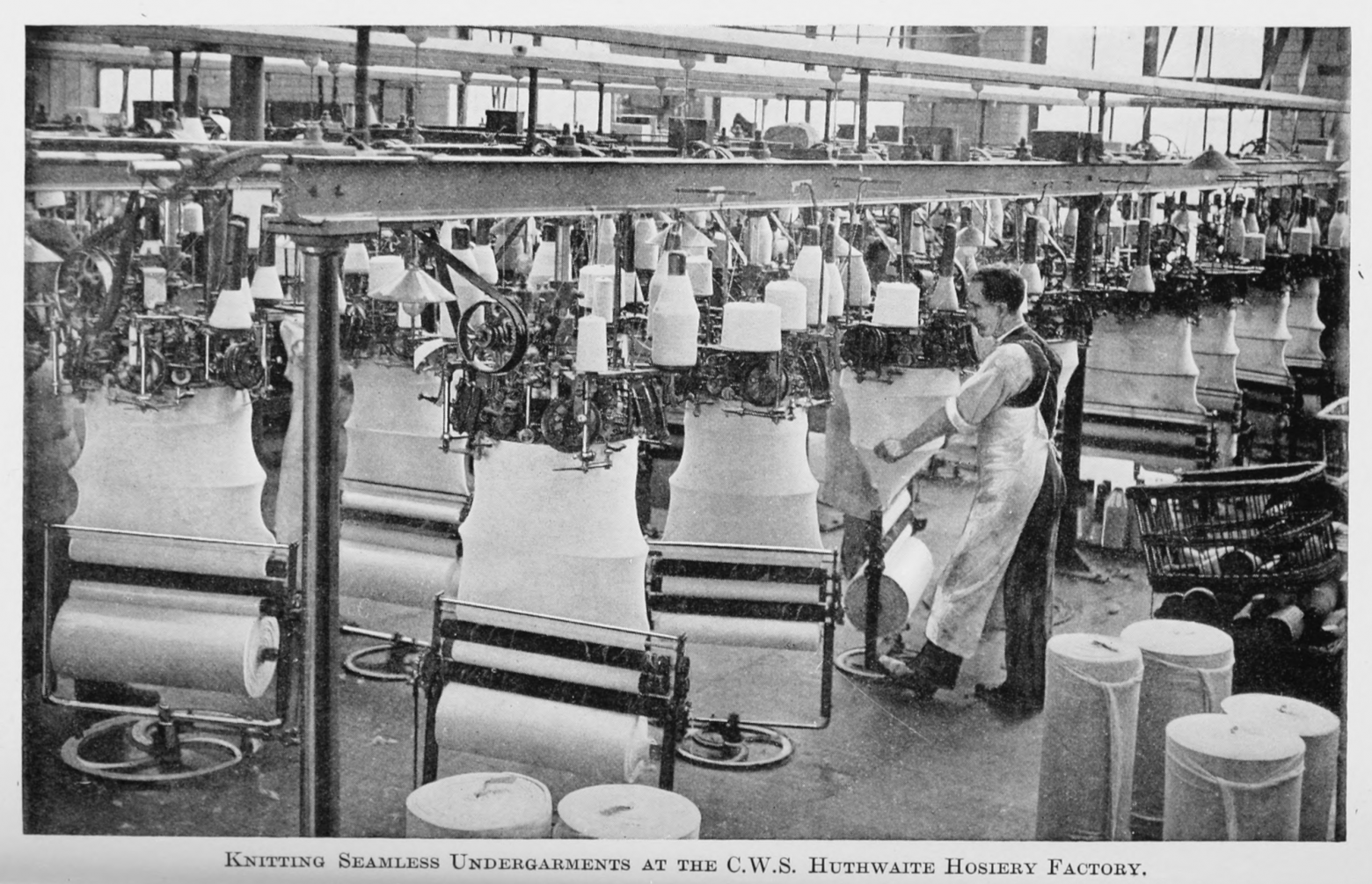
Knitting machines driven by engines gradually took over tasks that craftsmen had previously performed with their hands and feet.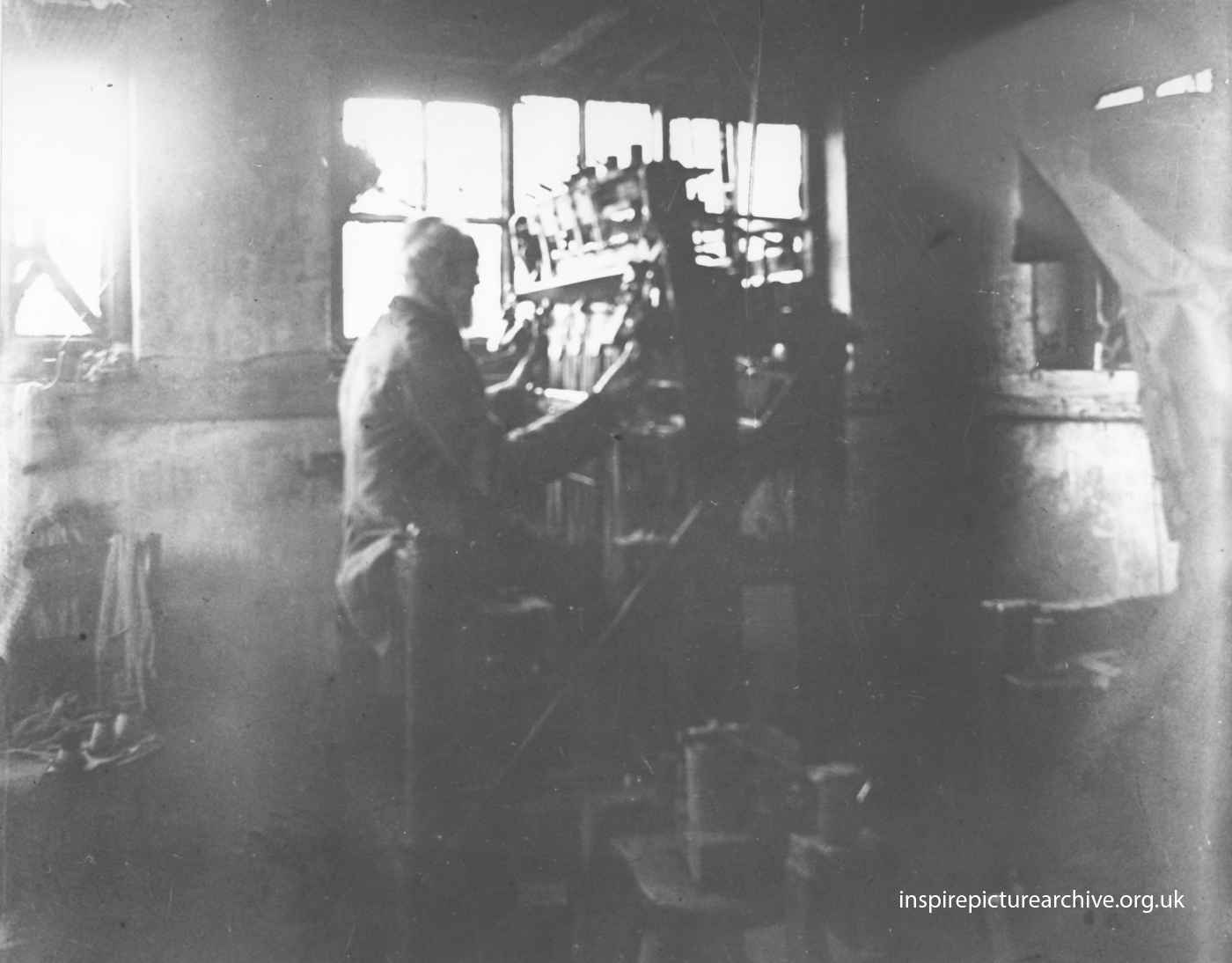 How it was: home workshop In the second half of the nineteenth century, their adoption helped transfer production from homes to large factory workshops, and many workers of manual labor retrained and began to operate machines, although manual frames and home workshops continued to coexist with factories for a long time.
How Luddites became a curse
After the suppression of the movement, machines continued to work. From this it is easy to derive an attractive moral: Luddites hindered the inevitable and received a just result.
But the word "inevitable" makes the cost of waiting invisible. According to one historical assessment, in Britain between 1780 and 1840, output per worker increased by about 46%, while real wages rose only by 12%. According to another, production increased significantly, but wages were not raised that much.
Even if the growth of production eventually improved the lives of future generations, workers of the transitional period might have spent a significant part of their lives in poverty. The benefits of future industrialization did not compensate for their current losses.
The image of the Luddite was then simplified from several sides at once. The mechanization advocates found it convenient to see in him a clumsy person, not understanding economic laws. Later supporters of the peaceful labor movement — participants in the primitive stage of struggle, which should have been overcome. In the influential article "The Machine Breakers," published in 1952, both views were challenged: the destruction of machines could be a meaningful way of pressure in those conditions where there were almost no other effective means.
Over time, the word "luddite" acquired a new meaning. In the 1980s, people once again began to question the notion of luddites merely as opponents of progress, asking whether the coming computer age would bring universal prosperity or merely increase inequality and people's dependence on technology. Shortly afterwards, the "Neo-Luddite Manifesto" appeared, criticizing technologies that concentrate power and wealth, destroy nature, and deprive people of their independence.
Thus, luddism turned into a broader discussion about who controls technological progress and who benefits from it. But "luddite" remained a swear word.
The AI era and luddism
Today, machines put those who sold their professional skills into an awkward position, as it turned out that the buyer often found the machine's result sufficient. AI does not necessarily have to write better than all authors, draw, create designs, or do something better than professionals. Sometimes it is enough for a specific customer to be satisfied with the result for the money paid. Very little money, compared to manual labor.
It is precisely here that historical analogy becomes useful. One can genuinely love one's craft, well understand new tools, and still lose income. You can master them — and discover that there are now fewer orders or that work is paid worse. The ability to adapt does not give a person control over the market.
Today's popular advice sounds simple: don't fear AI, learn to use it, become more efficient, faster, and productive. But knitters of the early 19th century already knew how to use machines. Some had mastered their craft for decades, but it didn't save them.
The question is not only about how well you master the tool. The question is about how much the market is willing to pay for the result of your work. And whether it is willing at all.
When I started my startup years ago, I spent a lot of money on a copywriter, an illustrator, and then a UK-based editor-translator. But today, I probably wouldn't pay any of them.
Interesting paradox: we simultaneously benefit as buyers and may lose out as sellers of our own labor. And it's not certain that one compensates for the other.
A great future
It's amusing, but even now you can encounter skepticism that AI is a bubble and "wait until then, and then see." Of course, it's a bubble — in the valuations, promises, and expectations, but the technology is always with us, and this charade can't be repeated, everything will change.
Remember Will Smith and the cursed spaghetti?

This was three years ago. Three.
Today there are world models that generate cinematic worlds on demand in real-time.

Industries of past centuries took decades, even centuries, to restructure production around new machines. Current machines, more precisely, interface for communicating with machines have changed within a few years. This does not mean that the entire economy will restructure at the same speed. The real world has huge inertia: infrastructure, laws, implementation costs, human habits, and numerous other constraints have not disappeared. Just as the Luddites' history does not predict our tools in ten years, but it helps us to reject two too convenient illusions: that change can be stopped simply by rejecting new technologies, and that it is enough to master them to guarantee victory. The Luddites were a small part of society: they represented specific professions in specific industrial areas of England, and most of their contemporaries never saw their machines or their attacks on factories. The Industrial Revolution won, the economy grew, and the fates of those who were unlucky gradually became lines in history textbooks. With AI, the scale of change may be even greater. Perhaps in two hundred years, historians will write just as calmly that productivity increased, new professions emerged, and humanity became wealthier. But we do not live two hundred years ahead. We live now, right in the middle of this transformation. And this storm may just be beginning.
Thank you!
My channel about agents, LLM, products and people: Agentic World and other articles:
When will the AI bubble burst?
Jev: A big engineering analysis of the famous System One model
How does the text watermark work in Claude


