
Meta announced that it will expand AI-powered age-estimation technology worldwide to provide account protections even to 13- to 17-year-olds who misrepresent their age.
Expanding Teen Account Protections to Teens Around the World
https://about.fb.com/news/2026/11/expanding-teen-account-protections-to-teens-around-the-world/
For more than a decade, Meta has worked with experts in various fields to develop tools and resources that enable teens and their families to confidently use Meta’s apps in age-appropriate ways. For example, on platforms such as Instagram, Facebook and Messenger, it offers “Teen Accounts” for teens, which automatically limit who they can contact, the content they see and how long they can use apps.
To make such protections available to all teen users, it is necessary to accurately determine their ages. However, Meta said that determining users’ ages has become a major industry-wide challenge because some teens register an inaccurate age in order to use features and services for which they are not yet old enough.
Meta reportedly applies Teen Accounts protections to accounts when AI technology identifies a user as a teenager, even if their registered date of birth indicates that they are an adult. Since the introduction of this technology, the number of teens receiving age-appropriate protections across Meta’s platforms has been growing. Meta welcomed these results and, drawing on its track record to date, announced that it would expand the technology worldwide.
As a result, millions of teens worldwide who use Instagram and have registered a false age are expected to become eligible for age-appropriate protections. Facebook is also rolling out similar technology, and Meta plans to begin phasing in a similar global rollout on Threads during 2026. This expansion is based on an agreement with 52 bipartisan U.S. attorneys general and follows Meta’s pledge to strengthen its mechanisms for identifying teen users and children under 13 on its apps.
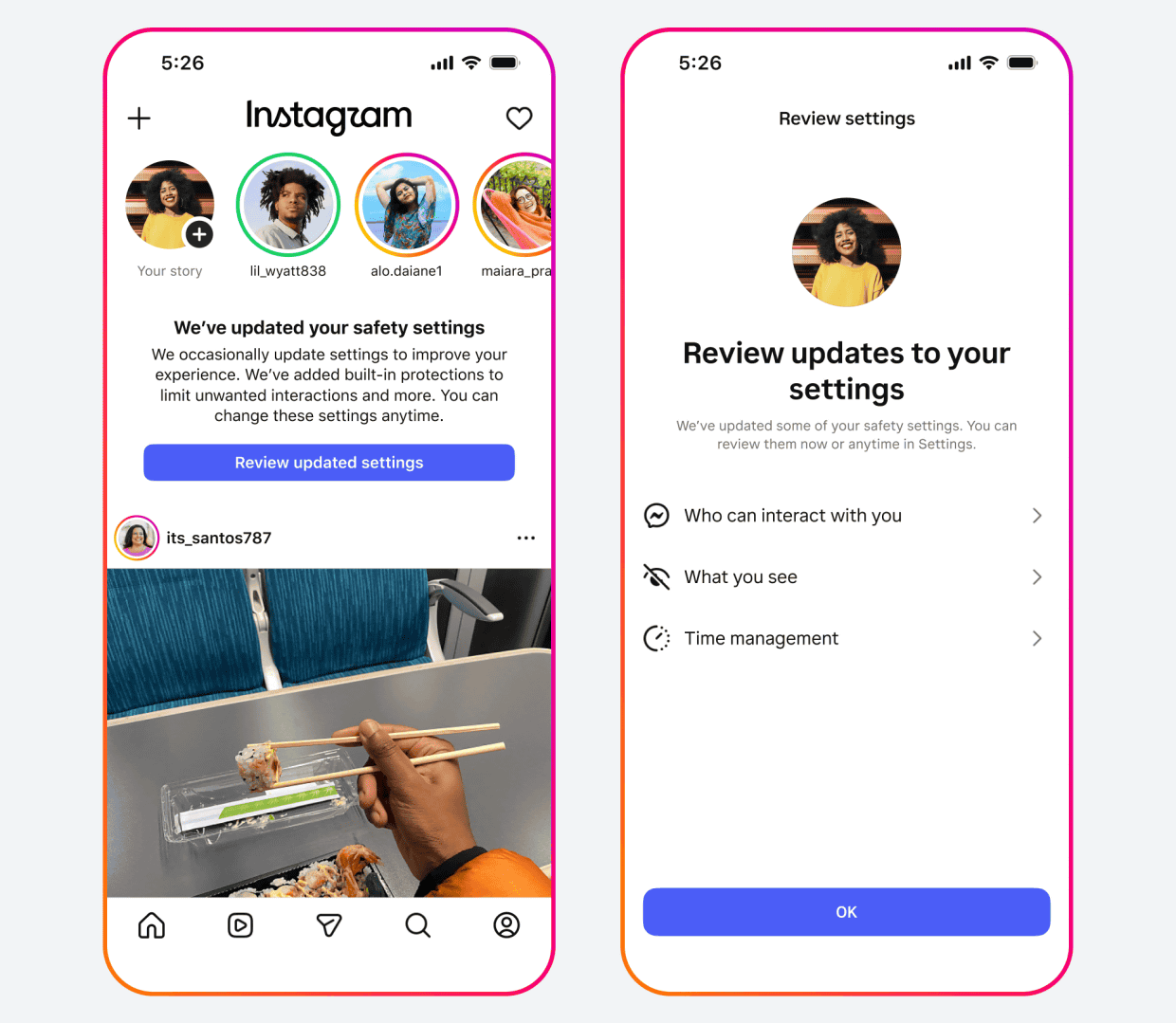
Beginning in November 2026, Meta will also display a video in U.S. parents’ Instagram feeds explaining “Meta’s efforts to apply age-appropriate protections for teenage children.” From the video, users can read an article written by Larry Magid, the president and CEO of ConnectSafely, an organization that promotes safe use of the internet.
Magid’s article explains how Meta combines multiple safeguards to determine users’ ages.Specifically, measures such as “measures to prevent children under 13 from using the platform” and “systems for providing an age-appropriate environment for teenagers” are expected to be introduced. Guidance will also be provided on how parents can cooperate with Meta to ensure that children report their correct ages online.
Furthermore, Meta has begun using the age range information provided by Apple as one means of more accurately determining the ages of users in Australia. When a parent sets up an iPhone for a teenage child, they may be required to share the age range. By using this age range information collected by Apple, Meta can check whether the child meets an app’s age requirements.
Meta has long supported legislation mandating age verification and parental consent on the App Store. Meta explained the reason as follows: “Compared with each platform verifying ages individually, uniformly sharing verified age group information obtained from a device across all apps is far more effective and makes it easier to protect privacy. Age estimates made by developers such as Meta can be used as a supplementary means of identifying errors. If an error is reported to the app store, the correction can be reflected across all the apps used by the child.”
Report detailing how Meta spent huge sums lobbying the government to pass a bill shifting responsibility for age verification onto app stores - GIGAZINE

In recent years, new laws intended to protect teenage users online have been introduced one after another around the world. Although these laws aim to protect young people, many do not specify how technology companies should determine users’ ages. Specifically, some laws require privacy-intensive age verification from all users, while others provide no guidance whatsoever.
Consequently, companies are expected to devise their own methods for determining users’ ages without indiscriminately requiring the submission of government-issued identification and similar documents. Meta stated: “Meta has established strict criteria for determining ages, but unless other companies also make similar efforts, the protections available to teenage users online will remain uneven and the laws will not fulfill their purpose.”
Meta has pledged to continue actively working to enable teenage users to use Meta apps in age-appropriate environments. As part of this effort, Meta is investing in improving technology to detect accounts believed to belong to children under 13 at an early stage, based on an agreement with 52 bipartisan attorneys general from U.S. states and territories and the District of Columbia. Meta is also improving technology to identify accounts believed to belong to users aged 13 to 17, enabling the application of a teen-oriented environment even when the registered date of birth indicates that the user is an adult. Since Instagram is one of the popular apps used by teenagers, it is reportedly calling on competitors such as TikTok and YouTube to introduce similar measures to protect young teenage users.

