
Meta introduced on Monday (12) two new artificial intelligence (AI) models, called Muse Wonder and Muse Wonder Full, to expand its presence in the advanced systems market. The company says the models deliver results close to those of Anthropic's most advanced tools in reasoning, writing, and programming tests.
The launch is part of Mark Zuckerberg's company efforts to strengthen its AI division and broaden revenue possibilities beyond online advertising. Access to the new features will be integrated into the company's products, including the Muse personal agents app and the Muse Code programming tool, with different subscription options.
Models arrive with a focus on programming and complex tasks
The development of Muse Wonder began after the hiring of Alexandr Wang, founder of the startup Scale AI, for the position of artificial intelligence director at Meta, in June 2025. The new family is the second series of models released by the division led by Wang and the first that the company explicitly presents as a competitor to frontier systems, known as frontier models.
These models are among the most advanced AI systems and typically require significant computing power to run.According to Meta, Muse Wonder also presents significant advances in programming compared with the company’s previous versions.
The model was developed to enhance personal and professional agents that perform tasks on behalf of users. In an interview with CNBC, Wang said the training aimed to prepare the system to try alternative approaches when it encounters obstacles, rather than stopping the activity and asking the user for guidance.
Examples mentioned by the executive include everyday tasks, such as making restaurant reservations and checking availability. The aim is to enable agents to better handle unforeseen circumstances while performing these activities.
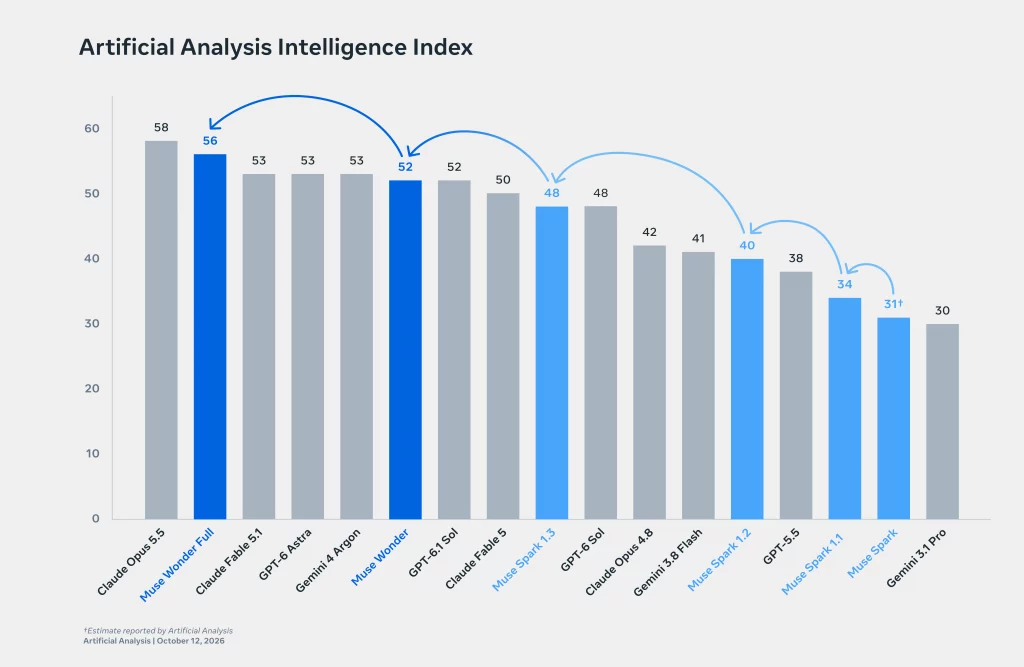 The Artificial Analysis Intelligence Index ranking compares AI models, including Meta’s Muse Wonder and Muse Wonder Full versions – Image: Courtesy / Meta
Access to the models will come with different subscription plans
The Muse Wonder will be integrated into parts of the Muse app, which was launched the previous month. Although the app has a free version, access to the new model will require a monthly subscription of US$20 or US$100.
The model will also be available to developers through the Meta Model API. Wang said this option will cost more than conventional subscriptions because it is a larger, more advanced system. Nevertheless, according to him, the cost will be significantly lower than that charged by OpenAI’s and Anthropic’s leading models.
The Muse Wonder Full will be the most powerful version of the new family.Access will be restricted to developers who subscribe to Muse Code, an AI tool focused on software engineering. The plans mentioned by CNBC cost US$50 or US$200 per month.
Meta highlights security measures
The launch comes amid concerns about the behavior of advanced models and AI agents. In a post on the company’s blog, Meta said the new model offers its strongest protections to date against cybersecurity-related misuse. For now, these measures are available only in the paid version.
Wang’s team also monitors incidents and problems related to the use of Muse. Some users complained on social media that the agent may have accessed personal messages without authorization, a claim disputed by the company.
According to Wang, Meta is guiding users on how the app works and the permissions granted during conversations. The executive said some people may have previously authorized certain communications and then forgotten about that authorization.
During the development of Muse Wonder, Meta faced delays. In July, the company suspended a training stage known as pre-training, delaying the models’ launch until October, according to information previously published by The New York Times.
The models, internally codenamed Watermelon, represent another step in Meta’s strategy to expand its presence in the AI market.The company is also seeking to increase sales of artificial intelligence services to other companies, in a segment where OpenAI and Anthropic already hold significant positions.

Ana Figueiredo is a technology editor at Olhar Digital. She graduated in Journalism from the Federal University of Uberlândia (UFU).




