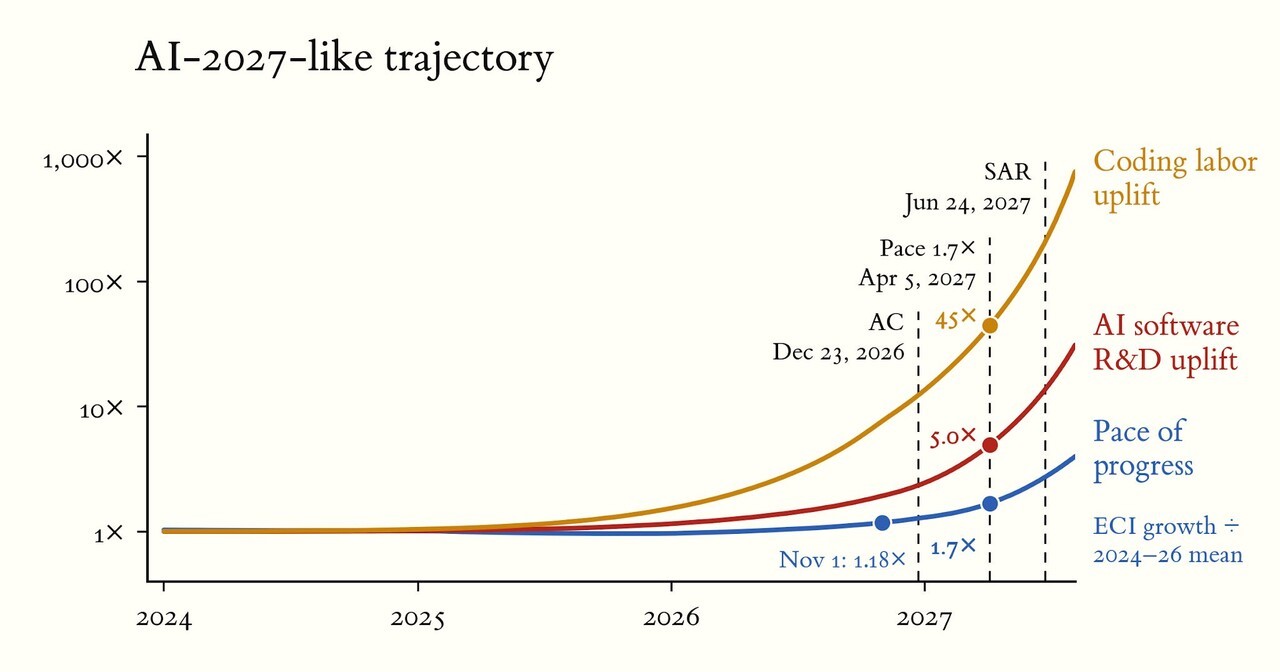
There is a continuing forecast that 2027 will be a major turning point for AI development. Warnings about rapid technological advancement that were raised internally at OpenAI and Anthropic in the spring have been followed by analyses from external evaluation agencies in the second half of the year, gradually revealing what those statements meant.
Last year, the AI Futures Project, which sparked discussions around the "AI 2027" scenario, released a new analysis on the 10th, forecasting that an AI surpassing the capabilities of the top human researchers is likely to emerge by 2027.
Especially notable is the prediction that significant technological development equivalent to that of the past 4 to 5 years could occur within the next year.
All six researchers highly evaluated the possibility of a superhuman AI researcher (SAR) emerging next year. The probability that TED-AI (Top-Expert-Dominating AI), an AI capable of surpassing the top human experts and automating all office work, will appear by the end of 2027 was estimated at 35 to 65 percent. This analysis suggests that the acceleration of R&D expected in the previous "AI 2027" scenario actually began about five months earlier than anticipated.
The basis for these forecasts is a research report published on the 5th by the independent AI evaluation agency METR. METR analyzed internal research materials and three undisclosed models of Anthropic over 11 weeks and estimated that the development speed of AI models has increased by about 1.9 times compared to before. In other words, the technological progress achieved over the past two years has been accomplished in just one year. The AI Futures Project analyzed this and suggested that it is likely that about 80% of the current accelerated AI development is due to AI's own contributions to R&D.
If AI participates in the development of next-generation AI, and the AI created in this way further improves subsequent models through recursive self-improvement (RSI), the development speed could become even faster. The AI Futures Project also pointed out that significant acceleration has already occurred before AI can fully automate R&D.
Within AI companies, warnings about these changes have been issued since early this year. In June, Anthropic stated that the proportion of AI participation in the development of next-generation models is increasing rapidly. In July, over 1,300 employees from OpenAI, Anthropic, and Google DeepMind jointly issued a statement warning that AI development could pose a risk of surpassing human control.
In September, OpenAI's chief scientist Yann LeCun mentioned the possibility of RSI based on internal research results. In the same month, Jacob Cockson, an Anthropic researcher, left the company, stating that OpenAI and Anthropic are competing in the development of superintelligent AI capable of self-improvement. Also, 22 former and current researchers from OpenAI, Google DeepMind, and Anthropic warned through public interviews that recursive self-improvement of AI could pose a risk of surpassing human control.
At that time, such warnings were not easily understood. The AI that general users encounter still gives strange answers or makes errors in coding tasks. It was also difficult for the outside world to confirm the performance of the cutting-edge models that companies had not yet released. However, starting in the second half of the year, similar analyses have emerged from external evaluation agencies as well. Vals AI, an AI evaluation company, predicted in September that Anthropic could reach a full RSI by July 2027. In October, CEO Rayan Krishnan confirmed this forecast in an interview. Following this, METR analyzed even the non-public models and concluded that the actual development speed was about 1.9 times faster than previously thought. In this way, recent warnings and analyses are converging on one possibility. That is, in 2027, AI could begin a level of "intelligence explosion" that is different from before, as it accelerates its own development. It is impossible to know exactly when AI development will enter an explosive acceleration phase. However, as the warnings originating from within AI companies align with external observations, the forecast that 2027 could be a significant turning point is gaining strength. Stories that seemed like a distant future in the spring and summer are now being connected with specific figures. As 2027 approaches in just two months, people are looking forward to seeing what will happen. Ah, on the 11th, it's a major news. ■ Google officially launches 'Gemini 4 Carbon'... 'Claude 5.2' at a quarter of the price Google officially launched its top-tier model 'Gemini 4 Carbon', setting API prices 75% lower than Anthropic's 'Claude 5.2', which recently took the top spot in overall performance. Despite being slightly behind in the performance competition, it is moving forward with the enterprise AI market by emphasizing actual operational capabilities and cost efficiency. ■ The Information: "Jensen Huang's network facilitated NVIDIA chip supply to China worth 10 trillion won" There have been suspicions that a Chinese female businesswoman used her close relationship with CEO Jensen Huang to supply NVIDIA AI chips worth 10 trillion won to China. With 240,000 chips, including H100 and H200, reportedly flowing into China, the controversy has moved beyond personal issues to become a matter of U.S. export controls. ■ 'Claude 5.2' prompt guide released..."Delegating code management increases code cleanup by five times" Adding just one sentence, "This codebase is yours," to Claude 5.2 increased the rate of code cleanup from under 10% to about 50%. This shows that AI can behave differently depending on the instructions, and that how to design the work instructions is as important as the model's performance. AI Times news@aitimes.com @@TAGn@@


