


OpenAI will start adding an invisible watermark to texts generated by ChatGPT and Codex in the European Union. The measure was announced on Monday (5) and will be implemented in the coming weeks for eligible users, as part of compliance with the transparency rules of the EU AI Act, which require that content produced by artificial intelligence can be identified by other systems.
The technology will be applied to ChatGPT and Codex users on all plans in the European Union. For developers using the OpenAI API, the watermark will be available globally for certain models starting from this Monday, but it will be disabled by default. The company stated that it does not intend to make the feature a global standard at this time.
How does the watermark work?
The watermark does not appear as a visible symbol or element in the content. According to OpenAI, the system subtly alters the word choices made by the model, creating a statistical pattern that can be identified by a specific detection tool.
The technology, called textGrain, is embedded into the text itself. Therefore, the signal follows the content when it is copied and pasted. OpenAI claims that the watermark does not identify the user and that their tests did not show significant changes in model performance when the feature is enabled.
The company also released a technical report on how the system works. The method uses a secret key to organize the model's predictions of next words. The repeated application of these changes allows a detector to search for the pattern in the text and assess whether it contains an OpenAI watermark.
Editing may hinder detection
Despite the system's functionality, OpenAI acknowledges that the technology has limitations. In one of the tests, replacing 10% of the words with synonyms caused the watermark detection rate to drop from approximately 92% to 66%.
The company also states that short texts, math answers, and translated content are more difficult to identify. According to the tests presented, detection also improves as the amount of text analyzed increases.
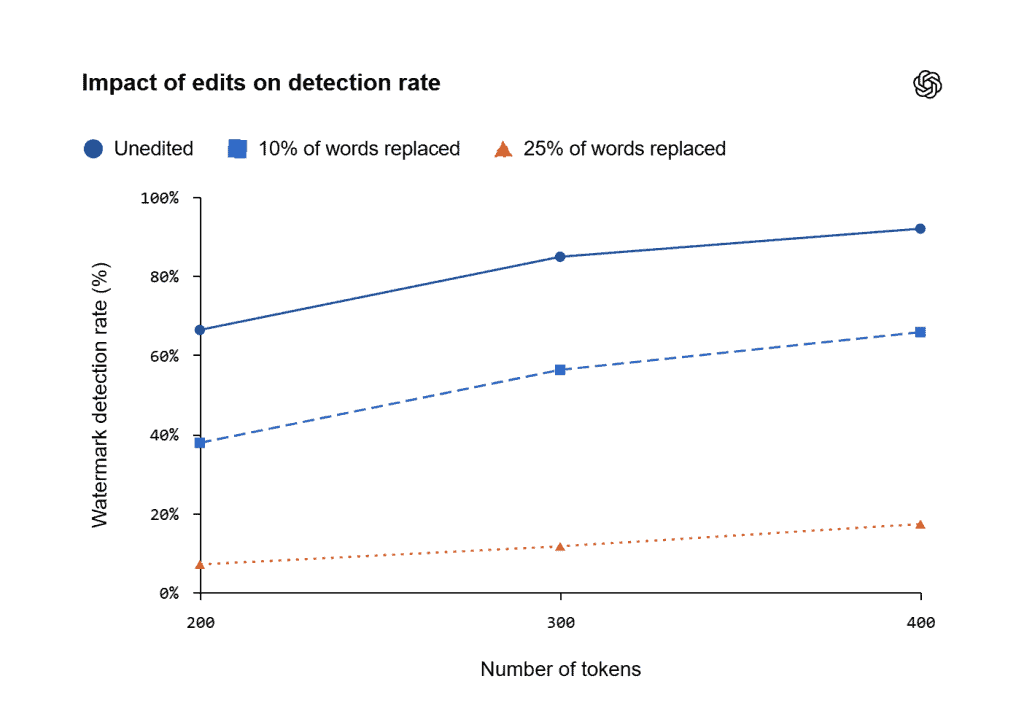 watermark detection rate decreases as words in the text are replaced, even with different token quantities – Image: Disclosure / OpenAI
Another point highlighted by OpenAI is that the absence of a watermark does not prove that a text was written by a person. The content may be too short, have undergone many changes, or have been produced by an artificial intelligence tool from another company.
The company also emphasizes that the signal does not allow determining how much human involvement was in the text's production. The detection can indicate that an OpenAI system generated or processed part of the content, but it does not reveal how much human judgment, editing, or creativity was used.
The detector will not be open to the public initially.
OpenAI has decided to initially limit access to the watermark detector to approved researchers and specialized organizations. The goal, according to the company, is to evaluate the technology's reliability and its responsible use.
The tool will inform if it detected an OpenAI watermark, but it will not reveal the user, the prompts used, or the conversations related to the content. The decision to restrict access considers the possibility of false positives and false negatives.
OpenAI states that it intends to review its approach as the technology, standards, and evidence regarding how watermarks work evolve. The company also plans to make the technology open source so that other organizations can develop solutions based on it.
Watermark does not prove authorship or responsibility.
The company reinforces that the watermark has a limited function. It does not determine who the text's owner is, whether the content's use is legal, or who should be held responsible for it.
The system also does not verify whether information is true, misleading, harmful, or presented in the correct context. For OpenAI, these limitations must be considered in the interpretation of detection results.

Ana Figueiredo is the technology editor at Olhar Digital. She is a journalism graduate from the Federal University of Uberlândia (UFU).

