Latest AI News

Meta reportedly used AI to lay off employees: here’s why this would be unthinkable in France

March 11, 2020 | 01net IA
Meta reportedly used AI to lay off employees: here’s why this would be unthinkable in France
Published July 15, 2026 at 6:00 p.m. Comment 0 𝕏 Print © YinYang - Getty Images Graded by algorithms, monitored down to the keystroke, then fired: 26 Meta employees describe an AI-driven cart. A method that would already have a cost in Europe: up to 4% of revenue. Meta’s big spring clean culminates in court. Monday evening, 26 current and former employees filed a complaint with the federal court in Oakland, California. According to them, the list of the 8,

Three publishers, including Hachette, accuse Google Gemini of plagiarizing millions of books

September 24, 2026 | 01net IA
Three publishers, including Hachette, accuse Google Gemini of plagiarizing millions of books
Published on July 16, 2026 at 09:00 Comment 0 𝕏 Print © Montage 01net The method has already cost Anthropic $1.5 billion. This time, Hachette, Elsevier, and Cengage are accusing Google of having fed Gemini millions of books without permission and without paying. For two years, American publishing has been refining its response to the AI giants: block the web crawlers first, negotiate next, and finally attack.Friday, Hachette Book Group, Elsevier and Cengag

OpenAI has just launched its first device, but it’s not the one you’d expect.

December 19, 2018 | 01net IA
OpenAI has just launched its first device, but it’s not the one you’d expect.
Published on July 16, 2026 at 09:44 Comment 1 𝕏 Print © OpenAI OpenAI has launched its first physical device. It is not the mysterious ChatGPT speaker envisioned in collaboration with Jony Ive, but a limited-edition mini keyboard intended for developers. Priced at $230 and designed with the manufacturer Work Louder, this small control pad allows developers to physically control Codex coding agents For months, rumors have multiplied about OpenAI’s first phy

The Death of ChatGPT Atlas: How the Anthropic Threat Forced OpenAI to Kill Its “Side Quests”

February 3, 2024 | 01net IA
The Death of ChatGPT Atlas: How the Anthropic Threat Forced OpenAI to Kill Its “Side Quests”
Published on July 16, 2026 at 11:32 Comment 0 𝕏 Print © Montage 01net / OpenAI OpenAI is abandoning ChatGPT Atlas less than a year after its launch. A strategic pivot driven by Anthropic’s competitive push toward a “super-app.” More than nine months after its high-profile launch, OpenAI’s web browser is already being regretted. Announced alongside the rollout of GPT-5.6, the abandonment of ChatGPT Atlas on August 9 marks an admission of failure in the face

AI can diagnose some genetic disorders using photos of faces - Ars Technica

August 22, 2021 | Ars Technica AI
AI can diagnose some genetic disorders using photos of faces - Ars Technica
Genomes are so five minutes ago. Personalized medicine is all about phenomes now. OK, that’s an exaggeration. But plenty of genetic disorders do result in distinctive facial phenotypes (Down syndrome is probably the best known example). Many of these disorders are quite rare and thus not easily recognized by clinicians. This lack of familiarity can cause the patients with the disorders (and their parents) to endure a long and traumatic diagnostic odyssey b

Alphabet subsidiary trained AI to predict wind output 36 hours in advance - Ars Technica

March 3, 2016 | Ars Technica AI
Alphabet subsidiary trained AI to predict wind output 36 hours in advance - Ars Technica
Alphabet subsidiary DeepMind (it was acquired by Alphabet in 2014) has been developing artificial-intelligence programs since 2010 to solve complex problems. One of DeepMind’s latest projects, according to a recent Google post, has centered around the predictability of wind power. Those giant turbines you see along the highway only produce power when they’re moving, and that poses a problem for the grid: in the absence of expensive energy storage, it’s dif

The basics of modern AI—how does it work and will it destroy society this year? - Ars Technica

January 5, 2018 | Ars Technica AI
The basics of modern AI—how does it work and will it destroy society this year? - Ars Technica
A starter on Skynet The basics of modern AI—how does it work and will it destroy society this year? Today’s AI is technically “weak”—but it’s complex and can have a great societal impact. Haomiao Huang – Apr 9, 2019 8:30 am | 122 You don't have to be Keir Dullea to know that fully grasping artificial intelligence can be intimidating. Credit: George Rinhart/Corbis via Getty Images You don't have to be Keir Dullea to know that fully grasping artificial intel

OpenAI bot crushes Dota 2 champions, and now anyone can play against it - Ars Technica

July 28, 2017 | Ars Technica AI
OpenAI bot crushes Dota 2 champions, and now anyone can play against it - Ars Technica
Global Thermonuclear War OpenAI bot crushes Dota 2 champions, and now anyone can play against it Reigning International champions Team OG were soundly beaten over the weekend. Ars Staff – Apr 15, 2019 4:09 pm | 113 Shadow Fiend, looking shadowy and fiendish. Credit: Valve Shadow Fiend, looking shadowy and fiendish. Credit: Valve Text settings Story text Size Small Standard Large Width * Standard Wide Links Standard Orange * Subscribers only Learn more Mini

The fourth Industrial Revolution emerges from AI and the Internet of Things - Ars Technica

October 11, 2024 | Ars Technica AI
The fourth Industrial Revolution emerges from AI and the Internet of Things - Ars Technica
Big data, analytics, and machine learning are starting to feel like anonymous business words, but they’re not just overused abstract concepts—those buzzwords represent huge changes in much of the technology we deal with in our daily lives. Some of those changes have been for the better, making our interaction with machines and information more natural and more powerful. Others have helped companies tap into consumers’ relationships, behaviors, locations an

For the industrial Internet of Things, defense in depth is a requirement - Ars Technica

November 14, 2021 | Ars Technica AI
For the industrial Internet of Things, defense in depth is a requirement - Ars Technica
hack the factory For the industrial Internet of Things, defense in depth is a requirement The shift in how we make things brings with it a shift in how we secure things. Matthew Rothenberg – Jun 19, 2019 9:30 am | 42 Sensors, sensors everywhere! Credit: Getty / 7postman Sensors, sensors everywhere! Credit: Getty / 7postman Text settings Story text Size Small Standard Large Width * Standard Wide Links Standard Orange * Subscribers only Learn more Minimize t

The trick to saving human factory jobs might be teaming up with the machines - Ars Technica

November 4, 2020 | Ars Technica AI
The trick to saving human factory jobs might be teaming up with the machines - Ars Technica
PICKER ROBOT HAS JOINED THE TEAM The trick to saving human factory jobs might be teaming up with the machines “It’s all about making humans better rather than replacing them.” Matthew Rothenberg – Jun 20, 2019 9:30 am | 114 "Oh brave new industry, that has such bots in't!" Credit: Javier Pierini / Getty "Oh brave new industry, that has such bots in't!" Credit: Javier Pierini / Getty Text settings Story text Size Small Standard Large Width * Standard Wide L

How YACHT fed their old music to the machine and got a killer new album - Ars Technica

October 21, 2016 | Ars Technica AI
How YACHT fed their old music to the machine and got a killer new album - Ars Technica
The band YACHT, named for a mysterious sign seen in Portland around the turn of the century. YACHT / Google I/O 2019 The band YACHT, named for a mysterious sign seen in Portland around the turn of the century. YACHT / Google I/O 2019 YACHT’s Claire Evans takes the stage not to rock out, but to talk out the band’s new album leveraging artificial intelligence and machine learning. Google I/O 2019 YACHT’s Claire Evans takes the stage not to rock out, but to t

Write AI code once, run anywhere—it’s not Java, it’s Intel’s oneAPI - Ars Technica

November 1, 2023 | Ars Technica AI
Write AI code once, run anywhere—it’s not Java, it’s Intel’s oneAPI - Ars Technica
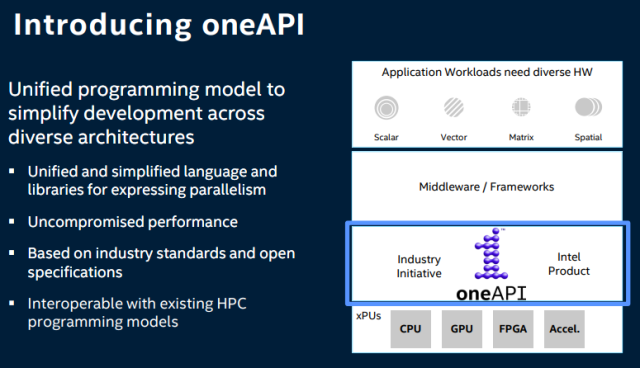
Saturday afternoon (Nov. 16) at Supercomputing 2019, Intel launched a new programming model called oneAPI. Intel describes the necessity of tightly coupling middleware and frameworks directly to specific hardware as one of the largest pain points of AI/Machine Learning development. The oneAPI model is intended to abstract that tight coupling away, allowing developers to focus on their actual project and re-use the same code when the underlying hardware cha

A sobering message about the future at AI’s biggest party - Ars Technica

December 21, 2017 | Ars Technica AI
A sobering message about the future at AI’s biggest party - Ars Technica
More than 13,000 artificial intelligence mavens flocked to Vancouver this week for the world’s leading academic AI conference, NeurIPS. The venue included a maze of colorful corporate booths aiming to lure recruits for projects like software that plays doctor. Google handed out free luggage scales and socks depicting the colorful bikes employees ride on its campus while IBM offered hats emblazoned with “I ❤️A👁.” Tuesday night, Google and Uber hosted well-l

How AI helps unlock the secrets of Old Master and modernist paintings - Ars Technica

October 27, 2016 | Ars Technica AI
How AI helps unlock the secrets of Old Master and modernist paintings - Ars Technica
There’s rarely time to write about every cool science-y story that comes our way. So this year, we’re once again running a special Twelve Days of Christmas series of posts, highlighting one science story that fell through the cracks each day, from December 25 through January 5. Today: How AI is helping shed light on famous paintings. X-rays are a well-established tool to help analyze and restore valuable paintings because the rays’ higher frequency means t

A neural network picks promising antibiotics out of a library of chemicals - Ars Technica

October 24, 2019 | Ars Technica AI
A neural network picks promising antibiotics out of a library of chemicals - Ars Technica
Biochemists have had some success at designing drugs to match specific targets. But much of drug development remains an arduous grind, screening hundreds to thousands of chemicals for a “hit” that has the effect you’re looking for. There have been several attempts to perform this grind in silico, using computers to analyze chemicals, but they’ve had mixed results. Now, a US-Canadian team is reporting that it’s modified a neural network to handle chemistry

How do you keep an AI’s behavior from becoming predictable? - Ars Technica

April 24, 2016 | Ars Technica AI
How do you keep an AI’s behavior from becoming predictable? - Ars Technica
A lot of neural networks are black boxes. We know they can successfully categorize things—images with cats, X-rays with cancer, and so on—but for many of them, we can’t understand what they use to reach that conclusion. But that doesn’t mean that people can’t infer the rules they use to fit things into different categories. And that creates a problem for companies like Facebook, which hopes to use AI to get rid of accounts that abuse its terms of service.

After watching 50,000 hours of Pac-Man, Nvidia’s AI generated a playable clone - Ars Technica

June 28, 2022 | Ars Technica AI
After watching 50,000 hours of Pac-Man, Nvidia’s AI generated a playable clone - Ars Technica
You may be familiar with the Infinite Monkey Theorem, an oft-cited (and often incorrectly quoted) claim that thousands of monkeys could bang on thousands of typewriters and eventually produce a work of art equivalent to William Shakespeare. (Yes, Simpsons did it.) This week, Nvidia confirms that it has taken this theory quite seriously with its own twist: an army of AI routines, dubbed GameGAN (short for “generative adversarial networks”), trained to build

Here’s why Apple believes it’s an AI leader—and why it says critics have it all wrong - Ars Technica

September 9, 2025 | Ars Technica AI
Here’s why Apple believes it’s an AI leader—and why it says critics have it all wrong - Ars Technica
We’ve known for a while now that machine learning was important to the palm rejection technology on the iPad when using a Pencil. Apple We’ve known for a while now that machine learning was important to the palm rejection technology on the iPad when using a Pencil. Apple It’s used for live translation in iOS 14. Apple It’s used for live translation in iOS 14. Apple AI is behind the automatic positioning of home screen widgets. Apple AI is behind the automa

New York City proposes regulating algorithms used in hiring - Ars Technica

January 8, 2022 | Ars Technica AI
New York City proposes regulating algorithms used in hiring - Ars Technica
In 1964, the Civil Rights Act barred the humans who made hiring decisions from discriminating on the basis of sex or race. Now, software often contributes to those hiring decisions, helping managers screen résumés or interpret video interviews. That worries some tech experts and civil rights groups, who cite evidence that algorithms can replicate or magnify biases shown by people. In 2018, Reuters reported that Amazon scrapped a tool that filtered résumés