
Latest AI News
Amazon doubles Anthropic investment to $8B
UK wants to prove AI can modernise public services responsibly
What might happen if AI can feel emotions? - AI News
AI governance: Analysing emerging global regulations
Ordnance Survey: Navigating the role of AI and ethical considerations in geospatial technology - AI News
CMU’s DensePose From WiFi: An Affordable, Accessible and Secure Approach to Human Sensing | Synced

The recent and rapid development of powerful machine learning models for computer vision has boosted 2D and 3D human pose estimation performance from RGB cameras, LiDAR, and radar inputs. These approaches however can require expensive and power-hungry hardware and have raised privacy concerns regarding their deployment in non-public areas. A Carnegie Mellon University research team addresses these issues in the new paper DensePose From WiFi, proposing WiFi
BERT-Style Pretraining on Convnets? Peking U, ByteDance & Oxford U’s Sparse Masked Modelling With Hierarchy Leads the Way | Synced

The natural language processing (NLP) field has achieved remarkable advancements spurred by the power of transformer-based pretrained large language models such as Google’s BERT and OpenAI’s GPT. Transformer architectures have recently also attained state-of-the-art performance on various computer vision tasks. Efforts to extend the BERT-style masked image modelling pretraining approach (where a portion of the image is masked and the model learns to recove
Meet Tracr: DeepMind & ETH Zurich’s Novel Interpretability Tool Compiles Human-Readable Code to Transformers’ Weights | Synced

Interpretability has emerged as a new buzzword and research focus in AI system development and deployment. Although deep learning models have achieved remarkable success in recent years, the question of how these models work remains underexplored and poorly understood — mainly due to a lack of ground truth information regarding the models’ complex internal mechanisms. In the new paper Tracr: Compiled Transformers as a Laboratory for Interpretability, a res
Stanford U’s Brain-Computer Interface Enables Stroke and ALS Patients to ‘Speak’ 62 Words per Minute | Synced

From drug discovery and protein folding to tumour detection, AI is revolutionizing the biomedical and healthcare fields. Recent research into brain-computer interfaces (BCIs) has revealed their potential to restore rapid communication to people with paralysis by capturing neural activities evoked by attempted speaking actions and decoding these into text. Among the many teams working on such BCIs, Frank Willett’s is one to watch. Willett is a research scie
Genius or Subpar AI Mathematician? New Study Questions ChatGPT’s Mathematical Capabilities | Synced

The November release of ChatGPT garnered unprecedented public and media attention. OpenAI’s conversational large language model (LLM) was widely applauded for its ability to answer complex queries, generate correct computer code and coherent long-form essays, and even solve math problems. But might that last claim have been premature? In the new paper Mathematical Capabilities of ChatGPT, a research team from the University of Oxford, TU Wein, University o
Hugging Face Releases LoRA Scripts for Efficient Stable Diffusion Fine-Tuning | Synced

Low-Rank Adaptation (LoRA) is a novel technique introduced by Microsoft in 2021 for fine-tuning large language models (LLMs). LoRA is an efficient adaptation strategy that introduces no additional inference latency and substantially reduces the number of trainable parameters for downstream tasks while maintaining model quality. Although LoRA was initially proposed for LLMs, it also can be applied elsewhere. Inspired by the Stable Diffusion paper published
Tackling Hallucinations: Microsoft’s LLM-Augmenter Boosts ChatGPT’s Factual Answer Score | Synced
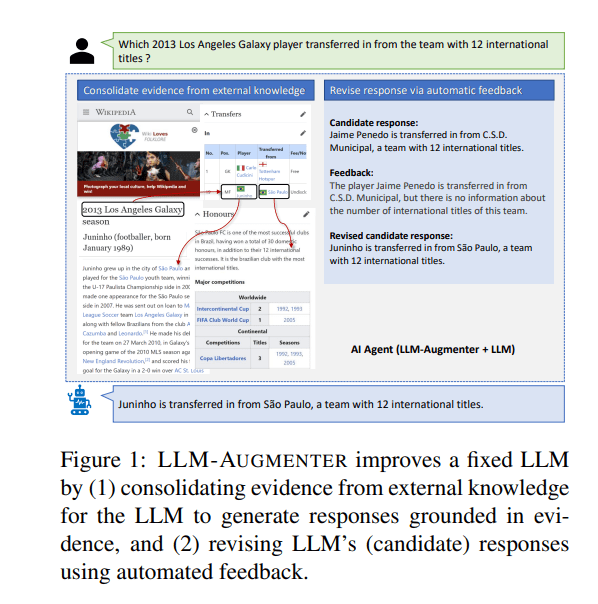
In the three months since its release, ChatGPT’s ability to generate humanlike, coherent and informative responses to a broad range of questions has evolved the OpenAI conversational large language model (LLM) from a curiosity into a magnet for public discussions regarding AI’s pros and cons. While there have been plenty of accolades, there are also serious concerns — particularly regarding ChatGPT’s occasional generation of misleading or factually incorre
AtScale Brings Trusted Business Context to Grok

Snowflake Delivers the Foundation for Autonomous Data Engineering, Powering the Agentic Enterprise with Trusted, Live Data

Guava Lands $12.5 Million to Tackle Voice AI’s Real-world Growing Pains

Dataiku Named a Leader in IDC MarketScape for Worldwide Agentic AI Platforms

Traversal Raises $120M with a $1 Billion Valuation to Keep Code Running With a Superintelligent AI Site Reliability Engineer
Acumatica Called Out for Industry Leadership in Customer Satisfaction, Business Impact, and Sustainability
project44 grows shipper new ARR 49% on its largest new customer deals to date as analysts and customers validate Intelligent TMS

Zifo Launches Service Accelerator to Reduce Validation Documentation Effort