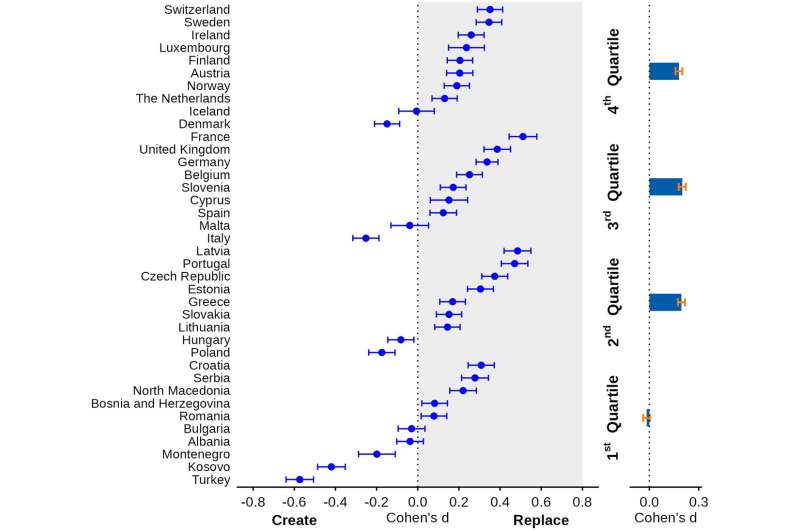
 Public perceptions of AI as labor-replacing (vs. labor-creating) by country (Left panel) and by GDP per capita quartile (Right panel) in Study 1 (N = 37,079). Colored dots and whiskers indicate the observed standardized mean differences (Cohen's d) from the 1 to 5 scale midpoint and their 95% CI. Credit: Proceedings of the National Academy of Sciences (2026). DOI: 10.1073/pnas.2523508123
Artificial intelligence is rapidly changing our society and economy. A new study shows that the majority of people believe that artificial intelligence is displacing more human labor than it is creating new opportunities. Scientists at the University of Vienna and Ludwig-Maximilians-Universität München (LMU) demonstrated a causal link: the stronger this perception, the more dissatisfied people are with democracy—and the less they participate in political debates about future technological developments. These effects occur even though artificial intelligence has had only a limited impact on the labor market so far.
The study was recently published in Proceedings of the National Academy of Sciences.
How does the population perceive artificial intelligence?
The research team first analyzed survey data from 38 European countries with over 37,000 respondents. The result is clear: in most countries, the prevailing view is that artificial intelligence destroys more jobs than it creates.
Study author Armin Granulo from the LMU Munich School of Management explains, "The actual impact of artificial intelligence on the labor market is still limited. Nevertheless, many people primarily perceive artificial intelligence as replacing human labor. This perception is remarkably stable and particularly widespread in economically developed countries."
What does this mean for democracy?
In the current study, the team from Munich and Vienna shows that these perceptions of artificial intelligence are not without political consequences. People who perceive artificial intelligence as destroying jobs are significantly more dissatisfied with the functioning of democracy. They are also less politically engaged—for example, in discussions, civic participation or the co-design of technology policy.
"When people feel that artificial intelligence replaces human labor, they express doubts about the political system—they are less satisfied with democracy and its institutions," says study author Christoph Fuchs from the Faculty of Business, Economics and Statistics at the University of Vienna.
Causal relationship: Experiments in the UK and the US
To test whether these correlations are indeed causal, the authors conducted two representative experiments in the UK and the US. Participants were presented with different future scenarios of artificial intelligence—one framing AI as a replacement for human labor and the other as a creator of new jobs.
The results show that when artificial intelligence was framed as replacing human labor, participants expressed significantly lower trust in democratic institutions and a reduced willingness to engage politically with artificial intelligence.
The study makes it clear that the social consequences of artificial intelligence do not only materialize when jobs actually disappear. Expectations and fears alone can change political attitudes.
Study author Andreas Raff from the University of Vienna says, "The very way we talk about artificial intelligence as a society can influence democratic attitudes. If public debates focus heavily on job losses, this can have unintended side effects for democracy."
Fuchs adds, "Our findings are a warning signal at a time when democratic legitimacy is declining in many established democracies and when democratic influence on the development of artificial intelligence is critical."
Targeted communication can counteract loss of trust
The study focuses on the political consequences of these perceptions, but not on the exact psychological mechanisms behind these effects.
Raff explains, "Artificial intelligence is a so-called general-purpose technology that will fundamentally change our economic and social system. If people perceive this technology as replacing human labor, this can undermine confidence in the political system as a whole. Further research is needed here."
At the same time, the authors emphasize that the findings also point to opportunities. "Our experiments suggest that people's beliefs about artificial intelligence are not fixed," says Granulo. "These beliefs could be changed through targeted communication that highlights that the trajectory of artificial intelligence—and its impact on labor—is not predetermined, but can be shaped through democratic choices."
The results provide important insights for politicians, the media and society. "If we want to strengthen democratic participation in the development of artificial intelligence, we must take people's perceptions of its economic consequences seriously—and actively help shape them," the authors conclude.

