Editor | Chen Yanshan
Also composed of carbon atoms, simply changing the arrangement of the atoms can make one material conduct electricity like a metal, while another exhibits semiconducting properties.
A latest study at the University of Science and Technology of China has demonstrated this contrast in carbon nanoribbons only about 0.9 nanometers wide.
On October 29, USTC announced the latest results from the team of Professors Wang Bing and Fan Qizhang of the Hefei National Research Center for Physical Sciences at the Microscale, along with their collaborators. The researchers successfully fabricated a new type of carbon nanoribbon composed solely of five-membered and seven-membered rings, and experimentally demonstrated that one of these structures is metallic, with a conductance of up to approximately 0.9 conductance quanta.
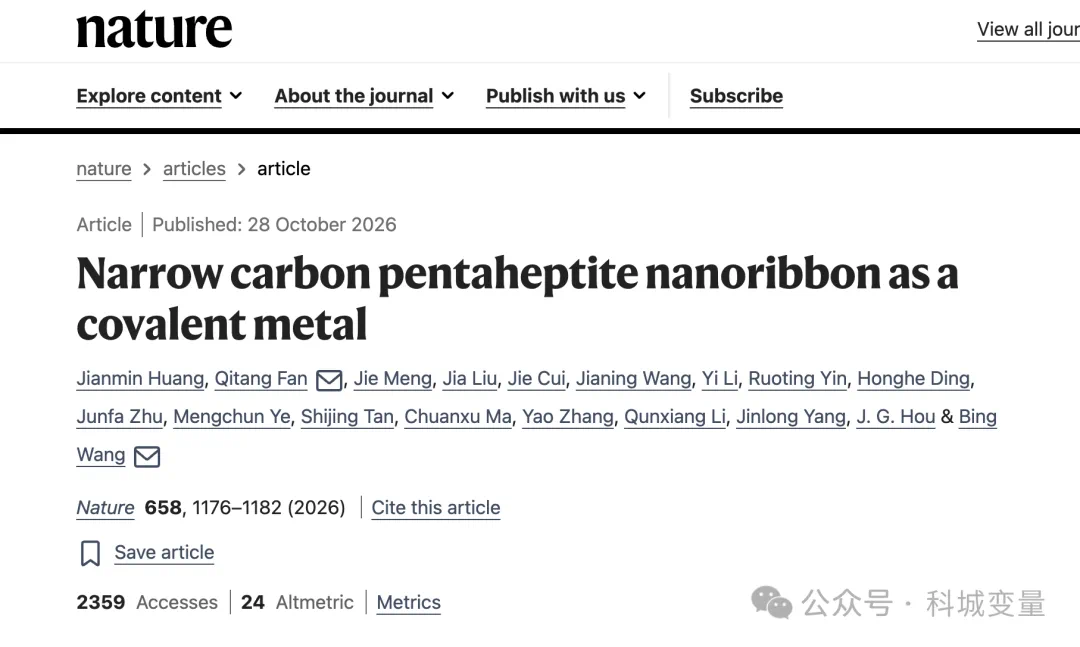
- Paper title: Narrow carbon pentaheptite nanoribbon as a covalent metal (narrow carbon five- and seven-membered-ring nanoribbon as a covalent metal)
- Authors: Jianmin Huang, Qizhang Fan, Jie Meng, Bing Wang, et al.
- Institutions: Hefei National Research Center for Physical Sciences at the Microscale, University of Science and Technology of China; Hefei National Laboratory; Nankai University; National Synchrotron Radiation Laboratory; et al.
- Published in: Nature
- Paper link: https://doi.org/10.1038/s41586-026-11202-2
The paper was published in the latest issue of Nature, with an online publication date of October 28. USTC was the paper’s first completing institution and sole corresponding institution. Jianmin Huang, Qizhang Fan, and Jie Meng were co-first authors, while Wang Bing and Fan Qizhang were co-corresponding authors.
Another notable aspect of this study is that as early as 1996, scientists had theoretically predicted that specific pentaheptite carbon structures could exhibit metallic properties.
Thirty years later, the USTC team finally obtained experimental evidence supporting this prediction in an ultranarrow carbon nanoribbon with a precisely arranged atomic structure.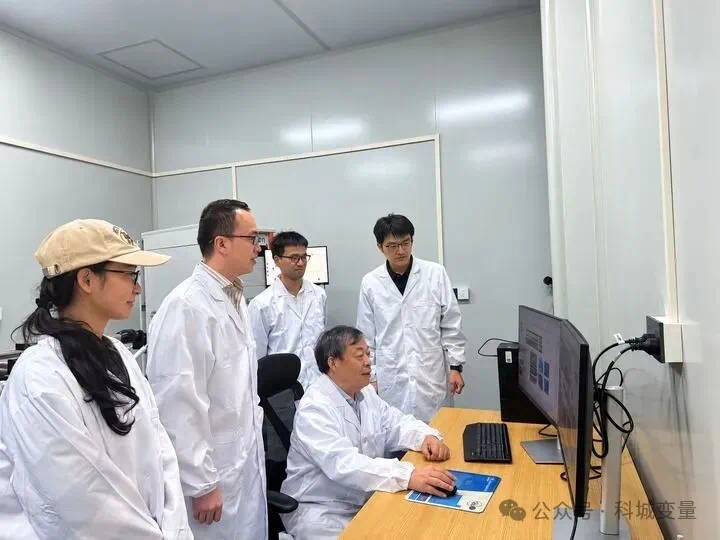
Professors Wang Bing and Fan Qizhang of USTC discuss the research progress. Photo source: Xinhua News Agency; image provided by the University of Science and Technology of China.
From Six-Membered Rings to Five- and Seven-Membered Rings: A Theoretical Prediction from 30 Years Ago
Carbon can form materials with vastly different properties.
Diamond is hard and generally does not conduct electricity, whereas graphite is relatively soft and can conduct electricity along specific directions. The main constituent element of both is carbon; the difference lies in how the carbon atoms are bonded.
Graphene, which has attracted much attention in recent years, is no exception. It consists of a regular honeycomb network of six-membered rings formed by carbon atoms and has a unique electronic structure.
Then what changes would occur in the material’s electronic properties if these six-membered rings were replaced with five-membered and seven-membered rings?
In 1996, researchers including Vincent H. Crespi, Marvin L. Cohen, and Steven G. Louie from the University of California, Berkeley, and other institutions published the paper “Prediction of a pure-carbon planar covalent metal” in Physical Review B. They proposed a planar carbon structure composed of five-membered and seven-membered rings and predicted that it would exhibit metallic properties.
This structure is known as a pentaheptite carbon structure (carbon pentaheptite).
When people think of metals, they often envision materials such as copper and silver. However, the “carbon-based metal” referred to here does not mean that the material contains metallic elements. Rather, the carbon atoms are covalently bonded to one another to form a structure capable of exhibiting metallic electronic properties, and it is therefore called a “covalent metal.”
However, the fact that a structure can be designed theoretically does not mean that it can be fabricated directly in experiments.
This is especially true when the material’s width is reduced below one nanometer, as its edge structure, atomic arrangement, and interactions with the substrate can all alter its electronic properties. To prove that this pentaheptite carbon material truly exhibits metallic behavior, researchers first need to precisely control how every carbon ring is connected.
This also became the key to the USTC team’s work.
Like a zipper being pulled shut, carbon atoms are assembled into a ribbon 0.9 nanometers wide
The first challenge researchers faced in making this material was how to obtain stable molecular chains of five-membered rings.
The team initially attempted to use dibromopentalene as a building block. Pentalene can be understood as two connected five-membered carbon rings and was theoretically well suited to constructing the target structure, but it was too reactive, making it difficult to obtain a stable synthetic precursor.
The research team therefore changed course: rather than starting directly with five-membered rings, they first used the more stable eight-membered-ring structure.
Specifically, the researchers selected molecules containing eight-membered carbon rings and linked them into chains on the surface of a silver crystal. They then heated the chains, causing the original eight-membered rings to rearrange into two connected five-membered rings.
This produced the poly(pentalene) chains that had previously been difficult to prepare directly.
Next, the team raised the temperature further, causing adjacent poly(pentalene) chains to fuse laterally on the silver surface. Between the two chains, newly formed carbon–carbon bonds created a series of seven-membered rings, ultimately yielding a carbon nanoribbon composed of five- and seven-membered rings.
The entire process is somewhat like zipping up a zipper: two molecular chains that have already been aligned gradually join together to form a complete ribbon-like structure.
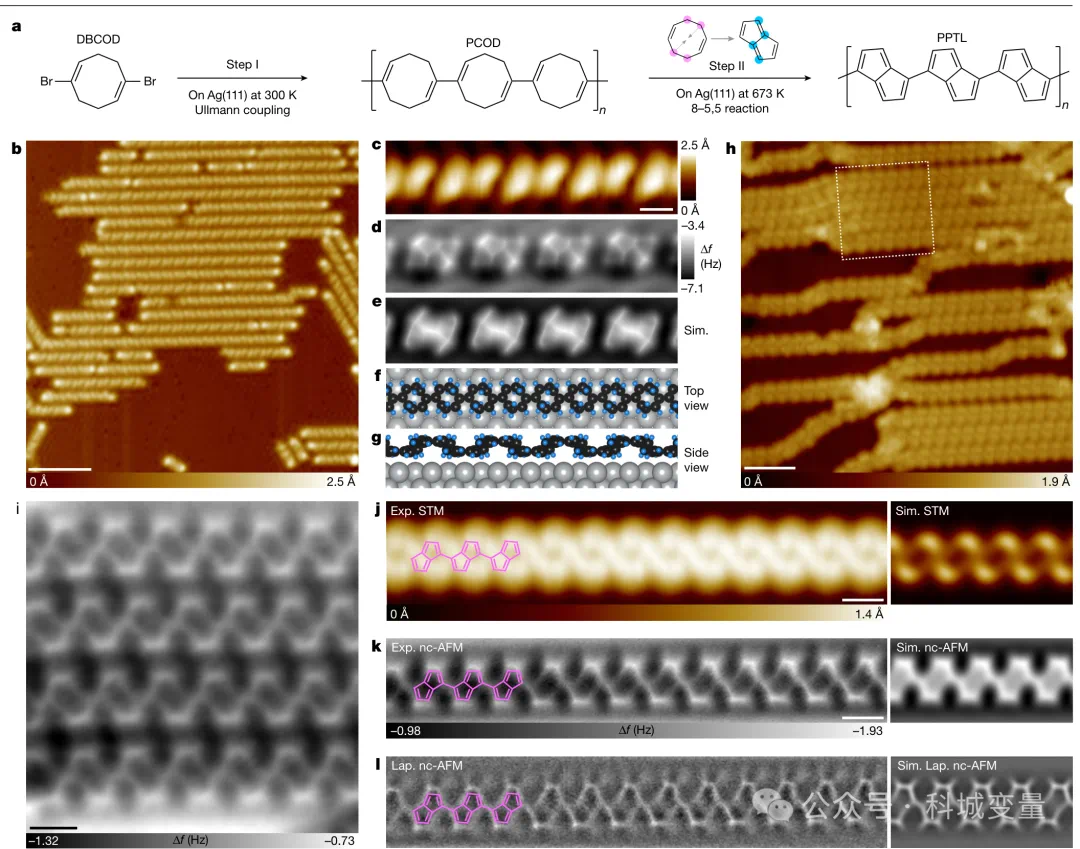
Construction and characterization of intermediates for synthesizing the carbon nanoribbon composed of five- and seven-membered rings. Using DBCOD as the precursor, the researchers formed PCOD chains on the silver surface through Ullmann coupling, then rearranged the eight-membered rings into two five-membered rings to obtain poly(pentalene) (PPTL) chains, laying the foundation for the subsequent lateral fusion used to prepare the carbon nanoribbon composed of five- and seven-membered rings. Image source: Nature, Fig. 1.
Using scanning tunneling microscopy and high-resolution atomic force microscopy, the team further examined the atomic structure of the synthesized products and confirmed the precise arrangement of the carbon rings.
The experiments also produced an interesting result.
Because the relative orientations of the two poly(pentalene) chains differed, the resulting carbon nanoribbons were not exactly the same. The researchers named them CPHN 1 and CPHN 2, respectively.
The main structures of the two nanoribbons were very similar: both consisted of five- and seven-membered rings, with only the arrangement directions of the molecular chains on the two sides differing.
Yet this small change in atomic arrangement led the two materials to exhibit completely different conductive properties.
One was metallic, while the other was semiconducting.
With the structure of the material now established, the next question was whether it could conduct electricity and how well.
The research team used scanning tunneling microscopy to measure electron transport in individual nanoribbons.
During the experiment, the researchers used the microscope tip to contact one end of a nanoribbon and then gradually lifted it, causing part of the nanoribbon to detach from the silver surface.
The tip and the silver surface then functioned as two electrodes, connected by an extremely narrow carbon nanoribbon. The researchers could measure the current during this process and observe how electrons traveled through this nanoscale channel.
The results showed that CPHN 1 reached a maximum conductance of approximately 0.9 times the conductance quantum.The conductance quantum is a fundamental measure of the conductive capability of an ideal electron-transmission channel. For a carbon nanoribbon only about 0.9 nanometers wide, measuring a conductance close to one conductance quantum is a significant result.
More notably, as the researchers continued lifting the nanoribbon, its conductance remained essentially stable over a lifting range of approximately 4 nanometers.
This indicated that, over the short distance covered by the experiment, electrons experienced relatively little scattering during propagation and exhibited behavior close to ballistic transport. Ballistic transport can be understood simply as electrons encountering few obstacles during their propagation and not experiencing a significant loss in transmission efficiency due to frequent scattering.
The other structure, CPHN 2, behaved markedly differently.
Under the corresponding measurement conditions, the conductance of CPHN 2 was approximately two orders of magnitude lower than that of CPHN 1, and the current at low voltage was also clearly suppressed.
In the corresponding measurements, the conductance of CPHN 2 was approximately two orders of magnitude lower than that of CPHN 1, and the current at low voltage was also clearly suppressed.This means that two nanoribbons composed of the same elements and similar carbon rings exhibited markedly different electron transport solely because their atomic connectivity differed.
To further confirm that this difference originated from the material’s intrinsic electronic structure, the team conducted another set of experiments.
The researchers inserted a layer of bromine atoms between the nanoribbons and the silver surface to reduce the influence of the metallic substrate on the measurements. They then measured interference patterns of electron waves using scanning tunneling spectroscopy and combined quasiparticle interference (QPI) analysis with theoretical calculations to study the electronic band structures of the two structures.
The results showed that the band structure of CPHN 1 crossed the Fermi level, indicating metallic behavior, whereas CPHN 2 had a band gap of approximately 0.22 electron volts and behaved as a narrow-gap semiconductor.
In simple terms, electrons in CPHN 1 can participate in conduction relatively easily, whereas electrons in CPHN 2 must overcome a certain energy interval before entering the corresponding conducting states.
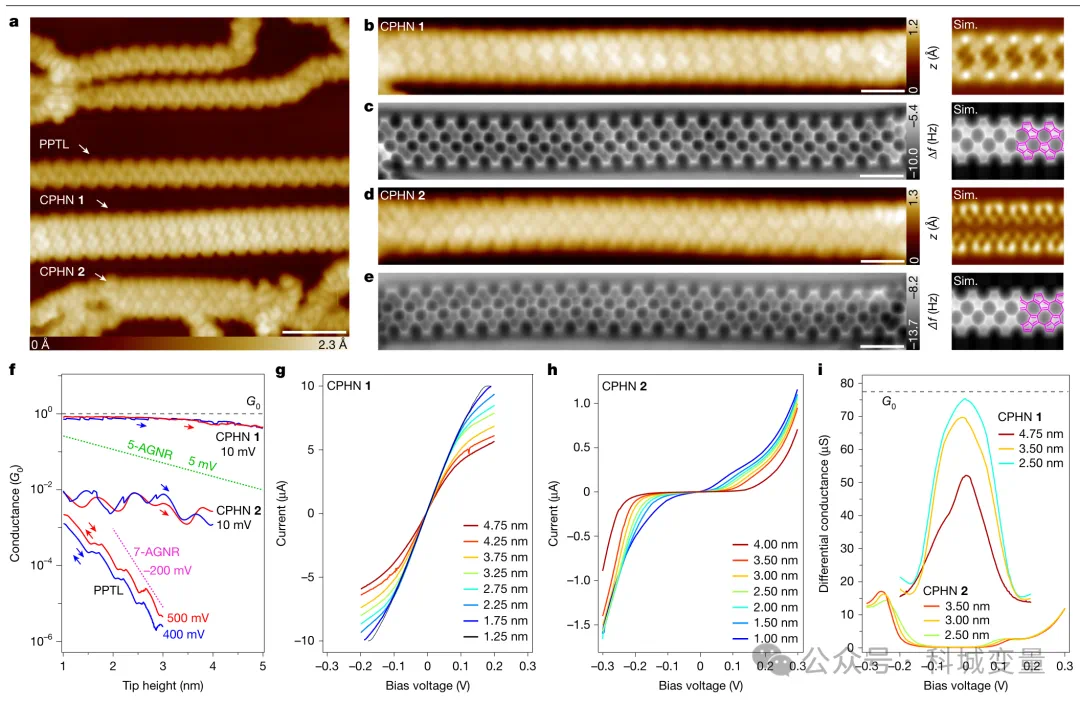
Atomic structures and electron-transport properties of two pentagon–heptagon carbon nanoribbons. The conductance of CPHN 1 reached a maximum of approximately 0.9 times the conductance quantum and remained essentially stable over a pulling range of about 4 nm, whereas that of CPHN 2 was approximately two orders of magnitude lower. Differential-conductance measurements revealed a zero-conductance gap of approximately 232.6 millielectron volts. Source: Nature, Fig. 2.
The team thus obtained mutually corroborating experimental evidence, from atomic-scale structural imaging and conductance measurements of individual nanoribbons to electronic band-structure analysis.
An important contribution of this study is that it not only successfully produced the relevant pentagon–heptagon carbon structures predicted by theory, but also demonstrated that atomic connectivity can determine whether such ultrathin carbon materials are metallic or semiconducting.
From atomic-scale wires to future carbon-based chips
Why go to such great lengths to fabricate a carbon nanoribbon only 0.9 nanometers wide?
One important research direction involves conductive channels and interconnect structures for future electronic devices.
As integrated circuits continue to shrink, the metal interconnects within devices must also be scaled down. However, as the dimensions of conventional metal wires approach the nanoscale, problems such as electron scattering, interconnect resistance, and power consumption become more pronounced.
Materials such as carbon nanotubes, graphene, and carbon nanoribbons have therefore become important subjects of research for next-generation nanoelectronic devices.One advantage of carbon nanoribbons is that the electronic properties of the material can be tuned by controlling its width, edges, and atomic arrangement.Previously, researchers had achieved metallicity in specific graphene nanoribbons through band-structure engineering. The USTC team has now gone further to realize a metallic nanoribbon composed entirely of non-six-membered carbon rings, adding a new structural option for carbon-based conductors.
If metallic and semiconducting carbon nanoribbons can be prepared and controlled separately in the future, it may be possible to use structurally distinct carbon materials to construct conductive and functional units in electronic devices.
However, the current results still rely primarily on atomic-scale synthesis on silver surfaces and low-temperature electron-transport experiments. Before practical chip applications can be realized, issues such as larger-scale controllable synthesis, material transfer, electrode connection, and device integration must still be addressed.The more direct significance of this studyis that it established a technical route for the precise synthesis of pentagon–heptagon carbon nanoribbons and demonstrated that electron-transport performance close to the quantum-conductance limit can be achieved in carbon frameworks less than 1 nanometer wide.
Thirty years ago, scientists predicted the metallicity of pentagon–heptagon carbon structures through theoretical calculations. Today, the USTC team has prepared the relevant structures and further found that, in the same pentagon–heptagon carbon framework, changing only the atomic arrangement is enough to produce a difference between metallic and semiconducting behavior.
There is therefore now another possibility for the materials used in future carbon-based electronic devices that can continue to be explored experimentally.
Reference links:
https://www.nature.com/articles/s41586-026-11202-2
https://news.ustc.edu.cn/info/1055/96661.htm
https://www.cas.cn/syky/202610/t20261029_5123069.shtml
https://journals.aps.org/prb/abstract/10.1103/PhysRevB.53.R13303

