Zhidx (WeChat official account: zhidxcom)
Author | Yang Jingli
Editor | Li Shuiqing
Zhidx reported on November 5 that today, Sand.ai (Sandai Technology), a Shanghai-based video generation foundation model startup, announced the completion of US$200 million (approximately RMB 1.334 billion) in a Series A+ funding round. This was the third funding round the company completed in 2026, bringing its cumulative fundraising over 10 months to US$300 million (approximately RMB 2.001 billion).
Sand.ai did not disclose its post-money valuation. The company said that it had officially become a unicorn after this round.
This funding round brought together industrial capital, prominent RMB and USD funds, Shanghai state-owned capital and other investors. Sand.ai said the proceeds would be used primarily for video foundation model R&D, training and inference infrastructure development, product iteration, and global market expansion. The official version of MAGI-2, Sand.ai's next-generation video generation foundation model featuring a larger parameter scale and an MoE architecture, will be released in the near future.
This round was co-led by C Capital and Wangsu Technology; renowned institutions such as Times Capital, BlueRun Ventures, and Orient Securities Capital participated; Tianchuang Capital made a strategic investment together with Shandong Tietou Industrial Investment and the Shandong Railway Fund; Shanghai state-capital-backed institutions, including Pudong Venture Capital and Shanghai Guofang, joined; and existing investors such as Matrix Partners China, Huaye Tiancheng, and CAS Star continued to increase their investments.
Sand.ai was launched in January 2024 and is headquartered in Shanghai. Its business focuses on R&D of video generation foundation models and application products.
The company's founder and CEO, Cao Yue, earned a PhD in software engineering from Tsinghua University in 2019. Cao Yue previously served as a principal researcher at Microsoft Research Asia and head of the Visual Model Research Center at the Beijing Academy of Artificial Intelligence, and was also a co-founder of LightYear, an AI large-model company acquired by Meituan. Cao Yue contributed to related research on visual models such as Swin Transformer, Video Swin, SimMIM, and EVA, with Swin Transformer winning the ICCV 2021 Marr Prize.
Based on publicly available information, Sand.ai has completed more than four funding rounds in total. In June this year, Sand.ai said it had completed two funding rounds totaling more than US$100 million, with investors including leading institutions such as Look Capital, Lollapalooza Capital, Ubiquant Ventures, Matrix Partners China, Heyu Capital (MSA Capital), Innovation Works, Xianghe Capital, Source Code Capital, CAS Star, Hongtai Fund, Today Capital, Huaye Tiancheng, Yunhui Capital, IDG, and Baidu Ventures.
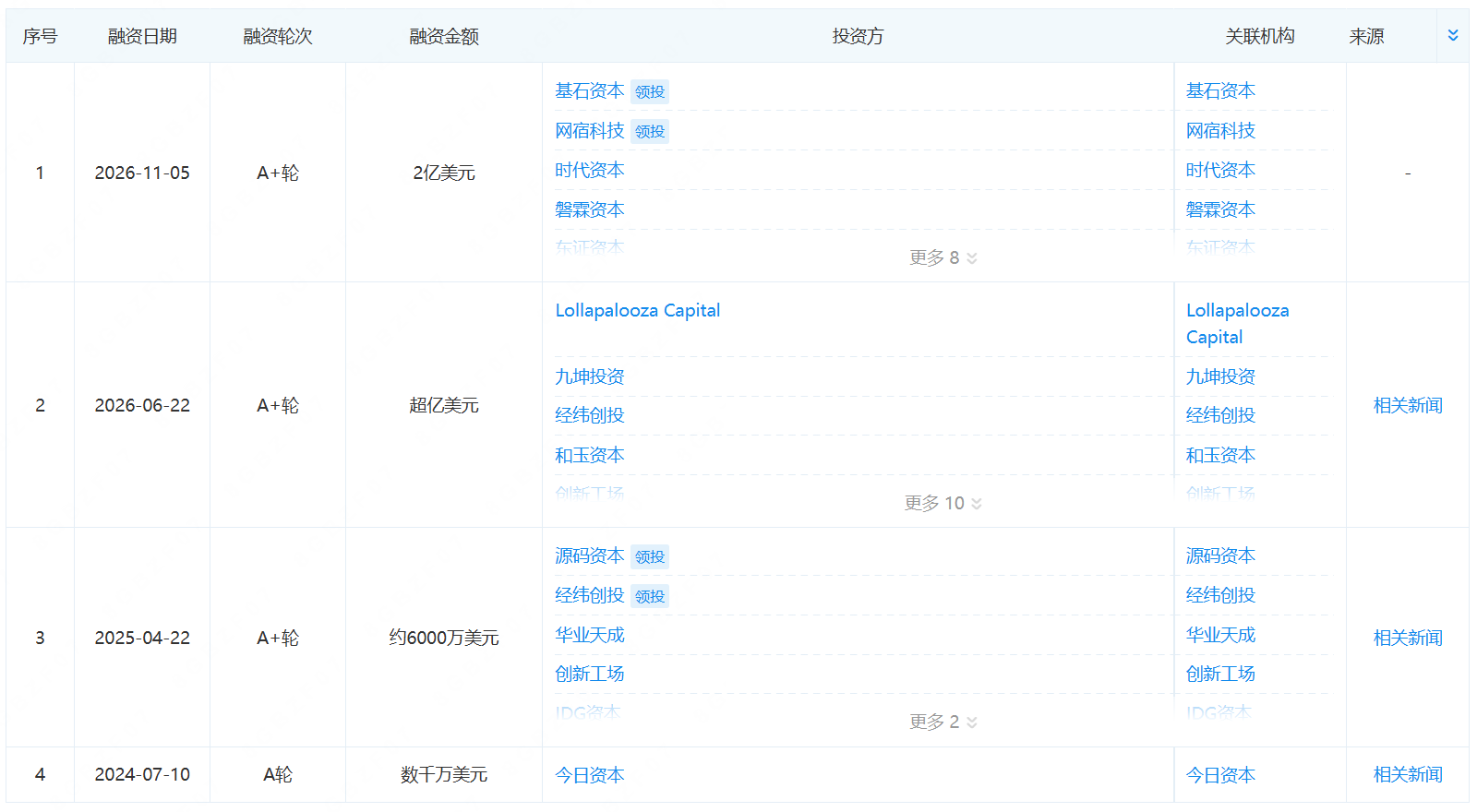
▲Sand.ai's past financing rounds (Image source: Qichacha)
Sand.ai has continued to advance the evolution of its video generation model architecture. Its technical path has expanded from autoregressive generation and joint audio-visual modeling to 100-billion-parameter MoE models, with optimization centered on model capabilities and inference efficiency.
In April 2025, Sand.ai released and open-sourced the autoregressive video generation model MAGI-1, which, by generating video segments in chronological order, supports continuous video generation and long-duration extension.
In March 2026, the company further open-sourced MagiHuman, an audio-visual foundation model that adopts a unified single-stream Transformer architecture to jointly model text, visuals, and audio. It also leverages infrastructure technologies such as MagiAttention and MagiCompiler to improve the training and inference efficiency of large-scale video models.
In August 2026, Sand.ai released and open-sourced MAGI-2 Preview, becoming the first team in the world to scale a video generation model to the 100-billion-parameter range and open its model weights. The model uses a fine-grained MoE architecture, with approximately 114B parameters in total and only around 6B parameters activated per forward pass. At release, MAGI-2 Preview ranked sixth globally on the image-to-video leaderboard of the third-party evaluation platform Artificial Analysis.

Additionally, Sand.ai launched VidMuse, a video generation product. Sand.ai said that two months after its launch, annual recurring revenue (ARR) surpassed US$10 million.
After completing this round of financing, Sand.ai will continue to advance the development of next-generation large-scale video models, accelerate the implementation of open-source foundation models and application products, and expand its global developer ecosystem and commercial use cases. Against the backdrop of intensifying competition in the video generation model market, whether the company can translate its model capabilities into stable product revenue, a developer ecosystem, and overseas market share will be the main focus of the next phase.
jQuery(document).ready(function($) { $.post('https://www.zhidx.com/wp-admin/admin-ajax.php', {action: 'wpt_view_count', id: '607594'}); });