The trend of companies entrusting system development itself to AI is spreading. AI agents handle everything from requirements definition to code generation, while people focus on judgment. Examples of development speeds increasing severalfold through such “AI-driven development” are no longer rare.
ASKUL is one such company. However, the gateway to full-scale adoption was not a proactive investment. It was a ransomware attack that brought the entire business to a halt.
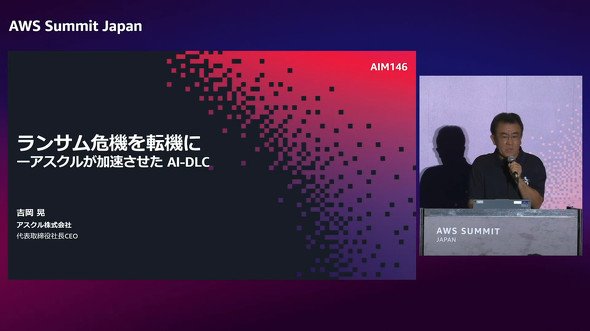 ASKUL President and CEO Akira Yoshioka speaking at “AWS Summit Japan 2026”
“Turn adversity into evolution”—About two weeks after the attack, President and CEO Akira Yoshioka, who had led the recovery, called for this during a company-wide morning meeting. Rather than seeing the situation as one requiring the business to be restarted from zero, he regarded it as an opportunity to rebuild its ideal form. At “AWS Summit Japan 2026,” held by AWS Japan on June 25–26 at Makuhari Messe, President and CEO Yoshioka personally recounted that journey.
Sales down 95%, all logistics halted—The course of the ransomware incident
ASKUL announced that it had been infected with ransomware on October 19, 2025. The attackers encrypted its logistics and internal systems, bringing logistics operations across Japan to a simultaneous halt. The corporate “ASKUL” service and consumer “LOHACO” service both suspended new orders, and sales from October 21 to November 20, 2025, fell 95.1% year on year to ¥169.8 million. The attack also resulted in the leak of a substantial amount of personal information. Reflecting on the incident, President and CEO Yoshioka said, “As a company, our awareness of risk was insufficient.”
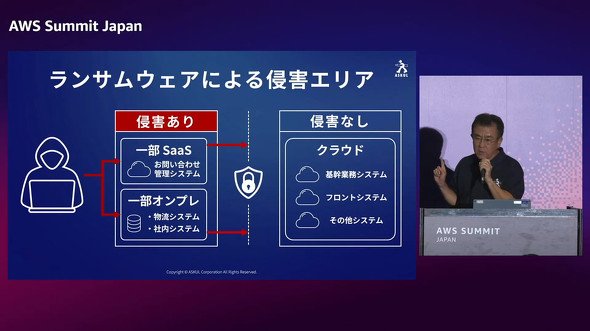 Areas compromised by ransomware (Source: ASKUL presentation materials; same below)
Rebuilding everything from scratch on our own: Policy finalized on Day 4
On the other hand, ASKUL maintained its decision not to pay the ransom, with the aim of avoiding any contact with the attackers and the risk of financing antisocial groups or facing another attack.
In carrying out the recovery, President and CEO Yoshioka adopted three criteria: “preventing the spread of damage,” “ensuring safety and security,” and “achieving rapid recovery.” On the fourth day after the attack, the company finalized a policy to rebuild the affected systems from scratch on its own. It immediately decided to migrate the logistics system, previously operated on-premises, to the cloud of US-based Amazon Web Services (AWS), helping to bring about recovery as quickly as possible.
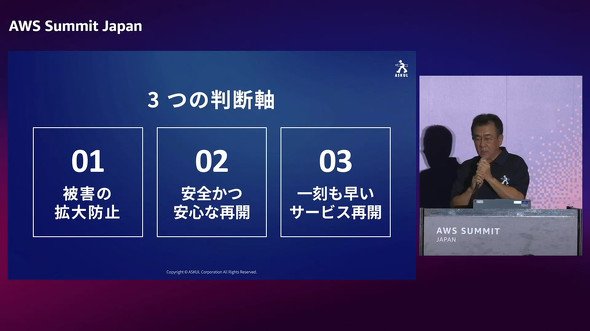 The three criteria adopted during the recovery
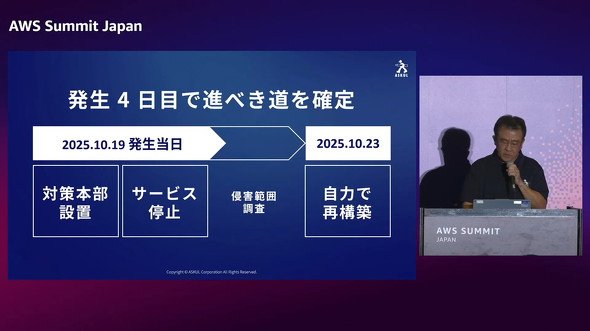 Decision-making over the first four days after the incident
Network: 28 days; sites: 108 days
However, restoring the logistics locations proved difficult. While the internal network was brought back online in approximately 28 days, restoring the 10 logistics locations across Japan took 108 days.
Each location had more than 7,000 servers and PCs combined, with different operating systems and versions depending on when the location had opened. Each machine had to be decontaminated and updated one by one.
President and CEO Yoshioka shared lessons from the perspective of the business continuity plan (BCP), stating, “To prepare for crises at operational sites, meticulous specification management and continuous updates during normal times are indispensable.” Ultimately, it took 3.5 months to achieve full recovery.
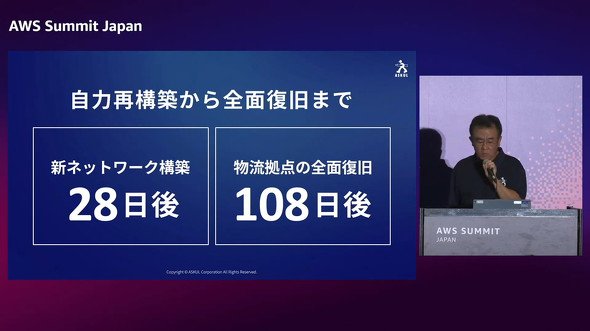 A significant difference in the number of days required to restore operations. Network restoration took 28 days, while the logistics hub took 108 days.
Putting AI at the Center of Development—“AI-DLC” and “Kiro”
“AI-DLC” proved invaluable during this rebuilding process. It refers to an approach in which AI takes the lead in the development cycle, people focus on formulating hypotheses and making decisions, and AI primarily handles research, generation, and product creation.
ASKUL used AWS’s AI agent-based development tool “Kiro” (kee-ro), shifting all processes except direction-setting to AI-led execution and leveraging it to rebuild its systems. President and CEO Yoshioka described the results of its implementation as, “The speed of decision-making changed dramatically.”
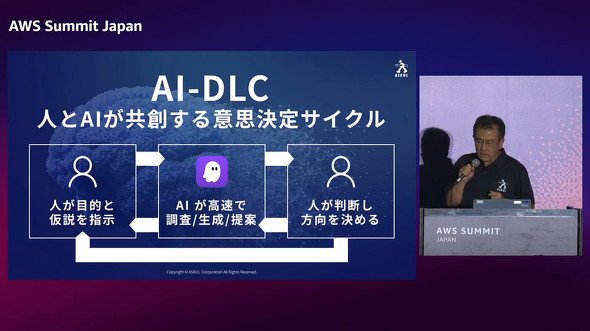 The decision-making cycle of AI-DLC, where humans and AI co-create
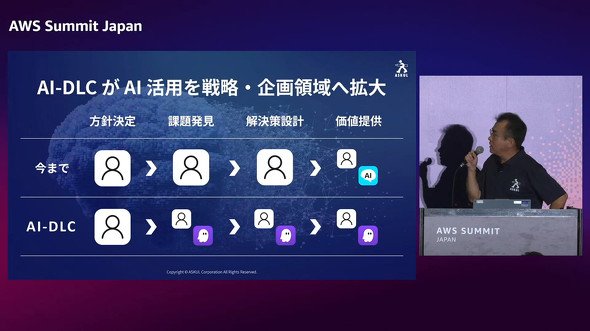 AI-DLC expands the use of AI into the strategy and planning domains