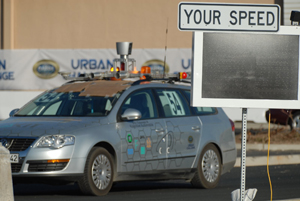
Robotic vehicles move slowly and
are required to obey all local traffic laws.
For nearly 50 years, the Defense Advanced Research Projects Agency (DARPA) has funded scientific developments and promoted their adoption by the companies that supply military technology. For the last few years, the agency has been encouraging the development of automated vehicles through a series of Grand Challenges. The first two editions tested the ability of automated vehicles to navigate desert terrain, but this year's version raised the difficulty dramatically by changing the environment: the 2007 version was called the Urban Challenge.
DARPA's description of the obstacles sound a bit like a description of a typical commute to work: "They must obey traffic laws while merging into traffic, navigating traffic circles, negotiating busy intersections and avoiding obstacles." The competition rules, in fact, included a copy of the California Driver's Handbook. Instead of dropping carpoolers off at work, however, the vehicles were expected to run simulated supply missions that had them covering 60 miles in under six hours. As the Challenge's literature notes, "The urban setting adds considerable complexity to the challenge faced by the robotic vehicles, and replicates the environment in which many of today’s battlefield missions are conducted."
Given that no vehicles completed the first desert challenge, it's clear that experience has made a big difference for many of the teams. This time around, three teams finished within the allotted time. Computer science hotspot Carnegie Mellon's Tartan Racing took home $2 million for driving a Chevy Tahoe into first place. The Volkswagen Passat wagon of the Stanford Racing Team, winners of the second Desert Challenge, pocketed $1 million for second, while Virginia Tech's Team Victor Tango drove a Ford Escape Hybrid named Odin into the $500,000 third prize. According to Wired, all three vehicles averaged speeds in the low teens.

