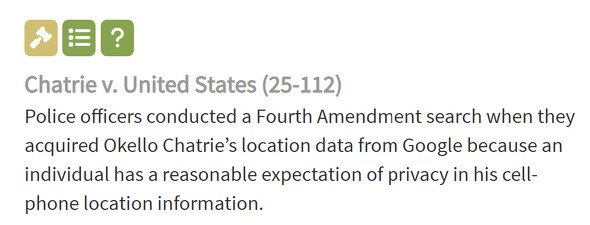
The ruling came in the case “Chattary v. United States” and was issued by a 6–3 vote. Justice Elena Kagan wrote the opinion, which five justices joined. The opinion stated that users have a “reasonable expectation of privacy” in the location information on their own smartphones and concluded that law enforcement’s acquisition of that information constitutes a “search” under the Fourth Amendment.
A “geofence warrant” is a warrant that directs an IT company to submit data from devices that were within a designated area at a specified time, with law enforcement establishing a virtual boundary (a geofence) around the scene of a crime. It has been used in cases where suspects cannot be identified as a means of determining “who was there.” In this case, during the investigation of a credit union robbery in Virginia in May 2019, police asked Google for location information from devices within a 150-meter radius centered on the scene. After progressively narrowing down the anonymous data, Google ultimately disclosed the identities of three people, one of whom was the defendant, Okello Chattary.
The issue in this case was location data known as “Location History,” which is collected and stored by Google’s apps. It records a device’s location approximately every two minutes, with an error margin of about 20 meters, and is said to be capable of estimating even which floor of a building a user is on. The Supreme Court cited its 2018 “Carpenter v. United States” decision, which recognized the acquisition of cellular base station location information (CSLI) as a “search,” and pointed out that because Location History records an individual’s movements in even greater detail than CSLI, the same rationale applies with greater force. It also rejected the “third-party doctrine,” under which information entrusted to third parties is not protected by the Constitution, holding, as in Carpenter, that the doctrine does not apply in this case.
However, although the Supreme Court held that the acquisition in this case constituted a “search,” it did not decide whether the warrant itself satisfied Fourth Amendment requirements, including probable cause and particularity of the scope of the search, and instead remanded the matter to the U.S. Court of Appeals for review. Consequently, Chattary’s conviction is not immediately overturned.
In December 2023, Google announced a change to its system under which Location History data would be stored on users’ devices rather than on Google’s own servers. According to the opinion, Google said that, with this change, it could no longer respond to geofence warrants seeking Location History. As a result, the method at issue in this case is now nearly impossible to use. The core of the Supreme Court’s holding, however, is that data users consider “their own” cannot be obtained without a warrant even if it is stored on an IT company’s servers. The opinion grouped Location History alongside Gmail emails, Google Photos images, and calendar appointments, and the same reasoning could extend to personal data in the cloud beyond location information. Thus, even after the particular geofence method has become unusable, the principle announced in this ruling could have a broad impact on future investigations and the handling of digital data.
(empty)


