product description on the site takes three screens, everything is chewed over and looks tasty to the reader
, while ChatGPT, GigaChat, Alice AI, and Perplexity respond with general terms or confuse it with a competitor
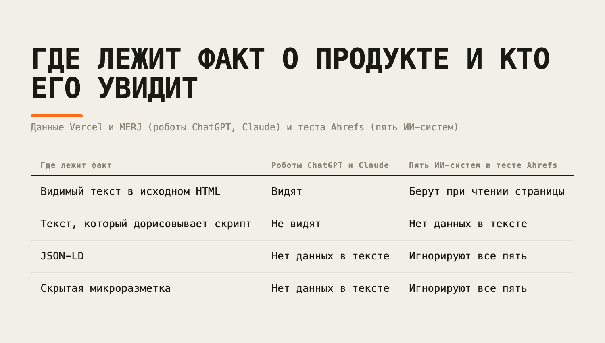
. The whole point is that neural networks read not the entire site, but several found fragments, and if there is no direct text explaining what the product is and who it is for, details on other pages won't help. Part of the text may not even reach the AI at all: Vercel and MERJ found that ChatGPT and Claude robots download page scripts but do not execute them, so the text that the site generates in the browser does not reach them.
Therefore, in the fragments that the neural network can find, there must be exact text explaining what the product is, who it is for, and what distinguishes it, and this text must be in the page code.
Where do ChatGPT and Alice AI get the text from your site
? How the neural network reads the site depends on the service: ChatGPT has its own robots, while Alice AI does not crawl sites itself and relies on Yandex Search. According to OpenAI's information about robots, ChatGPT's search is handled by OAI-SearchBot: through it, sites enter search results. GPTBot collects data for model training and is not related to search, with independent settings in robots.txt. There is also ChatGPT-User: it opens the page when a user asks a question, but the network does not crawl it itself, and it does not affect the site's appearance in search results.
Alice AI, according to Yandex Webmaster's information, breaks down the question into sub-questions, sends them to Yandex Search, and uses its results. It relies on pages that are highly ranked and does not reproduce them verbatim. The ready answer Alice divides into semantic blocks, and each can have its own source page. For Alice's AI, this means that a poorly ranked page has few chances to become a source, while for ChatGPT's search, it's important whether the OAI-SearchBot is running on the site.
Why do ChatGPT and Claude bots not see the text that the script adds to the page?
ChatGPT and Claude bots receive HTML (the page's source code before script execution) and JavaScript files from the server, but they do not execute the scripts. Crawler is a robot that browses pages and downloads them; JavaScript is code that builds the page in the visitor's browser.
In the Vercel and MERJ study released in December 2024, JavaScript files accounted for 11.50% of ChatGPT's crawler requests and 23.84% of Claude's requests. The downloaded script for the robot remains as program text: the page it would have built in the browser is not visible to the robot.
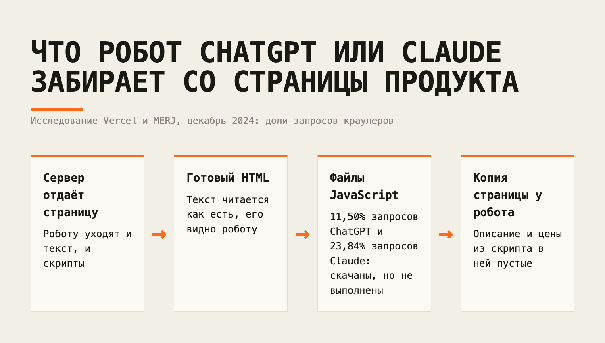
If the product description is loaded by a script, it isn't present in the original HTML. Vercel recommends delivering the product description, metadata, and navigation in ready HTML via server-side rendering (SSR): the page is assembled on the server, and the robot immediately receives the text. Otherwise, according to the authors, AI responses about dynamic sites will be incomplete or outdated. Yandex's robot is different by default: it decides on its own whether to execute JavaScript on the page.
If a website has server-side rendering or pre-rendering, script execution can be blocked, and for text that appears with a delay, there are waiting settings.
What does the neural network learn about prices if they are written by a script or if there are no price pages
? Nothing from the website itself: crawlers without JavaScript cannot see prices from scripts, and without a price page, the neural network takes numbers from third parties. Profound checked 77 public price pages, and on 10 of them, roughly one in eight, crawlers couldn't see at least 40% of the main text. These pages could have been written in any way: for the AI bot, there was no such part there.
On its own website, Profound also had prices rendered by a script in the browser, and AI crawlers that took the original HTML couldn't see them. Moving prices to server-side rendering helped.
Worse when there are no pages at all. For one product in Profound's study, there were no public price pages, and neural network responses pulled numbers from third parties, often from Reddit discussions: from about $100 to $2,400 per user per month. A 24-fold difference for the same product: buyers can't rely on such an answer.
Will the neural network see Schema.org markup if there is no product information in the text itself
? No: when five AI systems read the page in real-time, they only used visible HTML. Ahrefs tested ChatGPT, Claude, Perplexity, Gemini, and Google AI Mode. JSON-LD (a code block where product data is recorded for machines according to the Schema.org vocabulary), hidden microdata Microdata, and RDFa were ignored by all five. This is bad news for those who rely solely on price or characteristics in markup.
Ahrefs tracked another 1,885 pages that added JSON-LD from August 2025 to March 2026, and compared them with 4,000 control pages. Among the pages that the neural networks had already cited, citations in AI Mode and ChatGPT stopped after that, AI Overviews saw a 4.6% decrease, and authors cannot confidently link this to markup. Overall, pages with markup are cited more frequently, but Ahrefs explains this by noting that markup appears on better-maintained sites with strong content and links. Google even states that for its AI functions, special Schema.org markup is not needed.
Therefore, markup should not be the only source of factual information: who the product is for, its price, and what makes it different should be written in the visible text.
The neural network takes several pieces from the page, and each should contain information about your product.
The neural network receives several found page fragments, and if they don't include direct text about what the product is and who it's for, details on other pages won't help. What happens to the cut-out fragment, Anthropic shows in the document fragment search analysis: a fragment stating that the company's revenue increased by 3% in the quarter itself does not mention the company or the period, making it difficult to find the relevant information or use it.
Anthropic suggests adding a 50–100 token explanation to each fragment before indexing (a token is a piece of a word that the AI model considers as text): from which document it comes and what it is about. In tests on their own data, Anthropic's search made almost half as many errors with such explanations: 2.9% failed searches instead of 5.7%. The site cannot add an explanation to the paragraph cut by another system, but it can insert the product name into each meaningful paragraph itself.
The problem isn't that the text is too short, but that it cannot be paraphrased in parts: marketing phrases apply to a thousand products, key facts are in scripts and images, and there's no single phrase on the page stating what it is and for whom. The page should be written so that any paragraph ripped out of context correctly names the product.
Conditional example, the product is called Кассир:
• Was: A solution that helps grow and save time.
• Became: Кассир — cloud cash register for small online stores: accepts payment, prints a receipt, and sends it to the customer.
Six checks of the site for neural networks so the AI can accurately see all important information about your product.
Open robots.txt and find the block User-agent: OAI-SearchBot: from this robot depends whether the site will be found in ChatGPT search. The line Disallow: / in the block closes the site entirely. If there's no separate block, the rules for User-agent: * apply, and without Disallow: / in them, access is open.
Get the product page without JavaScript and find the product name, price, and words about who it's for. The browser's source code or the command:
Zero means that the word "cloud" is not present in the original HTML: it's added by a script or isn't on the page at all. Also check the text from tabs and sliders: if it's not in the source code, the robot won't get it. Duplicate important facts from PDFs and images with text on the page. I have already compared the test page with the copy that the AI bots receive: the text matched at 97%, but the price in the copy was old.
If the required text is not in the original HTML, move it to server-side rendering or prerendering. For Yandex robot, there are separate settings for executing scripts in Webmaster.
Compare JSON-LD with visible text on the page: every value from the markup should be present on the page itself.
Read each paragraph about the product separately, without the page header. If it's not clear from it what the product is, for whom it is intended, and what makes it different, add more information.
Ask ChatGPT, GigaChat, Alice AI, and Perplexity what the product is and for whom it is intended, and compare their answers with the website. If the answer is incorrect, but points 2–5 are in order, open the sources the neural network refers to and find a foreign page with incorrect information: without a public price page, the neural network took numbers from third parties.
What to start with when editing the site for neural networks
Everything is simple — check the text in the page code, then each paragraph about the product. When optimizing the site for neural networks, start with point 2: as long as the text is not in the original HTML, the ChatGPT and Claude robots won't have it, and rewriting paragraphs too early is not effective. Next comes point 5, because even visible text is taken in pieces by the neural network.
What is inaccurate in these data. The Vercel and MERJ study came out in 2024, since then the robots may have changed, and it is unknown whether the GigaChat and Perplexity robots execute scripts. Profound collected answers from July 29th to August 10th, 2026, only about prices, and they themselves warn that engines regularly change citations. Ahrefs counted how often pages cited, but it didn't check the accuracy of the retelling.
The text in the original HTML and paragraphs with product names do not guarantee an accurate retelling, but without them, neural networks remain to gather the product from general words and other pages. Interesting, has the retelling of the product in the answers from neural networks changed after switching to server-side rendering?


