 © 01net
Google is testing Gemini-powered autofill, capable of drawing from Gmail and Photos to complete your forms. The feature carefully sidesteps Europe, and the regulation that has Google miffed is no coincidence.
Chrome has been able to autofill an address or card number for years. The new feature spotted in Chrome Canary, the browser’s experimental version, takes things further. A feature called “Find and Fill with Gemini” offers to let AI rummage through your entire Google account to track down the missing information.American testers already have access; you don’t (we’ll return to this below).
Two @ signs and Gemini digs through your inbox
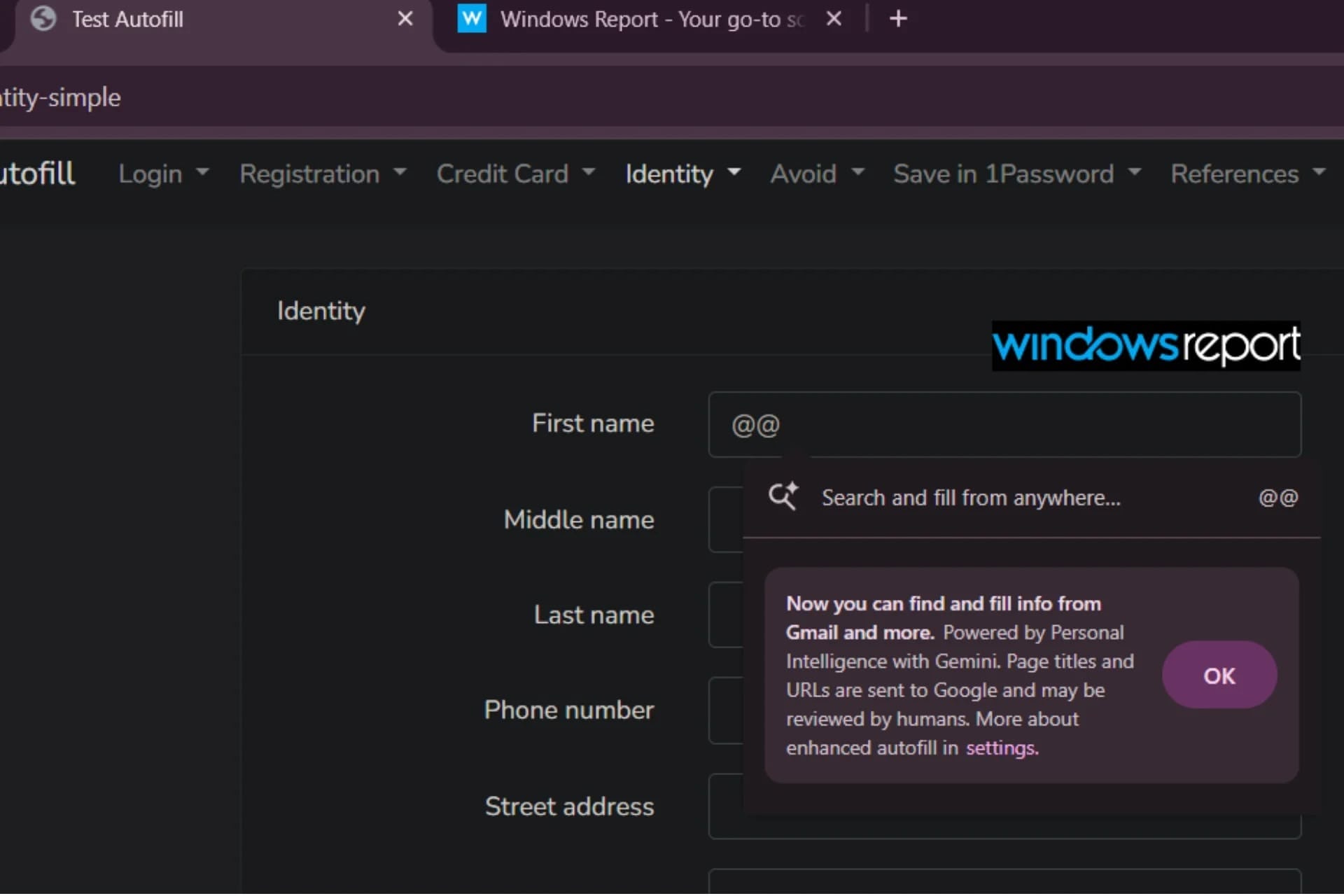
The instructions boil down to a shortcut: type “@@” in any text field, or right-click and select the “Search and fill from anywhere” option. Under the hood, Google connects its layer of personal intelligence, the one that already links Gmail, Google Photos, and the account’s connected apps. In practical terms, Gemini would retrieve a reservation number buried in a confirmation email, or the details from a photographed document, and insert them into the form for you.
 © Windows Report
On paper, the safeguards are in place: the inserted information would not be used to train the AI and would not come under any human eyes. The documentation does specify, however, a few lines further down (as it should), that the titles and addresses of the pages where the feature is invoked are sent to Google and may be reviewed by humans. Google also acknowledges the risk of prompt injection—those malicious instructions that a web page can feed to an AI to hijack its behavior. And there is no guarantee that a feature tested in Canary will ever reach the browser’s stable version.
Why French internet users don’t have access
Now comes the painful part: Gemini’s personal intelligence is in beta everywhere in the world, except in the European Economic Area, Switzerland, and the United Kingdom.Britons did indeed get Gemini in Chrome on July 14, but without this building block. No date has been set for France, and the rumor of a rollout in the second half of the year remains what it is: a rumor.
The explanation lies in Brussels, as often. Google has been designated a gatekeeper under the DMA since September 2023, and Article 5 of the regulation specifically prohibits cross-referencing personal data across services without consent that complies with the GDPR. Meta learned the cost the hard way: €200 million fine for its “consent or pay” model. The European Commission also issued two decisions to Google on July 16, concerning the interoperability of AI assistants on Android and the sharing of search data. Neither directly targets Chrome, but the mood has been set. The CNIL, for its part, published a note in early July on the risks that so-called agentic AI poses to personal data.
A password manager simply returns what you have entrusted to it. Here, the AI would go looking on its own, through years of emails and photos, for what it considers relevant to you. The distinction is well worth an EU regulation. In the meantime, you will still have to fill in your forms by hand.Considering the trade-off in terms of personal data, the chore almost looks like a good deal.
👉🏻 Follow tech news in real time: add 01net to your feeds on Google, and subscribe to our WhatsApp channel.

Source: Windows Report








- Google Play Store
- 4K Video Downloader Plus
- VLC Media Player
- Adobe Reader
- uTorrent
- WinRAR
- Xender
- Google Chrome
- CCleaner
- Mozilla Firefox
- Avast Free
- ChatGPT
- Microsoft 365
- Opera One
- Avast One










Download
- Google Play Store
- 4K Video Downloader Plus
- VLC Media Player
- Adobe Reader
- uTorrent
- WinRAR
- Xender
- Google Chrome
- CCleaner
- Mozilla Firefox
- Avast Free
- ChatGPT
- Microsoft 365
- Opera One
- Avast One


