Zhidx (WeChat account: zhidxcom)
Compiled by | Yang Jingli
Edited by | Li Shuiqing
Zhidx reported on November 11 that early this morning, Google announced that its most powerful AI model, Gemini 4 Carbonis now officially available to developers, businesses, researchers, and consumers. Gemini 4 Carbon reaches state-of-the-art levels in cybersecurity capabilities and in long-horizon agentic workflows for complex knowledge work, software engineering, and scientific reasoning.
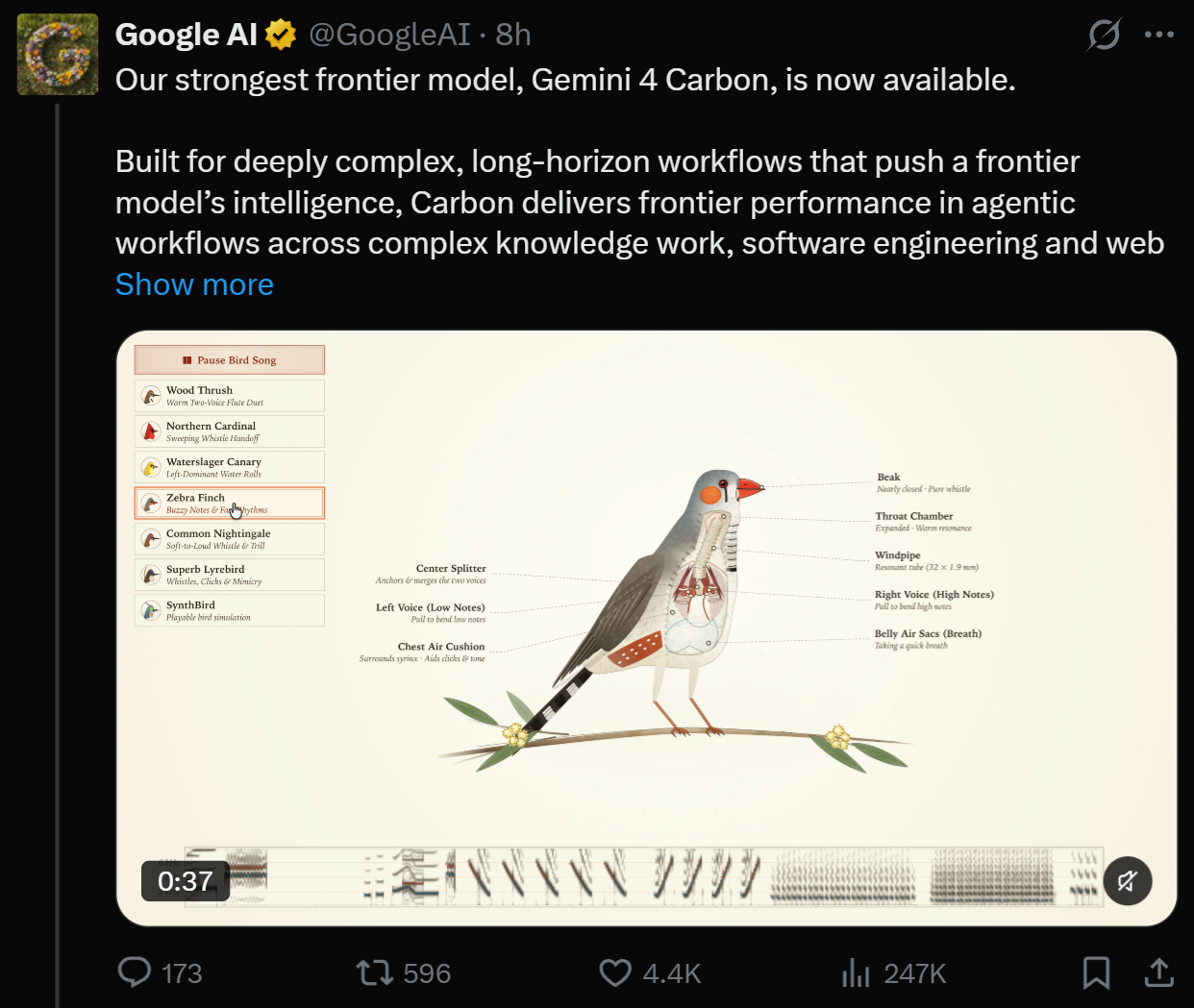
▲Google announces the availability of Gemini 4 Carbon (Image source: X)
Two weeks ago (October 28), Gemini 4 Carbon was released and made available to a group of cybersecurity professionals through the Fairwind program. Following this expanded availability, developers and business users can access the API via Google AI Studio and Gemini for Business. Google AI Ultra subscribers can try the model in Google Antigravity, the Gemini app, and AI Mode in Google Search.
In independent benchmarks that measure models’ performance on real-world workflows, Carbon balances frontier-level accuracy with the cost of practical deployment. It ranked first on the CursorBench 4.0 benchmark leaderboard, Perplexity’s WANDR, and Zapier’s AutomationBench. The cost per task was less than half that of the highest-ranked external model, and it outperformed Fable 5.2, Opus 5.5 and other models.
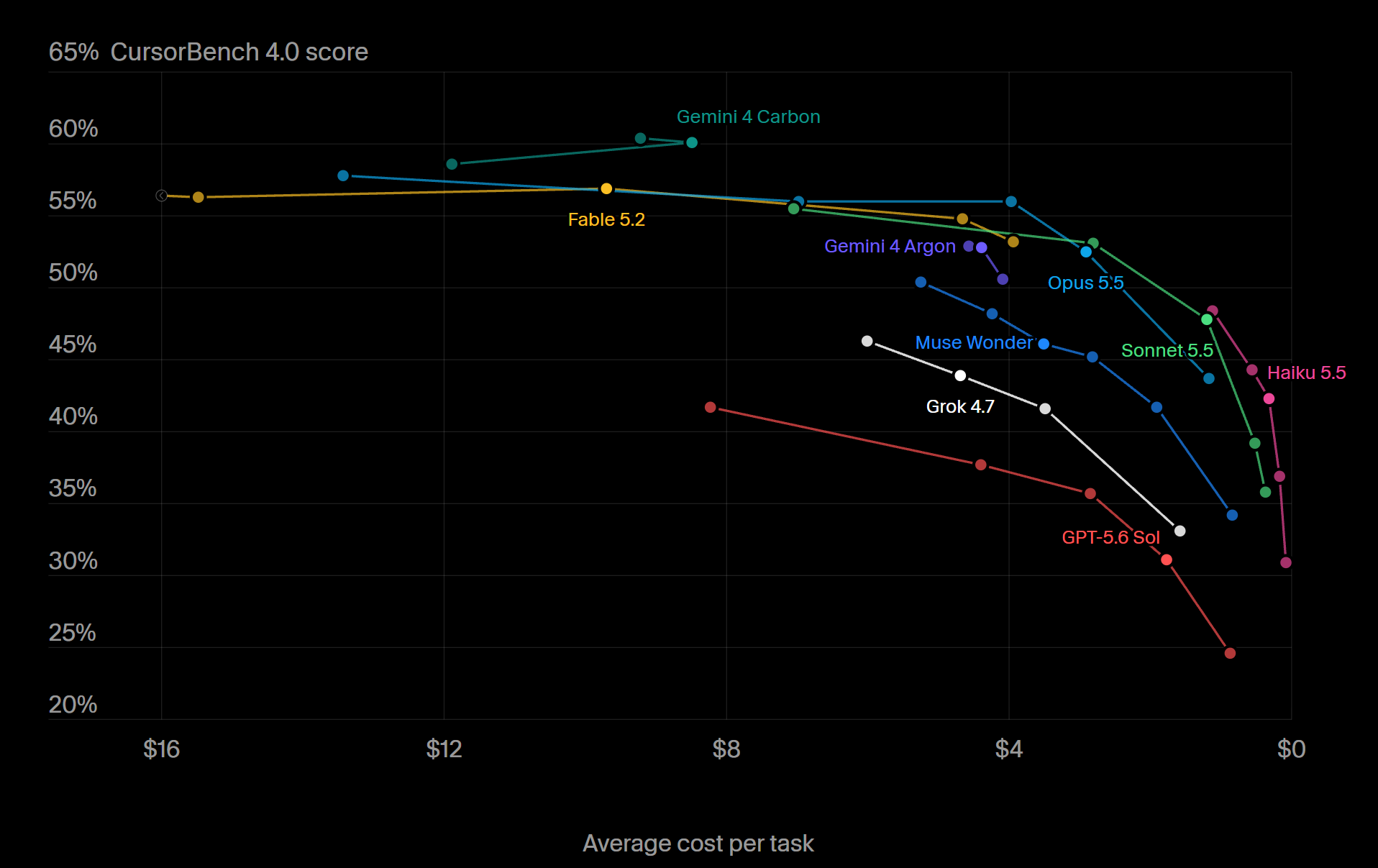
▲Gemini 4 Carbon’s performance in the CursorBench 4.0 evaluation (Image source: Cursor)
On the Artificial Analysis Intelligence Index, Gemini 4 Carbon (high) scored 60 points and ranked second, trailing only Claude Fable 5.2 (max) and surpassing a host of models, including Claude opus 5.5 (max), GPT-6 Astra (max), and GPT-6.1 Sol (max).
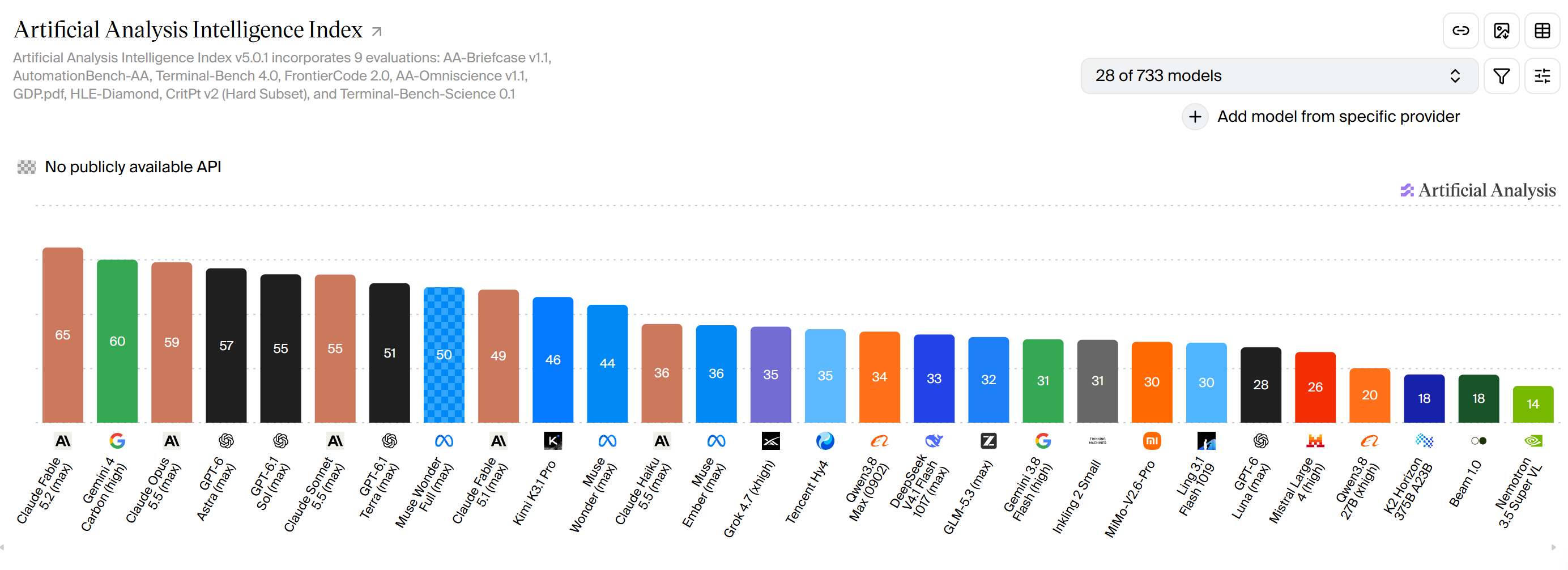
▲Gemini 4 Carbon ranks second on the Artificial Analysis leaderboard (Image source: Artificial Analysis)
In terms of pricing, Gemini 4 Carbon’s introductory API pricing is the same as Argon’s: $2 per million input tokens (about RMB 13.3) and $10 per million output tokens (about RMB 66.7), with the promotion running through November 30. Afterward, input and output tokens will be priced at $4 (about RMB 26.7) and $20 (about RMB 133.4), respectively.
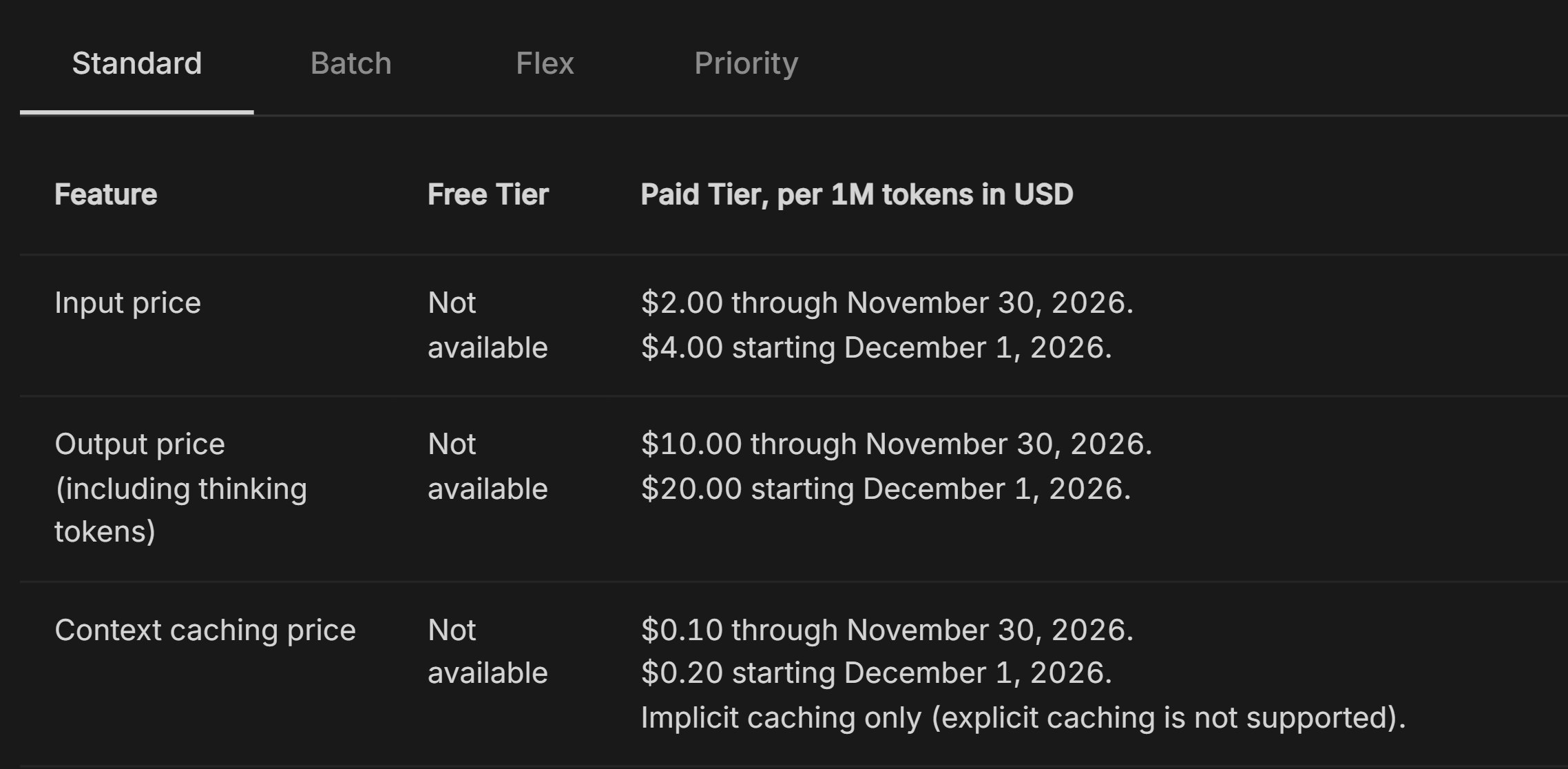
▲Gemini 4 Carbon pricing (Image source: Google)
Currently, in the Gemini 4 series, Google still recommends using Argon for most software engineering and knowledge work. Carbon is designed for complex code debugging, open-ended scientific research, and other more difficult tasks. It consumes more tokens, performs deeper reasoning, and repeatedly validates results.
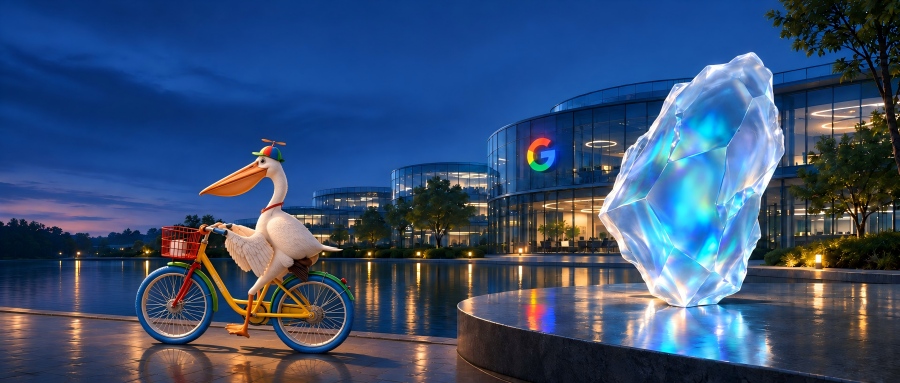
Google CEO Sundar Pichai wrote: “Carbon made a demo of a pelican riding a bicycle, so you don’t need to test it specifically.” In the animation, the pelican rides through Google’s campus. After launching off a ramp, it spreads its wings to maintain balance, then lands smoothly on the ground and continues riding.

After the model became available, some developers posted on the overseas social media platform X that Gemini 4 Carbon was a significant improvement over Argon, highly capable, and approached problems in a way different from Claude and GPT.
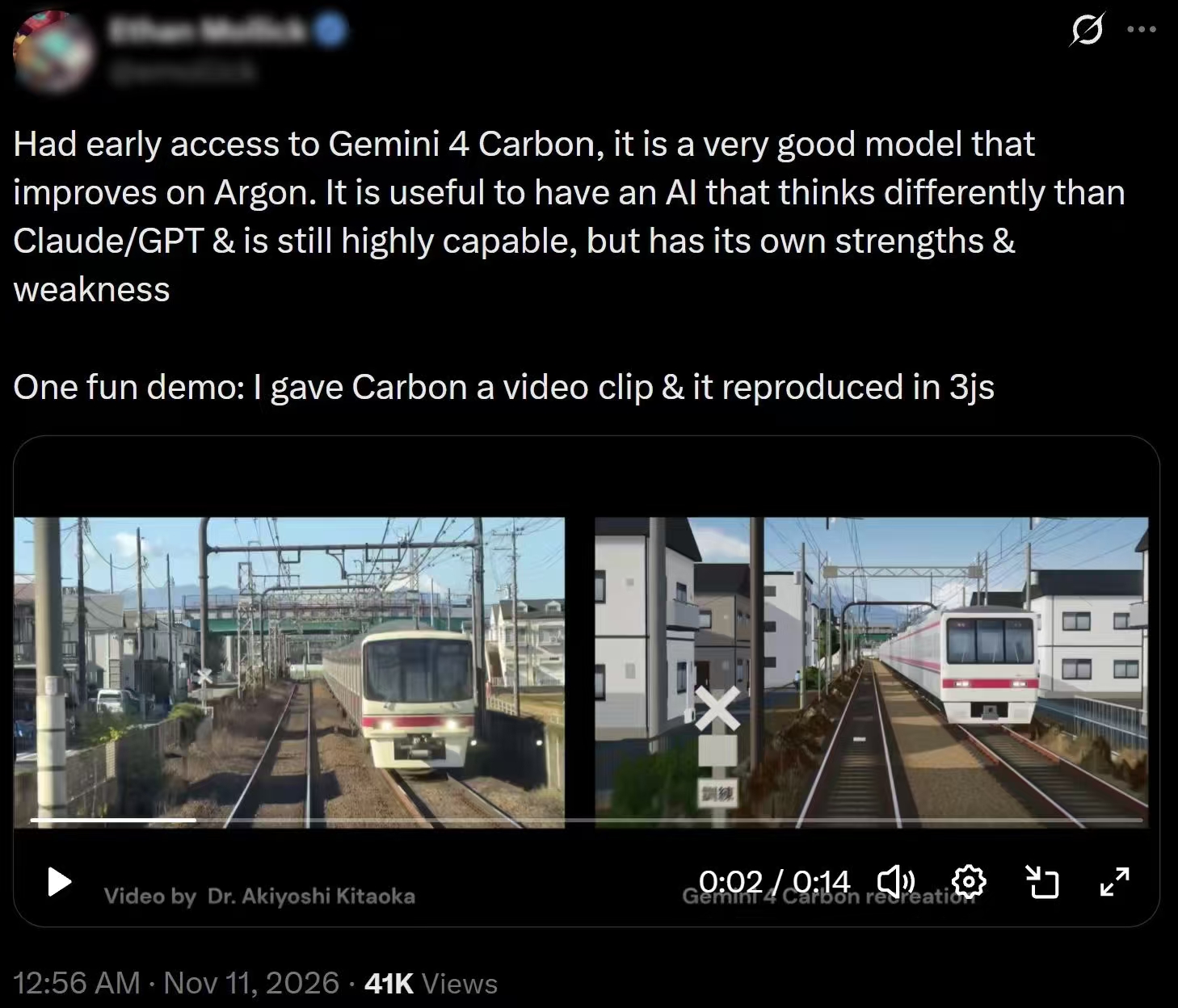
▲Developers’ evaluations of Gemini 4 Carbon (Image source: X)
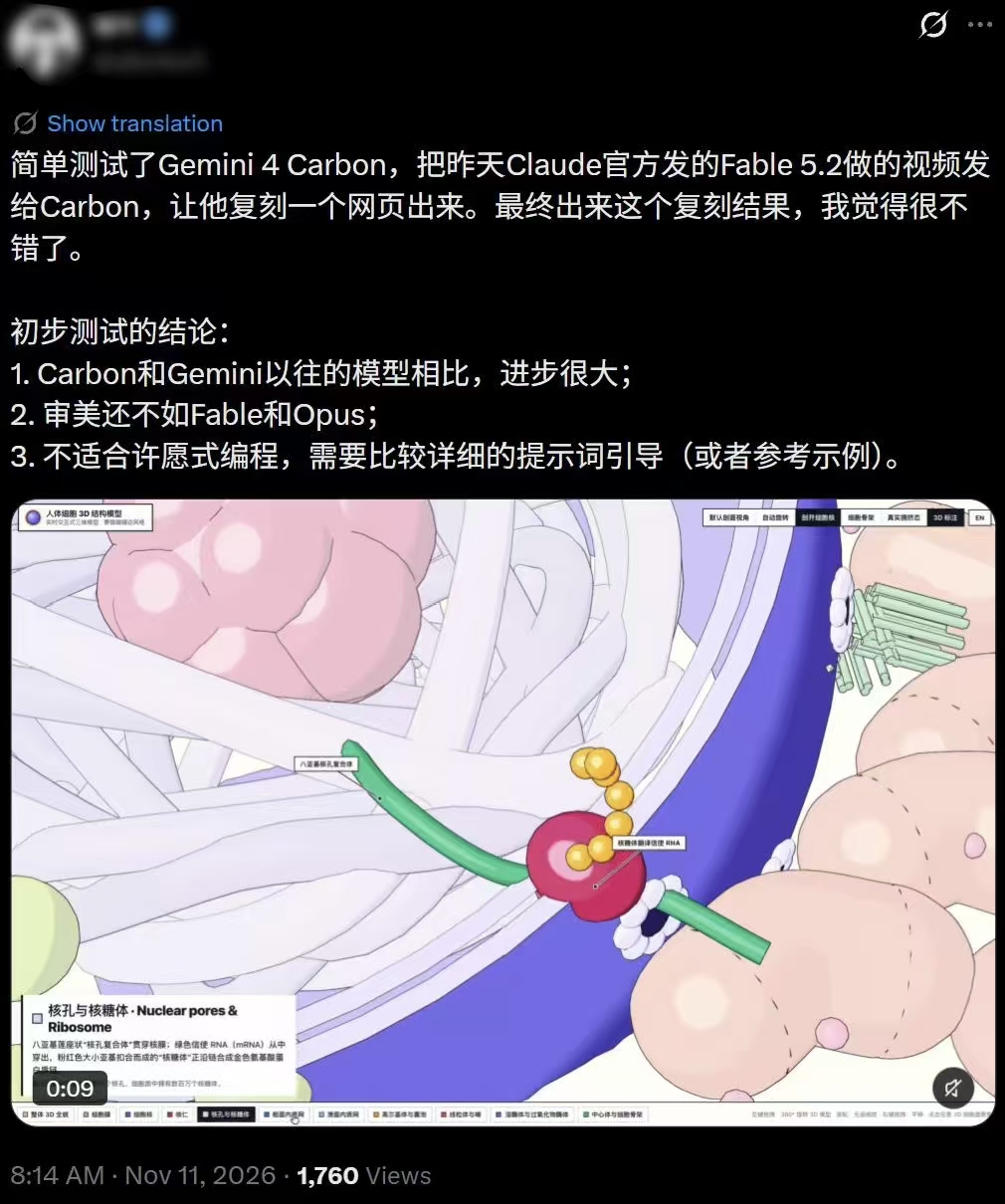
Other developers said that Gemini 4 Carbon represented a major improvement over previous Gemini models, but its aesthetic quality was inferior to Fable and Opus and required more detailed prompts or reference examples for guidance.
I. Ranks second in the multimodal knowledge work evaluation and recreates Google’s office building based on 206 engineering drawings
In scenarios such as law, finance, and business operations, Carbon can retrieve and analyze large volumes of documents, combine the charts, images, and tables within them to draw evidence-backed conclusions, and then generate spreadsheets, presentations, or reports in a specified structure and format.
To evaluate agents’ ability to handle complex materials such as engineering blueprints, schematic diagrams, and data tables, Google partnered with Artificial Analysis to launch the Multimodal Knowledge Agent (MKA) benchmark. Google said Carbon ranked second in the test, with an average cost per task of less than one-sixth that of the top-ranked model.
Google demonstrated how Carbon can turn different types of materials into interactive applications. In one example, a group of Carbon agents used a single prompt to turn historical photographs and engineering drawings into a Three.js-based 3D exhibition depicting the construction of the Eiffel Tower from 1887 to 1889.

In another demonstration, the Carbon team used a single prompt and seven publicly available city council planning PDFs to extract 206 engineering views and, over ten iterations overnight, created an interactive 3D model of Google’s Platform 37 office building containing approximately 906,000 triangles.

II. Excels at multi-agent collaboration and rewrites the OpenCode desktop app overnight
Google said Carbon excels at engineering tasks requiring multi-agent collaboration, including cross-package migrations, root-cause troubleshooting across subsystems, and complex architectural refactoring. When developing web applications, Carbon repeatedly builds, runs, and validates them, attempts to recover after errors, and checks the source code and the page’s actual rendered output.
Before leaving work, the OpenCode team gave Carbon a list of requirements, hoping to keep the desktop app visually consistent with the existing interface framework. By the next day, Carbon had built a Rust interface library from scratch, rewritten the OpenCode desktop app, and delivered a runnable demo. HubX tested Carbon on 16 real bug-fixing tasks in a codebase containing 14,000 tests, achieving a 94% fix rate with no regressions observed during testing.
In a case demonstrated by Google, Carbon used a video generated by Gemini Omni as a reference to build procedural ruins, underwater caustics lighting, and a water simulation in Blender. It then ported the underwater Atlantis scene to Three.js and rendered it in real time in the browser, creating an interactive 3D game.

III. Leading in vulnerability discovery, exploitation, and remediation benchmarks, with Google's internal scan test achieving 100% recall
Gemini 4 Carbon has the strongest cybersecurity capabilities Google has developed to date and can provide end-to-end support for security teams protecting critical software. Carbon, used through the Fairwind initiative, led three key benchmarks: vulnerability discovery (SEC-bench Pro), vulnerability exploitation (ExploitGym), and vulnerability remediation (CWE-bench v1).
Google tested Carbon in Project Fortify, its internal automated security initiative covering scanning, triage, and remediation. According to Google's internal evaluation, Carbon achieved 100% scan recall and 95% triage precision. In testing on open-source code repositories, its vulnerability discovery recall improved by more than 25% relative to Argon, identifying logic vulnerabilities that had previously been missed.
Under Google's cybersecurity company Wiz's “Scan for Good” initiative, the team used Carbon to assess the security of public digital infrastructure. Google said that, when Wiz examined two major SaaS providers, it discovered previously unknown vulnerabilities in under two hours and then worked with the affected organizations to remediate them, with the potential to affect tens of thousands of companies.
IV. Helping Verify Signal Protocol Code, with the Free Research Program Expanded to Carbon
Google said Carbon has improved reasoning capabilities in physics, mathematics, and the life sciences, and can be used to integrate experimental data, test hypotheses, and handle multistep problems. Axiom Bio, a drug toxicity research company, said Carbon performed best on its translational science tasks, helping the team discover previously unknown toxicity mechanisms. The company is now migrating the analytical workflows and agents used in practical research to Carbon and Argon.
Inside Google, researchers have used Carbon for formal code verification, enzyme assay method development, and protein structure prediction.
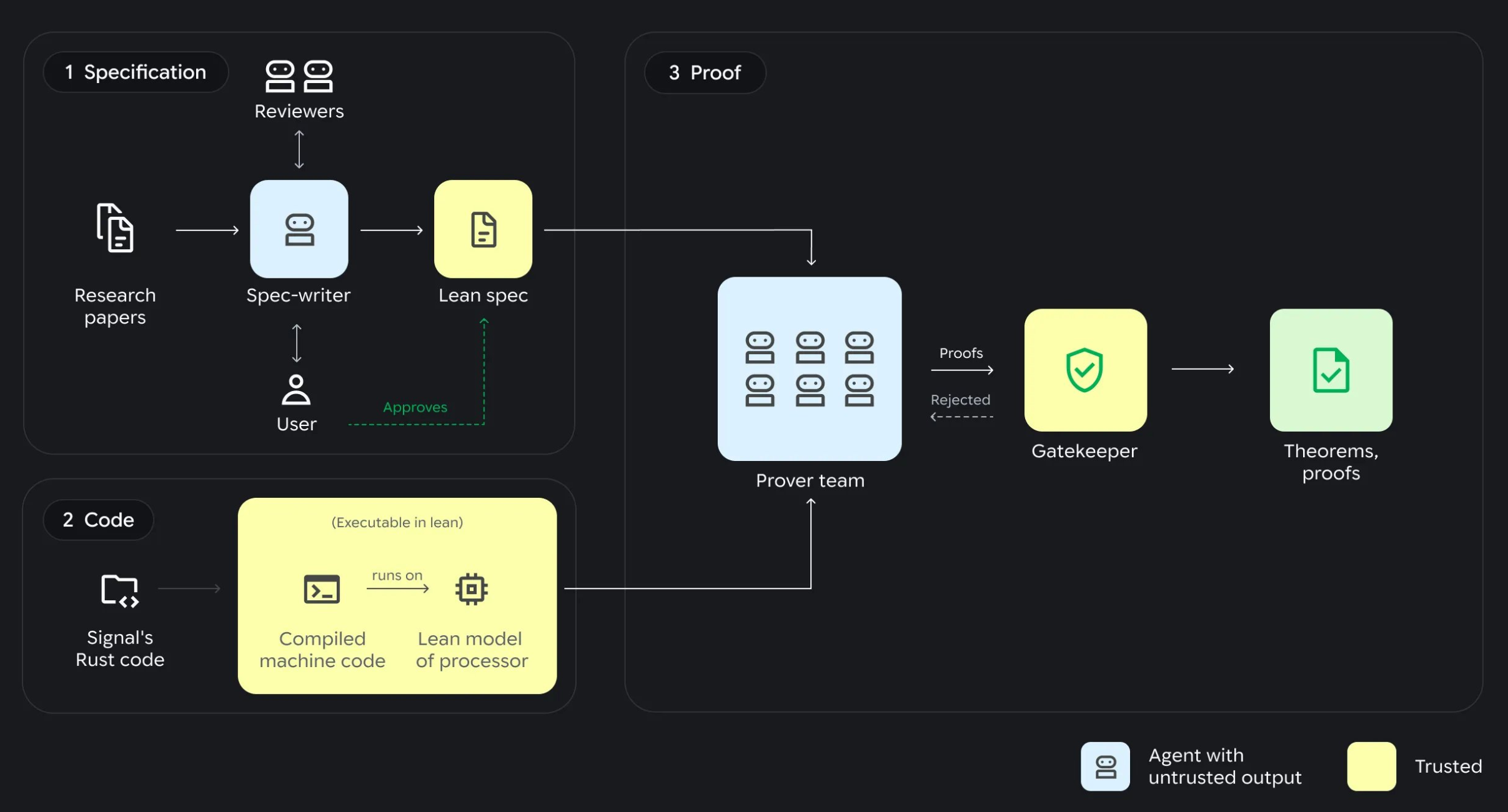
For code verification, researchers built an agent framework called AlphaProof Code to mathematically verify the actual code of the Signal encryption protocol. Using Carbon and other models, researchers translated security objectives into mathematical theorems. Carbon generated more than 6 million lines of proof code automatically checked by Lean, reducing verification work that would otherwise have taken experts years and completing it in weeks, with approximately 1% of the codebase requiring manual review.
In enzyme assay method development, Carbon found difficult-to-explain anomalies in experimental records and raw data, helping researchers identify problems such as insufficient automated mixing in deep-well plates and trace sample residue in instruments, while improving chromatographic peak resolution methods. Google said these improvements increased the reproducibility of experimental results and accelerated the development of new detection methods.
In protein structure prediction, models such as AlphaFold 3 can use multiple sequence alignments to infer folding structures from evolutionarily related protein sequences. Proteins with few known homologous sequences in databases also provide less information for prediction models. Google said that, across seven low-homology protein families in the CASP17 blind test set, the number of homologous sequences retrieved with Carbon's assistance increased on average to 40 times the original number, augmenting the information available to the models without retraining the structure prediction models. A broader evaluation is still underway.
About four weeks ago, Google launched a free program for 10,000 scientists that provides six months of access to Google Antigravity, and thousands of scientists have already joined. Following this expansion, both existing and newly joined participants have the opportunity to use Carbon and Argon. Google will open access in weekly batches based on eligibility, capacity, and screening results, and plans to continue providing participants with access after the next generation of frontier models launches.
Conclusion: Carbon Is Officially Available, and Complex Tasks Enter Real-World Testing
From rewriting a desktop app overnight to machine code that helped validate the Signal protocol, Google demonstrated how Gemini 4 Carbon repeatedly invoked tools, checked results, and revised its approach within a single task.
With the launch of Carbon, Google has drawn a clearer division of labor within the Gemini 4 family: Argon handles most everyday development and knowledge work, while Carbon tackles challenging problems that require multiple rounds of validation using more inference tokens. Now that Carbon is officially available, its task duration, token consumption, and the amount of human review required before delivery will become factors for users to consider when choosing a model.
Source: Google, X