
“I use artificial intelligence to…”
Here is a sentence that, before it is even finished, can lead to different reactions. While some crinkle their noses, others get excited.
The technology generates distrust. Either due to a fear of impact on the labor market, or due to lack of trust in the results it presents in response to a demand.
In the first case, we are living a constant change still difficult to measure and project for the future. In the second case, ultimately, the responsibility to check whether what an AI generates is real falls to humans.
If you have already been in the labor market for some time, when the race of AI intensified, depending on your profession, you may have had to adapt.
And just as happened during the digital revolution, there is a generation that is already growing and developing in these new times.
The Organisation for Economic Co-operation and Development (OECD) released on Tuesday (8) the Pisa 2025. The Programme for International Student Assessment is a work applied every three years to measure students' knowledge in reading, mathematics, and science.
Result: at least once a week, almost half of Brazilian 15-year-old students use AI chatbots, such as ChatGPT, to study. It was the first time that Pisa raised this information.
Here in Brazil, the percentage reached 48%. The OECD average was 46%.
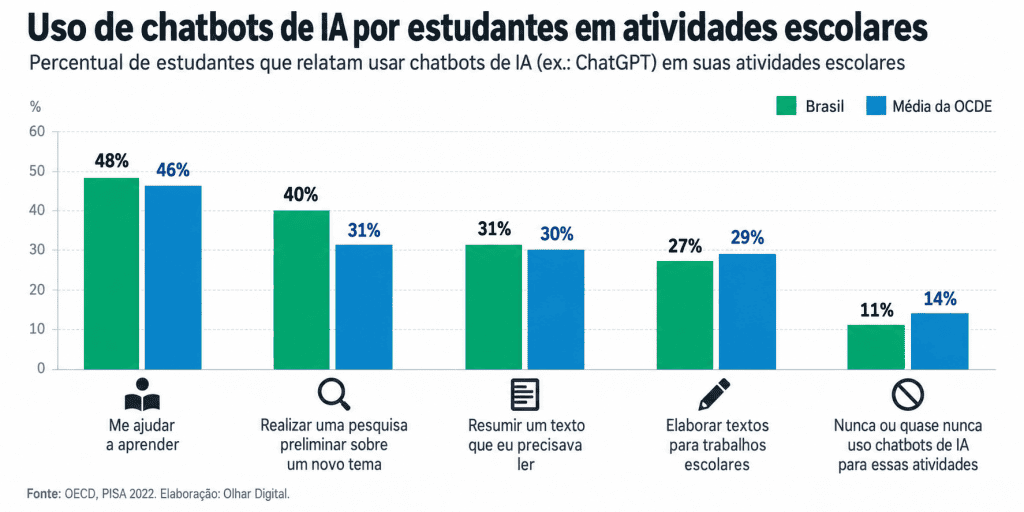 Comparison between Brazil and the OECD average regarding students' use of AI. – Graph generated with AI. ChatGPT/Olhar Digital
- To conduct preliminary research on a new topic, the index is 40% in Brazil and 31% in the OECD average.
- Meanwhile, 31% of Brazilian students use the technology to summarize texts they need to read, compared to 30% in the OECD average.
- To draft outlines for school assignments, it is 27% in Brazil and 29% in the OECD.
- Finally, 11% of Brazilian students said they never or almost never use AI chatbots in the analyzed school activities, while the OECD average is 14%.
OECD issues a caution
Daily use of artificial intelligence in study routines may be associated with worse performance in assessments. The data shows that 15-year-old students who rely on chatbots daily for certain school tasks obtain lower grades than peers who almost never use the technology.
Learn more here.
Bullying and cyberbullying
In 2025, 17% of Brazilian students reported being victims of at least one form of bullying several times a month or more frequently. The percentage is below the OECD average of 20%. In Brazil, the incidence of bullying did not show a significant change between the 2022 and 2025 editions of PISA. However, during the same period, the issue increased in the majority of participating countries and economies.
The cyberbullying is less frequent than other forms of bullying. In Brazil, 3% of students said that information that bothered or harmed them was published online without their consent at least a few times a month in the 12 months prior to the PISA application. The index is equal to the OECD average, also 3%.
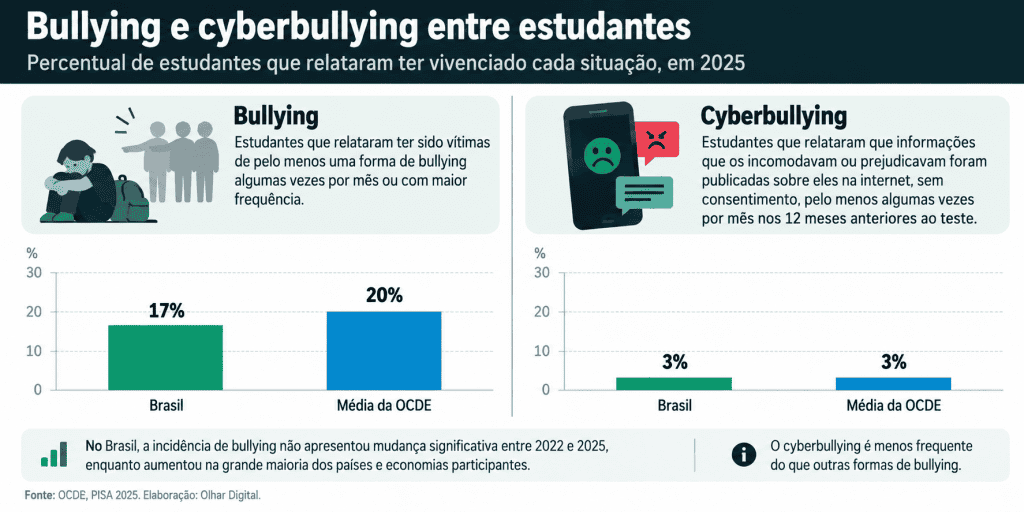 Image generated by AI. – Olhar Digital/ChatGPT
Smartphone and distractions
In Brazil, students reported spending, on average, 1.3 hours per day using digital devices at school for learning activities, below the OECD average of 1.7 hours. At the same time, a significant portion of the use of these devices during school days is for leisure: Brazilians spend, on average, 1 hour per day using digital devices at school for non-learning activities, compared to 1.1 hours in the OECD.
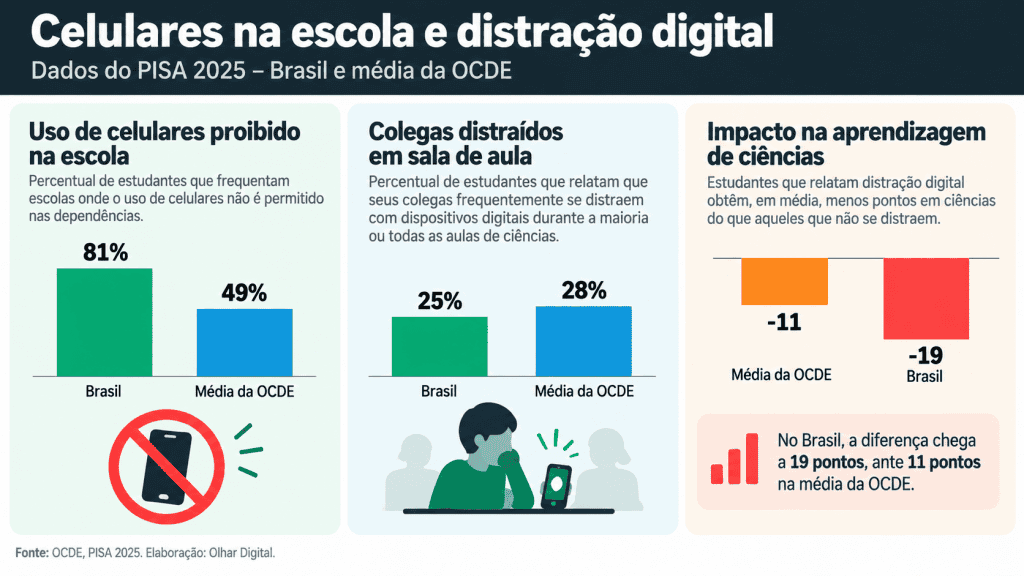
The distraction caused by technology also appears in the data. In Brazil, 25% of students stated that their classmates frequently get distracted by digital devices during most or all science classes, against 28% in the OECD average. Among the countries in the organization, students who report this type of distraction score, on average, 11 points lower in science, even considering socioeconomic differences between students and schools. In Brazil, the difference reaches 19 points.
The ban on cellphone use in schools has also become much more common. In 2025, 81% of Brazilian students attended schools where cellphone use was not allowed on school premises, a percentage much higher than the OECD average of 49%. In 2022, this proportion was only 37% in Brazil and 34% on average in OECD, indicating a strong increase in restrictions during the period.
OECD data also points to a relationship between these measures and distraction: students in schools that prohibit cell phones have a probability about 13% lower of reporting distractions caused by digital devices, on average across OECD countries.
Brazil below average in sciences, mathematics, and reading
Performance in sciences
In Brazil, 48% of students achieved at least level 2 of proficiency in sciences, while the OECD average is 74%. At this level, students can at least recognize correct explanations for familiar scientific phenomena and evaluate, in simple situations, whether a conclusion is valid based on the presented data.
The gap also appears among top-performing students. Only 1% of Brazilians reached levels 5 or 6 in sciences, compared to 7% on average in OECD. Students at these levels are able to apply their scientific knowledge creatively and independently to different situations, including those they are not familiar with.
Performance in mathematics
In mathematics, 28% of Brazilian students achieved at least level 2 of proficiency, well below the 65% recorded on average in OECD. At this level, students are able to interpret simple situations and recognize how to represent them mathematically, such as comparing the total distances of two routes or converting prices between currencies.
Almost no Brazilian student reached levels 5 or 6 in mathematics, while the OECD average is 8%. At these more advanced levels, students are able to model complex situations mathematically and select, compare, and evaluate different strategies to solve problems.
Reading performance
In reading, 49% of Brazilian students reached level 2 or above, compared to 69% in the OECD average. At this level, students are able to identify the main idea of a moderately long text, locate information based on explicit criteria, and reflect on the purpose and form of a text when guided to do so.
Among high-performing students, 1% of Brazilians reached level 5 or above in reading, against 6% in the OECD average. These students are able to understand long texts, deal with abstract or counterintuitive concepts, and distinguish facts from opinions based on implicit clues present in the content or the source of information.

Bruno Capozzi is a journalist, master in Social Sciences, and executive editor of OD.


