 Recommendation Reasons
Comprehensively presents the legal risks and response strategies that enterprises need to know in order to safely develop and operate AI. The author compares regulations in Korea, the EU, and the US, analyzes industry-specific issues in healthcare, finance, autonomous driving, and provides immediately usable guidelines and checklists.
The end of the year is the time for companies to plan their business strategies for next year. This year, a new item is added to the plan. Since January 22, the "Basic Act on the Development of Artificial Intelligence and the Establishment of Trust-Based Infrastructure," commonly known as the AI Basic Act, was implemented, transparency obligations such as product labeling and governance of high-impact AI have been placed within the framework of law. The government has announced that it will operate the regulatory provisions with a minimum of one year of guidance period, focusing on consulting. This means that now, with the postponement, is the time to revise internal AI policies.
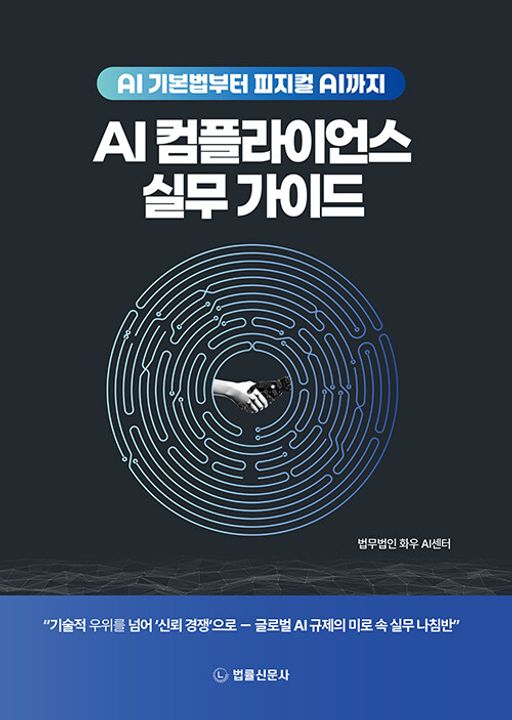
The Book Master at Youngpung Munho, a legal publishing company, chose the "AI Compliance Practice Guide" published by the legal publishing company in July. This book, written by the AI Center of the law firm Hwa Woo, targets readers including executives, legal teams, and developers. It divides corporate risks into four areas: data sovereignty, personal information, intellectual property rights, algorithm transparency and bias, and security threats and physical AI, and compares the Korean AI Basic Act with the EU AI Act and regulations in the US and Japan. It also touches on industry-specific issues such as where the responsibility lies when a hospital AI misses lung cancer or when a loan approval algorithm discriminates against a specific region, which still lack precedents.
The book is structured into six parts and thirteen chapters. The first part summarizes generative AI technology and the global regulatory landscape, then moves on to explain governance centered around financial sector AI guidelines, passing through data, security, and intellectual property rights. The final part concludes with the structure of the AI Basic Act, corporate responses, and Korea's strategic choices within global regulations.
Compared to other governance books in the same section, this book has a distinct character. "How to Control AI" systematically designs a framework over 612 pages from the perspectives of internal control and auditing. "Before AI Replaces the Executive" covers AI governance systems centered on ISO 42001 certification. This book dives into industry-specific issues such as healthcare, finance, and physical AI using the practical language of law firms, and includes tools that can be used immediately, such as internal AI usage policy templates and supply chain audit checklists.
Kwon Ki-won, head of the book department at Youngpung Munho, said, "This is not a book only for legal teams, but one that those planning AI services should read first. The seven internal AI usage policies are suitable to be directly copied into next year's plan."
Iwon-jun, the MD of the Technology Department at Eonhwa Bookstore, added, "From the developer's perspective, Chapter 4 on AI security and supply chain compliance becomes a checklist for the design phase." ■ Recommended Books - "AI Compliance Practice Guide" - Written by the AI Center of Hwa Woo Law Firm - Publisher: Law News Company | Published on July 30, 2026 | 275 pages | Regular price 32,000 won - ISBN 9791159190681 Eonhwa Bookstore has been a bookstore connecting books and readers since it opened in Jongno in 1992. It currently operates 46 branches nationwide and provides books and cultural content to 1 million members. AI Times news@aitimes.com