As the first part of the article showed. The experience of previous technological revolutions can be reduced to four conclusions:
automation really does eliminate individual operations, jobs, and sometimes entire professions;
employment grows only when a price reduction brings enough new buyers or creates a market that did not previously exist;
new jobs most often appear outside the automated operation—in infrastructure, implementation, maintenance, monitoring, and related services;
this growth is distributed unevenly and does not last forever: an industry may expand while a particular company cuts staff, and market saturation can reverse the effect of technology.
Thus, productivity itself promises nothing. To understand the implications of AI, we need to look not only at how many hours it saves, but also at what services will become available as a result, who will start buying them, and how much human labor will remain around the result.
 Vlad Lukashenko
Head of SEO & web analytics at Tensor (the developer of saby.ru), author of the Telegram channel “VladPRO”
I have been working in analytics, SEO, and team management in digital marketing for over 10 years. And in my Telegram channel and on thewebsite I write even more about all sorts of things from real-world marketing.I provide consulting on web project analytics and marketing tool configuration, and help conduct technical interviews with specialists across different types of traffic.
Where AI can create new jobs
Below, I am not trying to guess job titles from the 2030 job directory. I am interested in markets that do not exist today or are too small because the service is too expensive. Research confirms certain AI capabilities, while my conclusions about new orders and jobs remain scenarios.
The strongest objection: AI is not a new loom
Before projecting the past into the future, it is worth recognizing how different AI is from earlier machines. A loom automated a specific physical action. A generative model can encroach on programming, design, translation, support, law, marketing, and analytics all at once. Software is distributed almost instantly, and the marginal cost of one more generated page or code draft is close to zero. A single platform can be deployed across thousands of companies without building thousands of factories.
There is an even less pleasant feature. Earlier automation often left novices with simple tasks on which they could learn their profession. AI takes over precisely the grunt work: boilerplate code, initial research, preparing reference materials, annotation, and report reconciliation. If the bottom rung disappears, companies may gain experienced specialists today and face a shortage of experienced specialists in five years.
Finally, a new market does not necessarily mean many new companies. A few platforms may capture it, while small firms will merely become users of their models.Therefore, the analogy with industrial revolutions works only under three conditions: technology makes a service cheaper for new buyers, enough human tasks remain around it, and market access is not closed off by a handful of infrastructure owners.
We can now move on to specific industries and test these conditions using concrete examples.
Medicine: AI is valuable for additional screening
In medicine, a shortage of work sounds strange. People wait months for appointments, postpone examinations because of distance, and drop out of follow-up after being referred to another specialist. A new market may emerge here because care will reach patients whom the current system loses.
The randomized ACCESS study included 164 young patients with diabetes. Among those offered an AI eye examination during a routine appointment, 100% completed the examination within six months. With a standard referral to an ophthalmologist, the figure was 22%. The study examined the entire organization of care: diagnostics were moved to where the patient already was. Wolf et al., Nature Communications, 2024.
If clinics expand coverage, jobs will emerge not only for doctors. Someone will have to install equipment, train staff, conduct examinations, explain the results, contact patients, and arrange further care. Clinics, insurers, employers, or government programs may pay for this. AI does not replace the medical pathway here—it makes possible a pathway that previously broke down at the first transition.
Pharmaceuticals show another point of growth.In 2025, the results of the Phase 2a trial of rentosertib—an experimental drug for pulmonary fibrosis whose development used generative AI—were published. The study involved 71 people. Xu et al., Nature Medicine.
But where is the economic mechanism? Here it is. If the search for a promising molecule becomes cheaper, a company can test more hypotheses. Every hypothesis that reaches experimentation creates work for laboratories, data specialists, sample manufacturers, and trial coordinators. The search for a candidate is automated, while the volume of subsequent testing can grow.
With funding, additional projects mean new orders for laboratories and research centers. Without funding, even a perfect molecule will remain a database entry.

Education: cheap personalization still requires a teacher
Mass education has a long-standing problem: one teacher explains a topic to a group, even though students understand it for different reasons. Genuine personalized support is expensive because it requires the time of a strong teacher.
In the Tutor CoPilot study, the model suggested to the teacher how to respond to a student during the lesson. In the overall sample, 66% of students mastered the topic on the final assessment, compared with 62% in the control group. Among teachers with lower baseline scores, the gap was more pronounced: 65% versus 56%. The AI did not conduct the lesson in place of a human; it helped the teacher choose the next move. J-PAL, Human-AI Cooperation to Improve Tutoring.
If lesson preparation becomes cheaper, families and small businesses that previously could not afford personalized support will be able to purchase it. Demand will emerge not for a “neural network operator,” but for a teacher who identifies learning gaps, selects practice exercises, notices a loss of motivation, and is accountable for the result. There will also be instructional specialists who develop programs tailored to specific professions, as well as mentors for adults who need to retrain without leaving their jobs.
Here, however, I rule out a complete transition to AI-based education for children, however tempting it may be to many government officials seeking to completely cut education spending. It is a complex issue, but nevertheless I do not believe in it even in the medium term.
Agriculture: an expert does not visit every field
A small farm can rarely afford its own specialist for every crop. A seasonal service is economically more realistic: a field worker collects data, an app helps identify symptoms, and an agronomist verifies the result and recommends actions to several farms.
PlantVillage Nuru demonstrates both the possibilities and the limitations of this approach. In field trials, the app identified cassava diseases and damage with varying accuracy. In the assessment of six leaves, agreement with expert evaluation reached 93% for mosaic symptoms, 73% for brown streak, and 93% for mite damage. A single image of a plant produced a less reliable result: the data collection protocol itself mattered. Frontiers in Plant Science, 2020.
If the service pays off for the farmer, jobs will go to a field diagnostician, an agronomist, an equipment technician, and a cooperative coordinator.AI distributes scarce expertise across a large number of farms, but does not replace the person who will properly examine the plant and take responsibility for the recommendation.
Law and manufacturing: the market begins below the profitability threshold
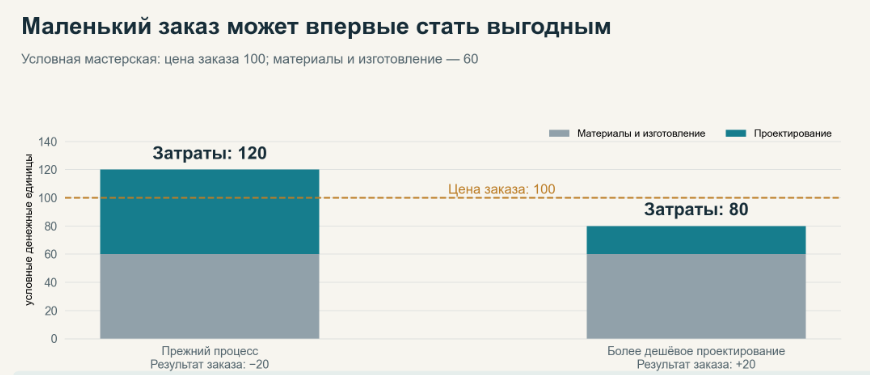
The most interesting new markets may emerge where demand already exists, but the size of the transaction is too small. If a dispute involves only a few tens of thousands of rubles, proper legal work can easily cost more than the problem itself. If a workshop needs a single nonstandard part, the cost of design makes the order pointless.
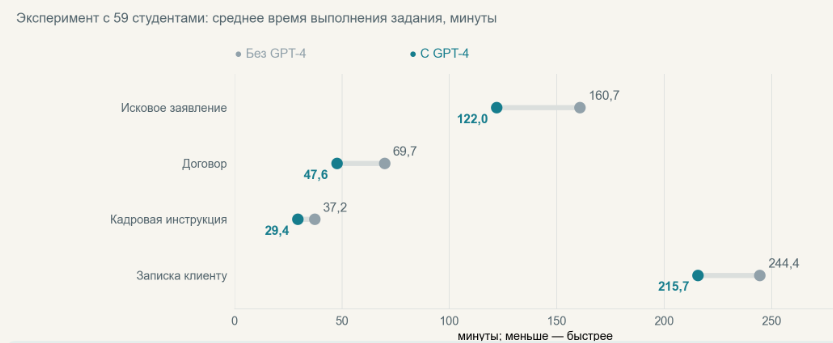
In an experiment by Choi, Monahan, and Schwarcz, 59 law students completed realistic assignments with and without GPT-4. With the model, they spent less time on all four types of task: preparing a legal complaint, a contract, an HR policy, and a memo to a client. The improvement in quality was modest and inconsistent. Choi, Monahan & Schwarcz, Lawyering in the Age of AI.
This suggests a model of small firms providing high-volume assistance: consumer claims, review of a microbusiness contract, and pretrial settlement. A lawyer no longer receives the same fee for a standard document; instead, they can take on a case for a client who previously would not have sought legal assistance at all. The individual or small business pays, while human work shifts toward verifying facts, negotiations, and responsibility for the advice.
The same threshold applies in manufacturing. AI helps evaluate design options and prepare draft documentation. An engineer checks loads and constraints, a craftsman builds a prototype, and the customer tests the product.Lower design costs can make small orders for tooling, custom furniture, workstation fixtures, and rare repair parts profitable.
This could create additional work for engineers, prototyping and installation specialists. But the economics of the physical world have not gone away: materials, machinery, shipping, testing, and mistakes still cost money. That is why I am most cautious about the forecast here.
IT: There will be more code, but selling hours will become harder
The threat was visible in IT even before. If a client receives a working draft of a feature within minutes, they will not want to pay for the same number of hours as before. Standard websites, simple integrations, data migration, standard tests, and interfaces are the first things to become cheaper.
At the same time, measuring AI’s impact on development has proved more difficult than claiming it. In three field experiments by Microsoft, Accenture, and one other large company, 4,867 developers with an AI assistant completed approximately 26% more tasks. Cui et al., 2025. In the METR study, by contrast, experienced developers of open-source projects using early-2025 tools spent 19% more time on tasks. By 2026, participants had probably already sped up, according to the authors, but task selection and developers’ refusal to work without AI made the precise magnitude of the effect unreliable. METR, study update.
The contradiction is interesting. AI works well where a task fits into a clear context and the result is easy to verify. It provides less help in an old project with hidden dependencies, implicit requirements, and costly mistakes.Therefore, the developer’s value is shifting from writing code to understanding the system and verifying the consequences.
Now imagine a ventilation installation company. Today, a manager calculates prices in a spreadsheet, an engineer selects equipment separately, a dispatcher keeps the maintenance schedule in another application, and a manager learns about overdue work from an dissatisfied customer. A custom system would cost too much, so the company puts up with manual work and losses.
A small AI team can build an industry-specific product: cost estimation, an equipment catalog, a schedule of site visits, and service reminders. The first client pays for implementation; subsequent clients pay for a subscription and configuration. The code for each module becomes cheaper, but there are interviews with engineers, cleanup of reference data, integration with accounting, validation of calculations, staff training, and support.
Here I expect new jobs in IT: in small teams that automate one specific industry and are responsible for the entire result. Not an abstract “AI specialist,” but a developer who understands ventilation calculations; an analyst capable of bringing the equipment catalog into order; an implementer who will establish the workflow at the client’s company; and a quality engineer who assesses the cost of an error. Companies for which the previous cost of custom development was prohibitive will pay.
There will be more software, but fewer hours of programming in each program. Employment will grow only if the number of new systems and clients offsets these savings.
Internet marketing: content production is no longer a business
Marketing was the second to feel the unpleasant side of abundance.Creating a thousand ads is now easier than finding a thousand additional buyers. Text, banners, and videos quickly turn from services into expendable materials.
This will hit the model in which an agency sells volume: twenty articles, a hundred creatives, a thousand pages. It is increasingly difficult to explain to a client why they should pay a premium for output that a model produces in minutes. Human work will remain where uncertainty begins: whom to persuade, what problem to promise to solve, why a buyer should believe, and which channel actually generated a profit.
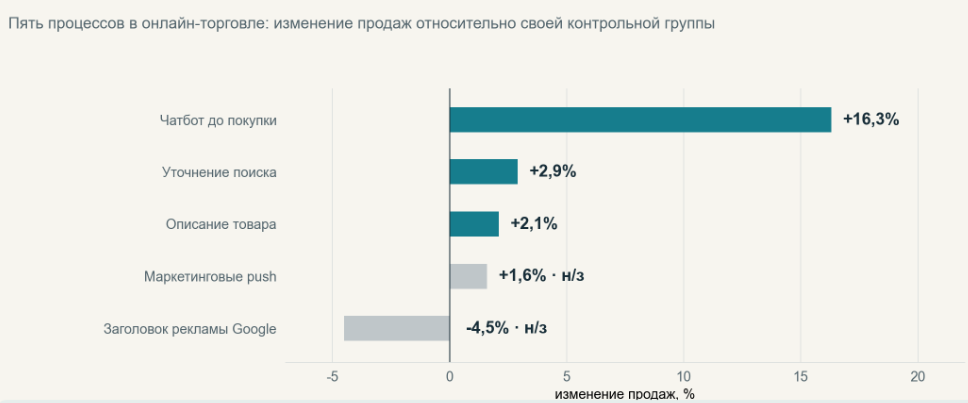
In a preprint about five experiments at a major online retail platform, the effect of generative AI on sales varied from process to process. A pre-purchase chatbot produced a 16.3% increase compared with situations involving no live response, refining search queries produced a 2.9% increase, and product descriptions produced a 2.1% increase. No statistically significant effect was found for marketing push notifications or Google ad headlines. Fang et al., Generative AI and Sales Productivity.
In the experiments on an e-commerce platform, value did not arise from the act of generation itself. The strongest result appeared where buyers had previously been left without assistance. This is the same historical mechanism: demand that was previously too expensive or inconvenient to serve is now being served.
Let us return to the ventilation company. A restaurant, a workshop, and a country house owner buy different outcomes and describe the problem in different ways. A marketer studies conversations with customers, tailors an offer for each segment, and tests it against real inquiries. AI accelerates the production of materials, but it does not determine which market is worth pursuing.
The path to purchase is changing as well.In a Pew observational study, users clicked the standard Google result in 15% of visits to a results page without an AI summary and in 8% of visits to one with a summary. They clicked links within the summary itself even less often. The study covered 900 American adults and does not establish that the AI feature caused the entire difference. Pew Research Center, 2025.
This creates additional work for SEO specialists. They need to determine what questions buyers ask the model, where it gets information about the company, in which comparisons the brand is absent, and whether the new visibility generates actual inquiries. The client will pay for measurable access to a customer who has stopped clicking familiar links.
Analytics: reporting is getting cheaper, while responsibility for drawing conclusions is getting more expensive
Regular data exports, standard dashboards, and verbal summaries of trends are almost ideal candidates for automation. If an analyst’s work ends with the statement “traffic increased by 12%,” a machine really will take that work over.
But businesses rarely need the chart itself. HVAC installers see an increase in leads while profits fall. The cause may lie in low-value orders, expensive call-outs, delayed responses from managers, costing errors, or seasonality. To distinguish among these possibilities, they need to connect advertising with the CRM, payments, and completed jobs, verify metric definitions, and run an experiment.
In a field experiment with 758 BCG consultants, AI accelerated and improved performance on a range of tasks. But in one complex task beyond the model’s capabilities, 84.5% of participants without GPT-4 gave the correct recommendation, compared with 70.6% using GPT-4 and 60% using GPT-4 with additional introductory material. The confident assistance nudged people toward an incorrect conclusion.Dell’Acqua et al., Navigating the Jagged Technological Frontier.
I expect new demand for preparing reliable data, organizing experiments, and validating the economics of decisions. A small company that previously could not afford to employ an analyst will be able to purchase several days of external team support each month. The best teams will connect development, marketing, and analytics around a single industry: building a tool, attracting customers, and answering the key question—has the system generated a profit?
Who will pay for the new work
Discussions about professions often end with appealing job titles: AI architect, model trainer, digital curator. The title is easy. Identifying the buyer is harder.
In my scenario, payment is not for having a person alongside a neural network, but for solving an industry problem:
a clinic pays for more patients actually completing examinations and continuing treatment;
a research company pays for a properly conducted experiment and data that can be trusted;
a training center pays for a student who has mastered the subject rather than received yet another generated set of notes;
a farming cooperative pays for early disease detection and clear recommendations;
a small business pays for a functioning industry-specific system, attracting profitable customers, and validating the economics;
an individual or entrepreneur pays for legal assistance on a matter that previously was too small to warrant professional support.
In all these cases, AI is notis a product. It reduces the cost of one part of the service. A job is created if the cost reduction makes it possible to sell the entire service to a new client.
New markets will not save everyone who loses their job
So far, I have been reasoning about aggregate activity. For someone laid off today, the growth of another market in three years is little consolation. A textile factory could expand production while laying off a particular weaver. The internet created a warehouse job in one city and closed a store in another.
Entry into the profession is especially difficult. In an updated Stanford Digital Economy Lab study, employment among 22–25-year-olds in occupations highly exposed to AI was 19% below the trajectory of less-exposed peers. The difference arose mainly through reduced hiring rather than layoffs. The authors describe the result as an early descriptive indicator, not a proven causal effect of AI. Canaries in the Coal Mine?, August 2026.
If boilerplate code, initial analytics, and a draft advertising campaign are automated, newcomers have nowhere to accumulate the first ten thousand hours of practice. This means companies will have to deliberately design training: give beginners real tasks with oversight, assess understanding rather than just speed, and not treat the automation of junior work as free.
There is also a political dimension. The transition requires affordable retraining, the ability to create small businesses, competition between platforms, and a distribution of benefits such that productivity gains do not accrue entirely to the owner of the infrastructure. History shows that new markets are possible.She says nothing about the fairness of the transition.
What jobs are we not noticing yet
By 2027–2029, I expect small industry-specific teams to emerge. They will bridge the gap between a general-purpose model and a concrete outcome: a patient who has been examined, functioning equipment, a competition won, a topic mastered, a profitable order.
In healthcare, these will be mobile diagnostic staff and patient pathway coordinators. In pharmaceuticals, laboratory and clinical teams supporting a larger number of research hypotheses. In education, personal support tutors and retraining specialists for adults. In agriculture, field diagnosticians and shared-service agronomists for several farms.
In IT, I expect small vertical automation teams: a developer, a subject-matter expert, a data specialist, an implementation specialist, and support. In marketing, buyer research, proposition testing, and measuring visibility in AI responses. In analytics, outsourced teams that clean up data and are accountable for the quality of the solution.
This is not a guaranteed list of vacancies. These are areas where one can already identify a task, a customer, and the reason why the service did not previously pay off.
Instead of a conclusion
AI really will take our jobs. It is already taking away hours for which people used to be paid: draft code, boilerplate texts, reconciling spreadsheets, preparing documents. Arguing with this means comforting yourself with a story rather than understanding it.
But a job and a paid operation are not the same thing. A machine reduced the labor required per meter of fabric and expanded the fabric market. An assembly line reduced the labor required per car and created an automotive economy.With AI, the outcome will still be determined by the same strict formula: how much the cost of the service will fall and how much new demand will emerge in response. If one specialist can do the work of ten, there may be no positions left in the existing ten-person department. But if, thanks to the new price, twenty companies buy the service, the work will return in a different form—along with implementation, verification, responsibility, and maintenance.
I do not know whether this growth will prove sufficient. For now, the data support a more cautious thesis: the end of work is not predetermined, nor is a successful transition.
That is why I suggest that readers not enumerate fantastical professions but instead conduct a practical thought experiment. Name a task in your industry that is not being performed today because of its cost. What will happen if its cost falls severalfold? What new product or service will become possible? What will be left for a human to do—and who will pay for the result?
Counterexamples are especially interesting: cases where AI has already reduced the cost of the work, but no new clients have appeared.That is precisely where the boundary of my forecast lies.
By the way, if anyone is interested in my reflections on AI, you can read my previous ramblings; there still seems to be an active discussion in the comments.
The machine uprising is called off: why intelligence without goals of its own has not yet become reason


